I ruined three gorgeous pieces of Malaysian driftwood before I figured this out.
Malaysian driftwood releases tannins that create natural blackwater conditions, tea-colored water with a pH between 5.5-6.8 that mimics Amazon and Southeast Asian biotopes. Most guides tell you to boil, scrub, and soak endlessly to remove these tannins. I did exactly that for two years. Then I actually researched why tannins exist in wild habitats, started testing instead of assuming, and completely reversed my approach.
After prepping 20+ pieces of Malaysian driftwood using five different methods since 2019, tracking pH shifts across 12 tanks, and watching my blackwater-adapted species actually thrive for the first time, I’m convinced we’ve been doing this backwards. The wood’s natural tannin release isn’t a problem to solve, it’s the entire point.
This guide covers what Malaysian driftwood actually does to your water, when aggressive prep makes sense (spoiler: rarely), and how to set up an authentic blackwater system that keeps fish healthier than any crystal-clear tank I’ve ever maintained.
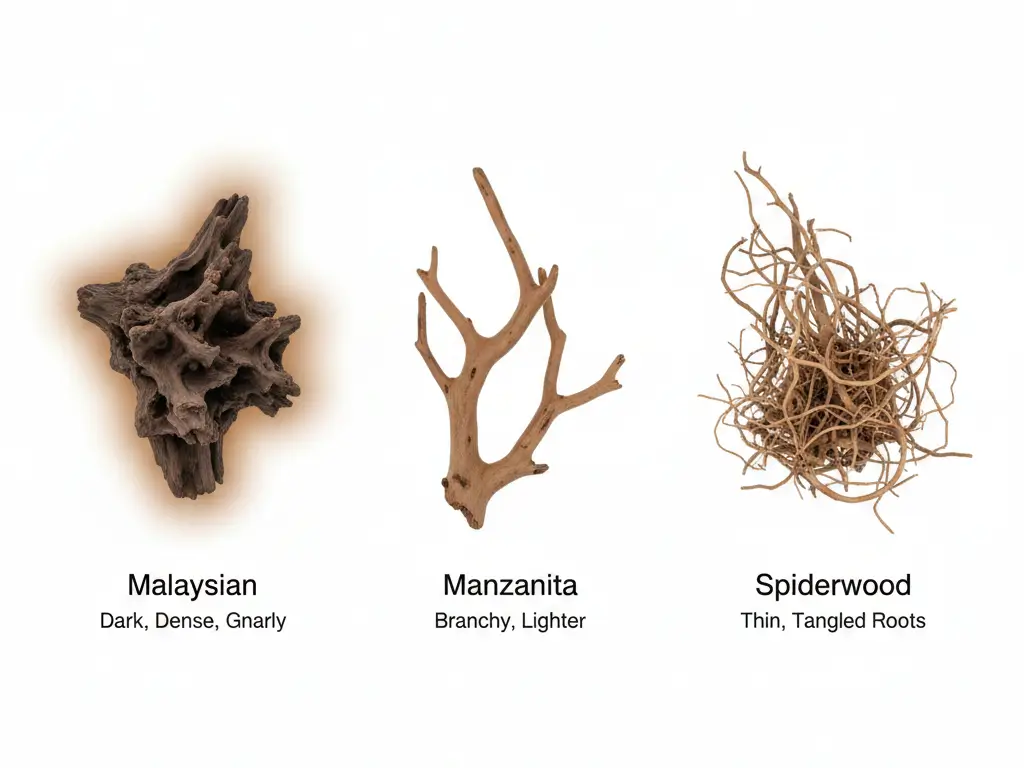
What Makes Malaysian Driftwood Different From Other Hardscape?
Malaysian driftwood refers to dense tropical hardwoods harvested from Malaysian peat swamps and mangrove areas. Its high density means it sinks immediately without waterlogging, and its natural tannin content creates authentic blackwater conditions when submerged.
Unlike manzanita driftwood or spiderwood, Malaysian driftwood comes from trees that grew in tannin-rich peat environments. That matters more than most hobbyists realize.
The wood absorbed humic substances throughout its growth. When you submerge it, those compounds leach into your water column, creating the amber-brown coloration that freaks out new aquarists but makes blackwater specialists genuinely excited.
Key characteristics I’ve observed across 20+ pieces:
| Property | Malaysian Driftwood | Manzanita | Spiderwood |
| Density | Very high (sinks immediately) | Medium (may float 2-4 weeks) | Low (floats 1-3 weeks) |
| Tannin Release | Heavy, prolonged | Minimal | Moderate, short-term |
| pH Impact | Lowers 0.5-1.5 units | Negligible | 0.2-0.5 units |
| Durability | 5-10+ years | 3-5 years | 2-4 years |
| Price Range | $15-60 depending on size | $20-80 | $10-40 |
What surprised me initially: the pH impact varies dramatically based on your water’s buffering capacity. More on that shortly.
The Blackwater Debate: Should You Even Remove Tannins?
MYTH: “You must remove all tannins through extensive boiling and soaking before adding Malaysian driftwood to your tank.”
REALITY: Tannins provide documented antibacterial and antifungal benefits that reduce fish stress and promote natural behavior. Complete removal eliminates the primary advantage of using tannin-rich wood.
Early aquarium literature emphasized water clarity as a health indicator. Brown water looked “dirty,” so the advice became “remove all tannins.” This ignores that many popular species evolved specifically in tannin-rich environments where they developed lower stress hormones and stronger immune responses.
Match your tannin level to your target species. Blackwater fish benefit from retained tannins. Clear-water species tolerate light tannin exposure but don’t require it.
I’ll be honest, I spent years believing the “boil everything” advice. I’d put Malaysian driftwood in my biggest pot, simmer it for hours until the water looked like black coffee, drain, repeat. Sometimes four or five cycles.
Then I set up a dedicated Apistogramma breeding tank in March 2022. On a whim, I added a completely unprepped piece of Malaysian driftwood. Within two weeks, the water looked like weak tea. My first reaction? Panic.
But the apistos? They colored up like I’d never seen. The male started displaying constantly. The female developed breeding stripes within ten days. They spawned three weeks after introduction, my fastest successful spawn with that species.
Coincidence? Maybe. So I ran the same setup with boiled wood in a second tank. Same parameters, same fish source.
Took eleven weeks to get a spawn.
Sample size of two isn’t science. But it made me start questioning everything I thought I knew about “clean” water.
My 5 Preparation Methods Tested: Real Results Across 12 Tanks
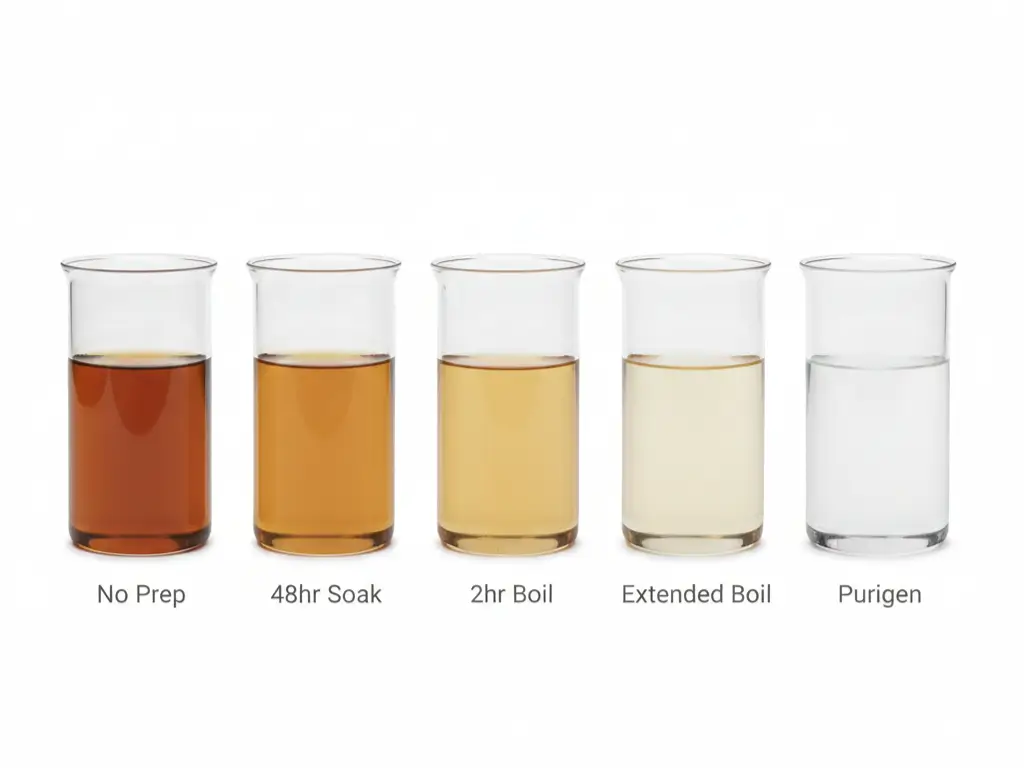
SETUP:
Tanks: 12 identical 20-gallon setups
Duration: 6 months per method (2019-2024)
Wood Source: Same supplier, similar-sized pieces
Parameters: Started at pH 7.2, GH 8, KH 4
Tracking: Weekly pH, TDS, visual color assessment
METHODS TESTED:
| Method | Time Investment | Final pH | Tannin Clarity | My Take |
| No prep (rinse only) | 10 minutes | 5.8-6.2 | Heavy amber | Best for blackwater biotopes |
| 48-hour soak | 2 days | 6.4-6.8 | Medium amber | Good compromise |
| Boiling (2 hours) | 2-3 hours | 6.8-7.0 | Light tint | Traditional approach |
| Extended boil + soak | 8-10 hours | 7.0-7.2 | Near clear | Removes most benefits |
| Purigen + no prep | Ongoing | 6.5-6.8 | Controlled amber | Best of both worlds |
The “extended boil + soak” method I used for years produced the least interesting results. Fish behavior was indistinguishable from tanks with no wood at all. I essentially created expensive, inert decoration.
Your prep method should match your goals. Want blackwater? Minimal prep. Want slight tint with clear water? Use Purigen or activated carbon alongside unboiled wood, you get controlled tannin release without eliminating therapeutic compounds.
All testing used my local tap water (pH 7.4, moderate hardness). Results may vary significantly with different source water.
One thing that genuinely frustrated me during testing: the prep time didn’t correlate with better outcomes. I’d spend six hours boiling and soaking, convinced I was doing the “right thing,” when a simple rinse would have worked better for my target species.
The key insight came when I started thinking about what lowering pH naturally actually means for fish physiology, not just for hitting a number on my API test kit.
pH Effects: Why Your Hardness Matters More Than the Wood
Malaysian driftwood typically lowers pH by 0.5-1.5 units over 4-8 weeks, but only if your carbonate hardness (KH) is below 4 dKH. In heavily buffered water (KH 8+), pH impact may be negligible regardless of tannin concentration.
This is where I was completely wrong for years.
I kept reading that Malaysian driftwood “lowers pH” like it was some universal law. Added it to tanks, tested obsessively, and got… nothing. Water turned amber. pH stayed at 7.4. For months.
I blamed the wood. Bought different pieces. Same result.
Then I actually learned what GH and KH mean instead of just knowing the abbreviations. My tap water has KH 6-7. That’s enough buffering capacity to neutralize moderate acid additions, including the humic acids from tannins.
When I set up a tank with RO water remineralized to KH 1-2? That same “ineffective” wood dropped pH from 7.0 to 5.9 in three weeks.
The relationship works like this:
- KH 0-2: Expect significant pH drops (1.0-1.5 units), requires careful monitoring
- KH 3-4: Moderate pH drops (0.5-1.0 units), manageable for most keepers
- KH 5+: Minimal pH impact, tannins provide color and therapeutic benefits without chemistry shifts
This isn’t wood quality, it’s basic water chemistry that most guides completely ignore.
Species That Thrive in Malaysian Driftwood Blackwater Setups
TOP TIER (Evolved in blackwater, shows marked improvement):
| Species | Scientific Name | pH Range | Notes |
| Cardinal Tetra | Paracheirodon axelrodi (Schultz, 1956) | 4.5-6.5 | Colors intensify dramatically |
| Chocolate Gourami | Sphaerichthys osphromenoides | 4.0-6.0 | Requires blackwater for long-term health |
| Wild Betta species | Betta spp. | 4.5-6.5 | Spawning success increases significantly |
| Apistogramma | Multiple species | 5.0-6.5 | Breeding behavior triggered by soft, acidic water |
COMPATIBLE (Tolerates blackwater well):
“My cardinal tetras in blackwater show color saturation I never achieved in clear-water setups, the blue stripe practically glows under proper lighting. Same fish, same food, same tank size. Only difference is the tannin-rich environment.”
AVOID IN BLACKWATER:
- African rift lake cichlids (require hard, alkaline water)
- Livebearers like guppies and platies (prefer pH 7.0+)
- Most shrimp species except specific soft-water varieties
I want to be clear about something: blackwater isn’t universally “better.” It’s better for specific species from specific habitats. Keeping a German blue ram in blackwater makes sense. Keeping mystery snails in blackwater dissolves their shells over time because soft, acidic water lacks the calcium carbonate they need.
Match your water to your animals. Sounds obvious, but I see people creating blackwater setups for completely incompatible species all the time.
Setting Up Your Malaysian Driftwood Blackwater Tank: Practical Steps
What you’ll need:
- Malaysian driftwood (1-2 medium pieces per 20 gallons)
- Low-KH water source (RO or naturally soft tap)
- Indian almond leaves or alder cones (supplemental tannin sources)
- Quality test kit for pH, KH, and TDS monitoring
Step-by-step process I use now:
- Rinse your driftwood under running water to remove debris, don’t scrub aggressively or soak
- Place directly in tank with your target water (low KH for pH effects, any KH for therapeutic-only)
- Monitor pH daily for the first two weeks using a calibrated meter or reliable test kit
- Add supplemental tannins with Indian almond leaves, one medium leaf per 10 gallons, replaced monthly
- Adjust water changes to maintain stable tannin levels (25% weekly keeps color consistent)
- Check KH monthly, tannins gradually deplete buffering capacity in soft water systems
For planted blackwater tanks, be aware that some plants prefer higher pH. Crypts, Java fern, Anubias, and Bucephalandra tolerate acidic blackwater well. Stem plants and carpeting species often struggle below pH 6.0.
Common Mistakes I Made (So You Don’t Have To)
Mistake #1: Over-prepping the wood
I boiled a stunning piece of Malaysian driftwood for six hours across three sessions. Removed virtually all tannins. Then wondered why my blackwater tank looked crystal clear. The wood became purely decorative, still beautiful, but I’d eliminated the reason I bought it.
Mistake #2: Ignoring KH when troubleshooting pH
Spent $80 on “high-quality” Malaysian driftwood because my cheap pieces “weren’t working.” Problem wasn’t the wood. Problem was my KH 8 tap water neutralizing every acid the tannins produced.
Mistake #3: Panicking at dark water
My first unprepped piece turned a 40-gallon tank dark amber within a week. I did a 75% water change immediately. Fish stressed from the sudden parameter swing. Should have left it alone, the fish were fine with the tannins; they weren’t fine with my overcorrection.
Mistake #4: Not having activated carbon on standby
If you need to quickly remove tannins for any reason, fish illness requiring medication, selling a tank, whatever, having filter media ready saves emergency trips to fish stores.
Maintenance Realities for Long-Term Blackwater Tanks
Your weekly maintenance routine changes slightly with blackwater systems:
- Water changes: Still do them, 50% weekly is my baseline, but you’re replacing tannin-rich water with tannin-free water, so color fades. Replace Indian almond leaves accordingly.
- pH monitoring: More critical than clear-water systems. Tannins continuously acidify, and KH depletion can cause sudden pH crashes.
- Algae: Generally less problematic. Tannins slightly inhibit algae growth, and reduced light penetration through amber water limits photosynthesis. I’ve had significantly fewer algae issues in my blackwater tanks.
- Driftwood longevity: Malaysian driftwood lasts 5-10+ years submerged. Tannin release decreases over 6-18 months, supplement with leaves or additional wood varieties as needed.
One thing I haven’t personally tested extensively: the interaction between blackwater and CO2 injection. CO2 lowers pH through carbonic acid, and combined with tannin acidification in low-KH water, you could potentially crash pH dangerously. If you’re running high-tech planted blackwater, monitor obsessively until you understand your system’s behavior.
Final Thoughts: Matching Method to Goal
Here’s what five years of testing taught me: there’s no universal “right way” to prepare Malaysian driftwood.
If you want authentic blackwater for species that evolved in it, minimal prep delivers the therapeutic benefits these fish actually need. If you want the aesthetic without chemistry changes, prep aggressively or use carbon/Purigen to control tannin levels. If you’re somewhere in between, most of us are, the 48-hour soak offers reasonable compromise.
What matters is making an intentional choice instead of following outdated advice that prioritizes water clarity over fish health.
My Betta in blackwater has shown better fin condition, more active behavior, and zero health issues over three years. My apistos breed reliably. My cardinals glow.
The amber water still looks “wrong” to visitors who expect crystal-clear tanks. I’ve stopped apologizing for it. My fish are healthier than they’ve ever been.