I killed seven mystery snails in my first year of fishkeeping. Seven.
The frustrating part? My fish were thriving. Parameters looked perfect on paper, zero ammonia, zero nitrite, low nitrates. Every care guide I read promised these snails were “bulletproof beginner invertebrates.” So why did mine keep dying?
Mystery snails (Pomacea bridgesii) need alkaline water with adequate mineral content, consistent temperatures between 68-82°F (20-28°C), and supplemental feeding, not just leftover fish food. Most tanks optimized for tropical fish actually work against snail shell health.
After three years of maintaining a breeding colony (currently 23 snails across four tanks), I’ve documented what actually keeps these animals alive long-term. This isn’t the sanitized version you’ll find on pet store care sheets. It’s what I learned by watching shells erode, troubleshooting mysterious deaths, and finally achieving consistent 2+ year lifespans.
Here’s everything that actually matters.
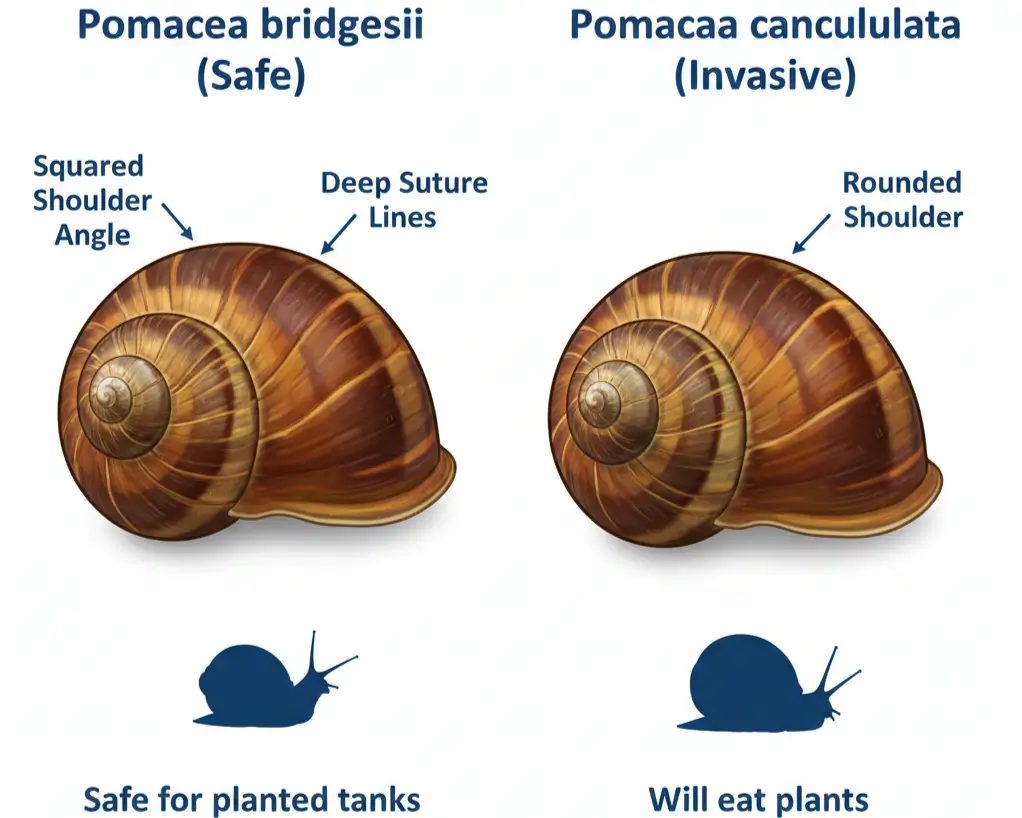
What Exactly Is a Mystery Snail? (Species Identification Matters)
Mystery snails are Pomacea bridgesii (Reeve, 1856), a freshwater gastropod native to South American rivers. They’re the only species in the Pomacea genus that doesn’t consume live aquatic plants, making them planted tank safe.
This distinction isn’t academic, it’s critical. The species commonly sold as “mystery snails” or “apple snails” can actually be one of several Pomacea species, and getting the wrong one means:
- Destroyed plants (P. canaliculata and P. maculata consume live vegetation aggressively)
- Legal problems (many Pomacea species are banned in the US and EU as invasive)
- Much larger adults (some species reach 6+ inches)
I learned this the hard way when a “mystery snail” from a chain pet store turned out to be a channeled apple snail (P. canaliculata). Demolished my Amazon sword in 72 hours. Looked nearly identical to true P. bridgesii as a juvenile.
How to identify true Pomacea bridgesii:
- Shell has more squared-off whorls (the spiral segments)
- Shoulder angle of shell is approximately 90 degrees
- Suture (line between whorls) is deeply indented
- Adult size maxes around 2-3 inches (5-7.5 cm)
The channeled apple snail (P. canaliculata) has a more rounded shoulder and a channeled suture, hence the name. If your “mystery snail” shows any interest in healthy plant leaves, you may have the wrong species.
Water Parameters: The pH-Hardness Relationship Nobody Explains
I used to think mystery snail care was simple: add calcium, maintain good water quality, done.
Then I watched a snail’s shell literally dissolve over six weeks despite cuttlebone sitting right in the tank. Same tank where my corydoras were breeding successfully. That’s when I realized the problem wasn’t calcium availability, it was that acidic water was actively dissolving the shell faster than the snail could repair it.
SPECIFICATIONS: Mystery Snail (Pomacea bridgesii)
SCIENTIFIC: Pomacea bridgesii (Reeve, 1856)
COMMON NAMES: Mystery Snail, Spike-topped Apple Snail, Inca Snail
PARAMETERS:
| Parameter | Acceptable | Optimal | Critical Threshold |
| Temperature | 68-84°F (20-29°C) | 76-82°F (24-28°C) | Below 65°F = torpor |
| pH | 7.0-8.4 | 7.6-8.0 | Below 7.0 = shell erosion |
| GH | 8-18 dGH | 12-18 dGH | Below 6 dGH = calcium deficiency |
| KH | 4-12 dKH | 6-10 dKH | Below 3 dKH = pH instability |
| Ammonia | 0 ppm | 0 ppm | Any detectable = stress |
| Nitrite | 0 ppm | 0 ppm | Any detectable = stress |
| Nitrate | 0-40 ppm | <20 ppm | >40 ppm = long-term issues |
“I maintain my snail tanks at 78°F, pH 7.8, 14 dGH, and 8 dKH. These parameters have given me consistent 2+ year lifespans with intact shells. But when I tested snails in my blackwater tank (pH 6.4, 4 dGH), which my tetras loved, shell degradation began within three weeks.”
Here’s what most care guides oversimplify: it’s not just about having calcium available, it’s about maintaining conditions where the snail can actually use that calcium while preventing existing shell from dissolving.
The relationship works like this:
- pH below 7.0 = water becomes acidic enough to chemically dissolve calcium carbonate (shell material)
- Low KH = pH can swing dramatically, sometimes dropping overnight
- Low GH = insufficient dissolved minerals for shell building
- Adequate calcium + acidic water = snail can’t win; shell dissolves faster than repairs
Understanding the difference between GH and KH is essential here, they’re not interchangeable, and both matter for different reasons.
The “Bulletproof Beginner Snail” Myth
MYTH: “Mystery snails are bulletproof, perfect for beginners who can’t maintain stable parameters.”
REALITY: Mystery snails have specific requirements that differ from most tropical fish. They tolerate poor conditions temporarily but develop shell erosion, shortened lifespans (months instead of years), and reproductive failure in suboptimal water chemistry.
Pet stores keep snails in temporary holding tanks with minimal concern for long-term health. A snail surviving 2 weeks in store conditions doesn’t mean it’ll thrive for 2 years in your tank. Additionally, many fishkeepers optimize for soft-water species (tetras, discus, most aquatic plants), which creates the opposite of what snails need.
If your tank runs acidic for your fish (below pH 7.0) or soft (GH below 8), mystery snails aren’t appropriate for that setup. Consider nerite snails instead, they’re more tolerant of varied conditions, though they won’t breed in freshwater.
I believed the “bulletproof” marketing for a year. Cost me seven snails and probably $40-50 in replacements before I accepted that my planted tank, optimized for soft-water tetras, was fundamentally inhospitable for Pomacea bridgesii.
What finally worked: dedicating a 20-gallon tank specifically to snails and livebearers, with crushed coral in the filter to maintain alkaline buffering. Different philosophy entirely.
Tank Setup and Size: Bigger Isn’t Always the Answer
Minimum Tank Size
A single mystery snail needs a minimum of 5 gallons (19 liters). For a small group of 3-4 snails, 10-20 gallons (38-76 liters) is appropriate. The “one snail per gallon” rule is outdated, it doesn’t account for bioload, territory, or surface area for grazing.
Tank requirements that actually matter:
| Element | Requirement | Why It Matters |
| Lid/Cover | Mandatory with minimal gaps | Snails WILL escape; they climb above waterline to lay eggs |
| Airspace | 2-4 inches above waterline | Required for egg-laying; insufficient space = eggs in water = death |
| Substrate | Sand, smooth gravel, or bare bottom | Sharp substrates damage foot; avoid crushed coral as substrate (fine as filter media) |
| Flow | Low to moderate | Strong flow exhausts snails; they can’t grip well in high current |
| Surfaces | Driftwood, rocks, broad-leaf plants | Grazing surfaces; biofilm accumulation |
Escape-proofing deserves emphasis. I lost a beautiful golden mystery snail in March 2023 because I’d left a 1-inch gap around filter intake tubing. Found her dessicated behind the tank stand three days later. Now I use foam weatherstripping around any openings.
Good plant choices for mystery snail tanks include hardy species like Anubias varieties and Java ferns, both tolerate the harder water snails need and won’t be damaged by snail grazing.
If you’re building a complete beginner planted tank setup, just keep water chemistry requirements in mind before adding snails.
Diet and Feeding: They’re Not Just “Cleanup Crew”
This might be the deadliest misconception in mystery snail care.
For my first year, I treated snails as self-sufficient waste processors. They’d eat algae, leftover fish food, decaying plant matter, right? That’s what cleanup crew means?
Wrong. Spectacularly wrong.
Feeding Impact on Shell Health
SETUP:
Tank: Two 10-gallon tanks, identical parameters (pH 7.8, 14 dGH, 78°F)
Duration: 12 weeks (January-March 2024)
Method: Tank A = leftover fish food only; Tank B = supplemental vegetable feeding 3x/week
Snails: 3 golden mystery snails per tank, all juvenile (1 cm shell diameter)
RESULTS:
Week 4: Tank A snails showing slight shell thinning near apex; Tank B shells dense, good growth rings
Week 8: Tank A snails with visible erosion patterns; Tank B shells intact, 30% larger diameter
Week 12: One Tank A snail died (shell degradation at apex); Tank B all healthy, active, 2x starting size
- Calcium availability was identical (crushed coral in both filters). The difference was nutrition density. Snails not receiving supplemental feeding weren’t getting enough raw material to build shell, regardless of dissolved calcium.
- Mystery snails need direct feeding. “Cleanup crew” status isn’t a feeding strategy, it’s a death sentence.
- IMITATION: Small sample size (6 snails total). Individual variation may exist. But the pattern was clear enough for me to change my approach permanently.
What I feed now (3x per week minimum):
- Blanched zucchini, cucumber, or spinach (weighted down to sink)
- Algae wafers or bottom feeder pellets
- Calcium-rich vegetables: kale, collard greens
- Occasional protein: blanched shrimp, bloodworms
Leave vegetables in tank 12-24 hours, then remove to prevent water quality issues. My snails demolish a 2-inch zucchini slice overnight.
Cuttlebone gets mentioned constantly for calcium supplementation, but honestly? It dissolves slowly and unevenly. I’ve had better results with crushed coral in the filter (raises KH and slowly releases calcium) plus calcium-rich vegetables. The combination addresses both water chemistry and direct nutritional intake.
Tank Mates: Compatible Species and Known Killers
Mystery snails are peaceful, slow, and completely defenseless. This makes them targets.
COMPATIBILITY MATRIX: Mystery Snails
| Tank Mate | Compatibility | Notes |
| Livebearers (guppies, platies, mollies) | Excellent | Similar water chemistry needs; no aggression |
| Corydoras catfish | Excellent | Peaceful bottom dwellers; shared foods |
| Small tetras (ember, neon) | Good | May prefer softer water; watch parameters |
| Peaceful rasboras | Good | Good community choice |
| Cherry shrimp | Excellent | Great tankmates; similar care needs |
| Ghost shrimp | Good | Occasional antenna nipping reported |
| Bettas | Variable | Some individuals attack tentacles relentlessly |
| Goldfish | Avoid | Will eat snails or damage tentacles; different temperature needs |
| Cichlids (most species) | Avoid | Predatory toward snails |
| Loaches (clown, yoyo, others) | DANGER | Active snail predators, will kill mystery snails |
| Puffers | DANGER | Snails are literally puffer food |
| Crayfish | DANGER | Will catch and consume snails |
The betta compatibility question comes up constantly. Here’s my honest experience: I’ve kept mystery snails with three different bettas. Two ignored the snails completely. The third ripped tentacles off relentlessly until I separated them.
Individual temperament varies so dramatically that you essentially need a backup plan before attempting this combination.
Cherry shrimp make excellent mystery snail companions, similar water parameters (though shrimp tolerate slightly softer water), no aggression, and they occupy different tank zones. I run both in my 20-gallon community tank with zero conflict.
Critical warning: Any loach species will eventually kill mystery snails. I don’t care what the pet store says. Loaches eat snails. It’s their thing. One clown loach will systematically eliminate every snail in a tank, usually starting with the babies.
Breeding Mystery Snails: What Three Years of Egg Clutches Taught Me
Mystery snails are gonochoristic, separate males and females, no hermaphroditic breeding. This sounds straightforward until you’re staring at a tank of identical-looking snails trying to figure out who’s who.
Sexing mystery snails:
The only reliable method is catching them in the act. Males mount females from behind and to the right, extending a penial sheath. You can also check by gently restraining the snail (they’ll retract) and waiting, when they extend again, look for the sheath structure on the right side near the head.
I can’t reliably sex mystery snails visually any other way. Shell shape, size, color, none of these are consistent gender indicators despite what some sources claim.
Egg Clutch Viability
SETUP:
Tank: 20-gallon with 6 adult mystery snails (confirmed 2M:4F)
Duration: 18 months ongoing (July 2023-present)
Environment: 2-3 inches airspace above waterline, humidity maintained, 78°F ambient
Method: Left clutches in place vs. incubator box comparison
CLUTCH DATA:
Total clutches: 31 (average: 1.7 per month)
Left in place: 18 clutches → 14 hatched successfully (78%)
Incubator box: 13 clutches → 12 hatched successfully (92%)
Eggs per clutch: 50-200+ (average ~100-150)
Hatch time: 14-21 days depending on temperature
- Clutches that fell into water before hatching had 0% viability. Even 24-hour submersion killed developing eggs. The “eggs must stay dry” rule is absolute.
- If you don’t want babies, remove clutches before they hatch. If you do want babies, maintain humidity and keep them above waterline at all costs.
Controlling population:
One mated female can store sperm for months. If you don’t want 200 baby snails, remove egg clutches within 24-48 hours of being laid, they’re pink/salmon colored and clearly visible above the waterline.
I remove about 80% of clutches to prevent overpopulation. The ones I let develop go into a dedicated grow-out tank until they’re large enough to sell or rehome.
Baby snails need the same parameters as adults. Don’t assume they’re hardier, they’re actually more vulnerable to parameter swings. Ensure proper cycling before introducing juveniles.
Common Problems and Troubleshooting
PROBLEM: Shell Erosion/Pitting
Symptoms: White patches, thin spots, holes in shell, rough texture
Causes (in order of likelihood):
- pH below 7.0 (acidic water dissolving shell)
- Insufficient GH/KH (no mineral buffer)
- Inadequate nutrition (can’t build shell material)
- Genetic weakness (some snails just have poor shells)
- Copper exposure (check tap water, medications)
Solution:
Test pH, GH, KH immediately. If pH < 7.2 or GH < 8, add crushed coral to filter. Increase supplemental feeding. Damage cannot be reversed, but further erosion can be stopped.
PROBLEM: Floating at Surface
Symptoms: Snail at surface, not actively climbing, may be upside-down
Causes:
- Air trapped in shell (often after being startled)
- Poor water quality (check ammonia/nitrite)
- Temperature shock
- Illness/dying
Solution:
Gently hold snail underwater and tip to release air bubble. Check parameters with reliable test kit. If snail doesn’t resume normal activity within 24 hours, problem is likely illness.
PROBLEM: Inactivity/Staying Retracted
Symptoms: Snail remains closed for extended periods (days), not eating
Causes:
- Temperature too low (torpor below ~65°F)
- Poor water quality
- Recent introduction stress
- Illness
Solution:
Verify temperature is 70°F+. Test parameters. New snails may take 1-3 days to acclimate, give them time before panicking.
PROBLEM: Deep Retraction (Won’t Come Out)
Symptoms: Operculum sealed tight, no response to stimulus, “death smell” may develop
Diagnostic:
Smell test: Hold snail to nose. Healthy snails have no odor or mild “earthy” smell. Dead snails produce unmistakable rotting protein smell within 24-48 hours.
Reality Check:
If the snail smells like death, it’s dead. Remove immediately, decomposing snails cause ammonia spikes.
CRITICAL SAFETY NOTE: Copper Toxicity
Mystery snails are extremely sensitive to copper. Concentrations as low as 0.03 ppm can be lethal with prolonged exposure. Common copper sources:
- Tap water (especially from copper pipes in older homes)
- Ich medications containing copper sulfate
- Some plant fertilizers
- Untreated driftwood from treated lumber
Always verify any medication is “invertebrate safe” before use. When in doubt, don’t dose.
Legality and Invasive Species Concerns
Mystery snails (Pomacea bridgesii) are banned in the UK and EU under Regulation (EU) No 1143/2014 due to concerns about invasive Pomacea species generally. In the United States, importation and interstate transport of some Pomacea species is prohibited under USDA regulations (7 CFR 330).
Check your local regulations before purchase. Don’t release mystery snails into wild waterways under any circumstances, even “plant-safe” species can establish invasive populations in appropriate climates.
I’ve watched aquarium forum users cavalierly suggest dumping unwanted snails in local ponds. Don’t be that person. The invasive species laws exist for good reason.
Final Thoughts: What Actually Keeps Mystery Snails Alive
After three years and probably 50+ mystery snails (including many babies I’ve raised and rehomed), here’s what I’d tell my past self:
Stop treating them as an afterthought. Mystery snails aren’t accessories. They’re animals with specific biological needs that often conflict with parameters optimized for tropical fish.
The three non-negotiables:
- Alkaline water (pH 7.2+, preferably 7.6-8.0)
- Adequate hardness (GH 12+, KH 6+)
- Direct feeding (vegetables and/or algae wafers 3x weekly)
Get these three right, and most other problems never develop. Ignore any of them, and you’ll repeat my first year, watching shells erode and wondering why “bulletproof” invertebrates keep dying.
Mystery snails remain one of my favorite aquarium animals. They’re genuinely interesting, the way they explore with their tentacles, the visible breathing through their siphon, watching them lay egg clutches above the waterline. But appreciating them requires abandoning the “cleanup crew” mentality that sets them up for failure.
Respect the requirements, and they’ll live 2-3 years with intact shells and active breeding. Ignore them, and you’ll replace dead snails every few months while blaming genetics.
The choice is yours.