I used to think Anubias was bulletproof. Everyone says it is. “Just tie it to wood and walk away,” they said.
So, in 2019, I walked away. Three weeks later, I came back to a 10-gallon tank that smelled like swamp gas and $60 worth of Anubias Nana Petite that had turned into clear, mushy slime. It wasn’t a “beginner mistake”, I had ten years of experience. It was a fundamental misunderstanding of how epiphyte rhizomes breathe.
While Anubias barteri var. nana ‘Petite’ is tough, it has an Achilles heel that most generic guides ignore. It’s not about lighting intensity. It’s about the relationship between the rhizome, water flow, and how you attach it.
If you are tired of scrubbing Green Spot Algae off tiny leaves or watching expensive clumps disintegrate, we need to change how you look at driftwood setups.
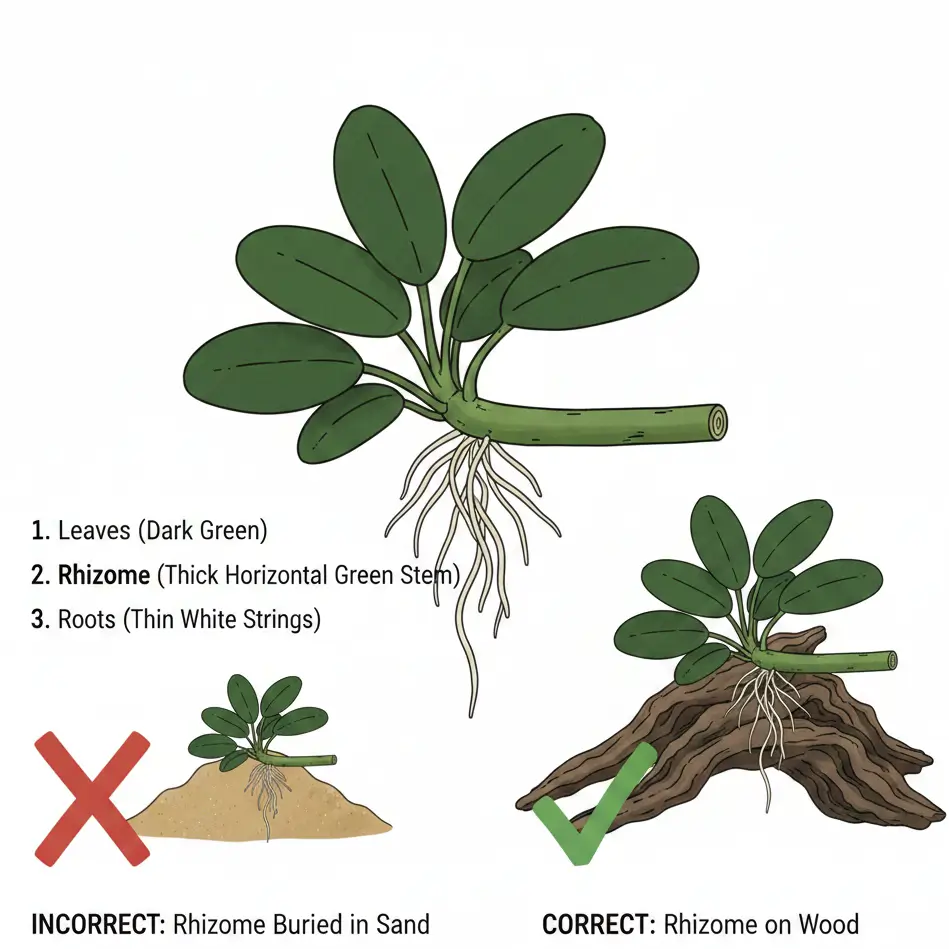
The Golden Rule of Rhizomes
To successfully mount Anubias Nana Petite to driftwood, you must attach the plant by its lateral roots or the very bottom of the rhizome, ensuring the horizontal “stem” (rhizome) is 100% exposed to the water column. Never bury the rhizome in substrate or cover it completely with glue.
The Critical Metric: Maintain water circulation around the rhizome. Stagnant water leads to bacterial rot (soft rot) within 14-21 days.
Best Method: Cyanoacrylate gel (super glue) applied sparingly, or cotton thread that dissolves over time.
The “Super Glue Burn” Incident: Glue vs. Thread
This is where I messed up my first high-stakes nano tank.
There is a fierce debate in the hobby: Super Glue (Cyanoacrylate) vs. Fishing Line vs. Cotton Thread.
In 2019, I was rushing a setup. I grabbed liquid super glue, not gel, and doused the driftwood. I pressed the delicate Petite rhizomes directly into the glue puddle.
Within 48 hours, the rhizomes turned white, then brown, then dissolved.
Cyanoacrylate curing is an exothermic reaction, it generates heat. On a thick Anubias Barteri, you might get away with it. On a tiny Nana Petite rhizome, the heat from a large globs of glue literally cooks the plant tissue. The dead tissue then invites bacterial infection (Erwinia/Pectobacterium), which spreads to the rest of the plant.
Comparison: My Attachment Test Results (2023)
I ran a test on three pieces of Manzanita driftwood to settle this for myself.
| Method | Setup Time | Hold Strength | Plant Health (Week 4) | Verdict |
| Fishing Line | 15 mins (Frustrating) | High | Excellent | Safe but ugly. Hard to remove later without cutting leaves. |
| Cotton Thread | 10 mins | Medium | Excellent | Best for nature tanks. Thread rots away in 2-3 months; roots take over. |
| Super Glue (Liquid) | 30 seconds | High | FAILED (Rhizome damage) | Dangerous. Too runny, runs into crevices, heats up too much. |
| Super Glue (Gel) | 60 seconds | High | Good | Winner (with caution). Stays put. Apply to ROOTS, not rhizome. |
Use Super Glue GEL. But here is the trick nobody tells you: Dip the wood and plant in water immediately after gluing. The water cools the reaction instantly, preventing the thermal burn.
Driftwood Selection: Why Texture Matters
You can’t just slap a $15 plant onto a smooth stick and hope for the best.
Anubias Nana Petite is an epiphyte, it feeds primarily from the water column, but its roots need purchase. I’ve found that Spiderwood is often too smooth for the roots to grip quickly, requiring glue or ties to stay indefinitely.
By contrast, Mopani wood or heavily textured Malaysian Driftwood offers crevices. I specifically look for “crooks”, natural V-shapes in the wood. You can often just wedge the Anubias into these cracks without any glue at all. This “Jam Method” is actually my favorite because there is zero risk of chemical burn or strangulation from thread.
Note: If you are using new driftwood, remember that tannins can lower your pH. Anubias doesn’t mind the acidity, but a sudden drop below 6.0 can stall growth.
The Flow Paradox: Stopping Algae Before It Starts
MYTH: “Anubias gets algae because your light is too high.”
REALITY: Anubias gets algae because it collects organic debris (detritus) that decomposes on the leaves, creating a localized ammonia spike that triggers algae spores.
Studies on epiphytic algae colonization indicate that surface roughness and nutrient availability (the debris layer) are primary drivers (Wetzel, 1983).
I placed Nana Petite in high light (80 PAR) with massive flow, and low light (30 PAR) with zero flow. The low light tank grew Black Beard Algae (BBA). The high light tank stayed clean.
People see algae and assume “too much light energy.” But Anubias are slow growers. They can’t shed leaves quickly. If flow is low, dust settles. Dust = Algae food.
Position your driftwood in the path of your filter output. You want the leaves to gently sway. If you see dust settling on the leaves during your weekly maintenance, your flow is insufficient, or you need to manually baste the plant with a turkey baster.
If you are already battling BBA on your wood or plants, spot treating with liquid carbon (Glutaraldehyde) is effective, but be careful, Nana Petite is hardier than mosses, but you can still melt it with an overdose.
Anubias Nana Petite vs. Standard Nana
Is the “Petite” version worth the markup? Usually, Petite costs 30-50% more than standard Nana.
I have a 5-gallon portrait tank where I tried to save money by using “Small” standard Anubias Nana. Within six months, two leaves spanned the entire width of the hardscape. It looked ridiculous, like a giant wearing a tiny hat.
Size Comparison:
- Standard Nana Leaf: 2.0 – 4.0 inches long.
- Nana Petite Leaf: 0.5 – 0.8 inches long.
For any tank under 20 gallons, or for intricate Anubias Nana Petite driftwood setups intended to create a sense of scale (making the tank look bigger than it is), the Petite is the only viable option.
The Propagation ROI
Here is how I justify the cost. Nana Petite is incredibly easy to clone.
- Buy one large “Mother Pot” ($15-20).
- Wait until the rhizome is 3 inches long.
- Cut the rhizome with a razor blade, ensuring each piece has at least 3-4 leaves and some roots.
- Glue the new piece to a small pebble.
I turned one pot into six separate plants over 8 months. If you have the patience, you never need to buy it twice.
Specifications: Anubias Barteri var. nana ‘Petite’
SCIENTIFIC: Anubias barteri var. nana ‘Petite’ (Cultivar status)
ORIGIN: West Africa (cultivar likely developed in Singapore/Europe)
PARAMETERS (Success Range)
Temperature: 72-82°F (22-28°C)
pH: 6.0 – 7.5 (optimal: 6.8)
Hardness: 3-15 dGH (Very adaptable)
CO2: Not required, but accelerates growth by 200%
“I’ve kept this species in unheated shrimp bowls at 68°F and high-tech tanks at 80°F. It stops growing in the cold, but it doesn’t die. It melts instantly if buried.”
REQUIREMENTS
Light: Low to Medium (10-40 PAR). High light requires CO2.
Placement: Epiphyte (Wood or Stone). NEVER substrate.
Growth Rate: Extremely Slow (1 leaf per month without CO2).
CARE REALITY CHECK
Difficulty: Easy (if not buried).
Beginner-Suitable: Yes.
Common Failure: Rhizome Rot (planting too deep) or GSA (Green Spot Algae).
COSTS
Pot/Clump: $12 – $18
Tissue Culture: $15 – $22 (Pest free)
Fertilization: Do Epiphytes Need Root Tabs?
This is a common question I get asked. “Should I shove a root tab into the wood?”
Please don’t. It won’t work, and you’ll just leach ammonia into the water column.
Since Anubias feeds from the water, you rely entirely on liquid fertilization or fish waste. In a stocked tank with something like Cherry Shrimp, the waste produced is often enough nitrogen. However, Anubias are potassium hogs. If you see tiny pinholes developing in the older leaves, that’s Potassium deficiency, not snails eating it.
I use a lean dose of Seachem Flourish or similar all-in-one once a week after water changes. If you are keeping them with Java Fern varieties, the nutrient needs are almost identical.
Troubleshooting: The “White Slime”
If you see white fuzz on your new driftwood setup, don’t panic.
Scenario A: Biofilm
If the slime is all over the wood and the plant, but the plant feels firm, it’s just fungal biofilm feeding on the sugars in the new wood. Shrimp and snails will eat this. It’s harmless.
Scenario B: Rhizome Rot
If the slime is specifically oozing from the Anubias rhizome, and the rhizome feels squishy or smells bad, that is rot.
- Action: Remove the plant immediately. Cut away the mushy part until you see healthy green tissue. Dip in a diluted peroxide mix (1ml per gallon) for 5 minutes, and re-attach elsewhere with better flow.
Final Thoughts
Building an Anubias Nana Petite driftwood scape is not for the impatient. It is a slow-motion art form. But there is a reason this plant is in almost every award-winning aquascape. It provides a texture and a deep green color that few other plants can match at that scale.
Just remember: Keep the rhizome wet but exposed, use gel glue (and cool it), and keep the water moving. Do that, and you’ll have a plant that outlives almost everything else in your tank.