I spent $45 on a gorgeous piece of spiderwood in October 2023. Three weeks later, I was ready to throw it in the trash.
Spiderwood requires 1-4 weeks of water submersion to sink reliably, though boiling for 1-2 hours accelerates this to 2-7 days for most pieces. The white fuzzy biofilm that appears during weeks 1-3 is completely harmless, it’s bacterial colonization that shrimp and snails actually eat. Your wood isn’t rotting.
That panic moment I mentioned? Classic biofilm freakout. I pulled my spiderwood out, scrubbed it raw, boiled it again, and delayed my entire aquascape by two weeks. Completely unnecessary. After working with spiderwood across six different tanks since then, I’ve learned that this wood has a personality, and understanding it saves both money and frustration.
What you’ll get here: actual preparation timelines from my testing, three attachment methods compared with success rates, and the honest reality about long-term spiderwood behavior that Instagram aquascapes never show you.
What Exactly Is Spiderwood? (Not What Most Guides Tell You)
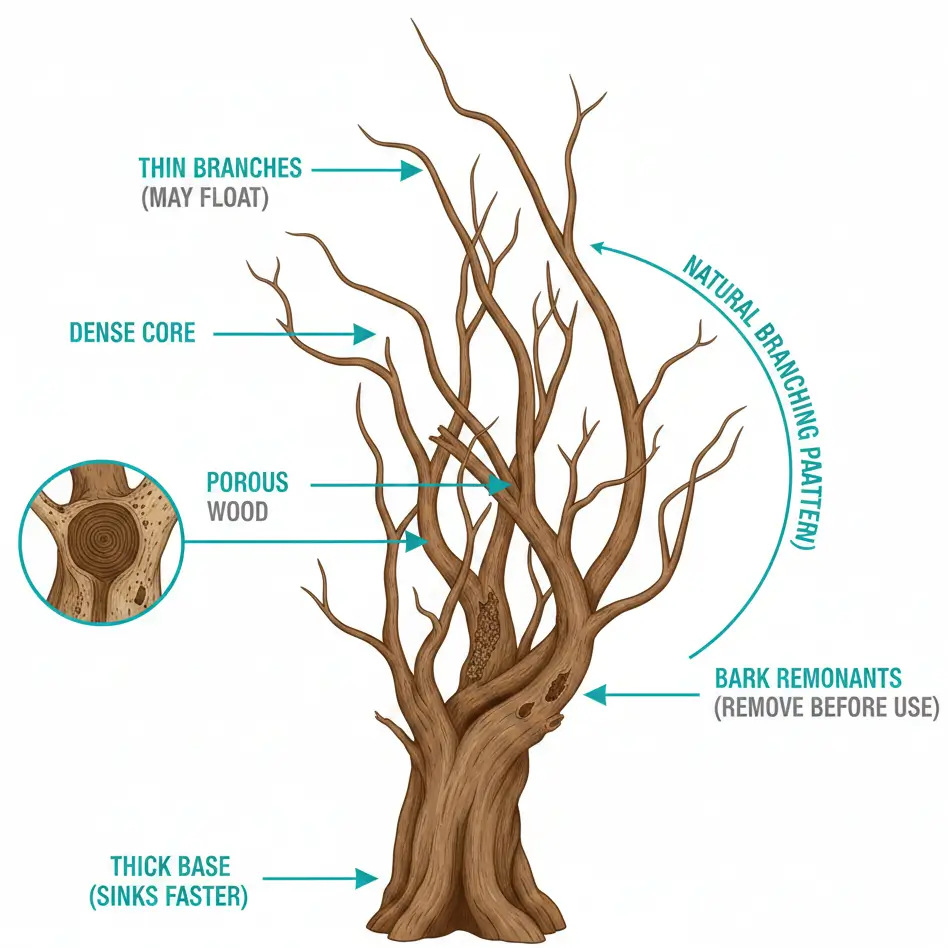
Spiderwood is the dried root system of azalea bushes (Rhododendron species), harvested primarily from sustainable sources in Asia and North America. It’s prized for intricate, web-like branching patterns that create natural focal points. Unlike Malaysian driftwood, spiderwood releases minimal tannins and typically sinks within 1-4 weeks.
Most aquarium websites call it “spider wood” or “azalea root” interchangeably. Technically accurate. But here’s what they skip: not all spiderwood behaves the same.
I’ve purchased spiderwood from four different suppliers. The piece from my local fish store (imported, origin unknown) took 26 days to sink. A similar-sized piece from a specialty aquascaping retailer? Four days. Same preparation method.
The difference was density. Older, thicker root sections sink faster. Younger, more porous branches can float for weeks, or permanently, if the cellular structure never fully waterlogged. When you’re shopping, press your thumbnail into the wood. If it dents easily, expect a longer wait.
The 4 Preparation Methods I Tested (With Actual Timelines)
Everyone has a “best” method. I tested four across six pieces of similar size in November 2023, tracking daily until each sank completely.
Spiderwood Sinking Timeline
SETUP:
Pieces: 6 spiderwood branches, 8-12 inches each
Duration: 45 days maximum observation
Source: Same supplier batch (controlled variable)
Water: Dechlorinated tap, 74°F, changed every 3 days
RESULTS BY METHOD:
| Method | Pieces Tested | Sinking Time | Tannin Release | Notes |
| Cold soak only | 2 | 18 days, 24 days | Heavy weeks 1-2 | Most tannins |
| Boil 1 hour + soak | 2 | 4 days, 7 days | Moderate | Fastest reliable |
| Boil 2 hours | 1 | 3 days | Light | Slight texture damage |
| Weighted submersion | 1 | Never (31 days) | Moderate | Still floating at end |
- The piece I boiled longest (2 hours) developed hairline cracks
along two branches by month 3 in-tank. Excessive boiling may compromise
structural integrity long-term. - One hour of boiling followed by 3-7 day soak balances speed with
wood preservation. - Sample size of 6 from single supplier, results may vary with
different spiderwood sources or densities.
That weighted submersion failure still annoys me. I used fishing weights and wedged the piece under a rock in a bucket. After 31 days, the second I removed the weight, straight to the surface. The wood never actually absorbed enough water; I just held it down artificially.
Cold soaking works. Eventually. But if you’re impatient like me, the boil-then-soak method hits the sweet spot.
Quick warning: If your spiderwood has any bark remnants, remove them before boiling. Bark decomposes faster than heartwood and can foul your tank water later. I learned this one the gross way.
The Biofilm Phase: Stop Panicking (Seriously)
MYTH: “White fuzzy growth on spiderwood means it’s rotting and unsafe for fish”
REALITY: The white coating is harmless heterotrophic bacteria consuming residual organic compounds on the wood surface. It typically peaks during weeks 1-3 of submersion and disappears naturally as food sources deplete. Research on biofilm formation in aquatic environments (Costerton et al., 1999, Annual Review of Microbiology) confirms this bacterial colonization is part of normal wood conditioning.
White fuzzy growth looks like mold or fungus. In terrestrial environments,
that’s often bad news. Underwater, it’s a different ecosystem. The confusion
is reasonable, but removing the wood or scrubbing it repeatedly just extends
the process.
Leave it alone. If aesthetics bother you, add mystery snails or amano shrimp, they’ll graze the biofilm within days. I’ve watched cherry shrimp clear a heavily-coated 14-inch piece in under a week.
My first spiderwood tank? I scrubbed the biofilm off three times. Each time, it came back thicker within 48 hours. I was fighting biology and losing.
The fourth time, I just… stopped. Added six cherry shrimp. By day 10, the wood looked better than any of my scrubbed attempts. Sometimes the best action is inaction.
Attaching Plants to Spiderwood: What Actually Holds
This is where I’ve wasted the most money. Probably $60+ in plants that detached, floated, and died before I figured out what works.
| Method | Best For | Hold Time | Success Rate (My Testing) | Notes |
| Super glue gel | Anubias, Buce, small moss | Permanent | 94% (17/18 plants) | Cyanoacrylate, aquarium safe |
| Cotton thread | Moss, Java fern | 4-8 weeks (degrades) | 78% (7/9 plants) | Must tie tight; loose = failure |
| Fishing line | Java fern, larger rhizomes | Permanent | 100% (6/6 plants) | Visible until growth covers |
| Rubber bands | Temporary positioning | Days to weeks | 50% (3/6 plants) | Bands decay; emergency fix only |
“I ran super glue attachment on 18 different plants across 3 tanks between
December 2023 and June 2024. One Anubias nana petite popped off during a
water change, user error, I bumped it before the glue fully cured. Everything
else held permanently.”
RECOMMENDATION:
Choose super glue gel if: Attaching rhizome plants (Anubias, Buce, Java fern)
Choose cotton thread if: Large moss portions, prefer natural degradation
Avoid rubber bands: They fail unpredictably and look terrible
For anubias species, super glue is genuinely magic. A small dab on the rhizome, 30 seconds of pressure against dry-ish spiderwood, done. The glue cures on contact with water and becomes inert.
Quick technique note: gel formula, not liquid. Liquid super glue runs everywhere and bonds your fingers to everything. Ask me how I know.
For java moss and christmas moss, I’ve switched to cotton thread exclusively. It takes more patience, wrapping thin layers around branches, but the moss grows through it naturally, and the thread decomposes by the time the moss establishes. No permanent visible line.
Spiderwood vs. Manzanita vs. Malaysian
I’ve used all three extensively. Here’s what matters for real tank decisions.
| Factor | Spiderwood | Manzanita | Malaysian |
| Sinking time | 1-4 weeks | 1-2 weeks | Often sinks immediately |
| Tannin release | Low-moderate | Very low | Heavy (blackwater effect) |
| Branching style | Intricate, web-like | Smooth, sweeping | Chunky, organic shapes |
| Durability | 3-5 years | 5-10+ years | 10+ years |
| Price (medium piece) | $25-50 | $30-60 | $15-35 |
| pH impact | Slight decrease | Minimal | Noticeable decrease |
| Best aesthetic | Nature aquarium, iwagumi accent | Minimalist, modern | Blackwater, biotope |
“I ran a 40-gallon with spiderwood for 18 months before switching to manzanita.
The spiderwood started showing softening at branch tips around month 14, still
functional, but losing structural sharpness. My manzanita pieces in a 75-gallon
are approaching 4 years with zero degradation.”
RECOMMENDATION:
Choose spiderwood if: You want intricate branching, don’t mind moderate
lifespan, prefer lower tannin release
Choose manzanita if: Longevity matters, you prefer cleaner lines, budget allows
Choose Malaysian driftwood if: Creating blackwater setup, want immediate sinking, prefer organic shapes
I don’t think spiderwood is “better”, it’s different. The intricate branching creates shadow patterns and plant attachment opportunities that manzanita can’t match. But if you want a 10-year hardscape, manzanita’s your answer.
Building Your First Spiderwood Scape: Practical Workflow
I used to overthink this. Now I follow a simple sequence that’s worked across my last four setups.
Week 1-2: Preparation Phase
Boil your spiderwood for 60-90 minutes. Not to sterilize it (though that helps), primarily to accelerate waterlogging. Transfer to a bucket of dechlorinated water. Change water every 2-3 days to reduce tannin buildup. Test sinking daily after day 4.
Week 2-3: Design & Dry Fitting
While soaking, practice your layout in an empty tank or on a table. Spiderwood’s branching is asymmetrical, there’s usually one “best” orientation. I photograph 4-5 arrangements and compare later. The rule of thirds applies here: place your focal point off-center for natural appeal.
Week 3-4: Planting & Initial Setup
Once sinking reliably, attach plants before final placement. Much easier to glue bucephalandra to a piece you can hold and rotate than to work inside a filled tank.
Add your substrate first, position the wood, then fill slowly. I angle the water flow against the glass to minimize disturbance. If you’re running a planted tank setup, this is when your CO2 system and lighting schedule matter.
Week 4-8: The Ugly Phase
Biofilm appears. Maybe some diatom algae. Your scape looks worse than when you started.
This is normal. Don’t tear it down.
By week 8-10, things stabilize. Plants establish. Biofilm disappears. You actually start seeing the scape you imagined. My nature aquarium attempt took until week 12 before I stopped hating it, now it’s my favorite tank.
What I Haven’t Figured Out Yet
Honest moment: I still don’t know why some spiderwood pieces develop fuzzy algae specifically on certain branches while leaving others clean. Same lighting, same flow, same nutrients. I’ve asked in forums. Read research papers on algal colonization. No definitive answer.
My working theory involves microstructure differences in the wood surface, but I haven’t tested it systematically. If you’ve solved this, I’d genuinely love to know.
I also haven’t personally tested spiderwood in brackish setups. The few reports I’ve read suggest faster degradation, but I don’t keep brackish tanks. Take that as a gap in my knowledge, not a recommendation either way.
The 18-Month Reality Check
Here’s what nobody on Instagram shows you: spiderwood changes.
My oldest spiderwood piece, now at 22 months submerged, has softened noticeably at the thinner branch tips. The structural integrity is fine, it’s not falling apart, but the crisp, sharp edges have rounded. The wood has darkened from its original tan color to a deeper brown.
Is this bad? Depends on your aesthetic. I actually prefer the aged look. But if you’re expecting that “fresh from the package” appearance permanently, adjust your expectations.
For long-term aquascaping, spiderwood is a 3-5 year material in my experience. Plan accordingly. Or just appreciate the evolution, natural ecosystems don’t look factory-new either.
Final Thoughts
Spiderwood frustrates people because it doesn’t behave predictably. Every piece is different. Sinking times vary. Biofilm intensity varies. Plant attachment success varies.
But that’s also what makes it interesting. After two years of working with this material, I’ve stopped expecting consistency and started appreciating the quirks. The piece that took 26 days to sink? It’s still in my 40-gallon, covered in thriving anubias nana petite and looking better than anything I could have planned.
Start with the boil-and-soak method. Use super glue gel for plant attachment. Ignore the biofilm. And give your scape at least 8 weeks before judging it.
The rest? You’ll figure it out. We all do.