I remember staring at my first attempt at a “Nature Aquarium” in 2011. It was a disaster.
I had bought the expensive soil, the high-iron glass tank, and the driftwood that cost more than my car insurance. Three weeks later? A soup of green hair algae and melting Cryptocorynes. I felt like an idiot. I thought I was copying nature, but I was actually trying to drive a Formula 1 car without a license.
What Takashi Amano created wasn’t just a design style; it was a high-performance biological system that balances on a razor’s edge.
If you’re here because you saw a photo of a lush, Zen-like box of water and thought, “I want that,” you need to understand the engine under the hood. It’s not about tossing rocks in a tank. It’s about mastering the relationship between high light, pressurized CO2, and aggressive maintenance.
Let’s break down how to actually achieve the Amano look without the algae farm I started with.
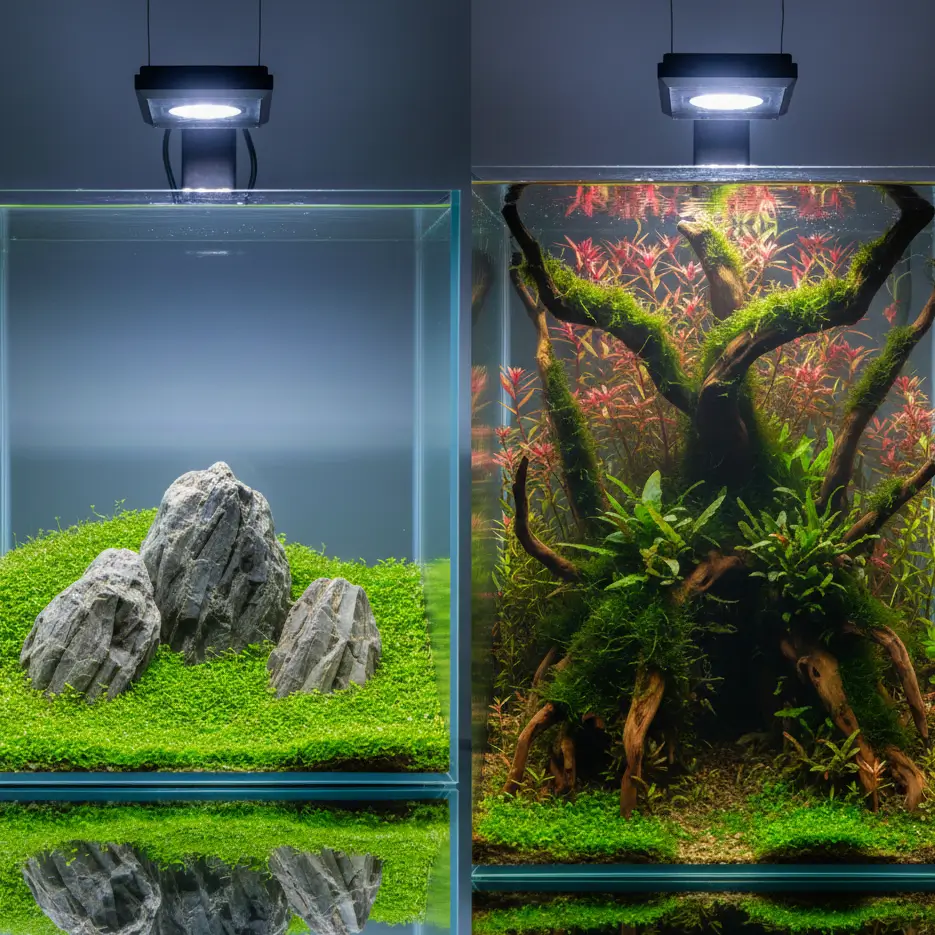
What Is a Nature Aquarium? (Defining the Style)
The Nature Aquarium is a freshwater aquascaping style pioneered by Japanese photographer Takashi Amano in the 1990s. Unlike “Dutch” styles (organized plant streets) or “Biotope” tanks (exact scientific replication), the Nature Aquarium uses Wabi-Sabi principles to create a hyper-realistic impression of a landscape, often mimicking terrestrial scenes like mountains or forests, using asymmetry, stone, wood, and dense vegetation.
The irony? To look this “natural,” the system is incredibly artificial. You are driving photosynthesis at 10x the speed of a low-tech tank.
The Philosophy: Wabi-Sabi and The Golden Ratio
When I finally got it right, it wasn’t because I bought better gear. It was because I stopped trying to make things perfect.
Amano’s philosophy leans heavily on the Japanese concept of Wabi-Sabi, finding beauty in imperfection and transience. In the aquarium, this means using driftwood that looks weathered, positioning stones so they look like they’ve fallen naturally, and allowing plants to grow wild within structured boundaries.
But there is a mathematical backbone here.
The Rule of Thirds (The Golden Ratio)
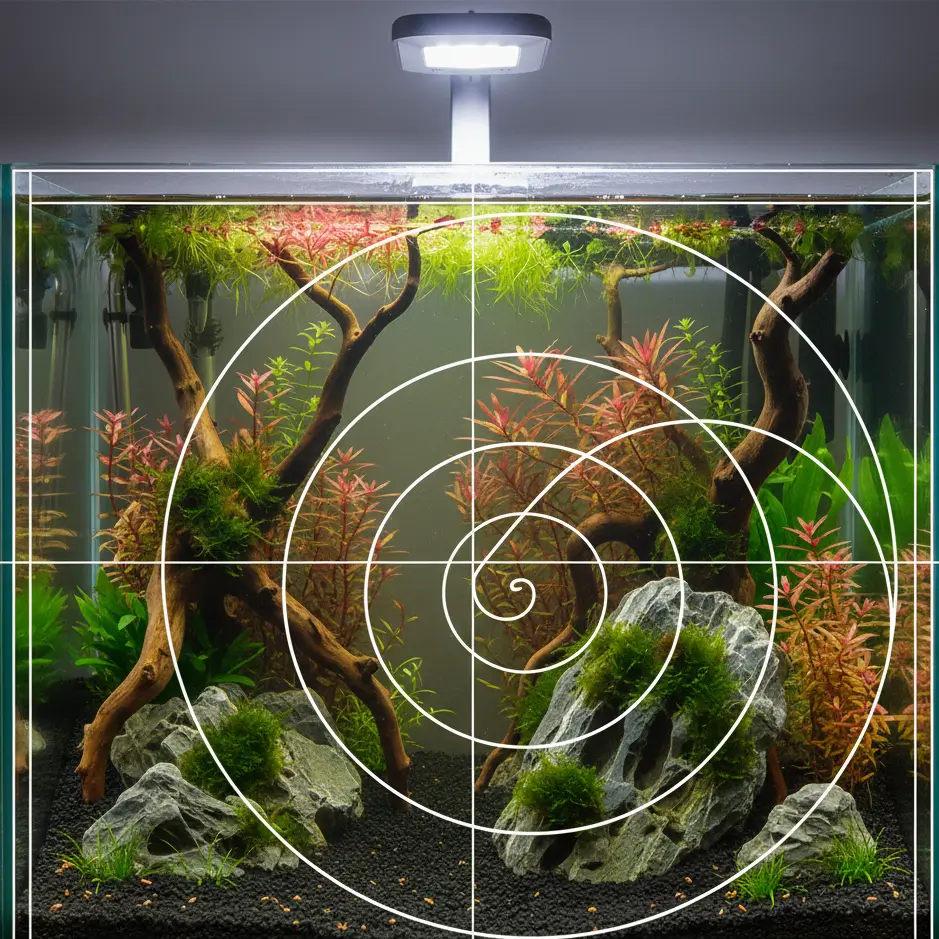
You cannot place your main stone (the Oyaishi) in the center. It looks static. Boring. Artificial.
In almost every winning scape from the International Aquatic Plants Layout Contest (IAPLC), the focal point sits at a 1:1.618 ratio. I used to eyeball this and fail. Now, I literally tape a grid on the front glass of my tank during the hardscape phase.
My Rule: If you place a stone and it “feels” stable immediately, move it. Nature is tension. A leaning stone suggests gravity, history, and water flow.
Note: For a deeper dive into layout geometry, check our guide on the Rule of Thirds in Aquascaping.
We frequently discuss these aesthetic principles at aquaticspoolspa.com, specifically how they apply to both massive architectural installations and nano tanks.
Iwagumi vs. Ryuboku: Choosing Your Discipline
Most beginners mix these up. Don’t. They require different maintenance and planting strategies.
| Factor | Iwagumi (Rock Formation) | Ryuboku (Driftwood) | My Finding |
| Hardscape | Stones only (Odd numbers) | Driftwood + Stones | Ryuboku is more forgiving. |
| Planting | Carpeting plants mostly | Ferns, Moss, Stems | Iwagumi demands perfect trimming. |
| Difficulty | 9/10 (Algae shows instantly) | 6/10 (Shadows hide errors) | Start with Ryuboku. |
| Cost | $$$ (Specific stones are pricey) | $$ (Wood floats, needs prep) | Stone shipping kills the budget. |
I ran a classic Iwagumi with Glossostigma elatinoides in 2018. It looked incredible for three months, then a single CO2 fluctuation caused an algae bloom on the rocks that took six weeks to scrub off. The Ryuboku setup I built with Spiderwood? It aged gracefully even when I neglected it for a week.
Choose Ryuboku if this is your first high-tech tank. The wood releases tannins that can help soften water, and the complex structure allows for hardy epiphytes like Anubias Nana Petite to absorb nutrients directly from the water column.
The “Holy Trinity” of Equipment
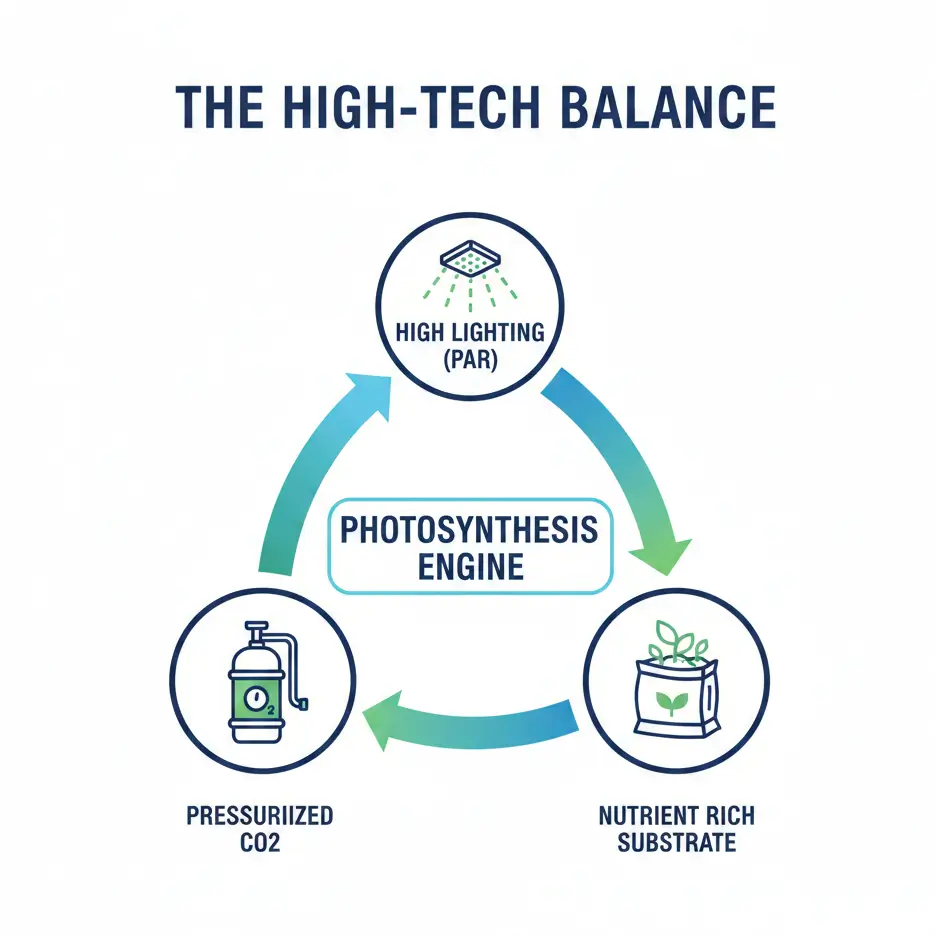
Here is where I contradict the “budget” advice you see on YouTube.
You cannot do a proper Amano-style tank with budget lights and DIY yeast CO2. I tried. I wasted $200 on cheap lights before eventually buying the $400 unit I needed. Buy nice or buy twice.
1. Lighting (The Engine)
You need high PAR (Photosynthetically Active Radiation). But more importantly, you need color rendering. Amano emphasized green clarity. Modern RGB LEDs are the standard.
- Target: 50-80 micromols of PAR at the substrate.
- Why: To penetrate deep water and force carpet plants like Dwarf Baby Tears (HC Cuba) to spread horizontally rather than reaching up.
2. Pressurized CO2 (The Fuel)
This is non-negotiable.
- Requirement: 30ppm concentration during the photoperiod.
- My Mistake: I was terrified of gassing my fish, so I ran it at 15ppm. The result? Black Beard Algae. Algae loves fluctuating or low CO2. Plants need stability.
3. Substrate (The Foundation)
Amano introduced “Aqua Soil”, a baked, nutrient-rich volcanic soil that lowers pH.
- The Shock: This soil releases ammonia for the first 2-4 weeks.
- The Fix: You must do huge water changes initially. If you don’t, that ammonia triggers algae before your plants establish. For details on handling this active substrate, see our ADA Aquasoil Guide.
The Maintenance Reality: It’s Not Set and Forget
There is a myth that once these tanks are balanced, they run themselves.
MYTH: “A balanced ecosystem doesn’t need water changes.”
REALITY: The Amano method relies on rich dosing and large exports.
- ADA guidelines specify 30-50% weekly water changes.
- On my 60P (17-gallon) tank, skipping water changes for two weeks raised TDS (Total Dissolved Solids) from 180 to 450ppm, stunting the Rotala Rotundifolia.
People confuse “Walstad” (low tech, no water change) with “Nature Aquarium” (high metabolism). In a Nature Aquarium, you are dosing excess fertilizers to ensure no limitations. You must remove the unused accumulation.
Commit to a 50% water change every 7 days. It resets your chemistry and removes organic waste that triggers algae spores.
The “Cleaning Crew” Is Essential
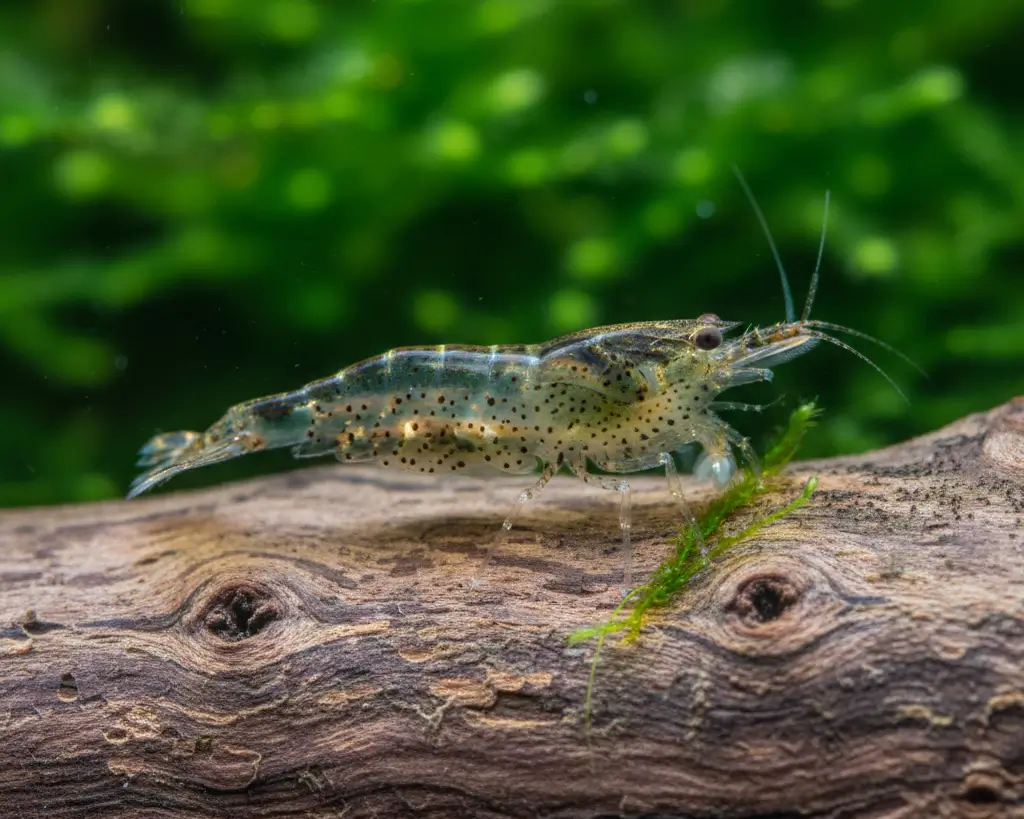
Amano didn’t just design tanks; he popularized the Amano Shrimp (Caridina multidentata). Before him, this shrimp was just Japanese river bait.
In my 20-gallon setup, I deployed:
- 10 Amano Shrimp: They eat leftover food and hair algae.
- 6 Otocinclus: The best diatom (brown algae) eaters on the planet.
- 1 Siamese Algae Eater: Only for larger tanks, but great for BBA. (Note: Check local laws regarding invasive species).
Warning: Don’t add these on Day 1. Add them after the ammonia spike from the soil clears (usually Day 21-28).
Specifications: Typical Nature Aquarium Parameters
If you want to replicate the success of a gallery tank, aim for these numbers. I’ve tracked these across five different layouts.
WATER CHEMISTRY:
Temperature: 72-78°F (22-26°C) – Cooler is better for mosses.
pH: 6.4 – 6.8 (Maintained by CO2 injection).
dKH: 2-4 degrees (Keep it low for plants).
dGH: 4-8 degrees.
CO2: 30ppm (Lime green on drop checker).
TYPICAL FLORA:
Foreground: Monte Carlo or Hairgrass.
Midground: Cryptocoryne Wendtii, Staurogyne Repens.
Background: Rotala, Ludwigia, or Vallisneria (for Iwagumi).
TYPICAL FAUNA:
Schooling: Cardinal Tetras or Harlequin Rasboras.
Centerpiece: Usually avoided to keep focus on the scape, but Angelfish work in tall Ryuboku layouts.
SOURCE: The International Aquatic Plants Layout Contest (IAPLC) Archives.
My Final Take: Is It Worth It?
It took me three years to build a Nature Aquarium that didn’t crash.
The frustration is real. But there is a specific moment, usually about three months in, when the plants transition to their mature form, the shrimp are breeding, and the water is so clear it looks like air. The “engine” is humming.
That moment of finding balance between technology and biology? That’s the real Wabi-Sabi.