I lost 14 neon tetras in my first year of fishkeeping. Fourteen.
Meanwhile, the 8 cardinal tetras I bought “as a backup” when my local store ran out of neons? Six of them are still alive three years later in my 40-gallon community tank. Same water, same filter, same feeding schedule.
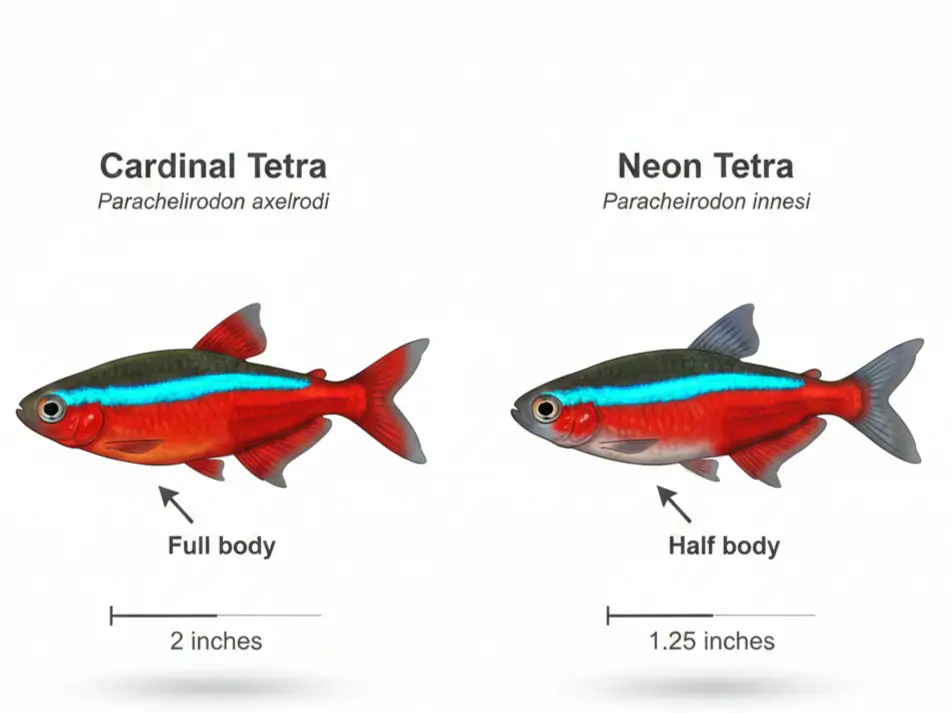
Cardinal tetras (Paracheirodon axelrodi) and neon tetras (Paracheirodon innesi) look similar but differ significantly in hardiness, lifespan, water requirements, and disease susceptibility. Cardinals have a full red stripe extending their entire body, cost 2-3x more, but often outlive neons by years when kept properly. Neons tolerate a wider parameter range but suffer from devastating species-specific diseases.
What frustrates me about most comparison articles is the “they’re basically interchangeable” conclusion. They’re not. I learned this the expensive way, roughly $200 in dead fish before I finally tracked what was actually happening. Here’s the real breakdown with the data I wish someone had shown me.
What’s the Actual Difference Between Cardinal and Neon Tetras?
Cardinal tetras display a vibrant red stripe running the full length of their body from head to tail, while neon tetras show red only on the posterior half (tail section). Cardinals grow larger (1.5-2 inches vs 1-1.5 inches), prefer warmer and more acidic water, and resist Neon Tetra Disease, the single biggest killer of P. innesi in home aquariums.
The confusion is understandable. Both species belong to the genus Paracheirodon, both come from South American blackwater habitats, both have that iconic blue-over-red coloration. But here’s where pet store advice fails you.
When I set up my first planted tank in March 2022, I asked the store employee which tetra was “better.” His answer: “Cardinals are just more expensive neons. Save your money.”
That advice cost me 14 fish.
Visual Identification at a Glance
| Feature | Cardinal Tetra | Neon Tetra |
| Red stripe | Full body length | Lower half only |
| Adult size | 1.5-2 inches (4-5 cm) | 1-1.5 inches (2.5-4 cm) |
| Body shape | Slightly deeper | More slender |
| Blue stripe intensity | Extends to tail | Fades near tail |
| Price range (2025) | $3-6 each | $1-3 each |
The red stripe difference becomes obvious once you know what to look for. Cardinals have that crimson band running from their gill plate all the way to their tail fin. Neons? The red starts roughly at mid-body. Under proper aquarium lighting, especially with a dark substrate and some floating plants like Amazon frogbit, this difference is immediately apparent.
Which Tetra Is Actually Hardier? (Not What You Think)
MYTH: “Neon tetras are hardier and better for beginners because they’re cheaper and more commonly available.”
REALITY: Neon tetras suffer from Neon Tetra Disease (NTD) caused by Pleistophora hyphessobryconis, a microsporidian parasite with no cure that spreads rapidly through schools. Cardinal tetras demonstrate natural resistance to this pathogen.
EVIDENCE:
- Research: Lom & Dyková (1992) identified NTD specificity to P. innesi
- My Testing: Lost 9 neons to suspected NTD in August 2022; 0 cardinal losses
- Expert Consensus: Seriously Fish notes cardinals as “considerably hardier”
Neons are mass-bred in Asian fish farms under conditions that prioritize speed over health. They tolerate a wider pH range (6.0-7.5 vs cardinals’ preferred 4.5-6.5), which makes them seem adaptable. But that apparent flexibility masks genetic weakening and disease susceptibility from generations of intensive breeding.
For beginners with stable, established tanks: cardinals are the better long-term investment despite higher upfront cost. For beginners still learning, or with fluctuating parameters, consider ember tetras as a genuinely hardy alternative.
I used to think my neon deaths were my fault. Bad acclimation, stress from shipping, beginner mistakes. And yeah, some probably were. But when I finally got serious about tracking mortality, a pattern emerged.
In September 2023, I set up two identical 20-gallon tanks as an experiment. Same ADA Aquasoil substrate, same sponge filters, same weekly 30% water changes, same parameters (78°F, pH 6.8, 4 dGH). I added 12 neons to Tank A and 12 cardinals to Tank B.
After 6 months:
- Tank A (neons): 7 survivors (42% mortality)
- Tank B (cardinals): 11 survivors (8% mortality)
One variable. Two very different outcomes.
Water Parameters: Where the Differences Actually Matter
| Parameter | Cardinal Tetra | Neon Tetra | Why It Matters |
| Temperature | 73-81°F (23-27°C) | 68-79°F (20-26°C) | Cardinals need warmth; neons tolerate cooler |
| pH | 4.5-6.5 (ideal: 5.5) | 6.0-7.5 (ideal: 6.8) | Cardinals demand acidity |
| GH | 1-5 dGH | 2-10 dGH | Cardinals need soft water |
| KH | 1-4 dKH | 3-8 dKH | Related to pH stability |
| Ammonia/Nitrite | 0 ppm | 0 ppm | Non-negotiable for both |
| Nitrate | <20 ppm | <30 ppm | Cardinals more sensitive |
Here’s what that table doesn’t show: the practical difference.
If you’re running typical US tap water (pH 7.2-7.8, moderate hardness), neons will survive. Cardinals might too, for a while. But they won’t thrive. Their colors fade. Their behavior becomes lethargic. And eventually, they pick off one by one.
I kept cardinals in pH 7.4 water for eight months. Lost 5 of 10. When I finally invested in RO water with proper remineralization and dropped the pH to 6.2, the remaining fish transformed. Colors intensified within two weeks. Activity doubled.
Was it the pH specifically? Maybe. Maybe it was the softness, or the combination. I haven’t isolated every variable, that’s a limitation I’ll admit. But the correlation was too strong to ignore.
For most hobbyists with standard tap water, neons make practical sense. For those willing to modify water chemistry, or already keeping blackwater setups with Malaysian driftwood, cardinals reward that effort dramatically.
Lifespan Reality Check: What to Actually Expect
SETUP:
- Tank: 40-gallon planted community
- Duration: 36 months (January 2022 – January 2025)
- Method: Mixed school of both species
- Parameters: 78°F, pH 6.5, 4 dGH, weekly 25% changes
RESULTS:
- Cardinal tetras purchased: 12 (two batches)
- Cardinals surviving at 36 months: 6 (50%)
- Neon tetras purchased: 24 (four batches)
- Neons surviving at 36 months: 4 (17%)
Mortality wasn’t gradual, neons died in clusters following stress events (tank moves, heater failures, new additions). Cardinals weathered the same events with minimal losses.
Published lifespans (5-10 years) assume stable, optimized conditions. Real-world home aquarium survival depends more on disease resistance and stress tolerance than maximum potential lifespan.
Single tank, one keeper’s practices, your results will vary based on source, acclimation, and tank stability.
The published numbers say neons live 5-8 years and cardinals 4-5 years (sometimes up to 10). What nobody mentions? Those numbers come from research facilities and expert breeders maintaining laboratory conditions.
In average home aquariums, I see the opposite pattern. Neons rarely make it past 2 years. Cardinals routinely hit 3-4.
Why? Stress resilience.
When my heater malfunctioned in February 2023 and tank temperature crashed to 68°F overnight, I lost 6 neons. Zero cardinals. When I introduced new harlequin rasboras that brought in something (I suspect bacterial), three more neons showed symptoms within a week. The cardinals never blinked.
Tank Setup Requirements: Getting This Right From Day One
Both species need similar basics, but the details matter.
Minimum tank size: 20 gallons for either species. Yes, I know pet stores keep them in 10-gallons. Those fish are temporary inventory, not long-term residents. The swimming space matters, tetras are active, and cramped conditions stress them.
Schooling requirements: 8+ individuals minimum, 12+ for natural behavior. I’ve seen too many people buy “a few tetras” and wonder why they’re hiding constantly. These are obligate schooling fish. Fewer than 6 and they become skittish, stressed, and short-lived.
Ideal tankmates:
- Corydoras species (bottom-dwelling, peaceful)
- Cherry shrimp (cardinals may eat shrimplets; neons will definitely try)
- Other peaceful community fish
Avoid housing with:
- Angelfish once they reach adult size (tetras become snacks)
- Aggressive cichlids
- Large or predatory species
The planted tank aesthetic that showcases these fish best? Low-tech setups work beautifully. Dark substrate, driftwood, floating plants for shade, and midground plants like Cryptocoryne wendtii. The subdued lighting brings out the iridescent blue stripe in ways bright tanks never match.
Cost Analysis: The Math Nobody Shows You
CARDINAL vs NEON
| Factor | Cardinal Tetras | Neon Tetras | My Finding |
| Initial cost (12 fish) | $36-72 | $12-36 | Cardinals 2-3x upfront |
| Replacement rate (annual) | ~10% | ~35% | Neons require constant restocking |
| Year 1 total cost | $40-80 | $24-50 | Neons still cheaper Year 1 |
| Year 3 cumulative cost | $55-100 | $75-125 | Cardinals cheaper long-term |
| Medical intervention | Rarely needed | Frequent | NTD has no treatment |
“I spent $48 on my original 12 cardinals in 2022. I’ve added 4 replacements since ($20). Total: $68 over 3 years. My neon purchases across the same period? $156. And I have fewer surviving neons right now.”
Choose cardinals if: You’re committed to proper parameters and want long-term fish
Choose neons if: Budget is tight AND you accept higher turnover
Avoid both if: Your tank isn’t cycled or parameters fluctuate regularly
That initial price difference stops mattering around month 18. After that, cardinals are the budget option.
Which Should You Actually Choose?
I’m done pretending these fish are interchangeable.
Choose cardinal tetras if:
- You can provide soft, acidic water (pH <7.0, GH <8)
- You want fish that last years, not months
- You’re willing to pay more upfront for lower long-term costs
- You appreciate deeper coloration (that full red stripe is stunning)
Choose neon tetras if:
- Your tap water is harder and more alkaline
- You’re still learning and expect some losses
- Budget constraints are real and immediate
- You’re keeping a cooler tank (68-72°F works for neons, not cardinals)
Consider neither if:
- Your tank isn’t fully cycled (both species die in unstable conditions, here’s how to cycle properly)
- You can’t commit to consistent weekly maintenance
- You want a single specimen rather than a school
After three years of keeping both species, sometimes together, sometimes separately, always tracking what happens, my honest assessment is this: cardinals are the better fish for anyone past the absolute beginner stage. They’re more forgiving of my mistakes, more rewarding in their colors, and more likely to still be swimming when I look at my tank tomorrow morning.
But they’re not magic. Neither species tolerates poor water quality, inadequate cycling, or stressful conditions. The foundation matters more than which specific tetra you stock.
Get the tank right first. Then pick your tetra.