My first angelfish died within six weeks. I had a 29-gallon tank, exactly what every care guide recommended. The parameters looked fine. The fish just… stopped eating and faded away.
Freshwater angelfish (Pterophyllum scalare) need tanks with at least 18 inches of vertical height more than they need specific gallon counts. A tall 20-gallon hex tank often works better than a standard 29-gallon long. They require stable temperatures of 76-84°F (24-29°C), soft to moderately hard water (3-8 dGH), and pH between 6.0-7.5. These South American cichlids live 10-15 years when conditions match their Amazon basin origins, but “conditions” means more than just numbers on a test kit.
That first loss frustrated me enough to actually dig into the research. I’ve since kept angelfish in five different tank configurations across eight years, lost count of how many forum arguments I’ve had about tank size, and finally understand why the generic advice fails so many keepers. What I discovered: the advice isn’t wrong, exactly. It’s just incomplete in ways that matter.
What Makes Angelfish Different From Other Community Fish?
Angelfish are cichlids, territorial, intelligent fish with complex social hierarchies, marketed as “peaceful community fish.” They grow 6 inches in body length and up to 10 inches tall including fins. This combination of size, cichlid temperament, and vertical body shape creates requirements most community fish don’t have.
I genuinely believed angelfish were “easy” cichlids when I started. Every pet store had them in community display tanks swimming peacefully with tetras. What nobody mentioned: those display fish are juveniles. They haven’t developed territorial instincts yet. They haven’t grown large enough to eat tankmates.
The angelfish I bought at 1.5 inches became 5-inch predators within a year. By month eight in my original tank, they’d eaten every neon tetra I’d carefully selected as “compatible tankmates.”
Here’s what actually separates angelfish from typical community fish:
Cichlid intelligence and memory. These fish recognize their keeper, establish complex hierarchies, and remember negative experiences. Dr. Kevin Laland’s research on fish cognition at the University of St Andrews demonstrates cichlids exhibit problem-solving abilities comparable to some mammals. My dominant male still flares at me if I approach from the left side, three years after I accidentally startled him during a water change.
Vertical body architecture. That iconic triangular shape isn’t just aesthetic. Angelfish evolved in slow-moving, vegetation-dense Amazon tributaries where vertical movement through plant layers matters more than horizontal swimming. This is why tank height trumps footprint.
Pair bonding and territory. Breeding pairs claim 18-24 inches of tank space as their own and defend it aggressively against all fish, including other angelfish.
Tank Size and Setup: The Height Factor Nobody Explains
I’ve run angelfish in these configurations:
| Tank | Dimensions | Duration | Outcome |
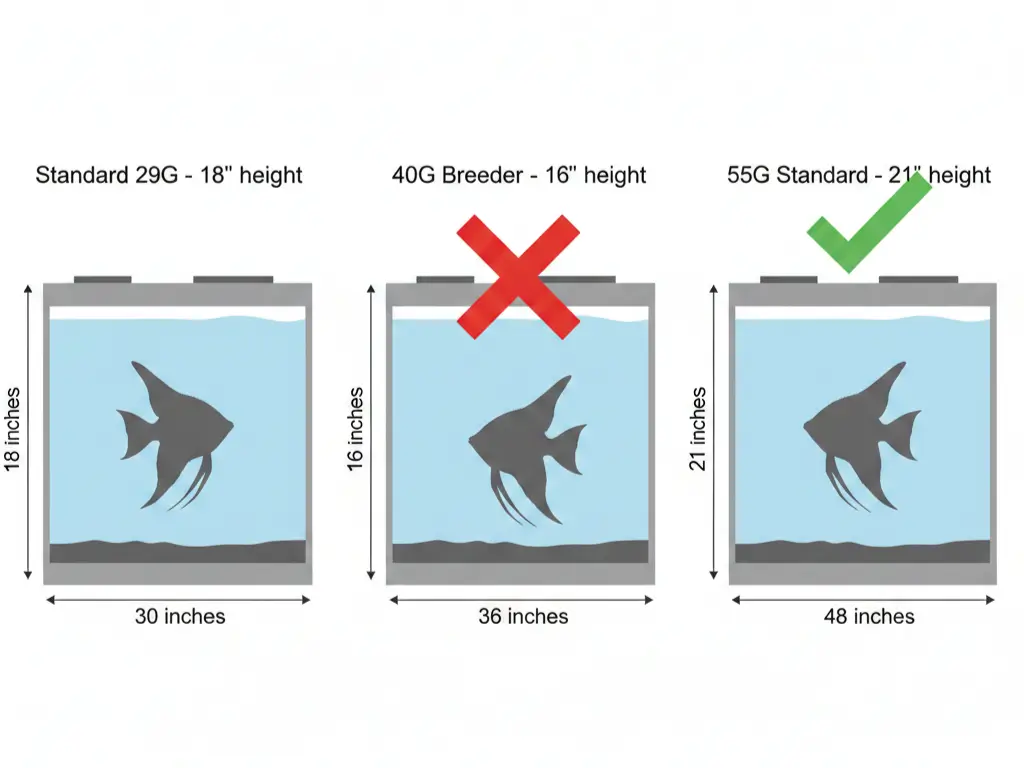
| 29-gal standard | 30″L × 12″W × 18″H | 14 months | Stress behaviors, fin damage |
| 40-gal breeder | 36″L × 18″W × 16″H | 8 months | Worse, too shallow for adult fins |
| 55-gal standard | 48″L × 13″W × 21″H | 3+ years | Success, adequate height |
| 75-gal | 48″L × 18″W × 21″H | Current | Optimal, breeding success |
| 20-gal hex | 18.5″ diameter × 24″H | 6 months | Surprisingly good for pair |
That 20-gallon hex outperformed the 40-gallon breeder. The 24-inch height let my pair’s fins extend fully. The breeder tank’s 16-inch height meant their dorsal and ventral fins touched substrate and surface simultaneously during normal swimming.
Constant contact created fin erosion I initially misdiagnosed as fin rot.
SPECIFICATIONS: Pterophyllum scalare
SCIENTIFIC: Pterophyllum scalare (Schultze, 1823)
COMMON NAMES: Freshwater angelfish, silver angelfish, common angelfish
PARAMETERS (Research-Based):
- Temperature: 76-84°F (24-29°C) ± 2° tolerance
- pH: 6.0-7.5 (optimal: 6.5-7.0)
- Hardness: 3-8 dGH / 50-140 ppm
- Ammonia/Nitrite: 0 ppm (non-negotiable)
- Nitrate: <20 ppm (optimal), <40 ppm (acceptable)
“I’ve successfully kept angelfish at pH 7.4 with stable KH, consistency matters more than chasing ‘ideal’ numbers. But I failed repeatedly at pH 7.8+ with unstable parameters.”
REQUIREMENTS:
- Minimum Tank Height: 18 inches (critical)
- Minimum Volume: 29 gallons for pair; 55+ gallons for group
- Recommended: 55+ gallons with 20″+ height for 4-6 fish
- Swimming: Moderate activity, vertical movement preferred
CARE REALITY CHECK:
Difficulty: Intermediate (not beginner despite common claims)
Beginner-Suitable: No, requires parameter stability and appropriate tankmates
Common Failure: Undersized tanks, incompatible tankmates, unstable pH
COSTS:
Initial: $8-15 per juvenile; $25-60 for quality adults/pairs
Monthly: ~$15-25 (quality food, water treatment)
Setup: $200-400 (appropriate tank, filtration, heating)
For your tank foundation, consider using quality aquasoil substrates that won’t affect your water chemistry unpredictably, or inert options like pool filter sand if you’re managing pH through other methods.
Water Parameters: What Actually Kills Angelfish
MYTH: “Angelfish need soft, acidic water between 6.0-6.5 pH.”
REALITY: Captive-bred angelfish (95%+ of hobby fish) adapt well to pH 6.5-7.5 if conditions remain stable. Wild-caught P. altum require stricter parameters, but you’d know if you bought those ($80+ per fish, specialty dealers only).
Early aquarium literature focused on wild-caught imports requiring conditions matching Amazon blackwater tributaries. Modern captive-bred angelfish have adapted over decades to harder, more alkaline water. The old advice persists because nobody updates it.
Test your tap water. If pH stays stable between 6.5-7.8 and hardness is below 12 dGH, work with what you have rather than constantly adjusting.
What actually killed my first angelfish wasn’t “wrong” parameters. It was parameter instability.
I was obsessively chasing pH 6.5 using products that worked temporarily, then crashed. Weekly swings from 6.4 to 7.2 stressed the fish more than stable 7.4 ever would. Once I stopped fighting my tap water and focused on consistency, problems disappeared.
Use a reliable API Master Test Kit and test weekly for the first few months. Track results. Look for patterns. If you need to modify water chemistry for specific breeding projects, understand GH and KH differences before adding anything.
Temperature matters more than most realize. I maintain 80°F (27°C) year-round using appropriately sized heaters, check our heater sizing guide if you’re unsure. Below 75°F, angelfish become sluggish and disease-susceptible. I learned this during a heater failure in February 2022 that dropped my tank to 72°F overnight. Lost two fish to ich that appeared within four days.
Tank Mates: The Compatibility Reality
This is where I’ve made the most expensive mistakes.
MYTH: “Angelfish are peaceful community fish compatible with most species.”
REALITY: Angelfish are semi-aggressive cichlids that will eat any fish small enough to fit in their mouths (roughly 1 inch or smaller at adult size) and may harass slower-moving or long-finned tankmates.
Juvenile angelfish sold at 1-2 inches are too small to eat typical community fish. They appear “peaceful” in store tanks. Problems emerge at 4-6 months when they grow, but buyers don’t connect the disappearing tetras to their “peaceful” angelfish.
Here’s what I’ve actually tested:
Works well:
- Corydoras catfish, bottom dwellers, ignored by angelfish
- Larger tetras like cardinal tetras (at 2+ inches, hit or miss)
- German blue rams, similar requirements, different territory levels
- Bristlenose plecos, sturdy algae control
- Kuhli loaches, nocturnal, stay hidden
Avoid entirely:
- Neon tetras, ember tetras, small rasboras (food items)
- Cherry shrimp and any dwarf shrimp (expensive snacks)
- Guppies, endlers (fin targets and food)
- Bettas (territorial conflict)
- Slow-moving gouramis (harassment)
Feeding for Health and Color
Angelfish are opportunistic omnivores. In the wild, they eat small fish, insects, crustaceans, and plant matter. In captivity, variety matters.
My feeding schedule (developed after watching color fade on pellet-only diets):
Daily rotation:
- High-quality cichlid flakes/pellets (base diet, 60% of feeding)
- Frozen bloodworms (2-3x weekly)
- Frozen brine shrimp (2-3x weekly)
- Blanched vegetables (zucchini, spinach, 1x weekly)
Adding spirulina-based foods noticeably intensified silver coloration within about three weeks. I wasn’t expecting diet to affect color that dramatically in non-“colorful” morphs.
One caution on overfeeding, angelfish beg constantly. Those puppy-dog eyes at the tank surface fool everyone. I feed once daily, enough that food is consumed within 2-3 minutes. Uneaten food crashes water quality fast, and angelfish are sensitive to nitrate spikes.
Tank Setup: Plants, Hardscape, and Territory
Angelfish need vertical structure. Period.
Bare tanks with nowhere to hide create stressed, aggressive fish. I’ve watched the same individuals shift from constant chasing to calm coexistence simply by adding tall plants and driftwood that broke sightlines.
What works:
- Tall background plants: Vallisneria creates excellent vertical cover
- Driftwood with height: Manzanita or spiderwood reaching toward surface
- Broad-leaf plants: Anubias on driftwood provides spawning sites
- Floating plants: Amazon frogbit diffuses lighting and adds security
The planted tank approach works beautifully with angelfish. They won’t eat or uproot most plants (unlike some cichlids), and vegetation creates the Amazon-tributary environment they evolved in. For comprehensive planted setup guidance including filtration and lighting, see our beginner planted tank guide.
Breeding: When Pairs Form
I haven’t covered breeding extensively because honestly, it happens whether you want it or not if you have healthy angelfish in good conditions.
My pair started spawning at about 14 months old. They chose a vertical Amazon sword leaf and defended a 20-inch radius around it against all tankmates, including a bristlenose pleco twice the female’s weight.
SETUP:
Tank: 75-gallon, 21″ height
Duration: 14 spawning events (March 2023-ongoing)
Method: Natural pair formation from group of 6
Parameters: 80°F, pH 7.2, 5 dGH
RESULTS:
Territory claimed: 18-24″ diameter around spawn site
Aggression level: High toward all tankmates during egg-guarding
Egg-to-fry: ~60 hours at 80°F
Fry survival (community tank): <5% due to predation
- The pair ate their first three batches of eggs. This is normal, new parents often fail initially.
- Don’t intervene too quickly. By batch four, parenting instincts kicked in.
- One pair, one tank, results vary significantly.
If you want to raise fry, you’ll need a separate tank and fry food cultures. Community tanks rarely produce surviving offspring.
Common Problems and Solutions
“My angelfish are fighting constantly.”
Usually a space or structure problem, not inherent aggression. Add vertical sightline breaks, remove the single most aggressive individual for 48 hours (disrupts hierarchy), or increase group size to 6+ to distribute aggression.
“Fins are ragged/eroding.”
Check water quality first (ammonia, nitrite, nitrate). If parameters are fine, consider fin-nipping tankmates or physical damage from decorations. Sharp plastic plants are a common culprit. Treat significant damage with clean water and consider salt therapy.
“Fish stopped eating.”
Stress indicator. Test all parameters. Check temperature stability. Review any recent changes (new fish, moved decorations, lighting schedule). Angelfish are sensitive to environmental shifts.
For disease treatment, especially ich outbreaks, act quickly, angelfish deteriorate faster than hardier species.
What I Wish I’d Known First
Start with a 55-gallon or larger. Yes, you can technically keep a pair in 29 gallons, but you’re creating problems you’ll spend months solving. The extra cost upfront saves frustration.
Buy six juveniles and let pairs form naturally. Trying to “pick” a pair rarely works. Angelfish choose their own partners. Once pairs establish, you can rehome the extras.
Test water weekly for the first year. These aren’t “hardy beginner fish” no matter what the pet store says. They need stable conditions, and you won’t know your tank’s stable until you’ve tracked it through seasons.
Accept that some tankmates will become food. If you want a true community tank with small schooling fish, angelfish probably aren’t your species. If you want intelligent, interactive fish with personality, and you’re okay with somewhat limited tankmate options, they’re fantastic.
I still have descendants of that second batch of angelfish. Watching the current pair spawn on the same piece of driftwood their grandparents chose feels like a small victory against my first disaster.