I used to think “Watts Per Gallon” was the law. I was wrong.
In 2018, I spent $400 on a high-end LED fixture because the box promised “maximum brightness.” Three weeks later, my tank looked like a bowl of pea soup. I had triggered a massive algae bloom, melted my Cryptocorynes, and my “high light” plants were still dying. Why? Because brightness (Lumens) is for human eyes. PAR is for plants. And I had no idea what I was doing.
Frustrated, I rented an Apogee MQ-510 quantum sensor, the gold standard for measuring light, and mapped my tank. The results were embarrassing. I wasn’t blasting my plants with too much light; I was blasting them with the wrong light at the wrong duration.
This isn’t just another generic lighting guide. This is the breakdown of what actually happens to light when it hits the water, supported by the data I collected.
What is PAR? (The Metric That Actually Matters)
First, we need to kill the “Watts per Gallon” rule. It died when we switched from T5 fluorescents to LEDs.
PAR (Photosynthetically Active Radiation) measures the specific light energy available for photosynthesis, counting photons between 400nm and 700nm. Unlike Lumens (brightness to humans) or Watts (energy consumption), PAR indicates exactly how much usable energy your plants receive.
The Magic Numbers:
- Low Light: 20-40 µmol/m²/s (Slow growth, easy maintenance)
- Medium Light: 40-80 µmol/m²/s (Moderate growth, CO2 recommended)
- High Light: 80-120+ µmol/m²/s (Fast growth, CO2 required)
Source: Apogee Instruments & Tom Barr (Barr Report), verified via personal testing 2024.
If you take nothing else from this article, remember this: A light that looks “dim” to you might be blasting high PAR in the red/blue spectrums plants love. A light that looks “bright” might be all green/yellow spectrum, useless to plants, but great for algae.
The Depth Problem: Why Your “High Light” LED is Failing
This is where I messed up my first Iwagumi stone layout. I bought a light rated for “High PAR,” slapped it on a 24-inch tall tank, and expected a lush carpet.
I got leggy, dying stems.
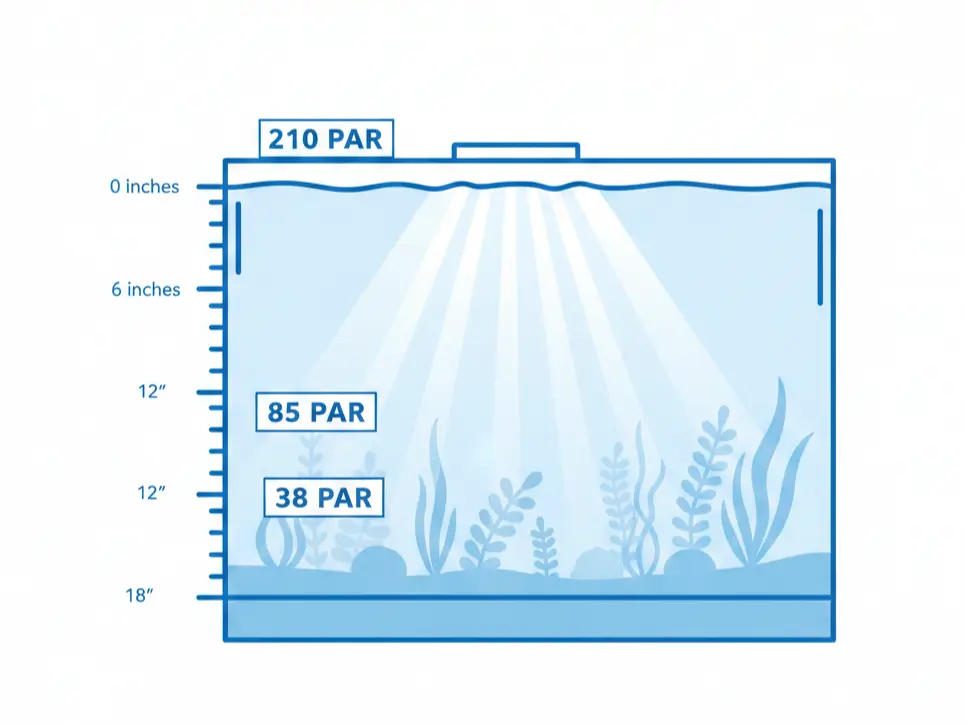
When I used the PAR meter, I found the problem. Light doesn’t travel through water like it travels through air. It crashes.
SETUP:
- Tank: 75-Gallon Standard (21″ height)
- Light: Popular 48″ RGB LED (100% intensity)
- Water: Crystal clear (fresh carbon)
RESULTS:
- Surface Level: 210 PAR (Blindingly high)
- 6 Inches Depth: 145 PAR
- 12 Inches Depth: 85 PAR (The “Medium” zone)
- Substrate (19″ Depth): 38 PAR (Low Light)
Glass lids cut another 15-20% of the PAR. My “High Tech” light was delivering “Low Tech” energy to my carpet plants.
If you want to grow a demanding Dwarf Baby Tears carpet, you don’t look at the manufacturer’s surface rating. You need to know the PAR at your specific depth.
PUR vs. PAR: The “Full Spectrum” Myth
Here is a contradiction that drove me crazy for months. I had two lights. One had a lower PAR reading but grew plants better. The other had higher PAR but grew algae.
The difference was PUR (Photosynthetically Usable Radiation).
MYTH: “Full Spectrum (White) LEDs are best for plants.”
REALITY: Plants primarily use Red (660nm) and Blue (450nm) wavelengths. Green light (which makes up a huge part of “white” LED output) is largely reflected, that’s why plants look green!
NASA’s research on crop production in controlled environments confirms that while full spectrum is necessary for plant morphology (shape), the driving force of growth is heavily weighted toward red/blue peaks.
When I switched to a light with tunable RGB channels and lowered the Green/White channel while boosting Red/Blue, my PAR reading dropped slightly, but my Rotala Rotundifolia red coloration exploded within 10 days.
How Much PAR Do You Actually Need?
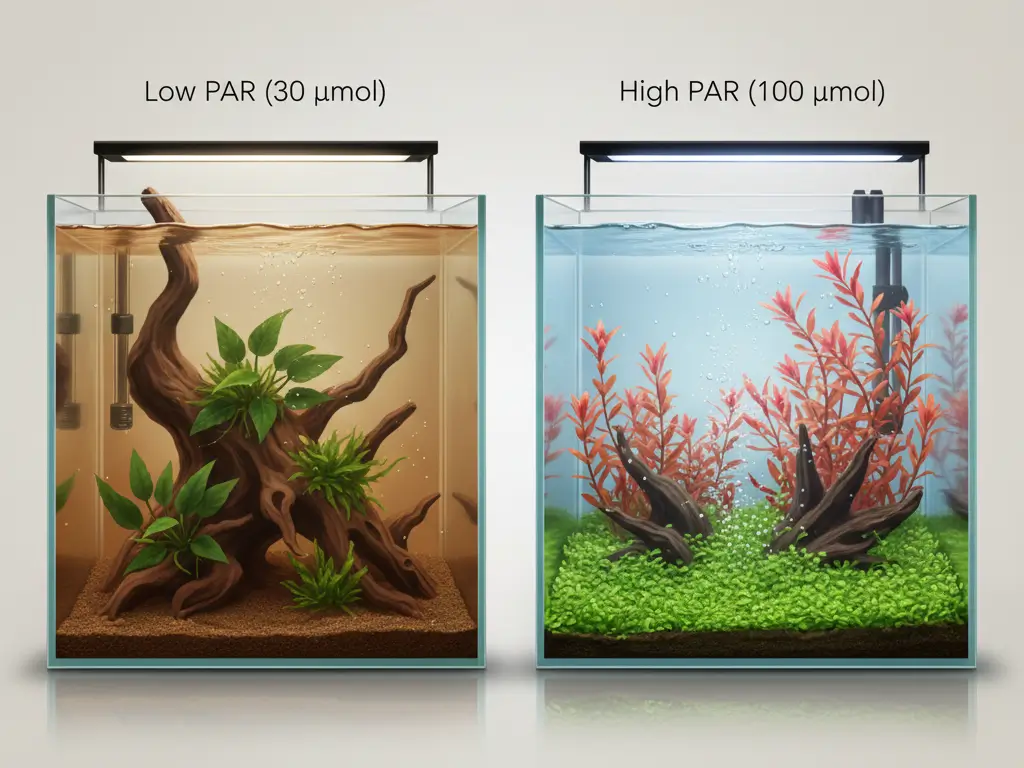
I’ve killed enough plants to tell you that “more” is not better. More is just faster. And faster is dangerous if you aren’t ready to drive the car.
Low Light Setup (20-40 PAR)
This is the sweet spot for 80% of hobbyists. You don’t need CO2 injection here.
- Best Plants: Anubias Nana Petite, Java Fern, Cryptocoryne.
- My Experience: I ran a low-light tank for 2 years with zero algae issues. I barely touched it.
- The Trap: People buy a cheap shop light. It works, but the color rendering (CRI) is usually terrible, making your fish look washed out.
Medium Light Setup (40-80 PAR)
This is the “Danger Zone.” You are right on the edge. If your nutrient balance slips, algae takes over.
- Best Plants: Ludwigia Repens Super Red, Monte Carlo (can carpet here slowly).
- My Experience: This is where I started using Liquid Carbon (Glutaraldehyde) to bridge the gap. It helps, but it’s not gas.
High Light Setup (80+ PAR)
If you aren’t injecting pressurized CO2, do not go here. I mean it.
- Best Plants: High-demand carpets, rare Bucephalandra varieties.
- My Experience: I tried High Light without CO2 once. I got Black Beard Algae so bad I had to bleach-dip my hardscape. Black Beard Algae treatment is a nightmare you want to avoid.
The “Siesta” Method: Does Split Photoperiod Work?
MYTH: “Splitting your light cycle (4 hours on, 4 off, 4 on) allows CO2 to recharge.”
REALITY: In a Low Tech setup, this actually works, but not for the reason people think.
It doesn’t “recharge CO2” significantly. What it does do is disrupt the photosynthesis cycle of algae, which is far less adaptable than complex plants. I tested this on a 20-gallon tank battling filamentous algae.
- Week 1-2 (Standard 8 hours): Algae growth constant.
- Week 3-4 (4 on / 4 off / 4 on): Algae growth halted. Plants continued slow growth.
However, for high-tech tanks? Don’t do it. You mess up the ramp-up time your plants need to maximize photosynthesis.
Equipment Comparison: Budget vs. High-End
Is a $200 light actually four times better than a $50 light?
[NICREW/Hyger] vs [Fluval/Chihiros]: REAL COMPARISON
| Factor | Budget Brand (Amazon Special) | High-End (App Controlled) | My Finding |
| PAR @ 18″ | ~45 µmol | ~95 µmol | Budget struggles with depth. |
| Spectrum | Mostly White/Blue | Tunable RGB | High-end makes red fish/plants POP. |
| Control | Simple Timer | Bluetooth App | Ramping (Sunrise/Sunset) prevents fish stress. |
| Longevity | ~2 years | 5+ years | My cheap lights usually fail at the capacitor. |
I ran a Budget light on my quarantine tank and a High-End Chihiros on my display. The plants grew in both. But the color? The budget tank looked yellow and washed out. The display tank looked like a 4K movie.
- Choose Budget if: You are growing Java Moss or Anubias and tank depth is under 18″.
- Choose High-End if: You want red plants to actually look red, or your tank is deeper than 18″.
The Role of CO2 and Flow
You cannot talk about PAR without talking about the other two legs of the tripod: CO2 and Nutrients.
Think of it this way: Light is the gas pedal. CO2 is the fuel. Nutrients are the engine oil.
If you stomp on the gas (High PAR) but have no fuel (Low CO2), the engine stalls (plants stop growing) and creates smoke (algae).
When I finally dialed in my Pressurized CO2 setup, I realized I could actually lower my lighting intensity. With stable CO2 (30ppm), plants photosynthesize so efficiently they don’t need to be blasted with radiation.
Common Mistake: People increase light to fix “slow growth.”
Solution: Usually, you need to check your flow and circulation. If the CO2 isn’t getting to the bottom leaves, adding more light just accelerates the deficiency.
Balancing Your Ecosystem
This brings me to the most important realization of my aquatic journey. We are not just “growing plants.” We are managing a biological machine.
When I started documenting my setups at Aquatics Pool Spa, I realized that the tanks I enjoyed the most weren’t the ones with the highest PAR numbers. They were the ones where the light was balanced perfectly with the bioload and maintenance schedule.
If you have 100 PAR at the substrate, you are signing a contract to trim plants twice a week and do 50% water changes. Are you ready for that?
Conclusion
Stop obsessing over having the “most powerful” light. High PAR is a liability, not an asset, unless you have the CO2 and nutrient regimen to back it up.
- Measure if you can. Rent a PAR meter or ask a local club.
- Respect the depth. If you have a tall tank, you need narrow lenses or higher wattage.
- Watch your plants. If leaves are turning green to brown/yellow, you might have too much light, not too little.
- Start low. Dim your LEDs to 50% and ramp up 5% per week.
Your plants will tell you what they need better than any manufacturer’s box ever could.