You know the feeling. You glance at your driftwood or filter outlet and see it, that dark, fuzzy tuft that looks like 5 o’clock shadow. Black Beard Algae (BBA). It clings so hard that if you try to pull it off a leaf, you’ll rip the leaf off before the algae lets go.
I spent six months in 2019 trying to scrub this stuff off Anubias with a toothbrush. Waste of time.
I eventually turned to chemical warfare: Seachem Flourish Excel. But my first attempt was a disaster. I followed a forum guide that said “just double dose the whole tank.” The result? The BBA turned red and died (yay), but I also melted my entire Jungle Val forest and lost three Crystal Red Shrimp overnight (nightmare).
There is a precise way to use liquid carbon products to kill BBA without nuking your ecosystem. It’s not about how much you pour in; it’s about how you apply it.
If you are looking for a complete resource on aquatic setups, from chemistry to livestock, Aquatics Pool Spa covers the broader spectrum of hobbyist knowledge, but right here, we are going to focus specifically on winning the war against BBA.
Here is the protocol I’ve refined over 15+ tanks to kill the algae while keeping the plants alive.
What Is Black Beard Algae (And Why Is It Hard to Kill?)
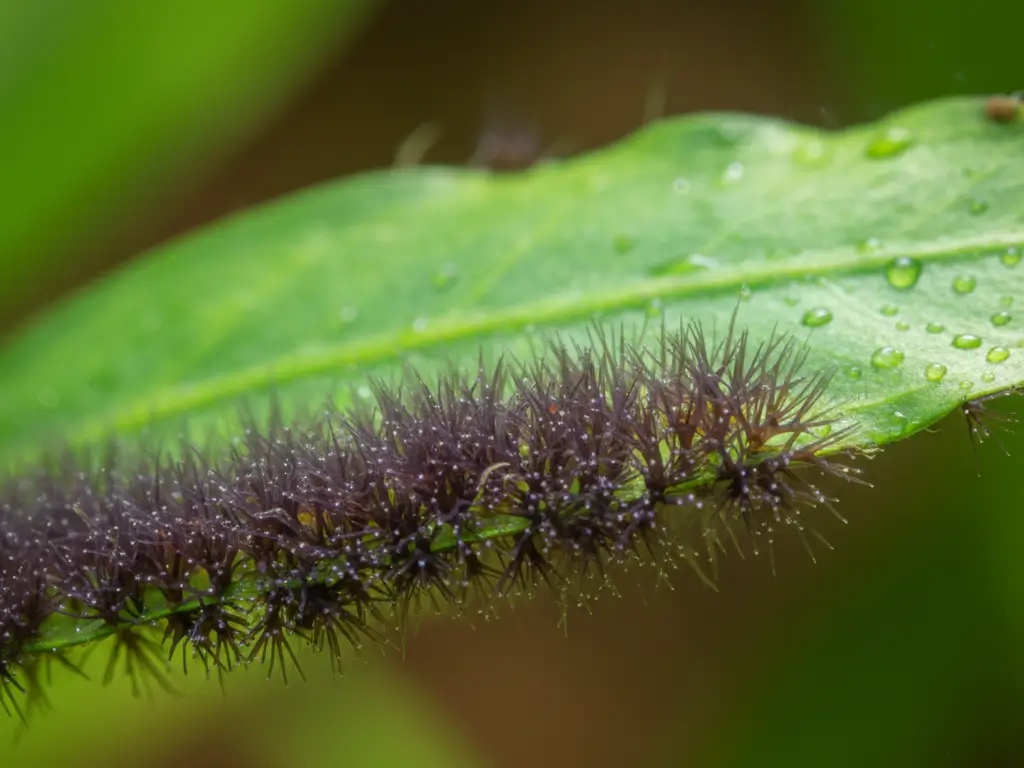
Black Beard Algae (BBA) is a species of red algae (Rhodophyta) characterized by dark, brush-like tufts that grow up to 3cm long. Unlike green algae, BBA contains distinct phycobiliproteins that allow it to photosynthesize in low-light and low-CO2 environments. It typically appears on slow-growing plant leaves, hardscape, and high-flow areas like filter outlets.
Most people think algae appears because of “too many nutrients.”
BBA is different.
In my experience, BBA is almost always a symptom of fluctuating CO2 levels. When your CO2 (carbon dioxide) isn’t stable, maybe your canister filter flow is clogged, or your pressurized CO2 runs out, BBA uses an enzyme called carbonic anhydrase to extract carbon from bicarbonates in the water. Plants can’t switch gears that fast. BBA wins.
That’s why we use Excel. It’s not just a fertilizer; it contains an isomer of glutaraldehyde, a biocide that breaks down the algae’s cellular structure.
The “Spot Treatment” vs. Water Column Dosing
Here is the mistake 90% of beginners make. They read the bottle, see “5ml per 60 gallons,” and dump a capful into the filter output.
Why this fails:
By the time that 5ml disperses through a 60-gallon tank, the concentration hitting the algae is negligible. You end up overdosing the fish while under-dosing the algae.
The Solution: Spot Treatment (Fogging)
I tested this side-by-side in two 20-gallon tanks.
- Tank A (Global Dosing): Standard dose dumped in water column daily. Result: BBA growth slowed, but didn’t die after 2 weeks.
- Tank B (Spot Treatment): Standard dose applied directly to algae with a pipette (filters off). Result: BBA turned red (dying) in 3 days.
Stop treating the water. Treat the problem.
Seachem Flourish Excel Dosage & Safety Chart
Before you pick up a pipette, you need to respect this chemical. Glutaraldehyde is a reducing agent, it consumes oxygen as it degrades. If you overdose, your fish don’t die from the chemical; they suffocate.
SPECIFICATIONS: Excel / Glutaraldehyde Safety
ACTIVE INGREDIENT: Polycycloglutaracetal (Glutaraldehyde isomer)
STANDARD DOSE: 5ml per 60 gallons (200L) daily or every other day.
INITIAL DOSE: 5ml per 10 gallons (40L) only after >40% water change.
SENSITIVE SPECIES WARNING:
- Plants: Vallisneria spiralis (Jungle Val), Egeria densa (Anacharis), Subwassertang, some Cryptocoryne species.
- Livestock: Crystal Red Shrimp, high-grade Caridina, sensitive fry.
“I have safely used 2x dosage in tanks with Cherry Shrimp, but Crystal Reds showed stress (lethargy) at 1.5x dosage. Never double dose if you have Vals, they will melt to the crown within 48 hours.”
The 14-Day BBA Eradication Protocol
This is the method I use. It requires patience. If you rush and dump half the bottle in, you will crash your cycle.
Equipment Needed:
- Seachem Flourish Excel (or generic Glutaraldehyde 1.5% solution)
- A 5ml or 10ml syringe/pipette (medicine droppers work)
- Cleaning Glass Algae Scraper (for later)
Days 1-3: The “Fogging” Phase
- Turn off all filters and powerheads. You want the water completely still.
- Draw up your standard daily dose (e.g., 2.5ml for a 29-gallon tank). Do not exceed the standard dose yet.
- Put your hand in the tank and target the worst patches of BBA.
- Slowly squirt the Excel directly onto the tufts. You want a “fog” of heavy liquid to settle on the algae.
- Wait 15-20 minutes with pumps off. This gives the chemical time to penetrate the cell walls.
- Turn filters back on.
Note: If you have Manzanita Driftwood covered in BBA, treat one section at a time. Don’t try to do the whole log in one day.
Days 4-7: Observation & Chemistry
By Day 4, the black tufts should turn a rusty pink, red, or white color. This is the victory signal. Dead red algae turns red (ironic, right?).
If the BBA is still jet black, your flow was likely too strong during treatment, or you didn’t apply directly enough.
Crucial Step: Increase surface agitation. As the algae dies and the Excel breaks down, oxygen levels drop. Raise your lily pipe or add an airstone.
Days 8-14: The Cleanup Crew
Once the algae is red/white, it is dead and softer. Now the cleanup crew can actually eat it. Live BBA is unpalatable to most fish, but dead BBA is a snack.
- Siamese Algae Eaters (Crossocheilus oblongus): The undisputed kings of eating BBA, especially once it’s weakened.
- Amano Shrimp: They will pick at the dying remnants.
- Manual Removal: Use a siphon to suck up the decaying tufts so they don’t rot and spike your ammonia.
Myth vs. Reality: Liquid Carbon
We need to clear something up because the marketing is confusing.
MYTH: “Excel is a replacement for pressurized CO2 injection.”
REALITY: Excel provides an intermediate carbon source that is significantly harder for plants to utilize than gaseous CO2.
It does provide carbon chains plants can use, so it’s better than nothing. But its primary benefit in BBA battles is as an algaecide, not a fertilizer.
Use Excel to kill algae and support growth in low-tech tanks. Do not expect it to carpet Dwarf Baby Tears without real CO2.
Troubleshooting: “I Treated It, But It Came Back”
This is the part that frustrates everyone. You nuked the tank, the BBA died, you felt like a wizard. Three weeks later… the fuzz returns.
Why? Because you treated the symptom, not the disease.
BBA thrives in:
- Fluctuating CO2: If you use a DIY yeast CO2 system that spikes and drops, you are rolling out the red carpet for BBA.
- High Organics: Dirty filters.
- High Flow + Low CO2: BBA loves filter outlets because it gets a constant stream of nutrients, even if the CO2 is low.
The Long-Term Fix:
After the Excel treatment, you must stabilize your parameters. If you are running a Low Tech Setup, stop messing with the water chemistry constantly. Consistency beats perfection.
I realized my BBA kept returning on my Anubias Nana Petite because I was forgetting to top off my tank, causing the spray bar to splash too much, gassing off all my CO2. Once I fixed my auto-top-off system, the BBA stopped returning after treatment.
Excel vs. Hydrogen Peroxide (H2O2)
I’ve tested both. Hydrogen Peroxide (3%) is cheaper, but Excel is safer for beginners if you respect the dose.
| Factor | Seachem Excel | Hydrogen Peroxide (3%) | My Finding |
| Cost | High ($15/bottle) | Low ($1/bottle) | H2O2 is virtually free. |
| Residue | Breaks down to CO2 | Breaks down to H2O + O2 | H2O2 increases Oxygen. |
| Risk | O2 Depletion | Burns Fish Gills/Bacteria | H2O2 is more dangerous to filter bacteria. |
| Effectiveness | 8/10 (Slower) | 10/10 (Instant) | H2O2 sizzles instantly; Excel takes days. |
“I use Peroxide for hardscape removal (rocks/wood) outside the tank or during water changes. I use Excel for in-tank treatment on plants. Peroxide is too harsh for delicate leaves like Cryptocoryne Wendtii.”
- Choose Excel if: Treating plants inside the tank.
- Choose Peroxide if: Treating rocks/wood during a water change (drain water, spray rocks, wait 5 mins, refill).
━━━━━━━━━━━━━━━━━━━━━━━━━━━
Can You Use “Metricide” Instead?
Yes, but be careful.
“Metricide 14” is a cheaper source of glutaraldehyde marketed for sterilizing medical instruments. It is roughly twice the concentration (2.6%) of Seachem Excel (~1.5%).
If you use Metricide to save money (I do this on my larger 75-gallon tanks), you must dilute it 50/50 with water or dose exactly half the amount. I learned this the hard way when I burned the tips off my Rotala Rotundifolia by dosing raw Metricide at Excel volumes.
Final Thoughts
Treating Black Beard Algae with Excel is effective, but it’s a bandage. The cure is ecosystem balance.
Start with the 14-day spot treatment protocol. Watch the algae turn red. Let your cleanup crew handle the rest. But while that’s happening, check your filter flow, clean your mechanical media, and stabilize your CO2.
Don’t let the “furry rock” win. You’ve got the chemistry; now you just need the patience.