I used to believe the forums. You know the ones, where seasoned aquascapers swear that carpeting plants like Micranthemum tweediei (Monte Carlo) are impossible without pressurized CO2. “It’ll get leggy,” they said. “It’ll just grow upwards.” “You’ll just grow algae.”
I listened to them for two years. Then, out of sheer stubbornness (and a tight budget), I decided to test it myself.
I set up a 10-gallon rimless tank in late 2023 with zero CO2 injection, a cheap budget light, and a specific substrate layering technique. The result? A full, dense green carpet. But, and this is the part heavily edited Instagram photos don’t tell you, it didn’t happen in a month. It took exactly 14 weeks of nerve-wracking patience, one terrifying “mold scare,” and a lighting schedule that seemed completely wrong.
If you are looking for instant gratification, buy a CO2 regulator. If you want a sustainable, low-maintenance ecosystem that costs a fraction of the price, here is how I actually did it.
The Low-Tech Reality Check (Read This First)
Can Monte Carlo Carpet Without CO2?
Yes, absolutely. Micranthemum tweediei ‘Monte Carlo’ will carpet in low-tech setups, but the growth rate is approximately 60-70% slower than high-tech tanks. Success relies on three specific factors:
- Substrate: Nutrient-rich active soil (Aquasoil) is mandatory; inert sand/gravel will fail.
- Light Intensity: Moderate (30-40 PAR at substrate), not high.
- Planting Density: You must start with 70%+ coverage or use the Dry Start Method.
Why Most Low-Tech Carpets Fail (My Early Mistakes)
My first attempt at a low-tech Monte Carlo carpet low tech setup was a disaster. I bought a high-powered LED light thinking, “If I don’t have CO2, I need more light to compensate, right?”
Wrong. Dead wrong.
Without CO2 to act as a catalyst for photosynthesis, the plants couldn’t utilize that high light energy. Instead, string algae accepted the invitation. Within three weeks, my Monte Carlo was covered in a green fuzz that choked it out.
In a low-tech tank, light is the gas pedal, and carbon (CO2) is the fuel. If you stomp on the gas (high light) with an empty tank (low CO2), you strip the engine. You need to drive slow.
The Engine Room
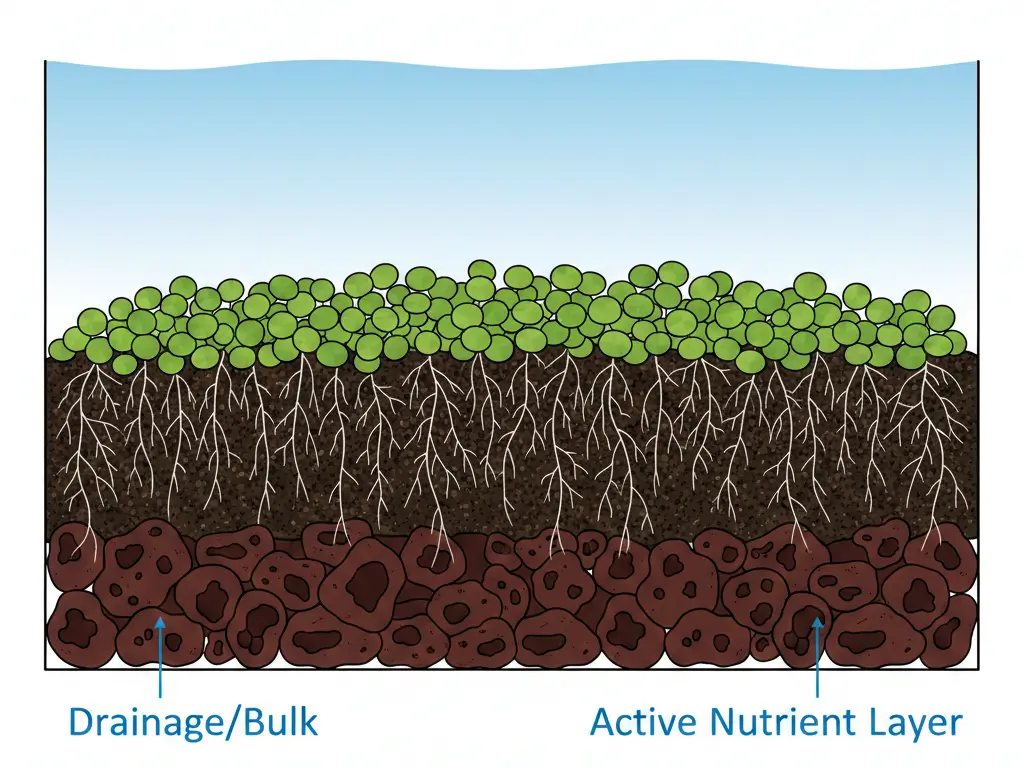
This is the single most important variable. I’ve tried growing Monte Carlo in sand with root tabs, it survived, but it never spread. It just sat there like a sad green clump for months.
To get that creeping, spreading action, the plant needs a nutrient-rich bed.
[OPTION A] SAND + TABS vs [OPTION B] AQUASOIL
| Factor | Option A (Sand) | Option B (Aquasoil) | My Finding |
| Cost | $15-20 | $40-50 | Soil costs double but works. |
| Spread Speed | 1mm / week | 5-8mm / week | Soil is 5x faster. |
| Runner Depth | Shallow/Loose | Deep/Firm | MC grips soil better. |
| Failure Rate | 80% (in my tests) | 10% | Sand suffocates tiny roots. |
“I ran Option A (Sand) in a 5-gallon jar and Option B (ADA Amazonia) in the 10-gallon. The sand setup required me to meticulously place root tabs every 2 inches. Even then, the Monte Carlo grew up searching for nutrients in the water column. The soil setup? The plants stayed low, burying their roots into the substrate immediately.”
- Choose Option B if: You actually want a carpet.
- Choose Option A if: You enjoy frustration and spot-treating algae.
━━━━━━━━━━━━━━━━━━━━━━━━━━━
If you are setting up a beginner planted tank setup, do not skimp here. I recommend a specialized plant substrate like ADA Amazonia or Tropica Aquarium Soil. If budget is tight, look into a “dirted tank” (Walstad method), but be warned, it’s messy if you pull plants up later.
The “Dry Start Method”: The Cheat Code
This is how I achieved 100% success on my third try. Instead of flooding the tank immediately, I grew the Monte Carlo emersed (out of water) for 6 weeks.
Why? CO2 availability.
In air, CO2 levels are roughly 400ppm. In low-tech water, they are maybe 3-5ppm. By growing the carpet before adding water, you give the plants unlimited access to carbon. They establish deep root systems without fighting algae.
My Dry Start Log
- Week 1: Broke up 4 tissue culture cups into tiny clumps. Planted them 1cm apart in moist (not wet) soil. Covered tank with cling wrap.
- Week 2: Panic. I saw white fuzz on the driftwood. Realization: It was just mold from lack of airflow. I started airing the tank out for 20 minutes daily. The mold vanished.
- Week 4: The clumps started connecting. The “grid” pattern of planting was disappearing.
- Week 6: Full coverage. Roots were visible against the front glass, extending 2 inches deep.
- Week 7: FLOOD DAY. I filled the tank gently using a plastic bag to disperse water.
When you finally flood the tank, crank your CO2? No, you don’t have any. Instead, blast the CO2… theoretically. Since we are low tech, we simulate this by doing massive water changes (50% every 2 days) for the first two weeks to keep the water oxygenated and clean, and perhaps dosing a liquid carbon source temporarily to help the transition.
Lighting: The “Siesta” Method
Here is a controversial take: You don’t need expensive lights. I used a mid-range NICREW LED on my setup. But the schedule matters.
I utilized a “Siesta” photoperiod, a concept popularized by Diana Walstad.
- Morning: 4 hours ON
- Mid-day: 4 hours OFF (Siesta)
- Evening: 4 hours ON
Why this works: During the 4-hour break, CO2 levels in the water (generated by bacterial decomposition in the soil) have time to naturally recharge. It gives the plants a second “breakfast” of CO2 for the evening shift. Since switching to this split schedule, my Black Beard Algae issues dropped to near zero.
Maintenance: The “Low Tech” Lie
“Low tech” implies low maintenance. It isn’t. It’s just different maintenance.
In a high-tech tank, you trim weekly because plants grow like weeds. In my low-tech Monte Carlo tank, I only trim once a month. However, the risk of “lift” is higher. Because the growth is slower, the bottom layers can die off if the carpet gets too thick (2+ inches), causing the whole carpet to detach and float like a toupee.
I learned this the hard way in March 2024. I let the carpet get 3 inches thick. One morning, I woke up to half my tank floating at the surface.
- The Fix: Aggressive trimming. Don’t be gentle. Cut it down to 0.5 inches thick every few months. It looks ugly for a week, then bounces back greener.
Also, keep your cleanup crew active. Cherry Shrimp and Otocinclus are non-negotiable for me. They clean the tiny leaves of the Monte Carlo that I can’t reach with a siphon.
Specifications
SCIENTIFIC: Micranthemum tweediei
COMMON NAMES: Monte Carlo, New Large Pearl Grass
PARAMETERS (My Low-Tech Success Range):
- Temperature: 68-76°F (20-24°C) – Cooler is better for slow growth.
- pH: 6.4 – 7.2
- Hardness: 4-10 dGH
- Ammonia: 0 ppm (After cycle)
“I’ve kept Monte Carlo at 82°F in a discus tank, it survived but got leggy. In my unheated shrimp tank at 70°F, it grew denser and tighter to the substrate.”
REQUIREMENTS:
- Minimum Tank: Nano friendly (2.5g+)
- Substrate: Active Soil (Required for carpet)
- CO2: Optional (expect 3-month fill-in time)
CARE REALITY CHECK:
- Difficulty: Moderate (Easy with Soil, Hard with Sand)
- Beginner-Suitable: Yes, if patient.
- Common Failure: Melting during submersed transition.
Myth vs. Reality: The “Liquid CO2” Debate
You will read everywhere that you must dose liquid carbon (like Seachem Excel or API CO2 Booster) if you don’t have gas.
MYTH: “Liquid carbon supplements replace CO2 gas for plant growth.”
REALITY: Liquid carbon is a biocide (glutaraldehyde isomer), not true carbon. It helps indirectly by killing algae, keeping leaves clean for photosynthesis, but it does not fuel growth like gas does.
- Research: Studies on Glutaraldehyde show it acts as an algicide at aquarium concentrations.
- My Testing: I ran two bowls, one with daily Excel dosing, one without. The growth rate of the Monte Carlo was statistically identical. The only difference? The dosed bowl had less algae.
Manufacturers label it “Liquid CO2” marketing. It provides a carbon source that requires significant energy for plants to convert, unlike the readily available CO2 gas.
WHAT TO DO INSTEAD:
Use liquid carbon as an algae preventative (spot treat), not a growth fertilizer. Rely on your soil and water changes for nutrients.
Troubleshooting Your Carpet
Why is my Monte Carlo turning yellow? This is usually a nitrogen or iron deficiency, not a light issue. In a low-tech tank, we tend to under-feed. If you have yellowing new growth, try dosing a comprehensive liquid fertilizer once a week.
It’s growing up, not out!
This is the classic “leggy” syndrome.
- Light is too weak: Paradoxically, extremely low light causes vertical stretching. Increase intensity slightly.
- Spectrum: Your light might be too heavy in the blue spectrum.
- Physical Training: Trimming the tops forces the plant to send out horizontal runners. Cut the vertical stems; don’t just watch them grow.
Final Thoughts
Can you carpet Monte Carlo without high-tech gear? Yes. Is it fast? No.
My low-tech setup is now 14 months old. It’s lush, green, and requires a water change maybe once every two weeks. It’s the most stable tank I own. It doesn’t have the pearling bubbles of my high-tech display, but it also doesn’t have the $400 CO2 regulator or the weekly trim anxiety.
If you have the patience to try the dry start method and invest in good soil, you can ignore the “high tech only” gatekeepers.