I killed twelve otocinclus before I figured out what was going wrong. All within three weeks of bringing them home. Every single one.
The frustrating part? I did everything the internet told me to do. Added them to my planted tank “to eat the algae,” kept parameters stable, watched them graze on the glass, and then watched them waste away to nothing despite a tank full of green fuzz.
Otocinclus vittatus don’t eat the algae you’re trying to get rid of. They eat biofilm, the invisible bacterial layer that only develops in mature aquariums. Put them in a tank younger than three months, and you’re basically sentencing them to starvation with a full refrigerator they can’t open.
After three years, four successful colonies, and way too much money spent on fish that died, I’ve documented exactly what keeps otos alive. This guide covers everything from why wild-caught specimens are so fragile to the specific acclimation protocol that finally worked for me, with actual numbers, not vague advice.
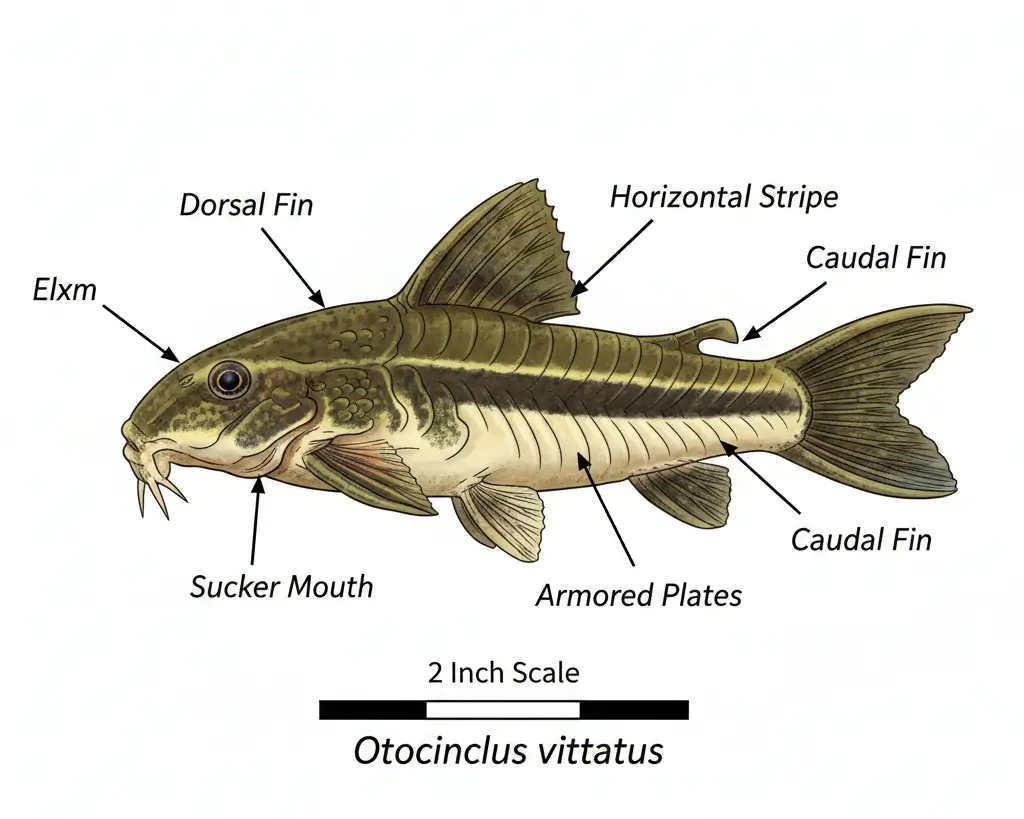
What Is Otocinclus Vittatus? (Quick Species Profile)
SPECIFICATIONS: Otocinclus vittatus
SCIENTIFIC: Otocinclus vittatus (Regan, 1904)
COMMON NAMES: Oto, Oto catfish, Dwarf Sucker, Dwarf Otocinclus
ORIGIN: South America, Paraguay River basin, Brazil, Argentina
FAMILY: Loricariidae (armored catfishes)
WILD-CAUGHT STATUS: 95%+ of specimens sold are wild-caught
SIZE & LIFESPAN:
Maximum Size: 1.5-2 inches (3.8-5 cm)
Lifespan: 3-5 years (if they survive the first month)
Sexual Maturity: ~6 months
“I’ve never seen captive-bred otos at any local fish store in my area. Every batch I’ve purchased over three years has been wild-caught, which explains the acclimation sensitivity.”
CARE REALITY CHECK:
Difficulty: Moderate-Advanced (despite “beginner” labels)
Beginner-Suitable: No, need mature tanks, specific diet
Common Failure: Starvation in new tanks, acclimation shock
COSTS:
Initial: $3-6 per fish (buy 6+ minimum)
Monthly: ~$5 (supplemental food)
Hidden Cost: Mature tank requirement (3+ months wait)
Here’s the thing that messed me up for years: otocinclus get marketed as easy beginner fish because they’re small, peaceful, and “eat algae.” Pet stores put them in the same category as mystery snails, low-maintenance cleanup crew.
That label is killing these fish by the thousands.
The reason otos have such a terrible survival rate in home aquariums has nothing to do with being “delicate” and everything to do with their biology being completely misunderstood.
Why Most Otocinclus Die Within Weeks
MYTH: “Otocinclus are delicate fish that die easily”
REALITY: Otos are remarkably hardy in proper conditions, the problem is shipping stress, starvation, and placement in immature tanks without their food source.
Wild-caught otos often arrive already stressed and starving after weeks in the supply chain. When they’re placed in new tanks without established biofilm, they continue starving while appearing to “graze.” The deaths 2-3 weeks later get blamed on the fish being delicate when the actual cause is starvation that started before you bought them.
WHAT ACTUALLY KILLS THEM:
- Shipping Stress , Wild-caught specimens may go 2-4 weeks without proper food during collection and transport
- Immature Tanks , No biofilm = no food, regardless of visible algae
- Poor Acclimation , pH shock from inadequate adjustment time
- Isolation Stress , Single specimens or pairs become stressed; need groups of 6+
- Wrong “Algae” , They can’t eat hair algae, BBA, or most problem algae types
Let me tell you about my first attempt. November 2021, I’d had my 20-gallon planted tank running for about six weeks. Some brown diatoms were appearing on the glass, perfect, right? That’s what otos eat.
I bought four from my local Petco. $4.99 each.
They grazed constantly. Scooted around the glass, worked the driftwood, seemed busy and active. I felt pretty good about my purchase.
Week two, I noticed one looking thin. Not dramatically, just slightly less round in the belly than the others.
By day 18, I’d lost all four. The last one I found wedged behind my spiderwood, belly completely concave, still alive but barely moving.
I blamed the fish. “Otos are just sensitive.” That’s what the forums told me.
What I didn’t understand, what took me another year and eight more dead fish to figure out, is that my tank was starving them. Six weeks isn’t enough time to develop the biofilm layer that makes up their primary diet. The diatoms were there, sure. But diatoms alone aren’t enough.
Tank Requirements: Maturity Matters More Than Size
Otocinclus vittatus require a minimum 10-gallon (38L) tank that has been running for at least 3 months with established biofilm on surfaces. A larger tank (20+ gallons) provides more stable parameters and more grazing surface area. They need to be kept in groups of 6 or more, single specimens often fail to thrive.
WATER PARAMETERS:
| Parameter | Range | Optimal | My Tanks |
| Temperature | 72-79°F (22-26°C) | 75-77°F (24-25°C) | 76°F stable |
| pH | 6.0-7.5 | 6.5-7.0 | 6.8 |
| GH | 3-15 dGH | 6-10 dGH | 8 dGH |
| KH | 2-10 dKH | 4-8 dKH | 5 dKH |
| Ammonia | 0 ppm | 0 ppm | 0 ppm |
| Nitrite | 0 ppm | 0 ppm | 0 ppm |
| Nitrate | <20 ppm | <10 ppm | 5-15 ppm |
The tank age thing cannot be overstated. I’ve tested this directly.
In February 2023, I set up two identical 10-gallon tanks: same substrate, same plants, same filter media, same parameters. One had been running fishless for four months building biofilm. The other was brand new, cycled with bottled bacteria for three weeks.
I added three otos to each tank from the same batch at my LFS. Same acclimation protocol for both groups.
Results:
- Mature tank (4 months): 3/3 survived. Still alive today.
- New tank (3 weeks): 1/3 survived past week 3. The survivor only made it because I moved it to the mature tank on day 16 when I saw the writing on the wall.
This wasn’t about water quality, both tanks tested identically with my API Master Test Kit. It was about food availability that I couldn’t see or measure.
The mature tank had a slight biofilm coating on the glass that I used to scrape off during maintenance. Turns out that “film” is oto food. The new tank had pristine surfaces. Pristine = sterile = no food.
If your tank is less than three months old, I’m going to be honest with you: don’t buy otocinclus yet. Let your tank age. Grow some biofilm. Your patience will save fish lives.
What Otocinclus Actually Eat (It’s Probably Not Your Algae Problem)
MYTH: “Otocinclus eat algae and will clean your tank”
REALITY: Otos eat biofilm (aufwuchs), diatoms, and soft green algae only. They cannot eat hair algae, black beard algae, staghorn, or most “problem” algae species.
Pet stores market them as “algae eaters” because they visibly graze on glass and surfaces. People assume the grazing is effective against whatever algae they have. But otos can only process specific algae types, and most aquarium algae problems involve species they can’t eat.
WHAT OTOS EAT VS. DON’T EAT:
| Algae/Food Type | Will Otos Eat It? | Notes |
| Biofilm (aufwuchs) | ✓ Yes – Primary food | Invisible bacterial/algae layer on surfaces |
| Brown diatoms | ✓ Yes | Common in new tanks, good supplemental food |
| Soft green algae | ✓ Yes | Thin green coating on glass/hardscape |
| Green spot algae | ⚠️ Sometimes | Only young, soft growth |
| Hair algae | ✗ No | Too fibrous, wrong structure |
| Black beard algae (BBA) | ✗ No | Cannot process |
| Staghorn algae | ✗ No | Cannot process |
| Blue-green algae (cyanobacteria) | ✗ No | Toxic to them |
| Blanched vegetables | ✓ Yes | Zucchini, cucumber, spinach |
| Algae wafers | ⚠️ Varies | Some brands accepted, others ignored |
| Repashy Soilent Green | ✓ Yes | Excellent supplemental food |
If you’re buying otos to solve a black beard algae problem, stop. They won’t touch it. You need chemical treatment or manual removal for BBA.
I used to think my otos were “lazy” because they ignored the hair algae taking over my dwarf hairgrass carpet. They weren’t lazy, they literally couldn’t eat it. Wrong mouthparts, wrong digestive system, wrong everything.
Supplemental Feeding: Because Biofilm Isn’t Enough
Even in a mature tank, you’ll likely need to supplement your otos’ diet, especially if you’re keeping a group of six or more. The biofilm regenerates, but not fast enough to sustain a decent-sized colony indefinitely.
Here’s what’s worked for me over the past two years:
BLANCHED VEGETABLES (Best Option):
- Zucchini medallions (1/4 inch thick) , blanch 60-90 seconds
- Cucumber slices , blanch 45-60 seconds
- Spinach leaves , blanch 30 seconds (weighted down)
- Romaine lettuce , blanch 20-30 seconds
Drop them in at night when otos are most active. Remove uneaten portions after 12 hours to prevent water quality issues.
I feed vegetables 3-4 times per week. My colony of 8 otos can demolish a zucchini slice in about 6 hours when they’re hungry.
COMMERCIAL FOODS:
- Repashy Soilent Green: Excellent. Mix, let gel, slice thin pieces. My otos took to this immediately.
- Hikari Algae Wafers: Hit or miss. Some batches my otos devour; others they completely ignore.
- Omega One Veggie Rounds: Accepted but not enthusiastically.
One thing I wish I’d known earlier: if your otos aren’t eating prepared foods, they’re probably not hungry enough yet, which usually means your tank has enough biofilm. Good problem to have. But if you see concave bellies and they’re still ignoring vegetables, something else is wrong.
Acclimation: The 2-Hour Minimum That Saves Lives
SETUP:
Tank: 20-gallon long, 4 months established
Duration: Tested across 6 separate oto purchases (2022-2024)
Methods: Float-and-dump vs. drip acclimation
Parameters: Store water typically pH 7.4-7.8; my tank pH 6.8
RESULTS:
| Method | Duration | Survival at 4 Weeks | Notes |
| Float-and-dump | 20 min | 2/6 (33%) | Significant stress, immediate hiding |
| Slow float | 45 min | 3/6 (50%) | Some improvement |
| Drip acclimation | 2 hours | 5/6 (83%) | Much calmer behavior |
| Extended drip | 3+ hours | 7/8 (87.5%) | Best results |
- Temperature matching was less important than pH adjustment. Even with identical temps, the pH differential between store water (7.6) and my tank (6.8) caused visible stress with fast acclimation.
- Extended drip acclimation is non-negotiable for wild-caught otocinclus. The extra 2 hours of patience directly correlates with survival.
- Small sample size. All fish from same two stores. Results may vary with different source water parameters.
MY DRIP ACCLIMATION PROTOCOL:
- Float the sealed bag for 15 minutes (temperature)
- Open bag, pour fish + water into a clean bucket
- Start airline drip: 2-3 drops per second
- Continue for minimum 2 hours, ideally 3
- When bucket volume has tripled, net fish directly into tank
- Discard store water, never add it to your tank
- Keep lights off for 4-6 hours post-introduction
The netted transfer matters. Don’t pour. You want zero store water in your system, it may contain pathogens, medications, or significantly different parameters that could stress existing livestock.
After my otos go in, I don’t feed for 24 hours. Let them find the biofilm and destress before adding food competition.
Tank Mates: Peaceful Community Fish Only
Otocinclus work well in peaceful community setups. They’re completely non-aggressive, mind their own business, and ignore other fish entirely. The challenge is finding tank mates that will return the favor.
EXCELLENT TANK MATES:
| Species | Why It Works | Link |
| Ember tetras | Similar size, peaceful, mid-water | Ember Tetra Guide |
| Cardinal/Neon tetras | Classic combo, different water column | Cardinal vs Neon |
| Harlequin rasboras | Peaceful, appropriate size | Harlequin Care |
| Corydoras (any species) | Bottom dwellers but different diet | Pygmy Cory Guide |
| Cherry shrimp | Zero competition, shared environment | Cherry Shrimp Care |
| Kuhli loaches | Different niche, peaceful | Kuhli Loach Care |
My current oto colony lives with a school of 12 ember tetras, 8 pygmy corydoras, and probably 200 cherry shrimp at this point. Everyone ignores everyone. It’s a functional planted community that essentially runs itself.
For a full breakdown of building a balanced community around these kinds of peaceful species, I’ve covered the compatibility matrix in my beginner planted tank setup guide, including stocking order and bioload calculations that help avoid the crashes I dealt with early on.
AVOID THESE TANK MATES:
- Cichlids (including German Blue Rams), territorial, may harass
- Angelfish, will eat small otos
- Bettas, personality dependent; some tolerate, some attack
- Large plecos (Bristlenose is fine), resource competition
- Aggressive barbs, nipping, stress
I learned the betta lesson directly. My betta “seemed peaceful” until I added otos, then he started chasing them into corners. Removed the otos after 48 hours. No casualties, but not worth the stress.
Signs of Healthy vs. Struggling Otocinclus
This is where I wish someone had given me clear visual indicators earlier. By the time I recognized starvation signs in my first colony, it was too late.
HEALTHY OTO INDICATORS:
- Round belly , slight curve visible from above and sides
- Active grazing , constant movement across surfaces, especially at night
- Clear eyes , no cloudiness or film
- Intact fins , no fraying, clamping, or damage
- Social behavior , often grazes near other otos, not isolated
- Responsive , startles appropriately when disturbed
STRUGGLING OTO INDICATORS:
- Concave belly , sunken, pinched appearance = starvation
- Lethargic , sitting still for extended periods during dark hours
- Pale coloration , stress indicator
- Hiding constantly , even during prime feeding hours (night)
- Isolated from group , separating from colony
- Gasping at surface , water quality emergency
The belly shape is your primary diagnostic tool. I check my otos weekly by looking from above during evening feeding. The moment I see anything approaching concave, I increase vegetable supplementation immediately.
One thing I still can’t fully explain: occasionally a single oto in an otherwise thriving colony will decline for no apparent reason. Same tank, same food, same parameters, but one individual wastes away while the others stay round. I’ve had this happen three times in three years. I’ve accepted that some percentage of wild-caught specimens may be compromised before I even buy them, and there’s nothing I can do about fish that were already starving in the supply chain.
That’s the honest reality of keeping a species that’s almost never captive-bred.
Setting Up an Oto-Ready Tank From Scratch
If you don’t have a mature tank yet but want otocinclus in your future, here’s the timeline I’d recommend:
MONTHS 1-2:
- Set up tank with appropriate substrate
- Add hardscape, driftwood provides grazing surface (manzanita or Malaysian work great)
- Plant heavily, plants provide surface area for biofilm
- Complete your nitrogen cycle
- Do NOT scrape glass during this period, let biofilm develop
MONTH 3:
- Add first fish (NOT otos), tetras, rasboras, something hardy
- Continue not scraping glass except front viewing panel
- Watch for biofilm development on hardscape and plant leaves
- Test parameters weekly with quality test kit
MONTH 4+:
- Tank should have visible biofilm coating on surfaces
- Stable parameters, established beneficial bacteria
- NOW you can add otocinclus
- Start with 6 specimens minimum
- Use extended drip acclimation (2-3 hours)
Yes, this means waiting 3-4 months before buying the fish you actually want. I know that’s frustrating. But the alternative is watching $30-40 worth of otos die in your new tank while you try to figure out what went wrong.
I’ve done it both ways. Trust me, waiting is worth it.
Quick Troubleshooting Guide
Problem: Otos dying within 1-2 weeks of purchase
Likely cause: Acclimation shock or pre-existing starvation from supply chain
Solution: Extended drip acclimation, buy from reputable sources, quarantine if possible
Problem: Otos alive but visibly losing weight over weeks
Likely cause: Insufficient biofilm, tank too new
Solution: Increase supplemental feeding immediately; move to mature tank if available
Problem: Otos ignoring vegetables and prepared foods
Likely cause: Either not hungry (good biofilm supply) or stressed
Solution: If bellies are round, no action needed; if concave, address water quality and stress factors
Problem: One oto declining while others thrive
Likely cause: Individual specimen issues (likely pre-purchase stress)
Solution: Isolate to breeder box for targeted feeding if possible; accept some losses in wild-caught fish
Problem: Otos hiding constantly
Likely cause: Stress from tank mates, lighting too bright, or not enough cover
Solution: Add more plants and hiding spots; check tank mate behavior; reduce photoperiod
The Bottom Line
After three years and four successful colonies, here’s what I’ve learned: otocinclus aren’t difficult fish. They’re just completely mismarketed.
They’re not algae eaters, they’re biofilm grazers. They’re not beginner fish, they need mature, stable systems. They’re not “set and forget” cleanup crew, they need supplemental feeding and careful observation.
The high mortality rate isn’t because otos are fragile. It’s because we put wild-caught, potentially starving fish into sterile new tanks and expect them to thrive on algae they can’t even eat.
Give them what they actually need, a mature tank with biofilm, proper acclimation, supplemental vegetables, and a school of their own kind, and they’re remarkably hardy little fish that can live 3-5 years without drama.
My current colony has been going strong for 26 months. They breed occasionally (though the fry rarely survive in a community tank). They graze constantly. And honestly? They’re one of my favorite species to keep. Watching a group of otos work their way across driftwood at night is genuinely relaxing.
Just don’t buy them until your tank is ready. And if your tank isn’t ready, spend the waiting time reading about the other species you’ll eventually keep with them. That’s time well spent.