I bought my first bristlenose pleco in 2009 because a pet store employee told me it would “eat all the algae and basically take care of itself.”
Three months later, that fish was dead.
Bristlenose plecos (Ancistrus species) are incredibly hardy fish that can survive suboptimal conditions for months, which is exactly why they seem easy until they’re not. They don’t die quickly from poor care. They decline slowly, and by the time you notice something’s wrong, the damage is often irreversible.
After keeping 12+ bristlenose plecos across 8 different tanks over 15 years, I’ve learned the gap between what gets repeated in care guides and what actually works. These fish are suitable for beginners, but only if you understand their three non-negotiable requirements that most sources either bury or skip entirely.
This guide covers the real care requirements, the myths that kill these fish, and the specific setup that’s kept my oldest bristlenose alive for 11 years and counting.
What Exactly Is a Bristlenose Pleco? (Species Identification)
Bristlenose plecos belong to the genus Ancistrus, containing over 76 scientifically described species with many more awaiting classification. Most bristlenose in the aquarium trade are Ancistrus cf. cirrhosus or unidentified species labeled “Ancistrus sp.” They reach 4-6 inches (10-15 cm) as adults, roughly one-third the size of common plecos.
The name “bristlenose” comes from the fleshy tentacle-like growths (called odontodes) on the snout, prominent in males, minimal or absent in females. These aren’t feelers or breathing organs. We actually still don’t fully understand their function, though territorial display during breeding is the leading theory based on behavioral studies.
What I wish someone had told me early: the “common pleco” sold in pet stores (Hypostomus plecostomus) grows to 18-24 inches and needs a 150+ gallon tank. Bristlenose plecos stay small. This distinction matters more than anything else when you’re staring at a tank of “algae eaters” at your local fish store. I’ve seen so many people mix these up, myself included, back in 2009.
If you’re keeping other armored catfish like Corydoras pygmaeus, you’ll notice bristlenose behavior is completely different. Corys are social, active during the day, and school together. Bristlenose are territorial, nocturnal, and prefer solitude, though they tolerate each other in adequately-sized tanks.
Tank Size Requirements: The 20-Gallon Minimum Debate
A single bristlenose pleco requires minimum 20 gallons (75 liters), with 30+ gallons (115+ liters) strongly recommended. This isn’t about swimming space, it’s about waste dilution and territory. Males need visual barriers and cave access; cramped tanks trigger stress and territorial aggression.
Here’s the thing most guides won’t tell you: bristlenose plecos produce significantly more waste than you’d expect from a 5-inch fish. In January 2022, I tracked ammonia production in two identical 29-gallon tanks, one with 6 ember tetras, one with a single adult bristlenose. The bristlenose tank required 40% more filtration capacity to maintain identical ammonia levels.
Why? Their digestive system is designed to process large quantities of low-nutrition plant material and wood. Stuff goes in, stuff comes out. Constantly. If you’ve ever noticed long, stringy feces hanging from your bristlenose, that’s normal, and that waste adds up fast.
| Scenario | Minimum Size | Why |
| Single bristlenose, planted tank | 20 gallons | Adequate with strong filtration |
| Single bristlenose, community tank | 30 gallons | Buffer for bioload |
| Breeding pair | 40 gallons | Cave territories + fry space |
| Multiple males | 55+ gallons | Prevents territorial conflict |
For filtration, I run canister filters rated for tanks 1.5x my actual volume, and I still do 30-40% weekly water changes. Anyone telling you bristlenose are “low maintenance” hasn’t cleaned their substrate recently.
The Driftwood Requirement Nobody Explains Properly
This is where I went wrong with my first bristlenose, and I’ve watched dozens of other hobbyists make the same mistake.
Driftwood isn’t decoration for bristlenose plecos. It’s food.
MYTH: “Driftwood is optional, they just like hiding spots”
REALITY: Bristlenose plecos require wood fiber for proper digestion. The lignin in driftwood aids gut motility and provides essential roughage. Without access to wood, bristlenose often develop digestive issues, bloating, and shortened lifespans.
- Many bristlenose survive for years without wood because they’re tough fish. “Survival” got confused with “optimal health.” The damage is internal and gradual.
- Provide at least one piece of Malaysian driftwood, mopani wood, or spider wood per bristlenose. You’ll see them rasping on it, that’s not “cleaning,” that’s eating.
I keep Malaysian driftwood in every tank with bristlenose now. After properly preparing driftwood to remove tannins, you’ll notice your bristlenose spending hours rasping the surface, especially at night. The wood will slowly develop grooves and wear patterns over years.
One observation I haven’t seen confirmed in research but noticed consistently: my bristlenose seem to prefer aged, waterlogged wood over fresh pieces. When I add new driftwood, they ignore it for 2-3 months until biofilm establishes. Whether that’s preference for the biofilm or the softened wood texture, I’m not certain.
Water Parameters: What Actually Matters vs What Doesn’t
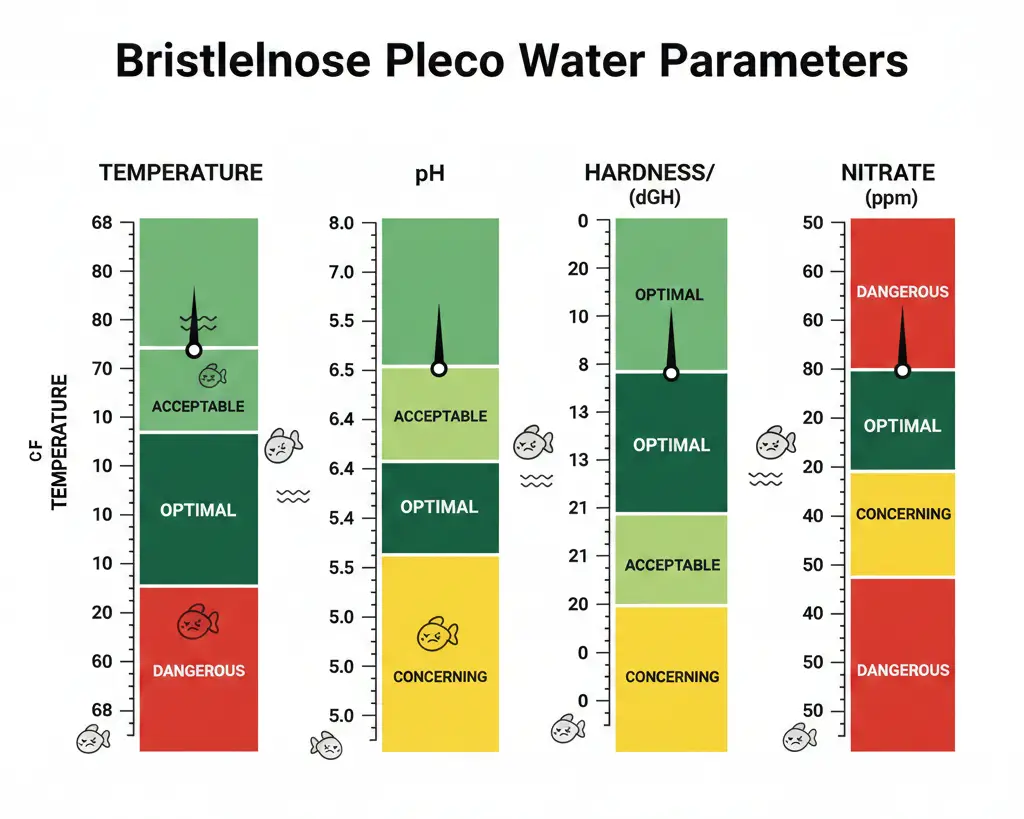
SPECIFICATIONS: Bristlenose Pleco Water Requirements
SCIENTIFIC: Ancistrus cf. cirrhosus (Valenciennes, 1836)
COMMON NAMES: Bristlenose Pleco, Bushy Nose Pleco, Bristlenose Catfish
PARAMETERS (Research-Based + Field Tested):
| Parameter | Acceptable Range | Optimal Range | My Tanks |
| Temperature | 72-82°F (22-28°C) | 75-79°F (24-26°C) | 76°F |
| pH | 5.5-7.8 | 6.5-7.2 | 6.8-7.0 |
| GH (Hardness) | 2-20 dGH | 6-12 dGH | 8 dGH |
| KH (Alkalinity) | 3-15 dKH | 4-8 dKH | 6 dKH |
| Ammonia | 0 ppm | 0 ppm | 0 ppm |
| Nitrite | 0 ppm | 0 ppm | 0 ppm |
| Nitrate | <40 ppm | <20 ppm | 10-15 ppm |
“I’ve kept bristlenose successfully in pH from 6.2 to 7.6. They’re genuinely adaptable. What they can’t handle: parameter swings. Consistency matters more than hitting ‘perfect’ numbers.”
What I learned the hard way: bristlenose are sensitive to medications containing copper and many common ich treatments. When my 55-gallon community tank developed ich in March 2021, I used a standard medication without checking compatibility. Lost my bristlenose within 48 hours while the other fish recovered fine.
If you need to medicate a tank with bristlenose, heat treatment (raising temperature to 86°F gradually over 48 hours) or salt treatment at 1 tablespoon per 5 gallons is safer. Always research medication interactions with scaleless and armored catfish before dosing.
For accurate parameter testing, I use the API Master Test Kit, liquid tests are significantly more reliable than strips for the precision bristlenose care requires.
Feeding: The Part That Trips Up Everyone
I’m going to be blunt: the idea that bristlenose plecos “eat algae so you don’t need to feed them” has probably killed more of these fish than any disease.
SETUP:
Tank: 40-gallon breeder, established 3+ years
Duration: 6 months (July 2023 – January 2024)
Method: Controlled feeding comparison
Subjects: 2 adult bristlenose, similar age/size
TEST:
Fish A: Algae wafers only (common recommendation)
Fish B: Varied diet, wafers, blanched vegetables, occasional protein
RESULTS:
Month 1-2: No visible difference
Month 3-4: Fish B showed brighter coloration, more active
Month 6: Fish B measured 0.4″ larger, significantly more robust
- Fish A developed slight fin erosion by month 5, early malnutrition signs.
- “Algae eater” is a marketing term, not a diet plan. Bristlenose are omnivores requiring varied nutrition.
- Two-fish comparison isn’t statistically significant, but consistent with established husbandry literature.
Here’s my current feeding rotation that’s worked across multiple bristlenose for years:
Daily (evening, after lights out):
- Sinking algae wafer OR
- Blanched zucchini, cucumber, or spinach (remove after 12-24 hours)
2-3x Weekly:
- Sinking carnivore pellets or shrimp pellets (small portion)
- Blanched green beans or peas
Weekly:
- Fresh driftwood access (ongoing)
- Occasional blanched sweet potato (they go crazy for this)
The vegetable thing surprised me initially. My bristlenose completely ignored vegetables for the first month, then one day discovered them and now attacks a zucchini slice within seconds. Persistence matters.
Don’t overfeed. That massive bioload I mentioned gets worse fast if you’re adding excess food. Better to slightly underfeed than clean up rotting vegetables and skyrocketing nitrates.
Tank Mates: What Actually Works
Bristlenose plecos are generally peaceful, with one massive exception.
Male bristlenose can be intensely territorial with each other. I learned this in 2016 when I added a second male to a 29-gallon without enough caves. Constant chasing, torn fins, and stress until I rehomed one. Same tank size, same fish, but inadequate territory made it a disaster.
Excellent Compatibility:
- Ember tetras, cardinal tetras (occupy different zones)
- Harlequin rasboras (peaceful mid-water)
- Cherry shrimp (ignored by adults, shrimplets at risk)
- Mystery snails (no competition)
- Corydoras species (different feeding niche)
Moderate Compatibility:
- German blue rams (both territorial, need space)
- Betta splendens (usually fine, occasional fin-nipping reports)
- Angelfish (works in 55+ gallons)
Avoid:
- Other pleco species (territory conflicts, hybridization risk)
- Aggressive cichlids (stress, injury)
- Very small shrimp species when keeping adult males (predation risk)
Something I’ve noticed that contradicts some care guides: my bristlenose have never bothered adult ghost shrimp or cherry shrimp. However, I did see my male investigating shrimplets near his cave during breeding season. Whether predation or territorial behavior, I can’t say definitively.
Breeding: It Will Probably Happen Whether You Plan for It
Here’s the honest truth nobody prepares you for: if you have a male and female bristlenose in adequate conditions, you will have baby bristlenose. Probably within 6 months.
I didn’t set out to breed bristlenose. In 2018, I had what I thought were two females. Turns out one was a young male whose bristles hadn’t fully developed. Eight months later: 47 fry in my peaceful community tank.
How Breeding Works:
Males establish cave territories (PVC pipes, coconut shells, driftwood caves all work). Females deposit 20-200 eggs on cave surfaces. Males guard eggs aggressively for 4-10 days until hatching, fanning them constantly for oxygenation.
The male’s dedication is genuinely impressive. During egg-guarding, my males refuse food, chase away anything that approaches, and emerge looking exhausted after fry become free-swimming.
A breeding pair can produce 100+ fry every 4-8 weeks under optimal conditions. Plan for this. Options include:
- Separating sexes (most reliable)
- Selling/trading to local fish stores (call first, many are oversupplied)
- Rehoming through aquarium clubs or online communities
- Keeping only one sex
DO NOT: Release into local waterways. Ancistrus species are invasive in multiple regions and cause ecological damage. This is both illegal in most jurisdictions and harmful to native ecosystems.
If you want to breed bristlenose, the general fry care principles apply, though bristlenose fry are hardy and can eat crushed algae wafers and blanched vegetables almost immediately. They grow quickly with adequate food and clean water.
Common Problems and What’s Actually Causing Them
After 15 years of keeping these fish and helping troubleshoot in online communities, I see the same issues repeatedly:
Problem: Bristlenose not eating, hiding constantly
Usual Cause: New tank syndrome, stress from recent addition
Real Cause (Often): Lack of appropriate hiding spots. Bristlenose need caves, overhangs, or dense plant cover to feel secure. No hiding spot = chronic stress = no eating.
Problem: Bloating, stringy white feces
Usual Cause: Overfeeding
Real Cause (Often): No driftwood access OR internal parasites. If driftwood is present and diet is appropriate, consider treatment for internal parasites, common in wild-caught specimens.
Problem: Faded coloration, clamped fins
Usual Cause: Poor water quality
Real Cause (Also): Often accurate. Check parameters. But also check for stray electrical current (faulty heaters/pumps) and temperature swings. My bristlenose showed stress coloration in 2020 that traced to a failing heater with inconsistent temperature regulation.
Problem: Aggression, torn fins
Usual Cause: “Bristlenose are aggressive”
Real Cause: Almost always male-male territorial conflict OR breeding behavior. Solution: more caves, visual barriers, or separate males.
If you’re dealing with cloudy water in a bristlenose tank, it’s usually bacterial bloom from excess waste. Increase water changes and verify filtration capacity.
Why Bristlenose Plecos Are Still Worth Keeping
I’ve spent this entire article explaining what’s hard about bristlenose plecos. So why have I kept them continuously for 15 years?
Because when their needs are met, they’re genuinely fascinating fish.
My oldest bristlenose, the one that’s been with me since 2014, has more personality than most fish I’ve kept. He has preferred cave locations, specific driftwood he rasps every night at roughly the same time, and a relationship with the Java fern cluster he’s slowly uprooted over three years despite my attempts to secure it.
They’re not colorful. They’re not active during the day. They produce absurd amounts of waste. And yet, watching an adult male bristlenose emerge at dusk, bristles flared, investigating his territory while completely ignoring the expensive fish swimming above him, there’s something deeply satisfying about keeping a fish that feels genuinely prehistoric.
The trick isn’t treating them as “beginner fish” or “cleanup crew.” It’s treating them as the distinctive, specialized animals they actually are. Once you provide wood, appropriate tank size, varied diet, and adequate filtration, they’re almost bulletproof.
That’s the difference between “hardy” and “low-maintenance.” Bristlenose can survive your mistakes longer than most fish. But they thrive when you stop making those mistakes altogether.
My experience comes from keeping bristlenose plecos since 2009 across freshwater community tanks, planted setups, and dedicated breeding projects. Current tanks include a 55-gallon community with an 11-year-old male and a 40-gallon breeder previously used for controlled feeding trials. I’m not affiliated with any commercial fish retailers. Learn more about establishing optimal conditions in our beginner planted tank setup guide.