You wake up, walk to your tank, and your heart sinks. Yesterday, the water was crystal clear. Today? It looks like someone poured a gallon of milk into the aquarium.
What causes cloudy water?
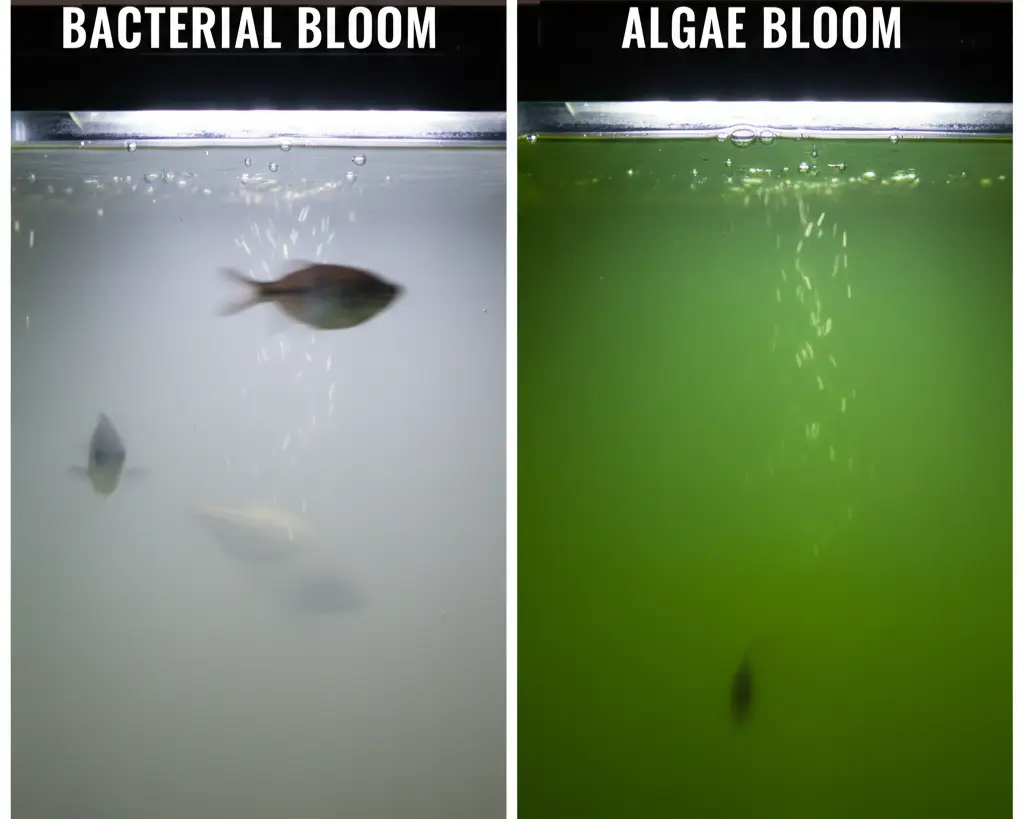
A sudden, milky white haze is almost always a bacterial bloom, an explosion of heterotrophic bacteria reproducing at exponential rates (doubling every 15-20 minutes) due to an excess of organic waste dissolved in the water column. Unlike the beneficial nitrifying bacteria living in your filter, these bacteria swim freely in the water, consuming oxygen and organics faster than your ecosystem can balance them.
It looks terrible. It feels like a failure. I know the feeling, I’ve stared at that white haze in a $2,000 planted setup and felt absolute panic.
The cloudiness itself isn’t toxic to your fish. The lack of oxygen caused by the bloom is. And the number one thing your instinct tells you to do, a massive water change, is usually the exact wrong move.
Let’s fix this properly, based on biology, not panic.
Heterotrophic Bacterial Bloom
A Bacterial Bloom is a rapid population spike of heterotrophic bacteria (scavengers that eat organic waste), causing water to appear milky or hazy.
- Cause: Excess dissolved organics (overfeeding, rotting plants, unseen dead livestock).
- Reproduction Rate: Doubles every 15-20 minutes (Authority: Hovanec, 2004).
- Oxygen Impact: Massive consumption; can drop dissolved oxygen (DO) below 4ppm rapidly.
- Duration: Typically 2-10 days if left undisturbed.
- Treatment: Increase aeration immediately; stop feeding; do not change large amounts of water.
The Day I Almost Suffocated My Tank
I used to think “clean water” meant “change the water.” In 2018, I had a 55-gallon community tank that had been running for about three weeks. It was going through the ammonia cycle, or so I thought. One morning, bam. Total whiteout.
I panicked. I grabbed the siphon and did a 50% water change. The water cleared up slightly. I felt proactive.
Six hours later? It was worse. Much worse.
The fish were at the surface, gasping. The water was thicker than before. I tested everything using my API Master Test Kit. Ammonia was 0.25ppm (manageable), Nitrite 0, Nitrate 5. Why were they gasping?
I hadn’t accounted for oxygen. These bacteria breathe oxygen just like fish do, but they reproduce millions of times faster. By changing the water, I had removed the competition but replenished the trace minerals and micronutrients the bacteria needed to bloom again. I essentially restocked their buffet.
I hooked up an emergency air stone, stopped feeding for three days, and sat on my hands. The water cleared in 48 hours. The lesson cost me two Tetra, but it taught me that clear water isn’t always safe, and cloudy water isn’t always dirty, it’s biologically busy.
MYTH vs REALITY: The “Water Change” Cure
MYTH: “If your water is cloudy, you need to do a huge water change immediately to clean it.”
REALITY: Large water changes often restart the bloom cycle by replenishing trace elements and disrupting the establishing biological balance.
We are trained that “solution to pollution is dilution.” This is true for chemicals (nitrates/ammonia) but false for biological population explosions.
Only change water if ammonia/nitrite levels are toxic (>1.0 ppm). Otherwise, maximize aeration and wait.
Diagnosing the Haze: Bacteria vs. Algae vs. Particulates
Before you treat anything, you have to know what you’re looking at. “Cloudy” is vague. The color tells the story.
I’ve wasted money on UV sterilizers for problems that were actually just fine dust from new substrate. Don’t be that guy.
The Comparison Matrix
| Visual Symptom | Likely Cause | The Fix |
| Milky / White / Hazy | Bacterial Bloom (Heterotrophs) | Aeration + Patience. Stop feeding. |
| Green / Pea Soup | Algae Bloom (Phytoplankton) | Blackout (3 days) or UV Sterilizer. |
| Dusty / Gray / Settles | Particulates (Substrate/Debis) | Mechanical Filtration + Filter Floss. |
| Yellow / Tea-Colored | Tannins (Driftwood) | Purigen, Carbon, or enjoy the blackwater look. |
If you recently added spiderwood or driftwood, you might see a white slime on the wood. That’s biofilm. A bacterial bloom is that same biology, just free-floating in the water column.
Why Does It Happen? (Root Cause Analysis)
It’s rarely random. If your tank looks like milk, one of these three things usually happened in the last 48 hours:
1. New Tank Syndrome (The Most Common)
If your tank is less than 6 weeks old, this is normal. Your ecosystem is an awkward teenager. The slow-growing nitrifying bacteria (the good guys in your filter) haven’t established enough territory yet. The fast-growing heterotrophic bacteria (the bloom) see all the free-floating organics and take over.
2. The “Hidden Rot” Factor
In established tanks, a bloom means something died or is rotting.
- Dead Livestock: A dead snail buried in the substrate is a massive ammonia/organic bomb.
- Rotting Plants: If you recently set up a planted tank, melting leaves release sugars and carbohydrates into the water.
- Dirty Filters: Ironically, a canister filter that hasn’t been cleaned in 6 months can become a “nitrate factory” and organic sludge pit. When flow reduces, heterotrophs take over.
3. Overfeeding (The Human Error)
Fish don’t need to eat as much as we think. Uneaten food decays in minutes. If you’re feeding flake food and it’s hitting the gravel, you are feeding the bacteria, not the fish.
My 4-Step Protocol to Clear the Cloud
I haven’t used a clarifier chemical in years. They usually work by clumping particles (flocculation), which just traps the rotting bacteria in your filter, clogging it and depleting oxygen there.
Here is the protocol I use for client tanks at Aquatics Pool Spa, which focuses on restoring biological balance rather than chemical intervention.
Step 1: Maximize Oxygen (Immediate)
This is non-negotiable. The bacteria are consuming oxygen.
- Add an air stone.
- Lower the water level slightly so the filter return splashes.
- Aim powerheads at the surface.
- Goal: Surface agitation.
Step 2: The 48-Hour Fast
Stop feeding. Completely. Your fish will not starve in two days (healthy fish can go weeks). By stopping the input of organics, you starve the bloom.
- Note: If you have fry or specialized feeders like Otocinclus, reduce feeding by 90% rather than stopping.
Step 3: Mechanical Polishing
While biological filtration fixes the root cause, mechanical filtration helps the symptoms.
- Add fine filter floss or a polishing pad to your filter.
- Crucial: Change this floss every 24 hours. As it traps bacteria, they rot in the filter. Get them out of the system.
- Check your canister filter setup to ensure flow hasn’t been reduced by the slime.
Step 4: Patience (The Hardest Part)
Do not scrub the glass. Do not vacuum the gravel deeply (which disturbs more organics). Just let the system stabilize.
Timeline:
- Day 1: Looks terrible. Fish active due to added air.
- Day 2: Still cloudy, maybe slightly gray.
- Day 3: Noticeable clearing.
- Day 4: Crystal clear.
When To Actually Panic (Safety Check)
While I advocate for patience, there are red flags that require intervention.
Monitor Ammonia:
The bacterial bloom itself consumes ammonia, but the cause of the bloom might be an ammonia spike. Test daily. If Ammonia hits >1.0ppm or Nitrite >0.5ppm, perform a 30% water change. Use a conditioner like Seachem Prime that binds ammonia temporarily.
Monitor Fish Behavior:
If fish are gasping at the surface despite added aeration, the bacterial load is too high for the gill function. In this extreme case, a large water change (50%) is necessary to mechanically remove the bacteria count, even if it risks prolonging the cycle. Life > Cycle.
Preventing Future Blooms
Once you clear this up, you never want to see it again.
1. Proper Maintenance:
Follow a weekly maintenance checklist. Don’t rinse your bio-media in tap water (chlorine kills the good bacteria, allowing the bad ones to bloom).
2. Watch the Food:
If food touches the bottom, you fed too much. For bottom feeders like Corydoras, use sinking pellets and remove uneaten portions after 20 minutes.
3. Plant Heavy:
Live plants compete with algae and bacteria for nutrients. A tank full of fast-growing stems acts as a massive nutrient sponge.
Final Thoughts: It’s Just Biology
It looks ugly. It feels like you’re failing. But a bacterial bloom is actually a sign that your aquarium is trying to balance itself. The bacteria are cleaning up the mess. Your job isn’t to kill them; it’s to stop feeding them and keep the fish breathing while they work.
I’ve been through this with dozens of tanks. The ones where I intervened constantly took weeks to settle. The ones where I added an air stone and walked away? Clear in days.
Trust the biology.