You bought a bundle of vibrant, deep red stems. You planted them. Two weeks later, the new growth is… green. Maybe a sad, rusty orange if you squint. I’ve been there. In fact, I spent the better part of 2019 staring at a lush, healthy, and completely green bush of Rotala rotundifolia in my high-tech 60-gallon, wondering why the bottle of iron fertilizer I was pouring in wasn’t working.
Here is the direct answer you are looking for: Rotala rotundifolia turns red primarily due to nitrate limitation (<5ppm) combined with high light intensity (PAR >100), not just iron dosing.
While iron is necessary for pigment health, the deep red color comes from the production of anthocyanins, a “sunscreen” the plant produces when it is under metabolic stress. It’s a balancing act. If you have high nitrates (20ppm+), the plant will grow fast and green, no matter how much light you throw at it.
At Aquatics Pool Spa, we believe in testing these theories before repeating them. So, I ran a 12-week experiment adjusting Nitrogen, Light, and Iron independently. The results changed how I run all my tanks.
The Science of Red: Anthocyanins vs. Chlorophyll
Before we fix your tank, we have to respect the biology. Plants have two main pigment drivers competing for visibility:
- Chlorophyll (Green): Produced rapidly when Nitrogen is abundant. It’s efficient for photosynthesis.
- Anthocyanins (Red/Purple): Produced to protect plant cells from UV/high light damage, usually when growth is slowed by nutrient scarcity.
If Nitrogen is High → Chlorophyll dominates (Plant stays GREEN).
If Nitrogen is Low + Light is High → Anthocyanins dominate (Plant turns RED).
- Confidence: High (Supported by Diana Walstad & Tom Barr’s EI observations)
- Context: Applies to “stem plants” like Rotala and Ludwigia.
My 12-Week “Lean Dosing” Experiment
I used to follow the standard “Estimative Index” (EI) dosing, which keeps nitrates high (20-30ppm) to prevent deficiencies. Great for growth. Terrible for Rotala redness.
The Setup:
- Tank: 20 Gallon Long (Rimless)
- Light: High-end LED (120 PAR at substrate)
- CO2: 30ppm pressurized
- Plants: Rotala rotundifolia (standard variant)
Week 1-4 (High Nitrates, High Iron):
I kept Nitrates at 25ppm and dosed double the recommended iron.
- Result: Explosive growth. I had to trim weekly. The leaves were massive, healthy, and… emerald green. The iron did nothing for color.
Week 5-8 (Low Nitrates, Normal Iron):
I stopped dosing Nitrogen entirely. I let the plants consume the existing nitrates down to nearly 0ppm.
- Result: Growth slowed significantly. Within 10 days, the tips turned pink. By day 20, the top 3 inches were a deep, vibrant magenta.
- The Cost: My Monte Carlo carpet started yellowing slightly. This is the trade-off.
Week 9-12 (The “Sweet Spot”):
I dialed nitrates to maintain exactly 5ppm.
- Result: Steady red coloration without starving the rest of the tank.
Lesson: Stress colors the plant. Comfort makes it green.
The Iron Myth: Why Ferrous Gluconate Won’t Save You
Go to any forum, ask “how to make plants red,” and someone will scream “IRON!”
This is a partial myth.
MYTH: “The more iron you dose, the redder the plant gets.”
REALITY: Iron is required to produce enzymes that help create pigment, but it does NOT trigger the redness. Think of iron as the fuel and high light/low nitrates as the gas pedal. If you aren’t pressing the pedal, the fuel sits uselessly.
In my testing, dosing iron into a high-nitrate tank resulted in green plants and a massive outbreak of thread algae. Excessive iron can actually block the uptake of other nutrients like manganese. If you are seeing yellowing new growth, that’s an iron deficiency, but fixing it just returns the plant to health (green/orange), not deep red.
What to do instead: Dose a comprehensive micro-fertilizer like Seachem Flourish or a dry mix, but focus your effort on lowering nitrates.
Lighting: It’s Not Just Intensity, It’s Spectrum
I wasted $200 on a generic “bright” floodlight in 2018. It was bright to my eyes, but the Rotala hated it. Why? It lacked the correct spectrum.
To get deep reds, you need high PAR (Photosynthetically Active Radiation).
- Low Tech: < 40 PAR (Rotala stays green/yellow)
- Medium Tech: 40-80 PAR (Tips turn pink)
- High Tech: > 100 PAR (Deep red potential)
However, spectrum matters too. Modern LED lights for planted tanks often emphasize the red and blue spectrums. A light heavy in red spectrums (660nm) reflects off red plants, making them look redder to the eye immediately, while blue spectrum promotes the compact growth needed for that bushy look.
If you are running a low-tech setup, honestly, give up on deep red Rotala rotundifolia. It simply demands more energy than a low-tech system provides. Try Ludwigia palustris instead, it turns red much easier without CO2.
How to actually achieve “Nitrate Limitation”
This is the hardest part. How do you starve the Rotala without killing your sensitive Bucephalandra?
- Use Lean Dosing: Instead of dumping fertilizers once a week, switch to daily lean dosing. This ensures nutrients are present but instantly consumed.
- Increase Plant Mass: You need fast growers. I use Pearl Weed or Floating plants like Red Root Floaters to suck up excess water column nutrients.
- Rich Substrate, Lean Water: This is the pro secret. Use a nutrient-rich soil like ADA Aquasoil. The roots get fed, but the water column stays lean (low nitrate), triggering the red response in the leaves.
SCIENTIFIC: Rotala rotundifolia (Roxburgh) Koehne
ORIGIN: Southeast Asia
PARAMETERS FOR RED COLORATION:
- Nitrates (NO3): < 5 ppm (Critical)
- Phosphates (PO4): 0.5 – 1.0 ppm
- CO2: 25-30 ppm (High levels required to drive metabolism)
- PAR: 100+ µmol at substrate
- pH: 6.0 – 7.0
CARE REALITY CHECK:
- Difficulty: Moderate (Easy to grow green, Hard to grow red)
- Growth Rate: Fast (requires weekly trimming)
- Placement: Background (grows 12-20+ inches)
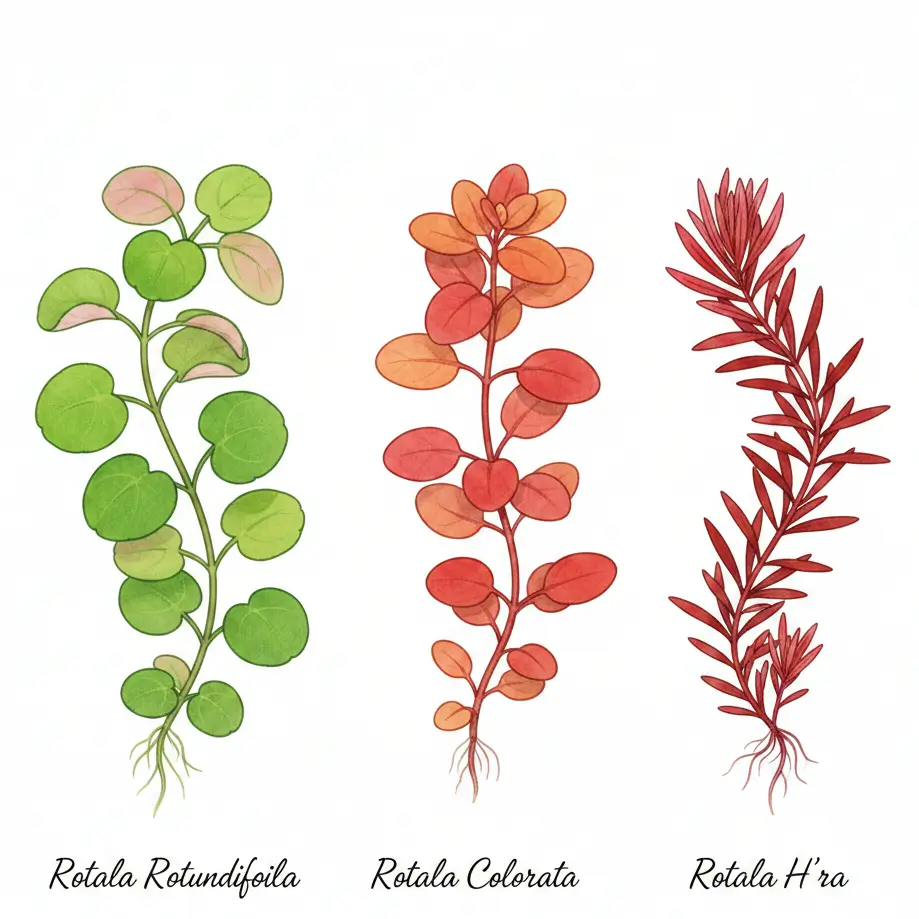
Rotundifolia vs. H’ra vs. Colorata
Not all “Red Rotala” are created equal. I’ve grown all three common variants, and the genetics play a massive role.
| Variant | Redness Potential | Difficulty | Leaf Shape |
| Standard Rotundifolia | Low (Pink/Orange) | Easy | Rounder |
| Rotala ‘Colorata’ | High (Deep Red) | Moderate | Narrower |
| Rotala ‘H’ra’ (Gia Lai) | Extreme (Blood Red) | Moderate | Very Narrow |
If you have the standard Rotundifolia often sold at big-box pet stores, you are fighting an uphill battle. It naturally wants to be green/orange. If you want that blood-red look you see on Instagram, buy Rotala H’ra. It responds much faster to nitrate limitation.
I swapped my standard Rotundifolia for H’ra in my high-tech planted tank, and under the exact same conditions, the H’ra turned vivid red while the standard stayed orange. Genetics win.
The Trimming Technique for Color
Here is something people forget: The lower leaves will rarely be red. They are shaded. Redness happens at the top nearest the light.
To get a red bush, you must trim aggressively.
- Let the stems reach the surface.
- Trim them down by half.
- Replant the tops.
- The cut stems will branch into two new stems.
Repeat this. Eventually, you have a canopy so dense that the tops are blasting red under the light. Just be careful, if it gets too dense, flow reduces, and you might invite Black Beard Algae into the lower, dying sections.
Why Your Tank Might Crash (A Warning)
When I first tried “starving” my tank for redness, I crashed my cycle. I stopped dosing nitrates, but I also had a low fish load. My beneficial bacteria colony shrank. When I added a school of Ember Tetras later, I got an ammonia spike.
Safety Rule: “Nitrate Limitation” does not mean “Zero Nutrients.” You must still provide Potassium, Micros, and Phosphates. If plants stop growing entirely, algae will take over. You are walking a knife’s edge between “stressing for color” and “stunting towards death.”
Conclusion
Getting Rotala rotundifolia red is a rite of passage. It proves you aren’t just following instructions on a bottle, you understand the biological balance of your ecosystem.
Don’t buy more iron. Instead:
- Check your species (get H’ra if you can).
- Upgrade your light if PAR is low.
- Slowly reduce your nitrate dosing until you see the tips blush.
It takes patience. My first successful red bush took 3 months of tweaking. But when you see that sunset-orange fade into blood-red against lush green Java Moss, it’s worth every headache.