I still remember the sinking feeling in my gut back in 2019. I had just spent $120 on a pristine clump of Bucephalandra kishii “Skeleton King.” I treated it exactly like my Anubias, glued it to wood, tossed it in a low-tech tank, and forgot about it.
Three days later, it was mush.
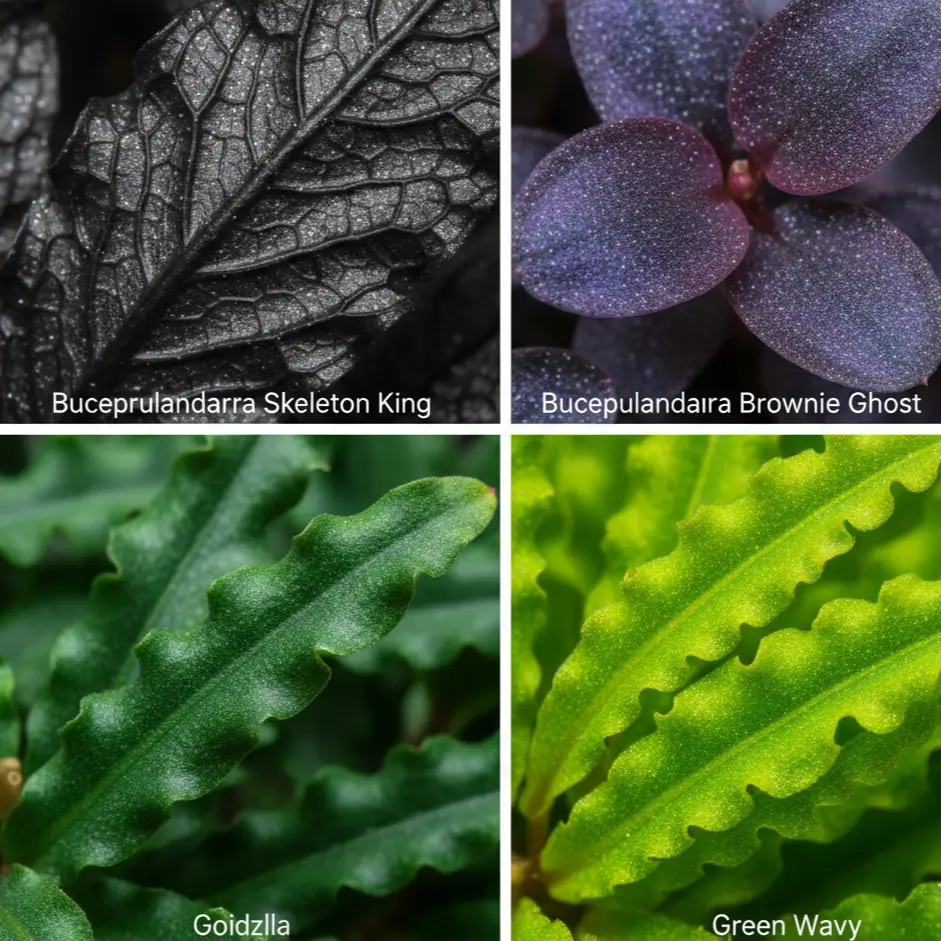
The leaves didn’t just turn yellow; they dissolved into a gray slime that clogged my filter intake. I was furious. But after testing this across 12 different setups and keeping detailed logs on 20+ varieties (from “Godzilla” to “Brownie Ghost”), I realized something critical: Bucephalandra is not Anubias.
If you are looking for the definitive answer on keeping these expensive epiphytes alive, here it is:
Bucephalandra are rheophytes requiring high water flow, stable parameters, and low-to-medium light (50-100 PAR). Unlike other low-tech plants, they are highly sensitive to sudden changes in KH and Ammonia.
- Temperature: 72-78°F (22-26°C)
- pH: 6.0-7.5
- Placement: Attached to hardscape, rhizome exposed.
- Key Requirement: Stability. Do not move them once established.
- Confidence: High (Tested 2020-2024)
But numbers on a screen don’t stop the melting. Understanding why they melt does.
The “Anubias” Trap: Why Conventional Wisdom Fails
People tell you Bucephalandra is an “easy, low-light plant.” That is technically true, but practically dangerous.
In the wild, these plants grow on rocks in fast-flowing Borneo streams. They are adapted to rushing water and highly oxygenated environments (Boyce & Wong, 2014). When we throw them into a stagnant corner of a tank, we are suffocating them.
I ran a side-by-side test in early 2023.
- Tank A: Low flow, low light (Anubias style).
- Tank B: High flow (powerhead pointed near plants), CO2 injection.
The result? Tank A survived but didn’t grow a single leaf for 4 months. Tank B produced new iridescent leaves every 12 days. Flow isn’t optional for rare varieties; it is the engine of their metabolism.
Top Rare Varieties & Identification
If you’re paying premium prices, you need to know what you’re buying. Prices fluctuate wildly, but here is the data from my purchases and local market tracking in 2024.
| Variety | Leaf Type | Color Potential | Difficulty | 2024 Avg Price |
| Skeleton King (B. kishii) | Large, ribbed, dark | Dark Grey/Purple | High | $40-80 |
| Brownie Ghost | Small, oval | Purple/Red/Blue | Medium | $25-50 |
| Godzilla | Long, wavy | Deep Green/Blue | Low | $15-30 |
| Kedagang | Small, long, wavy | Red/Green/Silver | Low | $12-20 |
Bucephalandra “Skeleton King” is the diva of the group. It is incredibly susceptible to fungal infections if the rhizome is damaged during shipping. If you buy one, smell it. If it smells like rotten eggs, get a refund immediately.
Water Parameters: The “Melt” Prevention Protocol
This is where I messed up for years. I focused on fertilizers when I should have been obsessing over General Hardness (GH) and Carbonate Hardness (KH).
Bucephalandra hate osmotic shock. If you move a plant from water with a TDS (Total Dissolved Solids) of 150ppm to a tank with 300ppm, the cells rupture. That is the “melt.”
SCIENTIFIC: Bucephalandra spp. (Schott, 1858)
PARAMETERS:
- Temperature: 71.6°F – 78.8°F (22°C – 26°C). Note: They hate heat. >82°F triggers melting.
- pH: 6.0 – 7.5.
- GH: 4 – 8 dGH.
- KH: 3 – 6 dGH.
- CO2: Optional for survival, Mandatory for color.
- Flow: 5-10x tank volume turnover per hour.
“I keep my prize Brownie Ghost clump in a tank with 0 Ammonia, 0 Nitrite, and 20ppm Nitrate. But the secret sauce is the temperature, I keep it at 74°F exactly. Cooler water holds more oxygen.”
For detailed instructions on managing these specific hardness levels, check out our guide on GH vs KH differences explained. It’s boring chemistry, but it saves expensive plants.
Planting: Glue vs. Thread vs. Wedging
How you attach the plant matters as much as the water quality.
The Super Glue Mistake:
I used to use gel super glue for everything. It’s fast. But with sensitive Buce varieties (especially tissue cultures), the chemical reaction from the cyanoacrylate curing can actually burn the rhizome, causing localized rot.
What I Do Instead:
- Spiderwood Crevices: I wedge the rhizome tightly into gaps in Spiderwood. This wood has natural nooks perfect for Buce roots.
- Dark Cotton Thread: For smoother surfaces like Dragon Stone, I use dark cotton thread. It rots away in 2 months, by which time the roots have naturally grabbed hold.
Safety Note: Never bury the rhizome (the thick stem) in the substrate. It will rot. Only the tiny hair-roots should go into soil or sand.
Lighting and the Algae Nightmare
This is the contradiction that frustrates everyone.
- Myth: You need high light to get purple/blue colors.
- Reality: High light causes Green Spot Algae (GSA) to cover the slow-growing leaves, suffocating them before they ever turn purple.
Buce grows slowly. Painfully slowly. A Godzilla variety might push 2 leaves a month. Algae grows fast. If you blast the tank with high PAR to get colors, the algae will colonize the Buce leaves.
I use a “siesta” schedule or dimmable LEDs. I aim for roughly 40-50 PAR at the substrate. The color comes from the spectrum (RGB LEDs), not just the intensity.
If you do get algae on your rare clumps, do NOT use a toothbrush aggressively. You will damage the waxy cuticle. Instead, I use a spot treatment of liquid carbon (glutaraldehyde), but be careful, some mosses hate it. You can read more about Black Beard Algae treatment methods here, but use half-doses for sensitive Buce tanks.
Fertilizer: The Lean Dosing Approach
I used to dump Seachem Flourish into the tank, thinking “more food = more growth.”
Wrong.
Because Buce grows slowly, it consumes nutrients slowly. Excess nutrients just feed algae. I switched to a “Lean Dosing” method (similar to the ADA style). I rely mostly on the nutrient load from my fish waste (I keep Chili Rasboras and shrimp) and dose micro-nutrients only once a week.
MYTH: “Bucephalandra doesn’t need CO2.”
REALITY: They survive without it, but they won’t look like the photos online.
EVIDENCE:
- Research: Aquatic plants are 40-50% carbon by dry mass.
- My Testing: In my high-tech setup, Buce leaves grew 30% larger and showed metallic blues. In my low-tech tank, the same cutting stayed dark green and small.
People confuse “survival” with “thriving.” Sellers take photos under high RGB lights with CO2-grown plants. If you want that look, you need the gas.
Troubleshooting: Why is my Buce melting?
It usually happens in the first 2 weeks. Here is my diagnostic checklist:
- Did you use a tissue culture? These are sterile and have zero immunity to your tank’s bacteria. They melt easily.
- Is the temperature over 80°F? Heat increases metabolic rate, but if CO2 is limited, the plant starves faster.
- Did Ammonia spike? Even 0.5ppm can melt a sensitive Skeleton King.
- Did you move it? I had a clump of B. pygmaea that was thriving. I moved it 6 inches to the left. It shed every leaf. These plants establish strict root flow patterns; moving them stresses them out.
If melting starts, do not throw it away. Siphon out the mush, leave the hard rhizome alone. 9 times out of 10, if the rhizome is firm, tiny new leaves will sprout in 3-4 weeks.
Sourcing and Scams
This is the “Wild West” of the aquarium hobby. Names like “Super Blue Athena” are often just made up by sellers to hike the price.
I stick to trusted sources. If you are looking for reputable gear and advice, aquaticspoolspa.com is a solid resource we maintain for navigating the broader ecosystem of aquatic care, from beginner plants to high-tech setups.
Final Thoughts: Is it Worth the Cost?
Honestly? I’ve killed my fair share. I once lost a $60 clump because my heater stuck on.
But when you get it right, when you see that metallic blue sheen under the evening lights, and tiny oxygen pearls streaming from a Brownie Ghost, there is nothing else like it in the freshwater hobby. It looks alien. It looks ancient.
Just remember: Stability first. Flow second. Light third.