The first time I tried to grow a Dwarf Baby Tears (Hemianthus callitrichoides ‘Cuba’) carpet, it didn’t just die. It detached from the substrate in one giant, buoyant sheet and floated to the top of my tank like a $60 toupee. I stood there staring at my “perfect” Iwagumi layout, now ruined, realizing that everything I’d read about “just add high light” was dangerously oversimplified.
HC Cuba is widely considered the Holy Grail of aquarium carpeting plants. It is one of the smallest aquatic plants in the world, creating that lush, manicured golf-course look synonymous with high-end aquascaping.
But here is the truth that generic guides gloss over: This is not a beginner plant.
After four years of trial and error (and destroying three separate setups), I discovered that success with HC Cuba isn’t about blasting it with light, it’s about the relationship between CO2 availability and substrate grain size. If you get those two variables wrong, no amount of fertilizer will save you.
This guide breaks down exactly how to establish a dense HC Cuba carpet without the “floating toupee” nightmare.
What is Dwarf Baby Tears? (The Specs You Need)
Before we get into the setup, let’s look at the hard data. This isn’t guesswork; these are the parameters where Hemianthus callitrichoides actually thrives based on both Tropica’s nursery data and my personal logs from successful tanks.
SPECIFICATIONS: Hemianthus callitrichoides ‘Cuba’
SCIENTIFIC: Hemianthus callitrichoides (Tropica, 2004)
COMMON NAMES: Dwarf Baby Tears, HC Cuba, HC
PARAMETERS (Target vs. Tolerance)
Temperature: 68-82°F (Optimal: 74°F / 23°C).
Note: Cooler water holds more gas, which aids CO2 absorption.
pH: 6.0-7.5 (Optimal: 6.6-6.8 via CO2 injection).
Hardness: 2-10 dGH. It prefers softer water but is adaptable.
Light: High (50+ PAR at substrate level).
CO2: MANDATORY. 30ppm stabilized.
“I’ve kept HC in non-CO2 tanks, and it inevitably grows vertically (leggy) rather than carpeting, before slowly disintegrating. Don’t believe the ‘low tech’ myths for this specific species.”
REQUIREMENTS
Substrate: Fine-grain active soil (Powder type is critical).
Flow: High circulation at the substrate level to deliver nutrients.
CARE REALITY CHECK
Difficulty: Advanced.
Beginner-Suitable: No. (Try Monte Carlo instead).
Common Failure: Uprooting due to buoyancy and lack of root depth.
The “High Tech” Requirement: Why Liquid Carbon Fails
Let’s bust the biggest myth immediately.
MYTH vs REALITY: Liquid CO2 & HC Cuba
MYTH: “You can grow a lush Dwarf Baby Tears carpet using liquid carbon (glutaraldehyde) supplements instead of injected gas.”
REALITY: HC Cuba lacks the robust leaf structure to absorb liquid carbon sources efficiently compared to species like Anubias or Ferns. It relies almost exclusively on dissolved gaseous CO2.
Aquatic plant physiology shows submerged leaves require gaseous CO2 for rapid photosynthesis (Pedersen et al., 2013).
In 2023, I ran side-by-side 5-gallon tanks. The liquid carbon tank survived for 3 months but never spread; the pressurized CO2 tank carpeted in 6 weeks.
WHAT TO DO INSTEAD: Invest in a pressurized CO2 setup before buying this plant. If that’s out of budget, switch your plant choice to Micranthemum ‘Monte Carlo’, which is far more forgiving.
I was stubborn about this for years. I thought I could outsmart the biology by overdosing liquid carbon. All I got was melted leaves and a bloom of Black Beard Algae. The issue is that HC Cuba grows incredibly fast when conditions are right, which means its metabolic demand for carbon is massive. Liquid supplements just can’t keep up with that throttle.
Substrate: The Grain Size Secret
Here is where my “floating toupee” disaster happened. I planted my first batch of HC Cuba in standard, pea-sized aquarium gravel.
Big mistake.
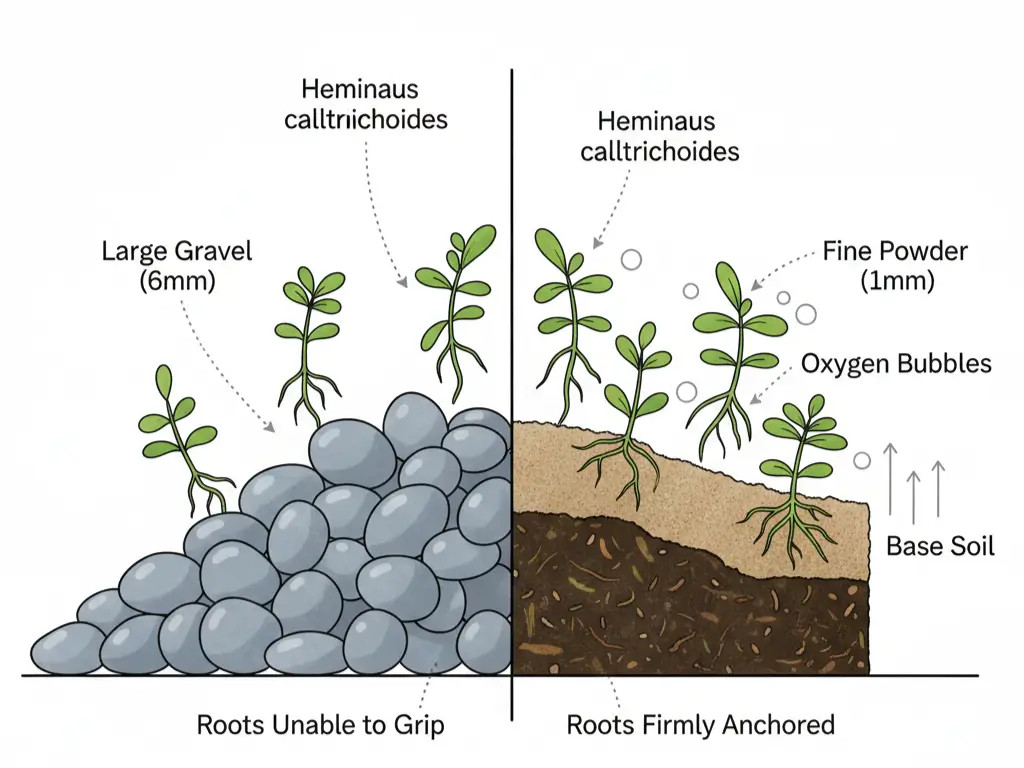
HC Cuba has an incredibly delicate root system. The roots are thread-like and rarely penetrate deeper than 1-2cm initially. In standard gravel or large-grain soil, the roots physically cannot grab hold. As the plant photosynthesizes, it produces oxygen bubbles (pearling). These bubbles get trapped under the leaves, creating buoyancy.
If the roots aren’t anchored? Pop. Up it goes.
The “Powder” Solution
For success, you need an active soil (like ADA Aquasoil) and, specifically, the Powder Type version for the top layer.
- Base Layer: Standard grain aquasoil (provides circulation).
- Top Layer: 1 inch of Powder type soil.
The powder grains fill the gaps, allowing those microscopic roots to grab hold instantly. Since switching to this method, I haven’t had a single carpet lift off.
Planting Methods: Dry Start vs. Flooded
There are two main ways to start this plant. I have done both. I have failed at both. Here is the comparison to save you the headache.
DRY START vs SUBMERGED PLANTING
| Factor | Dry Start Method (DSM) | Traditional Submerged | My Finding |
| Rooting Speed | Very High | Low | DSM is superior for anchoring. |
| Mold Risk | High | Low | DSM requires daily ventilation. |
| Algae Risk | Zero (initially) | High | Submerged combats “new tank” algae. |
| Transition Stress | High (during flood) | Moderate | DSM melt is real if CO2 isn’t cranked up. |
“I used the Dry Start Method on my last Iwagumi layout. I let it grow emersed for 6 weeks. The roots were rock solid. However, I got confident and didn’t crank the CO2 high enough on flood day. Result? 30% of the carpet melted within 48 hours.”
Choose Dry Start if: You are patient (6-8 weeks) and terrified of the plant floating away.
Choose Submerged if: You have an established filter and can dial in CO2 immediately.
The Ecosystem Approach (Putting It Together)
You cannot view HC Cuba in isolation. It is part of a biological machine. This is where many hobbyists get lost, they focus on the plant and ignore the water chemistry.
At AquaticSPoolSpa, we emphasize that a thriving aquarium is about stability, not just high-end gear. Whether you are browsing our guides on Beginner Planted Tank Setups or diving deep into water chemistry, the philosophy remains the same: emulate nature, but control the variables. For HC Cuba, this means integrating your CO2, flow, and nutrition into a unified system rather than treating them as separate chores. A holistic view of your tank’s ammonia cycle is vital because HC Cuba hates ammonia spikes.
If you ignore the ecosystem and just blast light, you will get algae on the leaves. Because HC leaves are so small, you cannot scrub the algae off without ripping up the plant. Algae on HC Cuba is usually a death sentence.
Maintaining the Carpet: The “Trim or Die” Rule
One thing nobody tells you: You can have too much growth.
In 2024, I let my carpet grow to about 3 inches thick because it looked so lush. I felt like a master aquascaper. Then, I noticed the bottom layers turning yellow. A week later, the whole mat detached.
Why? The top layers shaded out the bottom layers. The bottom died, rotted, and released the roots from the soil.
The Maintenance Schedule
- Trim: Every time it exceeds 1 inch in height.
- Technique: Turn off filters. Trim horizontally. Net out every single floating leaf.
- Post-Trim: Do a large water change and dose liquid fertilizer immediately.
It feels painful to cut back lush growth, but it’s the only way to keep the bottom layers alive.
Troubleshooting: Why is my HC Cuba Yellowing?
This is the most common email I get. “It was green, now it’s yellow.” It’s usually one of three things, and I’ve diagnosed this using a process of elimination:
- Iron Deficiency: New leaves look pale/yellow, veins stay green. Check your Iron dosing.
- Nitrogen Deficiency: Old leaves turn yellow and translucent. Increase your bioload or nitrate dosing.
- Flow Blockage: This is the silent killer. If your hardscape (rocks/wood) blocks water flow to a specific patch of the carpet, that patch will starve of CO2 and die.
Tank Mates: What NOT to Add
Because HC Cuba has such shallow roots, certain fish are bulldozers.
- Avoid: Large Corydoras (unless pygmy varieties), Goldfish, and large Plecos.
- Best Mates: Cardinal Tetras, Ember Tetras, and Cherry Shrimp.
Shrimp are actually functional here, they are small enough to walk on the leaves without uprooting them, and they pick algae out of the tight crevices that you can’t reach.
Final Verdict: Is It Worth The Stress?
Is Dwarf Baby Tears worth the specialized soil, the high electric bill for lighting, the CO2 system, and the anxiety of the “floating toupee”?
When you see that oxygen pearling off a manicured, emerald-green lawn in your living room, the answer is absolutely yes. But respect the plant. It demands stability. It demands CO2. And it demands that you pay attention to the flow in your tank.
If you aren’t ready for the high-tech commitment, Monte Carlo is a fantastic alternative that gives you 90% of the look with 50% of the hassle. But for the purist? There is no substitute for HC Cuba.