My first dry start method attempt was in January 2023 on a 20-gallon long. I planted Hemianthus callitrichoides (HC Cuba) on ADA Amazonia, wrapped it in plastic wrap, and waited. Every guide I’d read said 6-8 weeks. Mine took almost 10.
The dry start method (DSM) is a technique where you plant aquatic carpet species on moist substrate without water, maintain near-100% humidity with a cover, and allow emersed root establishment over 4-10 weeks before flooding the tank. Tom Barr, the same aquarist behind the Estimative Index dosing method, popularized DSM in the mid-2000s as a way to grow dense carpets without fighting buoyancy, algae, or melt.
Here’s what bugs me about most DSM guides: they hand you one timeline, one misting schedule, and zero explanation of why results vary so dramatically. After documenting 5 separate dry starts between 2023 and early 2025, I can tell you the timeline isn’t some fixed window. It’s controlled by four specific factors, two of which most guides don’t even mention. I’ll break all of it down here, including the mold disaster that wrecked my third attempt and how I fixed it in 48 hours.
What Is the Dry Start Method and Why Does It Work?
The dry start method grows aquatic carpet plants in emersed (above-water) conditions on nutrient-rich, moist substrate inside a sealed tank. Plants develop stronger root systems without the challenges of underwater planting, no floating, no algae competition, no CO₂ injection needed during establishment. After 4-10 weeks of emersed growth, the tank is flooded and transitioned to a normal aquarium.
Most carpet plants in the hobby are actually marsh species. Hemianthus callitrichoides, Micranthemum ‘Monte Carlo’, Eleocharis species, Glossostigma elatinoides, they all grow naturally at water’s edge, transitioning between emersed and submersed forms. This dual-growth capability is precisely why DSM works. When you plant them on damp soil with high humidity, they grow the way they would on a riverbank during dry season: compact, fast, with aggressive root networks penetrating the substrate.
The result after flooding? A carpet that’s already anchored. No floating clumps. No waiting three months underwater for roots to grab hold while you fight staghorn algae and melting leaves.
I didn’t appreciate any of this until I compared my DSM results against a traditional submerged planting on two identical 10-gallon tanks in April 2024. The DSM tank had a usable Monte Carlo carpet at week 6. The submerged tank? Patchy, thin, still lifting at the corners at week 10. Same plant source, same substrate, same lighting.
Not even close.
Why “Just Wait 6-8 Weeks” Is Terrible Advice
I want to be honest, I parroted the 6-8 week timeline for years before I actually tracked my own results. When I finally logged everything across five setups, the data didn’t cooperate with the conventional wisdom.
DSM Timeline Variability
| Tank | Size | Substrate | Plant Species | Temp (°F) | Ready (Weeks) |
| #1 | 20g long | ADA Amazonia | HC Cuba | 68-70 | ~10 |
| #2 | 10g | ADA Amazonia | Monte Carlo | 74-76 | 6 |
| #3 | 12g long | UNS Controsoil | HC Cuba + Glosso mix | 73-75 | 7 (mold at wk 3) |
| #4 | 10g | ADA Amazonia | Monte Carlo | 78-80 | 4.5 |
| #5 | 5g | Fluval Stratum | Dwarf Hairgrass | 74-76 | 8 |
Temperature was the single biggest variable. Tank #1 and Tank #4 used the same substrate brand, similar plant density, similar lighting, but #1 sat in an unheated fishroom during a cold January, while #4 was on a heated shelf in July 2024. The difference was 5.5 weeks.
The 6-8 week guideline assumes a narrow temperature band (~74-78°F). Go colder and you’re waiting significantly longer. Go warmer and you might be ready in under 5 weeks, but mold risk climbs.
Five tanks isn’t a controlled study. Substrate age, plant health at purchase, even ambient light from nearby windows probably influenced things. But the temperature correlation was stark enough that I’m confident in it.
What frustrated me about my first attempt wasn’t the 10-week wait, it’s that I spent those 10 weeks thinking something was wrong because every source told me it should’ve been done sooner. Nobody mentioned that running DSM in a 68°F room would slow emersed growth to a crawl.
The 4 Factors That Actually Determine Your DSM Timeline
After comparing my logs, reading through Tom Barr’s original posts on the Barr Report forums, and cross-referencing growing data from Tropica’s plant database, I’ve narrowed the real timeline drivers to four things. In order of impact:
1. Temperature: The Factor Nobody Quantifies
Emersed plant growth follows the same metabolic rules as any terrestrial plant. Warmer temperatures (within tolerance) accelerate cell division. The sweet spot for most DSM carpet species is 74-80°F (23-27°C).
Below 72°F, growth rate drops noticeably. Below 68°F, some species like HC Cuba practically stall. Above 82°F, you’re inviting mold and bacterial problems.
I now keep a small aquarium heater running dry inside the tank during DSM. I wedge a 25-watt preset heater into the substrate, add just enough water to contact the heating element (about half an inch), and let it create a warm, humid microclimate. It sounds janky. It works incredibly well.
2. Plant Species: Not All Carpets Are Equal
This matters more than most people think.
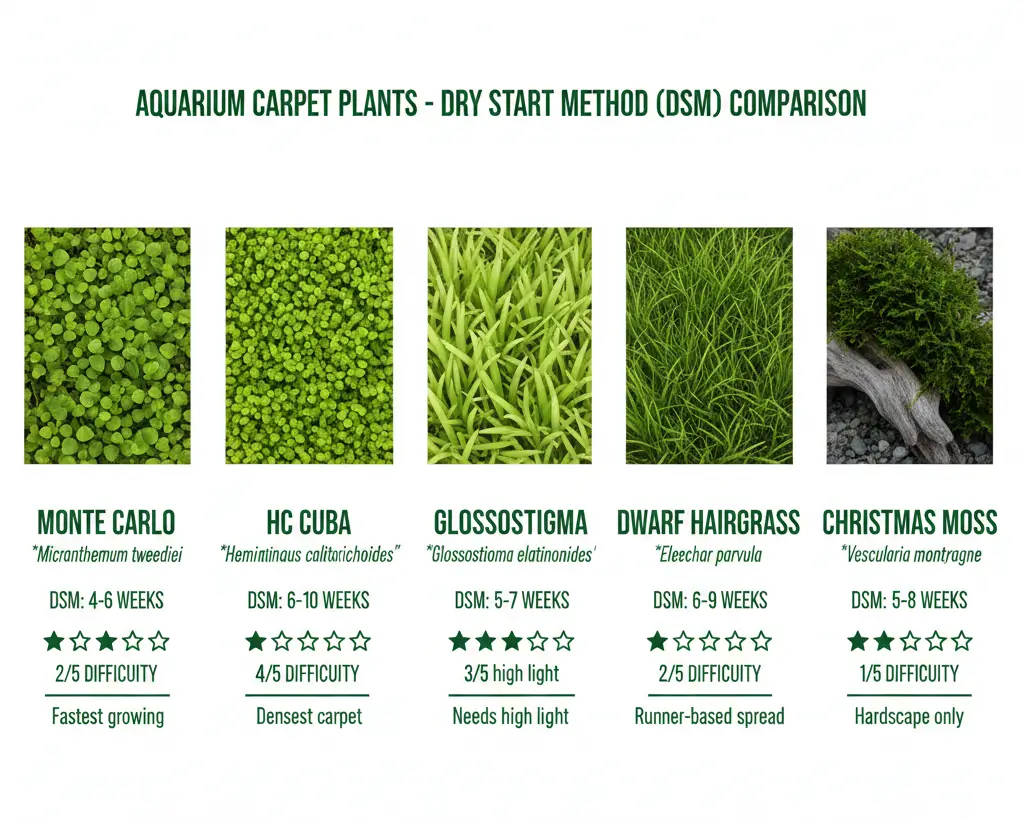
- Monte Carlo (Micranthemum tweediei): Fastest DSM species in my experience. Aggressive lateral runners, fills gaps quickly. Ready in 4-6 weeks under good conditions.
- HC Cuba (Hemianthus callitrichoides): Slower, denser, more prone to drying at leaf edges. Needs 6-8+ weeks. Beautiful results but demands patience.
- Glossostigma (Glossostigma elatinoides): Moderate speed, 5-7 weeks. Tends to grow vertically if light is insufficient. Needs strong PAR values.
- Dwarf Hairgrass (Eleocharis acicularis/parvula): Spreads via runners but can be slow emersed, 6-9 weeks in my testing. Individual blades are fine, so drying is a real risk.
- Mosses (Java, Christmas, Flame): Work emersed but don’t “carpet” the same way. Better for attaching to hardscape during a dry start rather than substrate coverage.
3. Substrate: Nutrient Density and Grain Size
Active substrates like ADA Amazonia or UNS Controsoil consistently outperformed inert options in my setups. The ammonium content in Amazonia acts as a nitrogen source for emersed roots, something you don’t get from pool filter sand or plain gravel.
Grain size matters too. Finer substrates hold moisture more evenly and give tiny roots something to grip. My Fluval Stratum tank (Tank #5) had slightly slower establishment than the Amazonia tanks, and I suspect the larger, rounder granules were part of why.
4. Light Intensity and Duration
You need light for DSM. Obviously. But how much?
I used LED fixtures rated at 40-80 PAR at substrate level across all five tanks, running 8-10 hours daily. Honestly, once you’re above ~40 PAR, more light didn’t seem to accelerate growth proportionally, it just increased the mold risk when combined with high humidity.
Eight hours is plenty. Ten is fine. Twelve is asking for trouble.
The Mold Problem Nobody Warns You About Enough
Week 3 of Tank #3. I pulled back the plastic wrap and found white, cobwebby mold spreading across a third of my HC Cuba and Glossostigma mix.
Gut reaction: panic. I almost scrapped the whole setup.
Here’s what I learned after digging through forums, reaching out to other aquascapers, and testing solutions: mold during DSM is common, it’s usually not fatal, and it’s almost always caused by insufficient air exchange.
The sealed environment that creates perfect humidity also creates zero airflow, ideal conditions for saprophytic fungi. The fix is absurdly simple. Unseal the tank for 15-20 minutes twice daily. Let fresh air circulate. If mold has already appeared, spray the affected area with a diluted hydrogen peroxide solution (3% H₂O₂, the standard drugstore concentration, in a 1:10 ratio with water). I did this on Tank #3, and the mold retreated within 48 hours. No plant damage.
Always ventilate when spraying hydrogen peroxide in enclosed spaces, and never use concentrations above 3% directly on plants.
After that experience, I started cracking the lid on every subsequent DSM setup for 15 minutes each morning and evening. Tanks #4 and #5 had zero mold issues. Not a speck.
I used to think the tank needed to be hermetically sealed the entire time. Wrong. It needs high humidity, not a vacuum chamber.
When to Actually Flood Your Tank (It’s Not About the Calendar)
MYTH: “Flood your dry start at 6-8 weeks.”
REALITY: The calendar is irrelevant. What matters is root establishment and coverage density. Some tanks are ready at week 4. Others need 10+. Flooding based on a calendar date instead of plant readiness is the second most common cause of DSM failure (after mold).
- Tom Barr’s original DSM recommendations emphasize visual root assessment over fixed timelines (Barr Report, 2006-2010 forum posts)
- My testing: Tank #4 was ready at 4.5 weeks. Tank #1 wasn’t ready at 8 weeks, I flooded anyway and lost about 30% of the carpet to floating.
The 6-8 week figure comes from averaging results under “typical” conditions, which almost nobody actually has. It became a rule when it was always an estimate.
WHAT TO LOOK FOR INSTEAD:
- Tug test. Gently pull a plant cluster. If it resists and the substrate moves with it, roots are anchored. If it pops right out, it’s not ready.
- Coverage. You want 80%+ substrate coverage. Bare patches larger than a quarter will invite algae post-flooding.
- Root visibility. If you can see white roots through the glass on the tank’s bottom or sides, that’s a strong ready signal.
- New growth. Active runners spreading into empty areas mean the plant is healthy and established.
Hit all four? Flood it. Hit two? Wait another week and check again.
After Flooding: The Critical First Two Weeks
This is where people celebrate too early and then watch things fall apart.
When you flood a DSM tank, every emersed leaf will eventually be replaced by submersed-form growth. Some species handle this transition gracefully, Monte Carlo barely flinches. HC Cuba can get dramatic, yellowing and melting old leaves while pushing new submersed foliage from the base. Don’t panic. Don’t rip anything out.
What you should do:
- Fill slowly. Use airline tubing or a plate to break the water flow. Pouring water directly onto the carpet dislodges plants, I learned this the hard way on Tank #2 when I got impatient with a measuring cup.
- Start CO₂ immediately. If you’re running a pressurized CO₂ system, turn it on at flood. Submersed plants need dissolved carbon, and the transition period is when they’re most vulnerable to being outcompeted by algae.
- Reduce lighting to 6 hours for the first week. The carpet can’t photosynthesize efficiently during the emersed-to-submersed transition. Excess light just feeds algae. Bump back to 8 hours in week two.
- Begin fishless cycling simultaneously. Your DSM tank has zero established biofilter. The ammonia leaching from active substrates like ADA Amazonia actually helps kickstart the nitrogen cycle, but you still need 3-4 weeks of cycling before adding livestock.
Do NOT add fish or shrimp immediately after flooding. There is no biological filtration established. Ammonia from the substrate will spike. Test daily and perform water changes as needed, I did 50% changes every other day for the first 10 days on my flooded DSM tanks.
Is the Dry Start Method Worth the Wait?
I’ve gone back and forth on this. After five dry starts and probably twice as many traditional submerged plantings, here’s where I’ve landed.
DSM is worth it if you’re growing carpet plants and you have the patience. The results are objectively better, denser coverage, stronger roots, less die-off, fewer algae problems during establishment. My best carpet ever came from Tank #4, the Monte Carlo dry start that took 4.5 weeks. That tank looked like something out of an IAPLC competition entry by month three.
But DSM isn’t magic. It’s not faster overall (you’re still waiting 4-10 weeks before you even add water), and it’s not appropriate for every setup. If you’re planting stem species like Rotala or Ludwigia, or working with obligate aquatics like Vallisneria, DSM doesn’t apply. And if you’re building your first planted tank, the wait can be discouraging, you might be better off starting submerged with forgiving species and trying DSM on your second or third setup.
For the rest of us, those chasing that perfect carpet for a nature aquarium or iwagumi layout, dry start is one of those techniques that rewards discipline. You put in weeks of misting, waiting, and checking. And then one morning you peel back the wrap, see roots threading through the soil and green covering every inch of substrate, and you know it’s time to add water.