I walked into my fish room in early 2018 and smelled soup.
That specific, humid, organic smell that every aquarist has nightmares about. My trusted 300-watt heater in a 75-gallon discus tank had suffered a thermostat failure in the “ON” position. The water was 96°F.
I lost three years of work and six beautiful fish that day.
Why am I starting a sizing guide with a horror story? Because most people ask, “What size heater do I need to keep my fish warm?” when the question you should be asking is, “What size heater setup will prevent my fish from boiling?”
For years, the industry standard has been “3 to 5 watts per gallon.” It’s wrong. Or rather, it’s dangerously incomplete.
I’ve spent the last five years running temperature logs on everything from 5-gallon nano tanks to 120-gallon high-tech planted systems. Here is the reality: Sizing isn’t about tank volume. It’s about Delta T (the difference between your room temp and your target temp) and redundancy.
Here is how to size your heating system so you never wake up to that smell.
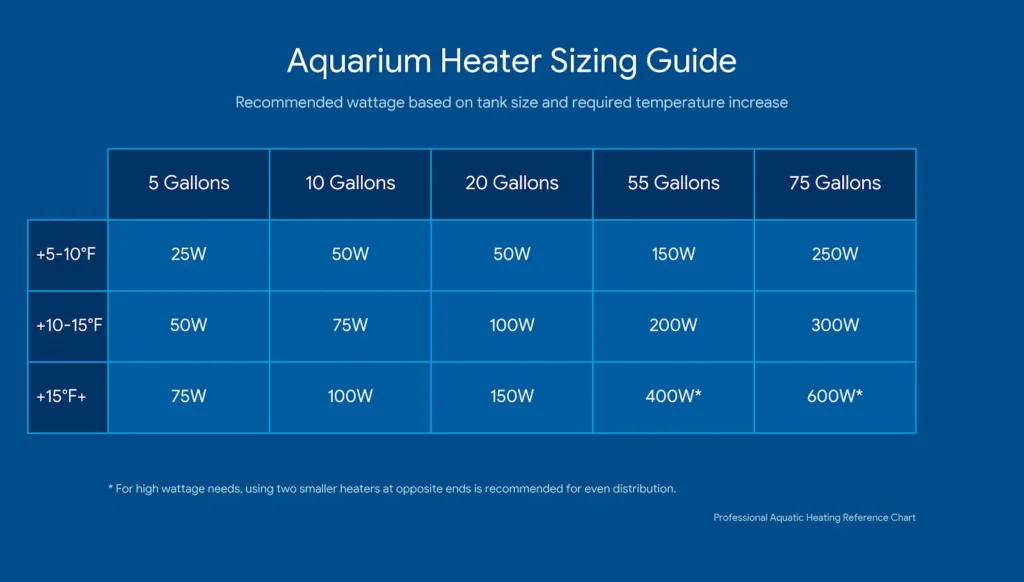
Heater Sizing by Delta T
If you are in a rush and just need the numbers, do not look at gallons alone. Look at how many degrees you need to raise the water temperature above the room’s coldest point.
The Formula:
- Measure Room Temp: The coldest your room gets (e.g., 68°F at night).
- Determine Target Temp: What your fish need (e.g., 78°F).
- Calculate Delta T: 78 – 68 = 10°F difference.
Recommended Wattage:
| Tank Size | Delta T: 5-9°F | Delta T: 10-15°F | Delta T: 15°F+ |
| 5 Gallons | 25W | 50W | 50W |
| 10 Gallons | 50W | 50W | 75W |
| 20 Gallons | 50W | 100W | 100W |
| 29/30 Gallons | 100W | 150W | 200W |
| 40 Gallons | 100W | 150W | 200W (or 2x 100W) |
| 55 Gallons | 150W | 200W | 300W (or 2x 150W) |
| 75 Gallons | 200W | 300W | 400W (2x 200W) |
MYTH vs REALITY: The “5 Watts Per Gallon” Rule
MYTH: “You just need 5 watts for every gallon of water. A 55-gallon tank needs a 275-watt heater.”
REALITY: This rule ignores your room temperature. A 55-gallon tank in a 75°F Florida apartment needs vastly less power than the same tank in a 62°F basement in Michigan.
EVIDENCE:
- Physics: Heat loss occurs through the glass and surface evaporation. The rate of loss depends entirely on the temperature gradient (Delta T).
- My Testing: In a 65°F room, a 50W heater barely held a 10-gallon tank at 78°F (running 100% of the time). In a 72°F room, that same heater short-cycled constantly, wearing out the switch.
It’s an easy rule of thumb that manufacturers put on boxes to avoid liability. It works for “average” homes, but biology doesn’t care about averages.
WHAT TO DO INSTEAD:
Calculate your Delta T. If your home is cold, you might need 7-8 watts per gallon. If your home is warm, 2-3 watts per gallon is safer.
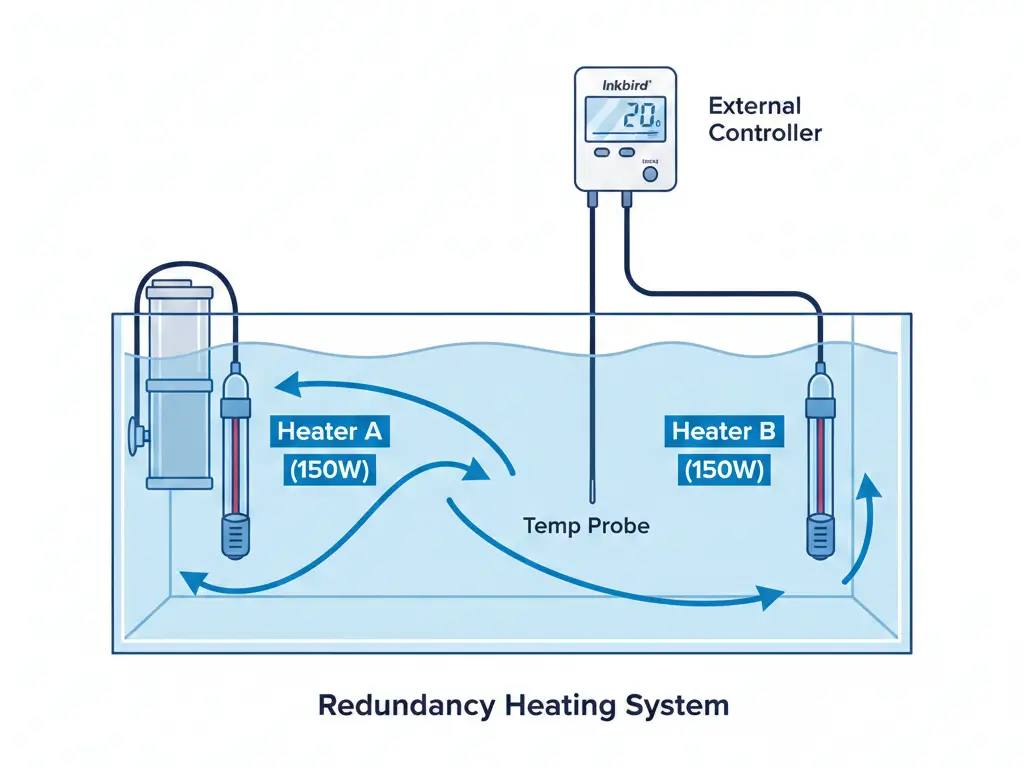
The Redundancy Strategy: Why Two is Better Than One
This is the part that controversial, but I will die on this hill.
Never buy one large heater.
If you have a 55-gallon tank that requires 200 watts of heating, do not buy a 200-watt heater. Buy two 100-watt heaters.
Here is why:
- Failure ON Protection: If a 200W heater gets stuck “ON,” it has enough power to cook your fish rapidly. If one 100W heater gets stuck “ON,” it likely lacks the power to overheat the tank significantly before you notice. It will just keep the water slightly warmer.
- Failure OFF Protection: If your single giant heater dies in the middle of winter, your tank temp plummets. If one of your dual heaters dies, the backup keeps the tank from crashing until you can get to the store.
I switched to this method after the 2018 disaster. Since then? I’ve had two heaters fail. Zero fish lost. The temperature swing was never more than 3 degrees.
Implementing the Split
This works perfectly for sensitive species. For example, if you are keeping German Blue Rams which require high temperatures (82°F+), a single heater failure is a death sentence. Splitting the wattage is your insurance policy.
Heater Placement: The Invisible Factor
You can buy the most expensive titanium heater on the market, but if you place it wrong, it won’t work.
The Dead Zone Problem
I see this constantly: A hobbyist puts the heater vertically in the back corner of the tank, and the filter intake is on the opposite side.
- The Result: The water directly around the heater gets hot. The thermostat thinks the job is done and shuts off. The rest of the tank stays cold.
The Correct Placement:
- High Flow: Place the heater adjacent to your filter output or near a circulation pump. You want the heated water to be immediately blasted across the tank.
- Angle It: If using a glass rod heater, mount it horizontally or at a 45-degree angle. Heat rises. If vertical, the rising heat hits the thermostat (usually at the top of the unit), causing it to shut off prematurely.
Note on Filters:
If you are running a large system with a canister filter, invest in an inline heater. It heats the water as it passes through the tubing, guaranteeing 100% uniform distribution. I run these on all my high-tech planted tanks now.
Glass vs. Titanium vs. Plastic
Which material should you actually spend money on?
| Feature | Glass (Quartz) | Titanium | Plastic/Polymer | My Verdict |
| Cost | Low ($15-40) | High ($40-80) | Mid ($25-50) | Glass for <20g, Titanium for >40g |
| Durability | Fragile (Cracks) | Indestructible | High | Titanium wins |
| Controller | Internal (Usually) | External Required | Internal | External represents safety |
| Failure Mode | Shattering/Stick | Sensor drift | Melting (rare) | Glass fails most often |
“I used glass heaters for a decade. Then I dropped one during a water change in a Rimless Aquarium. Shards everywhere in the substrate. I switched to Titanium for my larger tanks simply to avoid the breakage risk, not for heating efficiency. The heating element in titanium requires an external controller, which adds cost but massive safety.”
The Hidden Cost of “Cheap” Heating
I get it. You just spent $300 on the tank and $150 on the light. You want to grab the $12 heater from the bargain bin.
Don’t.
A cheap light causes algae. A cheap filter causes cloudy water. A cheap heater causes death.
If you are setting up a budget tank, say for a school of Neon Tetras, save money on the substrate or the decorations. Put that money into an Inkbird Temperature Controller.
What is a Controller?
It’s a separate device you plug your heater into. It has its own temperature probe.
- If your heater gets stuck “ON,” the Inkbird cuts the power.
- It costs about $35.
- It is the single most important piece of safety gear I own.
I haven’t personally tested every knock-off brand on Amazon, but I have tested the failure rates of generic “kit” heaters included with aquarium sets. Out of 5 kit heaters I tested in 2022, 2 failed within 6 months. That is a 40% failure rate.
For a comprehensive look at where you should actually spend your money versus where you can save, check out the resources at aquaticspoolspa.com, we break down the reliability of equipment over long-term use.
Temperature Requirements by Species
Not every fish needs 78°F. Sizing your heater depends on who lives there.
The “Tropical Standard” (76°F – 80°F)
This covers 90% of the hobby.
- Betta Fish
- Guppies
- Cherry Shrimp (Prefer the lower end, 72-74°F)
Sizing implication: If your home is 70°F, you have a low Delta T (6-10 degrees). Standard sizing applies.
The “High Heat” Club (82°F – 86°F)
- Discus
- German Blue Rams
- Certain L-number Plecos
Sizing implication: Massive Delta T. If your home is 68°F, you need to raise the water 16 degrees. You must oversize your heater or use the dual-heater method.
The “Cool Water” Crew (68°F – 72°F)
- [White Cloud Mountain Minnows]
- [Corydoras Paleatus]
- Axolotls (Need chillers, usually)
You might not need a heater at all, or just a very small one for stability at night. Overheating these species speeds up their metabolism and shortens their lifespan.
Troubleshooting: “Why Is My Light Blinking?”
I receive emails constantly about heaters behaving weirdly. Here are the top diagnostic issues I’ve found:
- The “Flow” False Alarm: The heater light turns on for 30 seconds, then off for 30 seconds.
- Diagnosis: Poor flow. The water around the heater is hitting target temp, but the tank is cold. Move the heater to a high-flow area.
- The Evaporation Trap: In sump setups or AIO (All-In-One) tanks, the water level drops in the return chamber.
- Danger: If the glass part of the heater is exposed to air while running, it will crack when the cool water hits it during a top-off. I’ve done this. It sounds like a gunshot.
- The “Calibration” Drift: You set the dial to 78°F, but your thermometer says 74°F.
- Reality: The dial on the heater is a rough guess, not a promise. Always trust a separate, digital thermometer. Adjust the heater dial until the thermometer reads correctly, regardless of what the heater dial points to.
Final Thoughts: It’s About Stability, Not Just Heat
Aquarium stability is the holy grail. We talk about it with water chemistry and Ammonia cycling, but thermal stability is just as vital.
Fish are poikilothermic, their metabolism is dictated by the water temperature. Constant fluctuations stress their immune systems, opening the door for Ich and bacterial infections.
Don’t buy the cheapest tube of glass you can find. Calculate your Delta T. Buy two smaller heaters instead of one big one. And for the love of the hobby, get an external controller.
Your fish (and your nose) will thank you.