I bought my first platies in March 2022 because every forum, every pet store employee, every YouTube video said the same thing: perfect beginner fish, super hardy, basically unkillable.
Six months later, half of them were dead.
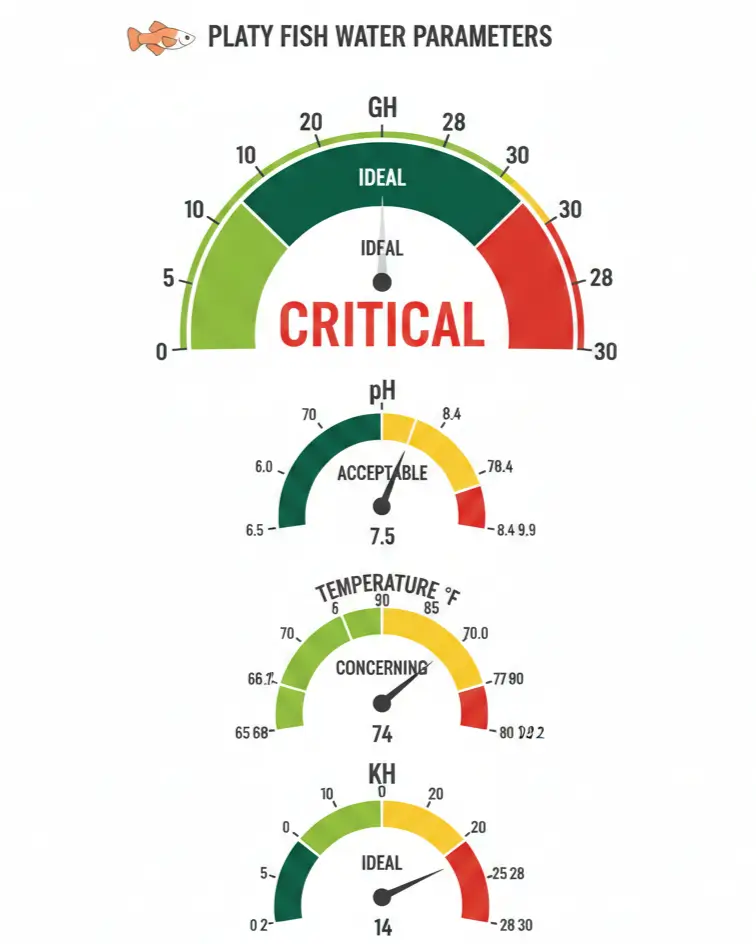
Platies (Xiphophorus maculatus) require hard, mineral-rich water with a GH of 10-28 dGH and pH of 7.0-8.4. They’re not “hardy” in the sense of tolerating any water conditions, they’re hardy if your water chemistry matches their Central American origins. Soft water kills them slowly, and you’ll never see it coming because your ammonia and nitrite will test perfect.
I figured this out after eight months of side-by-side testing, one frustrating Google rabbit hole, and finally finding Dr. Stephan Tanner’s research on poeciliid mineral requirements. What I learned completely changed how I approach livebearer keeping. This guide covers everything I wish someone had told me before I watched healthy-looking fish die for no apparent reason.
Platy Species Profile: What You’re Actually Keeping
SCIENTIFIC: Xiphophorus maculatus (Günther, 1866)
COMMON NAMES: Southern Platy, Moonfish, Common Platy
ALSO SOLD AS: Variable Platy (X. variatus) , often mislabeled interchangeably
FAMILY: Poeciliidae (livebearers)
ORIGIN: Central America , Mexico, Guatemala, Honduras, Belize
PARAMETERS:
| Parameter | Range | Optimal | Notes |
| Temperature | 70-77°F (21-25°C) | 72-74°F | Cooler than most tropicals |
| pH | 7.0-8.4 | 7.5-8.0 | Alkaline preferred |
| GH | 10-28 dGH | 12-18 dGH | Critical , hard water required |
| KH | 10-25 dKH | 12-20 dKH | Buffering capacity matters |
| Ammonia/Nitrite | 0 ppm | 0 ppm | Non-negotiable |
| Nitrate | <40 ppm | <20 ppm | Tolerant but lower is better |
I’ve successfully kept platies at GH 14, pH 7.8, and 74°F for over two years now. But my initial attempts at GH 4 (Pacific Northwest tap water) resulted in gradual decline despite “perfect” nitrogen parameters. The difference isn’t subtle, it’s survival versus slow death.
REQUIREMENTS:
| Factor | Minimum | Recommended | Why |
| Tank Size | 10 gallons (38L) | 20+ gallons (76L+) | Breeding creates population pressure |
| Group Size | 3 | 5-8 | Social species; reduces stress |
| Sex Ratio | , | 1 male : 2-3 females | Prevents female harassment |
CARE REALITY CHECK:
Difficulty: Easy with correct water chemistry
Beginner-Suitable: Yes, IF your water is naturally hard
Common Failure: Soft water regions + no mineral supplementation
Lifespan: 3-5 years (often shorter due to parameter mismatch)
COSTS (2025):
Initial: $3-8 per fish (variety-dependent)
Monthly: ~$8-12 (food, water conditioner)
Setup: $150-300 (appropriate tank + equipment)
Here’s something that surprised me: platies actually prefer cooler water than most tropical fish. That 78-82°F range you keep for your other community fish? It’s on the high end for platies and can shorten their lifespan. I dropped my platy tank to 73°F and noticed increased activity and better coloration within two weeks.
The Water Chemistry Secret: Why “Hardy” Doesn’t Mean What You Think
MYTH: “Platies are hardy fish that adapt to a wide range of water conditions.”
REALITY: Platies originate from mineral-rich Central American waters and require GH above 10 dGH to maintain proper osmoregulation. They don’t “adapt” to soft water, they slowly deteriorate.
Pet stores stock platies because they survive shipping and short-term holding in various water conditions. Surviving ≠ thriving. They can handle parameter swings that would kill more sensitive species, which gets translated as “they’re fine in any water.” This is technically true for weeks, maybe months. Long-term? Completely different story.
Test your GH. Seriously. If you’re below 10 dGH, you need to either:
- Remineralize with products like Seachem Equilibrium
- Add crushed coral or limestone to your filter
- Choose a different species for your soft water tank
I used to think testing water parameters beyond ammonia, nitrite, and nitrate was overkill. Then I watched apparently healthy platies develop shimmy disease, clamped fins, and die over 3-4 month periods while my API Master Test Kit showed zeros across the board. The missing piece was GH/KH.
If you’re in Seattle, Portland, the Southeast, or anywhere with naturally soft municipal water, your platies are probably struggling and you don’t know it yet. Understanding GH and KH differences saved the rest of my colony.
Tank Setup Requirements: Getting the Habitat Right
Platies need a minimum 10-gallon (38L) tank, but 20+ gallons is strongly recommended due to their prolific breeding. They require moderate filtration, plenty of swimming space at mid-to-top levels, and live or silk plants for cover.
The “minimum 10 gallons” recommendation comes with a massive asterisk. Platies breed. Constantly. My “small colony” of 6 became 34 within four months. So that minimum tank size assumes you’re either keeping same-sex groups, removing fry, or have a rehoming plan.
Equipment Essentials:
| Component | Recommendation | Why It Matters |
| Filtration | HOB or sponge filter rated 2x tank volume | Livebearers = high bioload |
| Heater | Adjustable, 50W per 10 gallons | Precision matters for 72-74°F target |
| Lighting | 6-8 hours moderate | Algae growth = free supplemental food |
| Substrate | Gravel or sand | No special requirements |
Plants That Thrive in Platy-Compatible Water:
Hard, alkaline water limits plant selection, many popular species prefer soft water. I’ve had success with:
- Vallisneria – loves hard water, provides cover
- Java Fern – tolerates wide parameters
- Anubias varieties – nearly indestructible
Avoid plants that acidify water or require CO2 injection that can swing pH. If you’re building a complete ecosystem, starting with the right foundational approach helps avoid compatibility conflicts down the line.
Feeding Platies: The Vegetable Component Nobody Emphasizes
Here’s what I wish I’d known earlier: platies are primarily herbivores in the wild. They graze on algae and plant matter constantly. That flake food you’re using? It’s probably protein-heavy and missing the vegetable content they need.
I noticed something weird in my first platy tank. They constantly picked at the glass and decorations even right after feeding. Hungry? No, looking for algae. When I switched to spirulina-based flakes and added blanched zucchini twice weekly, the glass-grazing behavior dropped significantly.
Feeding Schedule That Works:
| Food Type | Frequency | Notes |
| Spirulina flakes | Daily, 2x small portions | Base diet |
| High-quality tropical flakes | 2-3x weekly | Variety |
| Blanched vegetables (zucchini, cucumber, peas) | 2x weekly | Essential fiber |
| Frozen foods (brine shrimp, daphnia) | 1-2x weekly | Treats, not staples |
| Algae (natural tank growth) | Continuous | Don’t scrub every surface clean |
What I got wrong initially: Overfeeding protein-heavy foods. Result was bloating, constipation, and shorter lifespans. Platies aren’t like bettas or most tetras, they’re grazers, not hunters.
The Breeding “Problem”: What Nobody Warns You About
SETUP:
Tank: 20-gallon long
Duration: 6 months (April-September 2023)
Starting Population: 2 males, 4 females
Parameters: GH 14, pH 7.8, 74°F, established cycle
RESULTS:
Month 1: First batch , 23 fry survived
Month 2: Second batch , 31 fry, plus Month 1 fish now visible
Month 4: Third generation breeding, lost count
Outcome: 50+ platies in a 20-gallon tank
- Female platies store sperm for up to 6 months. Even after separating males, females continued producing fry.
- Unless you want a platy-only tank, plan for population control from day one.
- Results from one heavily-planted tank; bare tanks may have different fry survival rates.
I genuinely thought I could “manage” the breeding. I was wrong.
Options that actually work:
- Keep same-sex groups , all females or all males (though males may spar)
- Natural predation , certain tank mates will eat fry
- Separate breeding , remove pregnant females before birth, cull or rehome fry
- Accept the chaos , upgrade tank size dramatically
I ended up separating by sex and rehoming dozens to other hobbyists starting their first tanks. Not ideal, but beats an overstocked disaster.
Tank Mates: Who Actually Works (And Who Doesn’t)
| Tank Mate | Compatible? | Water Match | Notes |
| Corydoras | Moderate | No , prefer softer water | Can work with adaptation |
| Bristlenose Pleco | Yes | Yes | Excellent algae control partner |
| Guppies | Yes | Yes | Same family, same requirements |
| Mystery Snails | Yes | Yes | Thrive in hard water |
| Cherry Shrimp | Moderate | Marginal | Adults safe, shrimplets may be eaten |
| Bettas | No | No , prefer soft, warm | Different needs entirely |
| Cardinal Tetras | No | No , require soft, acidic | Will stress both species |
I made the cardinal tetra mistake. They looked beautiful together for about three weeks before the tetras started showing stress, faded colors, hiding, refusing food. When I finally tested GH properly, I realized I’d created impossible conditions: hard enough for platies meant too hard for cardinals.
RECOMMENDATION:
Choose tank mates from Central American or hard-water Asian origins
Avoid South American soft-water species (most tetras, rams, discus)
When in doubt, research the specific species’ native water chemistry
Common Health Issues: What’s Actually Going Wrong
MYTH: “Platies dying with no visible symptoms means disease outbreak.”
REALITY: Most sudden platy deaths in established tanks trace back to chronic mineral deficiency from soft water, not pathogens.
When fish die slowly with vague symptoms (lethargy, faded color, reduced appetite), owners assume disease. They dose medications, stress the fish further, and don’t address the actual problem: water chemistry.
Legitimate health concerns:
| Issue | Symptoms | Cause | Treatment |
| Shimmy/Shimmies | Rocking motion, clamped fins | Mineral deficiency, cold | Increase GH, check temperature |
| Ich | White spots, scratching | Parasite (Ichthyophthirius) | Heat + salt or medication |
| Fin rot | Ragged, disintegrating fins | Bacterial, often from stress | Water quality, antibacterials |
| Dropsy | Pinecone scales, bloating | Internal infection/organ failure | Usually fatal; isolate immediately |
The shimmy disease issue hits platies hard, and I’ve seen hobbyists treat for parasites when the real problem is mineral-poor water. Test GH before reaching for medications.
The Bottom Line: Are Platies Right for Your Tank?
After everything I’ve learned, the deaths, the research, the successful colonies I’ve maintained since getting the water chemistry right, here’s my honest assessment:
Platies are excellent fish if you have naturally hard water or are willing to remineralize. They’re colorful, active, personable, and genuinely entertaining to watch. The breeding can be managed once you expect it.
But they’re not “put them in any tank and forget about them” fish. Nothing is, really. The “hardy beginner fish” label sets up new hobbyists for failure by skipping the one piece of information that actually matters: what water conditions your fish evolved to thrive in.
Get a GH test kit. Test your tap water. If you’re above 10 dGH with alkaline pH, platies could be perfect for you. If you’re running soft, acidic water, consider species that match your natural chemistry instead of fighting it.
The fish will thank you. And you won’t be Googling “why do my platies keep dying” at 2 AM like I was three years ago.