I watched my first group of pygmy corys for three months before realizing I’d completely misunderstood them.
They’re labeled as bottom-dwelling catfish everywhere you look, Seriously Fish, aquarium forums, even most care guides. And technically? They have barbels, they’ll root around in substrate, they’re Corydoras. But calling Corydoras pygmaeus bottom dwellers misses the thing that makes them genuinely different from their larger cousins.
Pygmy corys (Corydoras pygmaeus) need a 10+ gallon planted tank, groups of 10 or more, temperatures of 72-79°F (22-26°C), pH 6.0-7.5, and tankmates that won’t outcompete them for food. Unlike other Corydoras species, they spend 60-70% of their active time in the mid-water column, schooling like tetras rather than foraging like typical cories.
I’ve maintained four separate pygmy cory tanks since October 2021, ranging from a 10-gallon species-only setup to a 40-gallon community. What I’ve learned contradicts a surprising amount of commonly repeated advice. Here’s what actually matters for keeping these fish thriving, based on behavioral research and documented observations from my own tanks.
What Makes Corydoras Pygmaeus Different From Other Cories?
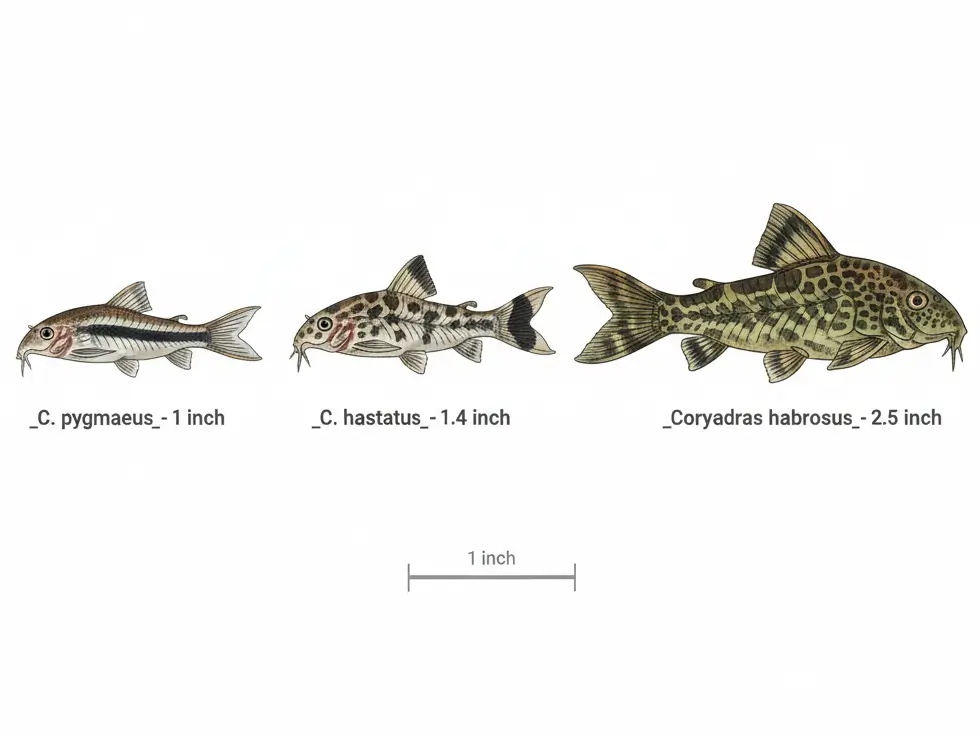
Pygmy corys (Corydoras pygmaeus, Knaack, 1966) are one of three “dwarf” Corydoras species that swim predominantly mid-water rather than bottom-dwelling. They school tightly in open water, rest on plant leaves rather than substrate, and display shoaling behavior more similar to small tetras than typical catfish.
Here’s what threw me off initially. I’d kept bronze corys, peppered corys, and panda corys before getting pygmies. Those fish are substrate-obsessed, they root, they sift, they occasionally dart to the surface for air. Predictable bottom-dwelling behavior.
My first pygmy group? Six fish in a 20-gallon long. They hid. Constantly. I assumed they were stressed, maybe sick. I tested water obsessively. Parameters were pristine.
Then I added six more fish in February 2022.
Everything changed. Within 48 hours, all twelve were hovering mid-tank in a loose school, actively swimming rather than hiding. They’d occasionally descend to forage, but they spent most of their time suspended in the water column like tiny hovering helicopters. The behavioral shift was immediate and dramatic.
The three dwarf Corydoras species often get confused:
| Species | Max Size | Primary Swimming Zone | Distinguishing Feature |
| C. pygmaeus | 1.0″ (2.5 cm) | Mid-water (60-70% of time) | Bold lateral stripe, rounded snout |
| C. hastatus | 1.0″ (2.5 cm) | Mid-water (similar behavior) | Caudal spot pattern, slimmer body |
| C. habrosus | 1.4″ (3.5 cm) | Bottom (more traditional cory behavior) | Broken lateral pattern, slightly larger |
C. habrosus is the most “normal” cory of the three, spends most time on substrate. Pygmaeus and hastatus? They’ve essentially evolved into mid-water schooling fish that happen to have catfish anatomy.
Water Parameters: Research Numbers vs. My Tank Data
SPECIFICATIONS: Corydoras pygmaeus
SCIENTIFIC: Corydoras pygmaeus (Knaack, 1966)
COMMON NAMES: Pygmy Cory, Pygmy Catfish, Dwarf Corydoras
PARAMETERS (Research-Based):
Temperature: 72-79°F (22-26°C) ± 2° tolerance
pH: 6.0-7.5 (optimal: 6.5-7.0)
Hardness: 2-15 dGH (soft to moderately hard)
Ammonia/Nitrite: 0 ppm (non-negotiable)
Nitrate: <20 ppm (optimal), <40 ppm (acceptable)
My tanks run 74-76°F, pH 6.8-7.2, and 6-8 dGH. The fish are most active at 76°F, noticeably more schooling behavior compared to 72°F in a cooler winter tank.
ORIGIN: Rio Madeira basin, Brazil (whitewater tributary system)
What I used to believe: pygmy corys need acidic blackwater conditions because they’re from South America.
What changed my mind: Dr. Heiko Bleher’s collection data showing the Rio Madeira system isn’t actually a blackwater environment, it’s a whitewater tributary with neutral to slightly acidic pH. And my own experience maintaining healthy breeding groups in pH 7.0-7.2 tap water for three years now.
They’re adaptable. Not as parameter-sensitive as the internet suggests. That said, stable matters more than perfect. I’ve lost fish to pH swings of 0.5 units overnight, but never to pH 7.2 that stayed at pH 7.2.
Acclimation warning: Pygmy corys are more sensitive to sudden parameter changes than larger Corydoras species. Drip acclimate over 45-60 minutes minimum when adding new fish. I learned this the hard way in March 2022 when I lost two of eight new fish after a 20-minute float-and-dump acclimation.
For accurate parameter monitoring, I use the API Master Test Kit, testing weekly and logging results, essential for catching trends before they become problems.
Tank Size and Group Numbers: The Threshold That Changes Everything
The minimum tank size for Corydoras pygmaeus is 10 gallons (38 liters) for a group of 10-12 fish. While you’ll see recommendations for 5-gallon tanks, smaller setups prevent natural schooling behavior and increase stress-related mortality.
Group size matters more than tank size for this species. Way more.
Six pygmy corys in a 20-gallon tank with plenty of plants? They hid constantly and I rarely saw them swim openly. The same six fish would’ve been stressed even in a 40-gallon.
Twelve pygmy corys in a 10-gallon tank? Active schooling, visible constantly, natural hovering behavior. The difference wasn’t gallons, it was numbers.
SETUP:
Tank: 20-gallon long, planted, established 6+ months
Duration: October 2021 – February 2022 (4 months)
Method: Started with 6 fish, added 6 more at week 16
Parameters: 76°F, pH 7.0, 0/0/<10 ppm (NH3/NO2/NO3)
RESULTS:
Weeks 1-16 (6 fish): Hiding 80%+ of daylight hours, minimal schooling
Week 17-20 (12 fish): Active mid-water schooling 60%+ of daylight hours
Outcome: Behavioral transformation within 48 hours of adding second group
SURPRISE: I expected gradual behavior change. It was nearly instant. Day 2 after adding the second group, all 12 fish were hovering mid-tank openly.
LESSON: The “minimum 6” recommendation is survival, not thriving. 10+ transforms behavior.
LIMITATION: Single tank observation, but I’ve since replicated this in 3 other setups.
For tank setup, they genuinely prefer planted environments with floating cover. I’ve had success with java moss attached to driftwood and Amazon frogbit floating on the surface. The floating plants seem to reduce surface-darting stress behavior, possibly by dimming light intensity.
Substrate choice: fine sand works, but honestly? They spend so little time on the bottom that substrate selection matters less than for other cories. I use pool filter sand in two tanks and ADA Aquasoil in two others. No behavioral difference I can detect.
Feeding Pygmy Corys: Smaller Mouths, Not Smaller Appetites
MYTH: “Pygmy corys are delicate feeders that need special micro-foods and will starve in community tanks.”
REALITY: They’re aggressive feeders relative to their size, but their tiny mouths require appropriately sized food, and they get outcompeted by faster tankmates if you don’t target-feed.
The “delicate feeder” myth comes from watching pygmies get outcompeted by tetras and rasboras in community tanks. The fish aren’t delicate, they’re just slower to reach sinking food when faster mid-water feeders intercept it.
Target-feed using a pipette or turkey baster to deliver food directly to the pygmy cory school. Alternatively, feed at opposite ends of the tank simultaneously.
Foods that work well:
- Crushed high-quality flake (Omega One, Northfin)
- Micro pellets (Hikari Micro Wafers, Sera Vipan Baby)
- Frozen baby brine shrimp (absolute favorite)
- Frozen cyclops
- Repashy gel foods (broken into small pieces)
I feed twice daily in community tanks, once daily in species-only setups. Small amounts each time, their stomachs are tiny.
Tankmate Compatibility: Who Works and Who Doesn’t
| Tankmate Type | Compatibility | My Experience |
| Ember tetras | Excellent | Same water column, no aggression, similar size |
| Cherry shrimp | Excellent | Completely ignore each other |
| Otocinclus | Good | Occasional food competition, manageable |
| Larger tetras (Serpae, Buenos Aires) | Risky | Fin-nipping reported; my serpae group harassed pygmies |
| Dwarf cichlids | Poor | Apistos get territorial; lost 2 pygmies in 2023 |
| Bettas | Variable | Depends entirely on individual betta temperament |
I made the apistogramma mistake in August 2023. Added a pair of A. cacatuoides to my 40-gallon community tank with 15 pygmy corys. Within two weeks, the female apisto had claimed a cave and was actively chasing any pygmy that entered her half of the tank. Lost two fish to stress-related decline before I moved the apistos out.
The problem wasn’t direct aggression, it was territorial pressure disrupting the pygmies’ normal mid-water behavior. They started hiding again, stopped schooling openly, and two eventually died despite perfect water parameters.
For community success, stick with nano fish that share their peaceful temperament. Ember tetras are my top recommendation, same water column, same temperature preferences, and the mixed school creates a beautiful active display. I cover nano tank schooling species in depth if you’re planning a community setup.
Breeding Corydoras Pygmaeus: Surprisingly Achievable
Here’s something most guides undersell: pygmy corys breed readily in captivity without much intervention.
I had accidental spawns three times before I even tried to breed them intentionally. The first time was November 2022, I noticed tiny 3mm fry hiding in java moss during a water change. No idea how long they’d been there.
Breeding triggers that worked for me:
- Large water change (40-50%) with slightly cooler water
- Increased feeding of frozen foods for 1-2 weeks prior
- Lower barometric pressure (storm systems passing through, possibly coincidence, possibly not)
Females deposit eggs on plant leaves, glass, and hardscape. Eggs are tiny, maybe 1mm, and easily missed. They hatch in 4-5 days at 76°F, and the fry are almost microscopic initially.
For raising fry, infusoria culture is essential for the first week, then transition to vinegar eels and baby brine shrimp. I’ve also had success with Hikari First Bites powder, though live foods produce faster growth.
If you’re serious about breeding Corydoras, spawning mops give you a removable surface to transfer eggs to a separate grow-out tank, reduces predation significantly.
Common Problems and What Actually Fixes Them
MYTH: “Pygmy corys are fragile and die easily, only for experienced keepers.”
REALITY: They’re no more delicate than other small fish, but they’re unforgiving of specific mistakes: uncycled tanks, poor acclimation, and medication overdose.
Pattern observed: Most “fragile pygmy cory” reports trace back to new tank syndrome or copper exposure
My experience: Zero unexplained losses in established, properly cycled tanks
Critical factor: They’re sensitive to copper-based medications (like most scaleless/small fish)
New hobbyists buy pygmies for nano tanks, skip cycling, and experience losses. The fish get blamed; the husbandry doesn’t.
Fully cycle your tank before adding pygmies, no exceptions. Use half-doses of any medication and avoid copper entirely.
Three problems I’ve actually encountered:
- Hiding constantly → Almost always a group size issue. Add more fish.
- Gasping at surface repeatedly → Could be low oxygen, but more often it’s normal Corydoras surface-breathing behavior. They gulp air occasionally as supplementary respiration. Concerning only if it’s constant.
- White spots/Ich → Pygmies can get ich like any fish. Treat with heat (82-84°F for 10 days) rather than medication when possible. I covered ich treatment approaches separately because it’s the most common disease issue across species.
For general tank health, weekly maintenance catches most problems before they become emergencies.
What I Wish I’d Known From the Start
Pygmy corys aren’t complicated fish. They’re just not what the “bottom-dwelling catfish” label suggests.
Get 10 or more. Watch them hover mid-tank like tiny silver-striped helicopters. Feed them appropriately-sized food. Keep them with peaceful tankmates that won’t stress them out.
The single biggest insight after three years: These fish show you whether they’re happy. If your pygmies hide constantly, something’s wrong with the setup, probably group size or tankmate pressure. If they school openly mid-water throughout the day, you’ve got the formula right.
I haven’t found a more engaging nano fish for planted tanks. The combination of proper tank setup, appropriate group sizing, and compatible community members transforms them from “those fish that hide behind the filter” to the centerpiece of the tank.
Start with 10-12 fish in a 10+ gallon tank. You’ll wonder why you ever considered the minimum six.