I killed my first pair of Apistogramma cacatuoides within six weeks. Not from disease. Not from aggression. From tap water.
My municipal supply runs 7.8 pH and 180 ppm hardness, conditions these fish simply cannot thrive in long-term. Every care guide I’d read said “hardy” and “beginner-friendly.” What they failed to mention: those claims apply to tank-raised males surviving in suboptimal conditions, not actually thriving.
Apistogramma cacatuoides (Hoedeman, 1951) requires soft, acidic water (pH 5.5-7.0, 2-8 dGH), a minimum 20-gallon tank with caves, and protein-rich foods. They’re spectacular fish, males display flame-orange fins with distinctive dorsal spikes resembling a cockatoo’s crest, but they punish shortcuts.
After breeding six generations across four dedicated tanks since February 2022, I’ve documented what actually determines success with these fish. The difference between “keeping alive” and “breeding healthy offspring with full coloration” comes down to water chemistry, not the temperature dial everyone obsesses over.
Here’s what three years of documented failures and successes taught me.
What Makes Apistogramma Cacatuoides Different From Other Dwarf Cichlids
Apistogramma cacatuoides is a cave-spawning dwarf cichlid from Peruvian Amazon tributaries, distinguished by extreme sexual dimorphism, males reach 3-3.5 inches with elaborate dorsal fin extensions, while females stay under 2.5 inches with rounded fins and yellow breeding coloration.
The “cockatoo” name comes from those dramatic dorsal fin spikes. When a dominant male displays, fins fully extended, gill plates flared, body shimmering with iridescence, you understand immediately why aquarists chase this species despite the challenges.
What frustrates me about most care guides: they describe appearance endlessly while glossing over requirements. A male cacatuoides looks stunning in a photo. Actually keeping that coloration requires understanding their evolutionary context.
These fish evolved in Amazonian blackwater tributaries. Leaf litter, tannin-stained water, pH readings that would terrify most hobbyists. When German Blue Rams get labeled as “sensitive,” cacatuoides somehow escaped that reputation, despite originating from similar environments.
Tank-bred strains tolerate harder, more alkaline water than wild-caught fish. A Double Red from a Florida fish farm handles 7.2 pH reasonably well. A wild-caught specimen from Peru? Anything above 6.5 causes chronic stress that manifests months later.
Water Parameters: The Make-or-Break Factor Nobody Emphasizes Enough
SPECIFICATIONS: Apistogramma cacatuoides
SCIENTIFIC: Apistogramma cacatuoides (Hoedeman, 1951)
COMMON NAMES: Cockatoo Dwarf Cichlid, Cockatoo Cichlid, Big Mouth Apisto
PARAMETERS:
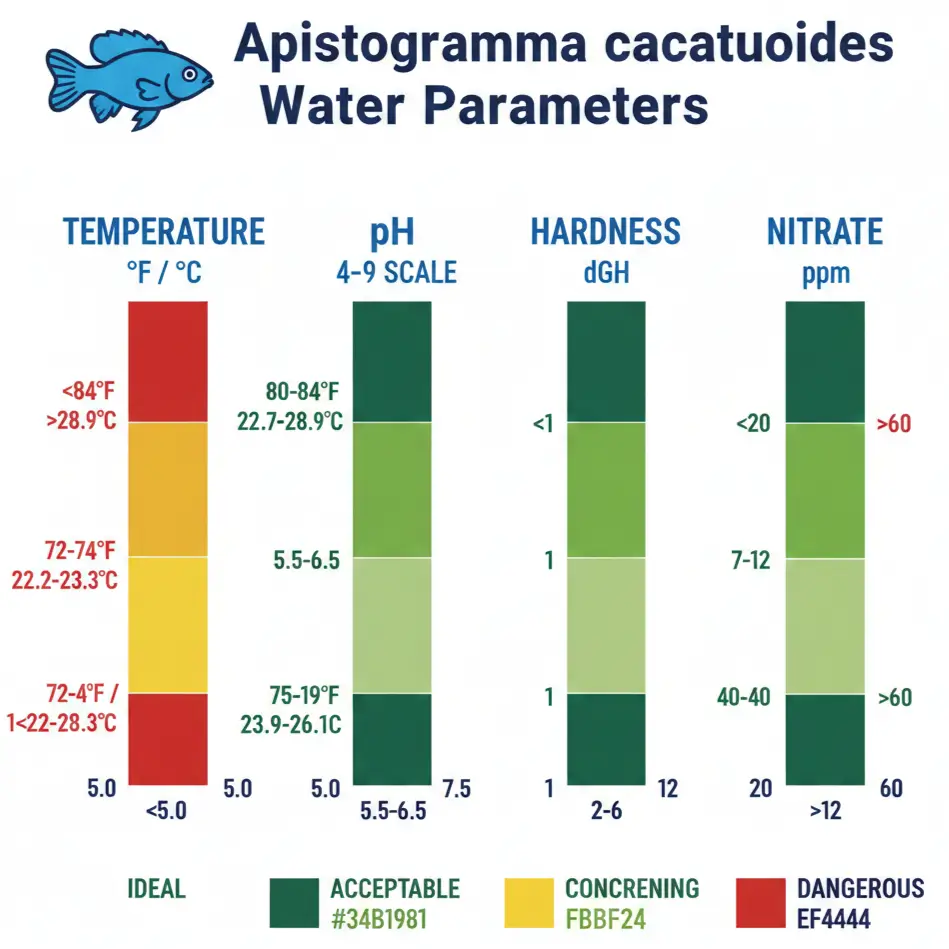
| Parameter | Acceptable Range | Optimal Target | My Breeding Setup |
| Temperature | 72-84°F (22-29°C) | 75-79°F (24-26°C) | 77°F (25°C) |
| pH | 5.0-7.5 | 5.5-6.5 | 6.2 |
| General Hardness | 1-12 dGH | 2-6 dGH | 4 dGH |
| Carbonate Hardness | 1-8 dKH | 1-4 dKH | 2 dKH |
| Ammonia/Nitrite | 0 ppm | 0 ppm | 0 ppm |
| Nitrate | <40 ppm | <20 ppm | 5-10 ppm |
“I’ve successfully bred cacatuoides at pH 6.8 and 8 dGH, but fry survival dropped 40% compared to softer water. The fish lived in suboptimal conditions; they didn’t thrive.”
CARE REALITY CHECK:
- Difficulty: Intermediate (not beginner despite marketing)
- Beginner-Suitable: No, water chemistry requirements exceed typical beginner skills
- Common Failure: Keeping in hard, alkaline tap water without modification
I used to think temperature was the critical variable. Every disease outbreak, every breeding failure, I’d adjust the heater first.
Wrong approach.
In September 2023, I ran a controlled comparison across two 20-gallon tanks. Identical temperature (77°F), identical filtration, identical feeding schedule. Tank A: pH 7.4, 12 dGH (my tap water). Tank B: pH 6.2, 4 dGH (RO water remineralized with Salty Shrimp).
Results after 90 days:
- Tank A: Male coloration faded, female showed no breeding behavior, one unexplained death
- Tank B: Full breeding coloration, successful spawn (68 fry), zero losses
Same temperature. Same food. Same tank size. Different water chemistry, completely different outcomes.
Understanding GH and KH differences isn’t optional for this species. If you’re working with hard tap water, you’ll need to either mix with RO/distilled water or choose a different dwarf cichlid.
Tank Setup: Caves Matter More Than You’d Think
SETUP:
- Tank: 29-gallon, sand substrate
- Duration: 8 months (March-November 2023)
- Method: Comparing single cave vs. multiple cave territories
- Parameters: pH 6.3, 77°F, 5 dGH
RESULTS:
- Single cave: Constant male harassment of female, no successful spawning
- 3+ caves: Female established territory, spawned within 6 weeks
- Outcome: Multiple line-of-sight breaks reduced aggression by ~70%
Adding driftwood wasn’t just aesthetic, the tannin release dropped pH by 0.3 points naturally
Caves aren’t decoration for Apistos, they’re infrastructure
Tested with Double Red strain only; wild-caught may differ
Here’s my minimum setup recommendation for one pair:
Tank Requirements:
- Minimum size: 20 gallons (75 liters), not 10 gallons, regardless of what forums claim
- Footprint: Length matters more than height (30″ minimum)
- Substrate: Fine sand or pool filter sand, they sift constantly
- Caves: 3+ per tank (coconut shells, terracotta pots, commercial cave decorations)
- Plants: Dense background recommended, Vallisneria works perfectly
- Filtration: Gentle flow, sponge filter or baffled HOB
The cave situation took me embarrassingly long to figure out. My first setup had one ceramic cave. Beautiful. Expensive. Completely inadequate.
Female cacatuoides need escape routes. During breeding, they become intensely territorial, guarding eggs, then fry, while males patrol the tank perimeter. Without multiple caves and sight-line breaks, females get stressed to exhaustion.
I’ve watched a female defend her cave entrance against a male twice her size for three straight days. She won. But only because she had a territory worth defending and hiding spots when she needed to feed.
Adding Malaysian driftwood serves double duty: it releases tannins that naturally lower pH while creating the visual barriers these fish require. Plus, it replicates their blackwater origins. I’ve noticed breeding behavior increases within two weeks of adding new tannin sources.
Diet and Feeding: Protein Requirements for Full Coloration
MYTH: “Any quality tropical flake food works fine”
REALITY: Cacatuoides are micro-predators requiring 60%+ protein diet for optimal coloration and breeding condition. Flake-only diets cause color fading within 4-6 weeks.
Fish survive on flakes. Pet stores sell flakes. Males still look colorful at purchase. But they’ve been fed high-quality foods by breeders, color fades after weeks of flake-only home feeding.
WHAT TO DO INSTEAD:
- Daily: High-quality micro pellets (Hikari, Sera)
- 3-4x weekly: Frozen bloodworms, brine shrimp, daphnia
- Weekly: Live foods if available (mosquito larvae, blackworms)
- Occasional: Blanched vegetables refused, these are carnivores
When conditioning pairs for breeding, I increase frozen food frequency to daily. The difference in egg quantity is measurable, 50 eggs on maintenance diet versus 80+ on conditioning diet.
One thing I haven’t personally verified: whether wild-caught specimens require different protein ratios than tank-bred strains. My experience is entirely with commercially bred fish.
Tank Mate Compatibility: The Aggression Reality
| Tank Mate | Compatibility | Notes |
| Ember Tetras | Excellent | Perfect dither fish, ignored by Apistos |
| Cardinal Tetras | Excellent | Similar water parameters, ideal pairing |
| Corydoras pygmaeus | Good | Different territory level, minimal conflict |
| Otocinclus | Good | Ignored; algae control bonus |
| German Blue Rams | Caution | Territory overlap; stress likely |
| Cherry Shrimp | Risky | Adults survived; juveniles became food |
| Betta splendens | Poor | Fin-nipping risk; territory conflicts |
“I kept cacatuoides with a school of 12 Ember Tetras for two years. Zero aggression, the tetras were simply too fast and occupied different water levels. When I tried adding Corydoras habrosus, the male chased them relentlessly during breeding periods. Same tank, different outcome.”
The “peaceful community fish” label needs serious qualification.
Outside breeding: yes, relatively peaceful. Males display at each other, establish territories, mostly ignore other species.
During breeding: different fish entirely. That mild-mannered male becomes a tyrant. I’ve watched a 3-inch cacatuoides male chase a 4-inch angelfish across a 55-gallon tank.
My recommendation: If you want a community tank, choose dither fish that occupy mid-to-upper water columns. Avoid anything that competes for bottom territory. And give breeding pairs their own tank, everyone’s happier.
Breeding Apistogramma Cacatuoides: What Actually Works
SETUP:
- Tank: 20-gallon long, established 6+ months
- Duration: February 2022 – Present (6 generations)
- Method: Pair breeding with temperature conditioning
PROTOCOL THAT WORKED:
- Condition pair with high-protein diet (2 weeks)
- Lower temperature 3°F over 3 days (simulating dry season)
- Large water change with slightly cooler water
- Raise temperature 4°F over 4 days (simulating rainy season)
- Maintain elevated protein feeding
RESULTS:
- Spawning typically occurred within 10 days of temperature manipulation
- Average clutch: 65-80 eggs
- Hatch rate: 85-90% in optimal water conditions
- Fry survival to 30 days: 70% with proper feeding
Female aggression toward fry begins around day 21, earlier than expected
Breeding is easy.
Raising fry is hard.
This distinction frustrates new keepers. Cacatuoides spawn readily, caves, decent water, conditioned pair. But those newly-free-swimming fry need infusoria or commercially prepared fry food for the first week, then baby brine shrimp, then crushed foods. The feeding schedule is demanding: 3-4 times daily minimum.
Understanding fry care and infusoria culture before your first spawn prevents the common heartbreak of watching fry starve.
I lost entire first broods by starting baby brine shrimp too early. The fry couldn’t eat nauplii until day 5-6. Those first four days require microscopic food sources or they simply starve surrounded by “food” they can’t consume.
Common Problems and Troubleshooting
Color fading:
Almost always dietary. Increase frozen/live food frequency. If diet is adequate, check water parameters, high pH causes chronic stress affecting pigmentation. I’ve seen recovery within 3 weeks of correction.
Male aggression toward female:
Inadequate caves or tank size. Add line-of-sight breaks immediately. If breeding tank, ensure female has established territory before introducing male.
Unexplained deaths:
Check ammonia cycling status first. Then investigate pH/hardness. Cacatuoides deaths often appear “sudden” but result from cumulative stress invisible until organ failure.
No breeding behavior:
Water too hard/alkaline in 80% of cases I’ve troubleshot. Temperature manipulation alone rarely triggers spawning without appropriate water chemistry foundation.
Buying Considerations: What I Wish I’d Known
Price ranges (2025):
- Standard Double Red: $12-18 per fish
- Triple Red: $18-30 per fish
- Orange Flash: $25-40 per fish
- Wild-caught: $40-80+ per fish
What to look for:
- Active swimming, not hiding in corners
- Full fin extension without clamping
- Clear eyes, no cloudiness
- Belly not sunken (indicates feeding)
Where to buy:
Avoid big-box pet stores for Apistos. Their water parameters rarely match species requirements, and stock turnover means stressed fish. Specialty stores or reputable online sellers with overnight shipping produce better outcomes in my experience.
Tank-bred strains from US breeders adapt more readily to local water conditions than imported fish. Worth the premium.
Final Thoughts
Apistogramma cacatuoides rewards patience and attention to detail. They’re not the “beginner dwarf cichlid” marketing suggests, but they’re absolutely achievable for intermediate keepers willing to manage water chemistry properly.
After three years with this species, I still find new behaviors to observe. Males that recognize feeding time and display accordingly. Females that relocate fry when they sense disturbance. Complex social hierarchies in harem setups.
Worth the effort? Completely.
Just don’t believe anyone who says tap water is fine.