I stood in the aisle of my local pool supply store staring at a 50lb bag of sand that cost $12.99.
Next to it on my phone screen was a specialized “aquarium sand” retailing for $35 for a 20lb bag. The math was practically screaming at me. I’ve built over 15 planted tanks in the last decade, ranging from high-tech Dutch styles to low-tech jungles, and the single biggest expense has always been the substrate.
So, does pool filter sand (PFS) actually work for planted aquariums?
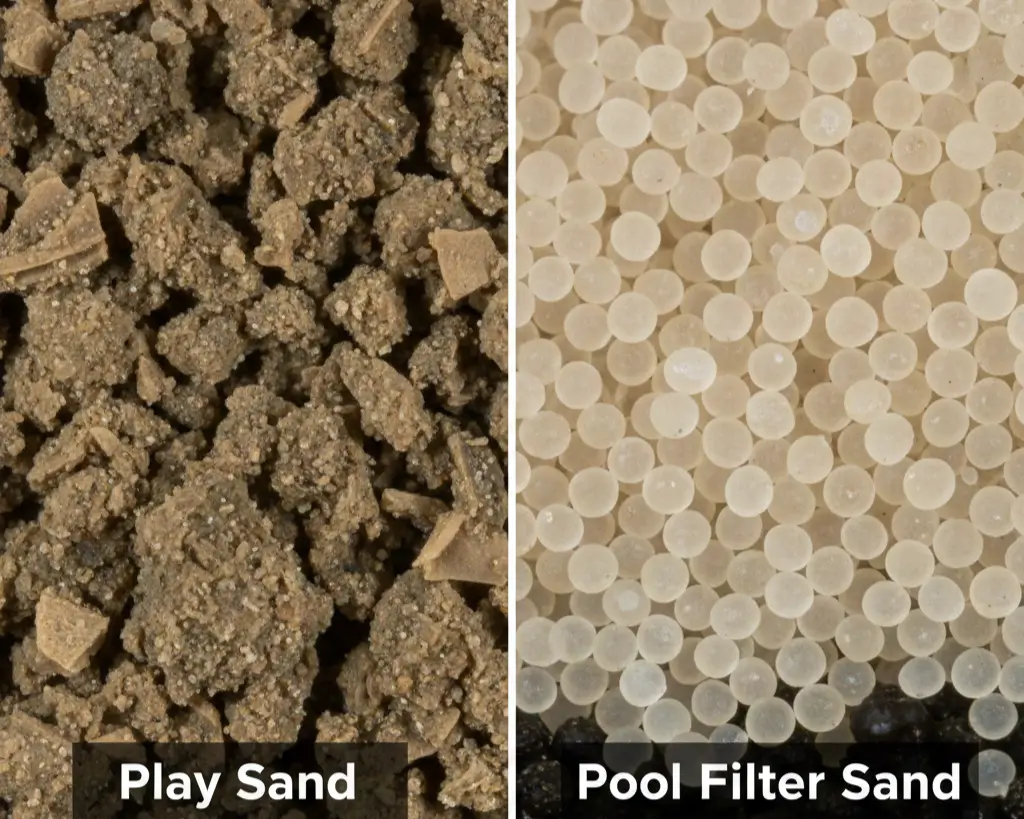
Yes, pool filter sand is an excellent, safe substrate for planted tanks because its uniform grain size (0.45mm–0.55mm) allows for water circulation, preventing the anaerobic gas pockets common with play sand.
However, and this is the part most guides gloss over, it is biologically inert. It has zero nutrients. If you dump sand in a tank and plant heavy root feeders without a plan, they will starve. I learned this the hard way on a 40-gallon breeder setup in 2021.
Here is the data, the mistakes I made, and the exact protocol to make a $15 bag of sand perform like a $100 specialized substrate.
Is Pool Filter Sand Safe? (The Technical Specs)
SPECIFICATIONS: HTH / AquaQuartz Pool Filter Sand
- Composition: 98-99% Silica (Quartz)
- Grain Size: #20 Grade (0.45mm – 0.55mm)
- Shape: Sub-angular (smooth enough for bottom dwellers, rigid enough to lock)
- Chemical Impact: Inert (Does not alter pH, GH, or KH)
- Color: Off-white / Beige / Tan
VERDICT: Safe for 99% of freshwater fish.
The “safety” concern usually comes from people confusing pool filter sand with play sand or industrial blasting sand. Play sand is too fine; it compacts like cement. Blasting sand can be sharp. Pool filter sand is engineered specifically to let water flow through it while trapping debris, that exact property makes it perfect for maintaining a healthy aquarium bed.
According to a Safety Data Sheet (SDS) from U.S. Silica (2022), the primary risk is inhaling the dust during the pouring phase (silicosis risk), not the water chemistry. Once wet, it’s harmless.
I currently keep a school of Corydoras pygmaeus (Dwarf Cory) on HTH brand pool sand. Their barbels (whiskers) are pristine after 18 months. If the sand were too sharp, those barbels would be eroded.
Comparison: Pool Filter Sand vs. Play Sand vs. Aquasoil
| Factor | Pool Filter Sand | Play Sand (Hardware Store) | Active Aquasoil |
| Cost (50lbs) | $12 – $18 | $5 – $8 | $150+ (Equivalent volume) |
| Grain Size | Uniform (0.5mm) | Irregular/Dusty (<0.2mm) | Pellets (2-4mm) |
| Prep Time | 15 mins rinsing | 2+ hours rinsing | 0 mins (Do not rinse) |
| Nutrients | None (Inert) | None (Inert) | High (Ammonia/NPK) |
| Compaction | Low (Breathable) | High (Dangerous) | Low |
| Clarity | Settles instantly | Cloudy for days | Clear (unless crushed) |
I tried the “Play Sand” route on a budget 20-gallon in 2019. Nightmare. Absolute nightmare. It took me three hours to rinse the dust out in a bucket with a garden hose, and the tank looked like milky tea for a week. Worse, six months later, I pulled up a plant and a massive bubble of sulfur-smelling gas Burped up. The sand had compacted so hard oxygen couldn’t penetrate.
PFS doesn’t do that. Because the grains are screened to be the same size, they stack with tiny gaps between them.
RECOMMENDATION:
- Choose PFS if: You are on a budget, keeping bottom dwellers, or doing a “Walstad” dirted tank.
- Choose Aquasoil if: You are growing difficult carpets like Dwarf Baby Tears (HC Cuba) and have the budget.
- Avoid Play Sand: Unless you enjoy washing mud for four hours.
The Nutrient Gap: Why Plants Fail in Sand
MYTH: “You can’t grow plants in sand.”
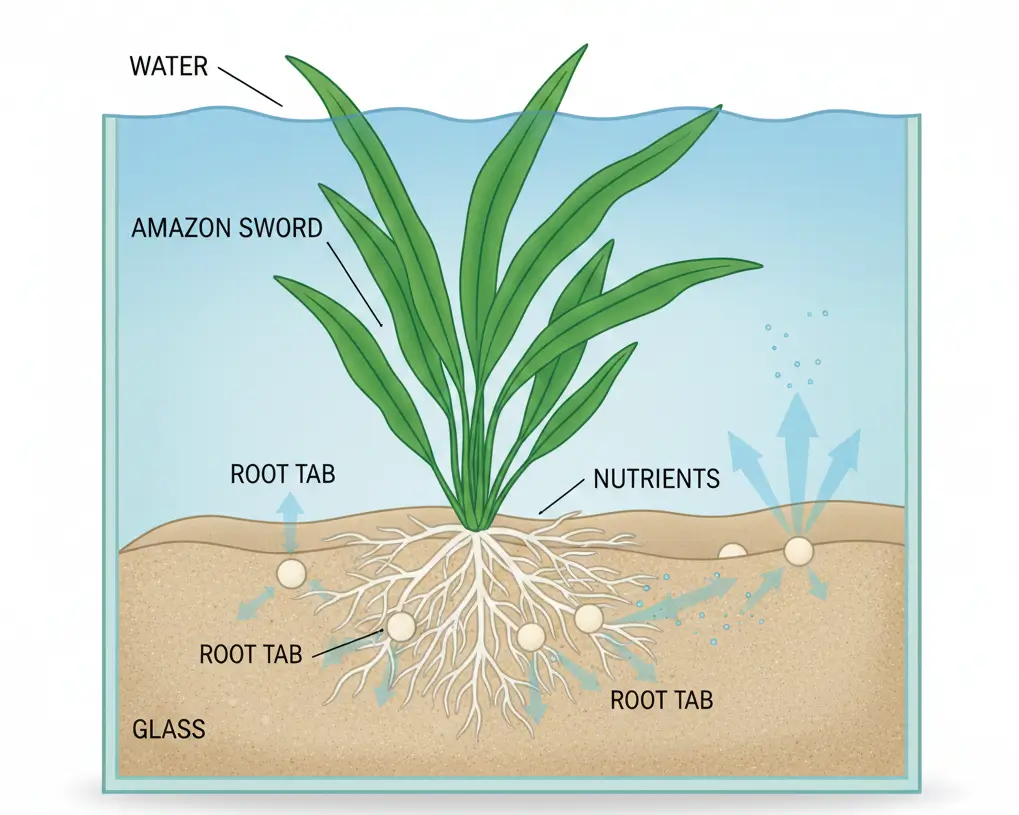
REALITY: You can grow anything in sand, provided you treat the sand as an anchor, not a food source.
Plants like Java Fern (Windelov) and Anubias don’t care about your substrate, they feed from the water column. You can grow them in a bare-bottom tank if you wanted to.
The problem arises with heavy root feeders.
MY TEST RESULTS:
In 2022, I set up two 29-gallon tanks side-by-side with pool filter sand.
- Tank A: Sand only. Dosed liquid fertilizer weekly.
- Tank B: Sand + Root Tabs (Osmocote Plus DIY) inserted every 5 inches.
Results at Week 8:
- Tank A: Amazon Swords were yellowing. Crypts were stunted.
- Tank B: Amazon Swords had doubled in size. Cryptocoryne wendtii Bronze was sending out runners.
THE FIX:
If you use PFS, you must use root tabs for root-feeding plants. The sand effectively holds the tabs in place, preventing them from leaching into the water column (which causes algae), while delivering concentrated nutrients to the roots. It works essentially like hydroponics.
How to Prepare Pool Filter Sand (The 15-Minute Method)
PROCESS: Preparing HTH / AquaQuartz
I used to think I had to rinse this stuff until the water was crystal clear in the bucket. I wasted so much water doing that.
- The Bucket Dump: Pour about 10lbs of sand into a 5-gallon bucket. Don’t do the whole bag; it’s too heavy to mix.
- The High-Pressure Blast: Stick a garden hose into the bottom of the sand and turn it on full blast. The water will overflow the bucket.
- The Swirl: Use your hand to swirl the sand while the water overflows. You’ll see a light milky foam float over the rim. That’s the dust.
- The Clarity Check: Do this for about 2-3 minutes. Once the overflow water looks mostly clear (it doesn’t need to be perfect), dump it in the tank.
- Repeat.
Wear a mask when pouring dry sand. Silica dust is fine and can irritate your lungs. Once it’s wet, it’s safe.
The “Brown Diatom” Phase
WHAT I WISH I KNEW:
Three weeks into my first PFS setup, the beautiful white sand turned a rusty brown. I panicked, thinking I had destroyed the tank balance or bought bad sand.
It was silicates.
Pool filter sand is silica-based. When introduced to a new aquarium, it can leach minor amounts of silicic acid, which is the primary food source for Diatoms (brown algae).
MY EXPERIENCE:
- Week 1-2: Pristine sand.
- Week 3-5: Brown dusting covers the sand bed and glass.
- Week 6: It vanished almost overnight.
THE SOLUTION:
Don’t scrub it aggressively; you’ll just mix the algae into the substrate. Let it burn itself out. Better yet, add a cleanup crew. Nerite Snails (linking Mystery here, but Nerites are the diatom kings) and Otocinclus love this stuff.
If the brown algae persists past 8 weeks, verify your water source isn’t high in silicates using a test kit, though standard API Master Test Kits don’t measure silicates, you need a specialized test.
Advanced Technique: The “Dirted” Cap (Walstad Method)
This is where PFS truly shines. It is, in my opinion, the best capping material for a dirted tank.
THE SETUP:
- Base Layer: 1 inch of organic potting soil (sifted).
- Cap Layer: 1.5 to 2 inches of Pool Filter Sand.
The sand is heavy enough to keep the dirt down (preventing the “mud volcano” mess) but porous enough to let mulm and detritus slowly work their way down to recharge the soil.
I used this method for a Vallisneria spiralis (Jungle Val) tank. Jungle Val is a nutrient hog. In plain sand, it melts. In a dirted tank capped with PFS, it took over the entire 4-foot tank in three months. The sand cap kept the water crystal clear while the roots feasted on the soil below.
Compatibility: Who Loves It, Who Hates It
LOVES IT:
- Corydoras & Loaches: They can sift through it easily. Kuhli Loaches will happily burrow through PFS.
- Cichlids: Specifically earth-eaters (Geophagus) and German Blue Rams. They filter sand through their gills to find food.
- Carpeting Plants (With Tabs): Dwarf Hairgrass runners spread easily in the light grain.
HATES IT:
- Slope Aquascapes: PFS does not hold a steep slope well. It eventually flattens out due to water flow and gravity. If you want a steep hill, you need supports or rocks.
- The “Clean Freak” Keeper: White/Tan sand shows everything. Fish poop, uneaten food, and decaying leaves stand out against the light background. If you aren’t diligent with siphoning, it looks dirty fast.
The Bottom Line
I used to believe that “you get what you pay for” in this hobby. Pool Filter Sand is the exception to that rule.
Is it as nutrient-rich as Amazonia Aquasoil? No.
Does it buffer your pH like Stratum? No.
But for $15, you get a biologically safe, mechanically perfect substrate that will last literally forever (it doesn’t break down like soil). If you are willing to spend an extra $10 on root tabs and 15 minutes rinsing it, it is the best value in the aquarium world.
For a complete breakdown of everything we cover regarding aquatic setups, check out the main hub at Aquatics Pool Spa to see how we integrate these cost-saving methods into high-end displays.
If you’re setting up your first planted tank, grab the bag of HTH sand. Your wallet, and your Corydoras, will thank you.