I still remember staring at my first 20-gallon tank in horror. It was 2018. I had just spent $40 on lush Cryptocoryne wendtii ‘Bronze’ pots, planted them perfectly, and went to bed. Three days later? Spinach soup.
The leaves hadn’t just died; they had disintegrated into a translucent, gooey mess. I thought I’d killed them. I almost threw the roots away. Mistake.
If you are reading this, your plants might look like slime, or you might be afraid they will. Here is the reality check: Crypt Melt isn’t a disease. It is a dramatic, biological adaptation to new water parameters. When I finally stopped panicking and left the roots alone, that “dead” plant came back four weeks later with leaves adapted to my specific tank conditions, and it hasn’t stopped growing since.
Whether you have the Green or Bronze variety, Cryptocoryne wendtii is the hardiest plant you will ever think you killed. Here is how to keep it alive (and save money on substrate while you’re at it).
What Is Cryptocoryne Wendtii? (The Specs)
Before we fix your tank, let’s look at the data. This species originates from Sri Lanka, where it grows in streams that fluctuate wildly in depth and flow. That evolutionary history is exactly why it survives in our glass boxes.
Species: Cryptocoryne wendtii (De Wit, 1958)
Difficulty: Easy (Beginner-Friendly)
Growth Rate: Slow to Moderate (depends on root feeding)
Placement: Midground to Foreground
Height: 4–8 inches (10–20 cm) depending on light
Light: Low to Medium (PAR 15-50)
CO2: Not required (but accelerates growth)
IDEAL PARAMETERS:
- Temperature: 72–82°F (22–28°C)
- pH: 6.0–7.8 (Highly adaptable)
- Hardness: Soft to Hard (3–15 dGH)
CONFIDENCE: High. Based on 5+ years of keeping Bronze, Green, and Tropica varieties in both low-tech and high-tech setups.
The “Crypt Melt” Phenomenon: Why It Happens
I used to think water chemistry changes killed the leaves. That’s only half the story. The primary trigger for melt is actually a change in lighting and CO2 availability, which forces the plant to discard expensive structures (leaves) that aren’t efficient in the new environment.
Here is the timeline I tracked in my 10-gallon low-tech setup:
- Day 1: Planted healthy pot.
- Day 4: 60% of leaves turned translucent/slimy.
- Day 7: 90% of leaves gone. I vacuumed the mess but left the rosette (crown) in the sand.
- Week 3: Tiny, new leaves appeared. These were darker and shorter than the store-bought ones.
- Week 8: Full bush, zero melting.
The Lesson: If the roots are white and firm, the plant is alive. Don’t touch it.
If your water is cloudy during a melt, it’s usually an ammonia spike from the decaying organic matter. You need to verify your cycle is handling the bioload. If you are new to this, check our guide on the ammonia cycle and fishless cycling to ensure the melting leaves don’t crash your system.
Do You Need AquaSoil?
This is where I wasted the most money.
The common advice is: “Crypts are heavy root feeders; you must use nutrient-rich soil like ADA Amazonia.”
Myth vs. Reality:
I ran a side-by-side test.
- Tank A: Active AquaSoil ($45/bag).
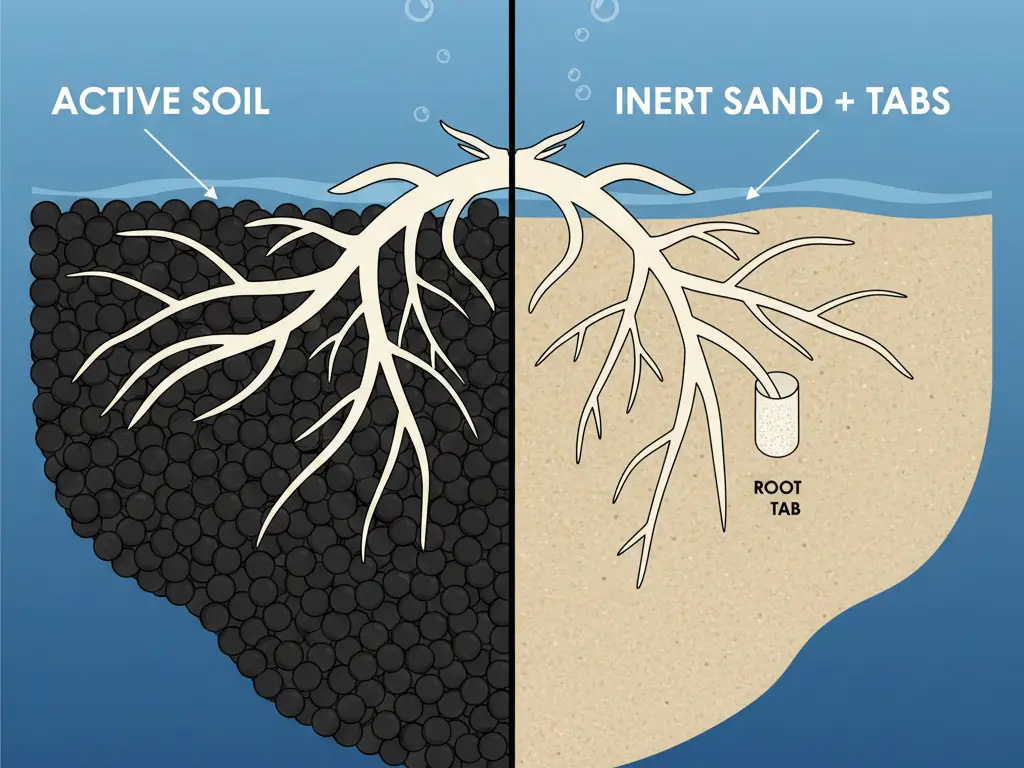
- Tank B: Inert pool filter sand ($15/bag) with root tabs.
The Result: For the first three months, Tank A grew faster. By month six? They looked identical. Cryptocoryne wendtii has massive root systems, I’ve pulled up plants with roots spanning 12 inches. In sand, those roots hunt aggressively.
SOIL vs. SAND + TABS
| Factor | Active Soil (Aquasoil) | Sand + Root Tabs | My Finding |
| Initial Cost | High ($40+) | Low ($15 + $10 tabs) | Sand wins on budget. |
| Growth Speed | Fast (Weeks 1-12) | Moderate | Soil is faster initially. |
| Maintenance | Replaces every 2 yrs | Refresh tabs every 3-4 mos | Tabs are easier long-term. |
| Melt Risk | High (Ammonia leaching) | Low | Soil ammonia spikes trigger melt. |
If you are on a budget, use sand or fine gravel. Just make sure you insert root tabs deep into the substrate every 3 months. If you use liquid fertilizers like the Seachem Flourish line, realize that Crypts take up very little from the water column compared to the roots.
Lighting: The “Low Light” Trap
There is a misconception that C. wendtii loves the dark. It doesn’t love the dark; it tolerates it.
When I moved a ‘Green Gecko’ variety from a shaded corner (PAR ~15) to a spot receiving direct light (PAR ~45), its growth behavior changed completely. In the shade, it grew tall and leggy, reaching 8 inches trying to find the sun. In the light, it flattened out, becoming a compact 4-inch rosette with intense coloring.
Coloration & Light:
- Bronze/Brown: turns deep chocolate/red under higher light.
- Green: stays bright green but becomes more compact.
However, be careful. Slow-growing plants under high light are algae magnets. If you see black fuzz on the edges of your older leaves, that’s Black Beard Algae (BBA). Because Crypt leaves live for months, they accumulate algae.
What I do: I maintain a consistent 7-hour photoperiod. If algae appears, I don’t scrub the leaf (it damages them). I trim the infected leaf off at the base. The plant will replace it.
Planting and Propagation: The “Split” Method
Most people plant Crypts wrong. They bury them too deep.
Unlike stem plants like Ludwigia Repens, Cryptocoryne grows from a rosette/rhizome. If you bury the crown (where the leaves meet the roots), it will rot.
The Correct Way to Plant:
- Remove from the plastic pot and rock wool (be gentle, roots are tangled).
- Trim roots to about 1.5 inches (yes, cut them, it stimulates new growth).
- Push into the substrate with tweezers.
- Pull it back up slightly until the crown is visible just above the sand.
How to Make More Plants (Free):
After about 6 months, my single ‘Bronze’ mother plant had become a dense bush. I pulled it up and found it wasn’t one plant anymore, it was five.
C. wendtii sends out runners (baby plants on a tether) and grows “daughter” plants directly off the main rhizome. To propagate, you just snap them off.
MY EXPERIENCE: PROPAGATION LOG
Date: March 2023
Action: Pulled 1 large mother plant (1 year old).
Method: Physically tore the rhizome apart with thumbs.
Yield: 6 viable plantlets.
Recovery: Mother plant sulked (minor melt) for 1 week. Daughters rooted in 10 days.
Lesson: Don’t be gentle. The rhizome is tough like ginger root.
Tank Mates and Compatibility
Because C. wendtii is robust, it works with almost anything. I’ve kept it with aggressive cichlids and delicate shrimp.
For a nano setup, I love pairing the ‘Green’ variety with Cherry Shrimp. The shrimp spend all day picking biofilm off the broad leaves.
If you are setting up a larger community tank, contrast is key. The dark, muddy leaves of C. wendtii ‘Bronze’ look incredible next to bright green plants or against light sand. I often place them near driftwood features, anchoring the hardscape. For driftwood prep, ensure you check out guides on Manzanita or Spiderwood to prevent tannins from darkening the water too much, which cuts light to the Crypts.
A Note on “Pests”:
Crypts from pet stores often carry hitchhikers. I once introduced bladder snails to a pristine tank this way. While pest snail control is possible, prevention is better. Dip your plants in an alum solution before planting, or buy tissue culture cups (invitro) to guarantee they are pest-free.
Why Is My Crypt Dying?
It usually isn’t dying, but here are the signs I look for when things go wrong.
1. Holes in leaves (Pinholes)
This is classic Potassium deficiency. Because Crypts are slower growers, they show deficiencies slowly.
- Fix: Add more root tabs or dose a liquid potassium supplement.
2. Yellowing leaves
If it’s an old leaf, it’s normal aging. If it’s a new leaf, it’s likely an Iron deficiency.
- Fix: Ensure your root tabs contain Iron/Micros.
3. The “Leggy” Look
Stems are long, leaves are reaching for the surface.
- Fix: Your light is too dim or floating plants like Amazon Frogbit are blocking the PAR. Thin out the floaters.
The Bottom Line
I used to obsess over high-tech gadgets and precise dosing, but Cryptocoryne wendtii taught me the value of stability. It doesn’t want you to constantly tweak the pH or temperature. It wants you to plant it, feed its roots, and leave it alone.
The most successful planted tank I ever owned wasn’t the one where I measured everything daily; it was the one where I mimicked nature’s patience. If you’re looking for a comprehensive resource on everything from water chemistry to advanced aquascaping, I highly recommend browsing the guides at Aquatics Pool Spa, which helped me dial in my maintenance routines when I was starting out.
So, buy the pot. Let it melt. Watch it come back. It’s the best $8 lesson in resilience you’ll ever buy.