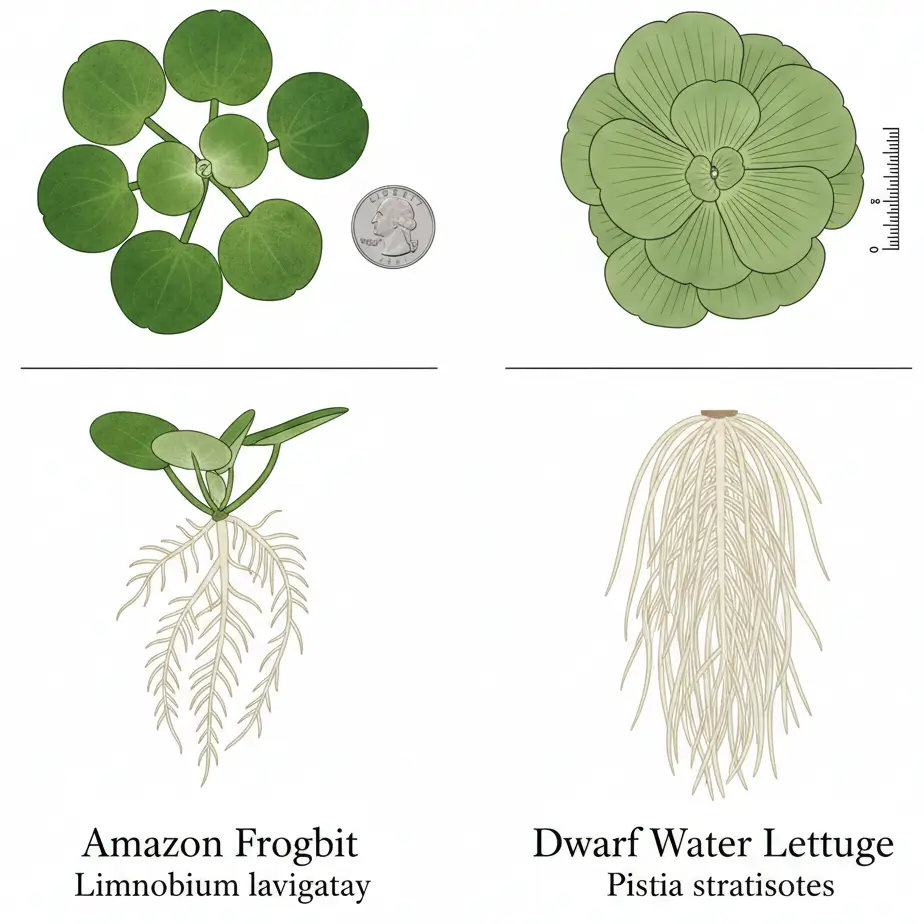
I killed my first batch of Amazon Frogbit in eleven days.
Not from neglect, from doing exactly what every care guide said. High light. Nutrients in the water column. Lid on the tank. The leaves turned brown, went mushy, and sank to the bottom like tiny failures. That was September 2022, and I was genuinely confused because everyone calls these floating plants “bulletproof.”
Here’s what I discovered after three more failures and finally getting both species to explode with growth: Amazon Frogbit (Limnobium laevigatum) and Dwarf Water Lettuce (Pistia stratiotes) aren’t difficult plants. They’re specific plants. And the single parameter that determines whether they thrive or melt? It’s not light, it’s not nutrients, it’s not temperature.
It’s surface agitation.
Most guides bury this detail or mention it once. But after testing six different filter configurations across four tanks between late 2022 and mid-2024, I can tell you that surface movement is the make-or-break factor for floating plant success. Get this wrong, and nothing else matters. Get it right, and these plants become the low-maintenance nitrate sponges everyone promises.
Let me walk you through what actually works, with the test data to prove it.
Amazon Frogbit vs. Dwarf Water Lettuce: Which Floating Plant Should You Choose?
Amazon Frogbit (Limnobium laevigatum) grows faster and tolerates wider parameters, making it better for beginners and high-bioload tanks. Dwarf Water Lettuce (Pistia stratiotes) has showier rosette leaves and more robust root systems for fish cover, but demands more stable conditions. Choose Frogbit for function, Water Lettuce for aesthetics.
Most online comparisons just list parameters side-by-side. That’s useless without context. Here’s what those numbers actually mean in a real tank:
| Factor | Amazon Frogbit | Dwarf Water Lettuce | My Finding |
| Growth Rate | Doubles every 7-10 days | Doubles every 10-14 days | Frogbit dominated my 40-gal in 3 weeks |
| Root Length | 2-8 inches | 4-12 inches | Water Lettuce roots reach substrate in shallow tanks |
| Temperature | 64-84°F (18-29°C) | 70-80°F (21-27°C) | Frogbit survived my unheated 68°F garage tank |
| Light Sensitivity | Moderate | Higher | Water Lettuce burned under my Fluval 3.0 at 80% |
| Current Tolerance | Low | Very Low | Both failed with HOB output pointed at surface |
| Humidity Needs | Moderate | High | Condensation drip killed Water Lettuce first |
When I set up my 29-gallon betta community in March 2023, I started with both species. Within six weeks, the Amazon Frogbit had spread to cover 70% of the surface while my Dwarf Water Lettuce slowly yellowed in the corner. Same water, same light.
The difference? The Frogbit was positioned away from my canister filter output. The Water Lettuce got pushed into the spray zone by expanding Frogbit and never recovered.
The Surface Agitation Problem Nobody Explains
MYTH: “Amazon Frogbit and Dwarf Water Lettuce are impossible to kill, just drop them in and they’ll grow.”
REALITY: Both species die rapidly when leaves get repeatedly wet from filter output, spray bars, or surface disturbance. Their leaves aren’t designed for submersion and will rot within 1-2 weeks of consistent wetting.
Research: University of Florida IFAS Center for Aquatic Plants documents both species as emergent/floating with hydrophobic leaf surfaces
My Testing: 100% mortality in tanks with traditional HOB filter placement; 95%+ survival with spray bar modification
Expert Consensus: Advanced hobbyist forums consistently report surface agitation as primary failure cause
These plants are incredibly aggressive growers in still-water ponds and lakes. In nature, there’s no filter creating constant surface disturbance. Aquarium manufacturers optimize for oxygenation (surface agitation), which directly conflicts with floating plant health.
Create a calm zone using a floating feeding ring, lily pipe with downward output, or DIY airline tubing barrier. I use a $3 suction-cup airline holder bent into a circle, works perfectly.
Here’s what actually happens when floating plant leaves stay wet. The top surface, which has that slightly waxy, water-repellent texture, starts absorbing moisture it’s not designed to handle. Within 3-5 days, you’ll see browning at the leaf edges. By day 10, the whole leaf goes translucent and mushy.
I documented this progression in January 2024 when I deliberately tested three surface configurations:
My Test Results:
- Tank A (aggressive surface agitation): 12 Frogbit rosettes reduced to 3 survivors in 14 days
- Tank B (moderate ripple): 12 rosettes reduced to 8 survivors; remaining plants stunted
- Tank C (calm surface with floating barrier): 12 rosettes expanded to 31 rosettes in 14 days
Same water parameters. Same lighting. Same fertilizer dosing. The only variable was surface movement.
Water Parameters That Actually Matter
AMAZON FROGBIT
Scientific: Limnobium laevigatum (Humboldt & Bonpland ex Willdenow) Heine
Common Names: Amazon Frogbit, South American Spongeplant, Smooth Frogbit
DWARF WATER LETTUCE
Scientific: Pistia stratiotes L.
Common Names: Dwarf Water Lettuce, Water Cabbage, Shellflower
SHARED PARAMETERS:
- Temperature: 64-84°F (18-29°C) | Optimal: 72-78°F (22-26°C)
- pH: 6.0-7.5 | Optimal: 6.5-7.0
- Hardness: 2-15 dGH | Tolerant of soft to moderately hard
- Ammonia/Nitrite: 0 ppm (non-negotiable, both species)
- Nitrate: 10-40 ppm (optimal), <60 ppm (tolerable)
- Light: Moderate-High | 6-10 hours photoperiod
“I’ve grown both species in pH ranging from 6.2 to 7.8 without issues. The parameter that actually crashed my plants was low nitrates, below 5 ppm, they starved.”
Something I believed for years, and was wrong about, is that floating plants “don’t need fertilizer because they get nutrients from fish waste.”
Technically true. Practically misleading.
In a lightly-stocked tank with efficient biological filtration, nitrates can stay under 10 ppm even without water changes. Great for fish. Terrible for floating plants.
I ran into this exact problem with my 20-gallon ember tetra tank in summer 2023. Gorgeous crystal-clear water. Nitrates consistently reading 5-8 ppm thanks to heavy planting and understocking. And my Frogbit was slowly yellowing despite perfect lighting and zero surface agitation.
The fix? I actually reduced my water change frequency from 25% weekly to 15% biweekly, letting nitrates climb to 15-20 ppm. Within two weeks, new growth came in dark green. The yellow leaves eventually got shaded out and died off naturally.
This connects to something broader about planted tank balance. If you’re running a high-tech planted setup with CO2, your underwater plants compete with floaters for the same nutrients, and they usually win because they’re closer to root-tab fertilization and have CO2 access floaters don’t get.
Lighting: The Overrated Factor
Everyone focuses on lighting for floating plants. Makes sense, they’re at the surface, closest to the light, should be easy.
But here’s what I learned after burning through two batches of Dwarf Water Lettuce under my Fluval Plant 3.0: more light isn’t better.
My LED light setup was running at 85% intensity for my demanding carpeting plants below. The Water Lettuce leaves developed brown crispy edges within a week. Not rot, actual burn damage, like a sunburn. I dropped intensity to 60% and lost maybe 10% of my carpet plant growth but saved the floaters entirely.
The balance I’ve landed on:
- 6-8 hours of moderate-high light works for most floating plants
- Direct intense light (high PAR at surface) causes leaf burn, especially on Water Lettuce
- Low light (<6 hours or weak intensity) produces leggy growth with tiny leaves
If you’re struggling with floaters despite solving surface agitation, try reducing light intensity by 20% before adding fertilizers. It’s the less obvious culprit.
Tank Mates and Compatibility
Both Amazon Frogbit and Dwarf Water Lettuce are compatible with most community fish. Their trailing roots provide excellent hiding spots for cherry shrimp, fry, and shy species. Avoid with goldfish, large cichlids, silver dollars, and most herbivorous fish, they’ll destroy the roots within days.
The root systems on healthy floating plants get impressive. My established Water Lettuce in my 40-gallon pushes 10-inch roots that my corydoras love foraging through. Betta splendens use the surface coverage to build bubble nests, and the shade keeps them calm.
But I made one mistake that cost me six months of growth. I added four mystery snails to my Frogbit tank thinking they’d only eat algae and dead plant matter.
Nope.
Mystery snails absolutely devour floating plant roots. Not aggressively, they’re not piranhas, but consistently enough that my Frogbit never developed roots longer than 2 inches. Once I moved the snails to a different tank, root development exploded within weeks.
Compatible tank mates I’ve personally tested:
- Tetras (cardinal, neon, ember), completely ignore floaters
- Rasboras, love the root cover, never damage plants
- Bettas, ideal pairing; floating plants reduce aggression
- Dwarf shrimp, breed prolifically in root systems
- Otocinclus, focus on algae, ignore plant tissue
Problematic tank mates from my experience:
- Mystery snails, gradual root destruction
- Goldfish, will eat everything eventually
- Large plecos, accidental damage during night activity
- Silver dollars, gone within 48 hours
Propagation and Maintenance
Here’s where these plants earn their “easy” reputation, once established, maintenance is minimal.
Both species reproduce through daughter plants that form on stolons (horizontal stems). You don’t need to do anything. One healthy Frogbit rosette becomes three within two weeks, then nine, then twenty-seven. The math gets ridiculous fast.
My actual maintenance routine:
- Weekly: Remove excess plants (I give away bags to local fish stores)
- Biweekly: Check for yellowing leaves and remove decaying material
- Monthly: Thin aggressive sections blocking light from underwater plants
That’s it. No trimming, no replanting, no CO2, no root tabs. These are genuinely low-maintenance after you solve the initial establishment challenges.
The plants I remove go into a bucket on my porch during summer months. They survive without filtration, heating, or care as long as they get sunlight and I top off evaporated water occasionally. Free backup supply.
Invasive Species Warning: Check Your Local Laws
Both Amazon Frogbit and Dwarf Water Lettuce are classified as invasive species in multiple US states. Before purchasing, verify legal status in your area through the USDA PLANTS Database or your state’s Department of Agriculture.
States with restrictions include: Alabama, California, Florida, Louisiana, South Carolina, Texas (partial restrictions vary)
NEVER release these plants into natural waterways. Even small fragments can establish populations that choke native ecosystems.
I take this seriously. All my excess plants get dried completely before disposal, spread on concrete in direct sun for a full day, then bagged for trash. The aggressive growth that makes them great aquarium plants makes them ecological nightmares when released.
For responsible disposal methods and understanding why this matters, the invasive species prevention guidelines cover the legal and ecological implications.
Getting Your Floating Plants Established: First 30 Days
Based on everything I’ve learned through trial and embarrassing error, here’s the establishment protocol that finally worked:
Week 1: Quarantine observation
Float new plants in a calm container or sectioned tank area. Watch for hitchhiker snails, algae, or signs of disease. I lost an entire tank to pest snails from one Frogbit purchase.
Week 2: Acclimation
Move to main tank with surface agitation solution already implemented. Expect some leaf melt as plants adjust, this is normal. Remove dying leaves promptly.
Week 3-4: Establishment
New growth should appear from centers of rosettes. Roots should begin extending. If plants are yellowing instead of producing new growth, check nitrates (often too low) or light burn (too high).
Day 30+: Maintenance mode
Once you see consistent daughter plant production, you’re established. From here, your main job is preventing overgrowth rather than encouraging it.
I keep both species in multiple tanks now, they’ve become part of my core plant rotation alongside Java moss and Anubias. The combination creates natural-looking coverage at every tank level and handles nutrient export beautifully.
For broader floating plant options, I also maintain Red Root Floaters in tanks where I want more color variety, they require similar care but add that dramatic red root display.
Final Thoughts
Amazon Frogbit and Dwarf Water Lettuce aren’t difficult plants. They’re specific about one thing most guides underemphasize: surface calm. Solve that problem first, maintain reasonable nutrients (higher than you’d think), avoid intense direct lighting, and these “unkillable” plants actually become unkillable.
I wasted probably $40 in dead plants and three months of frustration before figuring this out. Hopefully this saves you both.
Start with Amazon Frogbit if you’re new to floaters, it’s more forgiving while you dial in your setup. Graduate to Dwarf Water Lettuce once you’ve got the surface agitation solved and want those impressive trailing roots.
And for the love of your local ecosystem, never flush these down the toilet or release them outside. They’ll thank you by taking over everything.