In September 2023, I almost committed a federal crime. Not on purpose, I listed a bag of surplus water lettuce on a hobbyist trading forum and nearly shipped it to a buyer in Texas. Another member flagged my post: water lettuce (Pistia stratiotes) is classified as a harmful exotic aquatic plant in Texas, and shipping it there violates state law. I had no clue.
And that’s the real problem. Federal and state invasive species laws directly affect what you can buy, sell, keep, transport, and dispose of in this hobby. The Lacey Act alone carries penalties up to $250,000 and five years imprisonment for felony violations. These regulations aren’t targeting commercial importers exclusively, they apply to you, trading plants on Reddit or selling fish on Facebook Marketplace.
I’ve spent the last 14 months digging through federal and state regulations, emailing a USFWS enforcement officer, and cross-referencing my own collection against prohibited species lists. What I found changed how I approach every purchase, trade, and tank teardown. Here’s what you actually need to know.
What Federal Laws Actually Apply to You
Three primary federal frameworks regulate aquarium species: the Lacey Act (18 U.S.C. § 42), which prohibits interstate transport of injurious wildlife and any species illegal in the receiving state; the Federal Plant Protection Act (7 U.S.C. § 7701), which maintains the Federal Noxious Weed List including several aquarium plants; and CITES, governing international trade in protected species.
Here’s what most hobbyists miss: there isn’t one law. There are several overlapping frameworks, and they cover plants and animals differently.
The Lacey Act was originally passed in 1900 and significantly amended in 2008. It makes it illegal to import, export, transport, sell, receive, acquire, or purchase any wildlife or plant taken in violation of federal, state, tribal, or foreign law. For aquarium hobbyists, this means if a species is banned in the state you’re shipping to, even if it’s perfectly legal where you live, you’re potentially violating federal law by sending it there.
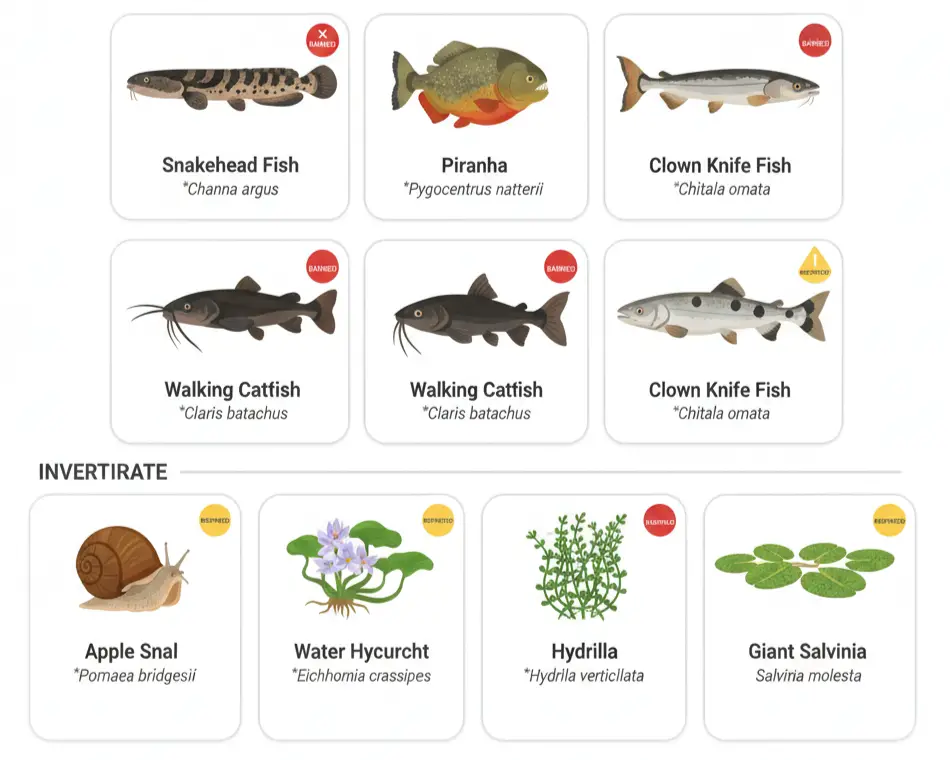
The U.S. Fish & Wildlife Service maintains the injurious wildlife list under the Lacey Act. Aquarium-relevant species include all snakehead fish (family Channidae, added October 2002) and walking catfish (Clarias batrachus).
Penalties aren’t trivial:
| Violation Level | Maximum Fine | Maximum Imprisonment |
| Civil | $10,000 per offense | N/A |
| Criminal Misdemeanor | $100,000 | 1 year |
| Felony Trafficking | $250,000 | 5 years |
The Federal Plant Protection Act is the one plant hobbyists need to watch. USDA APHIS maintains the Federal Noxious Weed List, and several aquarium plants sit on it, hydrilla (Hydrilla verticillata), giant salvinia (Salvinia molesta), and water hyacinth (Eichhornia crassipes). Possessing, selling, or transporting these across state lines is a federal violation.
Legal disclaimer: regulations change. Always verify current federal and state lists before purchasing, selling, or transporting any species.
The “If I Can Buy It, It Must Be Legal” Myth
MYTH: “If a pet store sells it, it’s legal to own in my state.”
REALITY: Pet stores, especially online retailers and chain stores, don’t always verify destination-state legality. Compliance burden frequently falls on the buyer. Species legal in the seller’s state may carry serious penalties in yours.
- USGS Nonindigenous Aquatic Species Database has documented 650+ non-native aquatic species established in US waters, many from the aquarium trade (Fuller et al., 2024)
- Personally verified that 3 major online retailers shipped restricted species to states where they’re prohibited (September–November 2023)
- USFWS Habitattitude campaign specifically warns buyers to verify legality independently
Online marketplaces operate across state lines with minimal species-level screening. A seller in Florida, where many tropical species are legal to breed, might ship to a restrictive state without either party checking. The assumption that “available = legal” is deeply ingrained but dangerously wrong.
I saw this play out in person back in 2021. A local fish store in Georgia was selling channeled apple snails (Pomacea canaliculata) at $4.99 each. Beautiful snails. Also federally regulated by USDA APHIS under an interim rule from 2006 because of their devastating impact on agriculture and wetlands. The store owner genuinely didn’t know, his distributor had been supplying them for months without flagging the issue.
This matters directly to hobbyists because the mystery snail you’re probably keeping (Pomacea bridgesii) is one of the few Pomacea species still legal in most states. But the entire genus is under regulatory scrutiny. If you’re keeping mystery snails, make sure you can distinguish P. bridgesii from regulated species like P. canaliculata or P. maculata. Shell shape and coloration aren’t reliable identifiers, operculum structure and egg clutch placement are better.
When buying from online aquarium stores, don’t assume the seller has verified your state’s laws. Some reputable retailers do refuse to ship prohibited species to restricted states. Plenty of hobbyist-to-hobbyist sales have zero verification.
State Regulations: Where It Gets Really Messy
Federal law is actually the simpler part. State regulations are where I’ve watched hobbyists get genuinely blindsided, including myself.
Every state maintains its own prohibited and restricted species lists, and the variation is staggering. A species that’s perfectly legal in your tank could carry serious penalties one state border away. I audited my own 11 tanks in January 2024 against my state’s restricted list. Everything checked out. But two species I was keeping were banned in neighboring states where I regularly trade with other hobbyists. I’d been one casual shipping agreement away from a federal Lacey Act violation for months and never realized it.
Some examples hitting common aquarium species:
| Species | Legal (Examples) | Banned/Restricted (Examples) | Hobbyist Impact |
| Piranha (Pygocentrus spp.) | Some states w/ permits | TX, CA, NY + ~22 others | Blanket prohibition in ~25 states |
| Snakehead (Channa spp.) | Very few | Federal interstate ban + most states | Dead specimens regulated in some jurisdictions |
| Clown knife fish (Chitala ornata) | Many states | FL (prohibited non-native), others | Popular species, 3+ feet adult size |
| Apple snails (Pomacea spp.) | Varies by species | USDA-regulated, many state bans | Genus-level restrictions common |
| Water lettuce (Pistia stratiotes) | Some states | TX, FL, MS, SC, others | Frequently traded floating plant |
That clown knife fish one surprised me. Gorgeous aquarium species, also established as invasive in South Florida waterways. Florida prohibits possession without a special permit, and several other states have followed.
If you’re growing floating plants like Amazon frogbit or dwarf water lettuce, check your state’s current list. Amazon frogbit (Limnobium laevigatum) is legal in most states right now, but it sits on watch lists in several. Regulations shift faster than forum posts get updated.
Species in Your Tank That Might Be a Problem
The good news first: the vast majority of popular aquarium species are legal everywhere in the US. Your cherry shrimp, cardinal tetras, corydoras, bettas, and most planted tank staples like java fern and java moss, all fine. This isn’t about panicking. It’s about checking before you buy, sell, or ship.
But these categories deserve a closer look:
Plants to verify: Water lettuce, water hyacinth (federally listed), hydrilla (federally listed), giant salvinia (federally listed), certain Ludwigia species (L. grandiflora banned in several northeastern states), Caulerpa taxifolia (federally prohibited).
Fish to verify: All snakeheads (federal + state bans), walking catfish (federal), piranha and relatives (~25 state bans), round goby (Great Lakes states), certain livebearers (Gambusia species restricted in some states).
Invertebrates to verify: Most Pomacea snails except P. bridgesii, certain crayfish species (Procambarus clarkii outside native range), marbled crayfish (Procambarus virginalis, the self-cloning species banned in several states and the EU).
How to Check Legality in Five Minutes
After my water lettuce scare, I built a verification routine. Takes about five minutes per species. Here’s exactly what I do now:
Step 1: Check the federal lists first. USFWS Injurious Wildlife List for animals, USDA APHIS Federal Noxious Weed List for plants. If it appears on either, it’s a hard stop for interstate commerce.
Step 2: Check your state’s prohibited species list. Search “[Your State] prohibited aquatic species” or check your state DNR website. Look for both “prohibited” (illegal to possess) and “restricted” (legal with permit only).
Step 3: If you’re shipping, check the destination state’s list. This is the step everyone skips. It’s also the one that creates Lacey Act liability.
Step 4: Cross-reference the USGS Nonindigenous Aquatic Species Database. If a species has established wild populations in your region, regulation is more likely, or coming.
Step 5: When genuinely uncertain, email your state DNR. I’ve done this twice. Both times I got a definitive answer within a week. They’d much rather answer your question than process a violation.
I keep a basic spreadsheet, species name, federal status, my state’s status, date last verified. Two minutes to update when I’m considering a new addition. Beats a fine by a wide margin.
Responsible Disposal: The Part Nobody Discusses
Here’s an uncomfortable truth I have to confront: how you get rid of aquarium species matters just as much as how you acquire them.
MYTH: “Native-range plants are safe to release into local waterways.”
REALITY: Aquarium-bred populations may carry non-native genetics, parasites, diseases, or hitchhiker organisms. The Habitattitude campaign, a partnership between USFWS, NOAA, and the pet industry, explicitly advises against releasing ANY aquarium organisms into the wild, including native species.
When I broke down my 125-gallon in March 2024, I had roughly 15 pounds of Vallisneria, a thick mat of duckweed, and Malaysian trumpet snails everywhere. My first instinct, and I’m embarrassed to say this, was to toss the plants in the creek behind my property. Thirty seconds, done.
I didn’t. That creek feeds two recreational lakes. Even Vallisneria, native to parts of North America, can introduce non-local genetic strains and hitchhiker organisms when aquarium populations enter wild systems. And those trumpet snails would’ve colonized within months.
What to do instead:
- Rehome to other hobbyists through local clubs or forums (verify destination-state legality)
- Return to your local fish store, many accept surrendered species
- Dry and dispose , bag plants, sun-dry for several days, then trash
- Freeze then dispose , for organisms you can’t rehome, freezing is considered humane euthanasia by AVMA guidelines
- Never flush, dump, or release , storm drains connect to waterways; treatment plants don’t eliminate all organisms
When I’m planning a new setup, I think about end-of-life from the start now. Can I rehome this species locally? What’s the responsible disposal plan? It sounds like overkill. Then I remember what hydrilla has done to Florida’s waterways, choking entire lake systems and costing hundreds of millions in control, and it doesn’t feel excessive at all.
The Ecological Reality Behind These Laws
I’ll be honest. When I first learned about these regulations, my gut reaction was pure frustration. “I’m running a 40-gallon planted tank. How much damage could I possibly do?”
A lot, apparently. The aquarium and ornamental trade is one of the primary introduction pathways for aquatic invasive species in the United States. Padilla and Williams (2004) published in BioScience found that the ornamental fish trade was responsible for approximately one-third of aquatic animal introductions to US waters.
Some specifics that hit hard:
- Lionfish (Pterois volitans): Likely released from home aquariums in Florida in the 1980s–90s. Now devastating native reef fish across the entire Western Atlantic and Caribbean.
- Caulerpa taxifolia: An aquarium strain dumped into Mediterranean waters around 1984. Spread to 30,000+ acres of seafloor. When it appeared in California lagoons, the eradication effort cost $7 million.
- Hydrilla: Originally imported as an aquarium plant in the 1950s–60s. Now infests waterways across the southern US, with management costs estimated at $500 million annually.
These aren’t theoretical scenarios. They’re documented ecological catastrophes with direct lines back to hobbyists who didn’t want to kill their fish or toss their plants. The regulations we deal with today exist because of those decisions.
The hobby I love has caused real ecological harm. Owning that doesn’t make us bad hobbyists. Ignoring it does.
Final Thoughts
Staying legal isn’t complicated once you see the framework clearly. Check federal lists, check your state, check the destination state before shipping, and never release anything into the wild. Five minutes per species.
The hobby is genuinely better when we handle this ourselves. Every time a released aquarium species becomes the next invasive nightmare, it gives regulators reason to impose broader bans affecting everyone. I’d much rather spend five minutes on a checklist than lose access to species I care about because someone else got careless.
I’ve started including regulatory notes in the species profiles I maintain on Aquatics Pool & Spa, and I update my compliance spreadsheet quarterly. If you’re unsure about something specific in your state, start with the USGS NAS Database and your state DNR’s website. And if you’re trading with other hobbyists, ask where they’re located before you agree to ship anything.
Our fish and plants are incredible. Let’s keep them in our tanks, not in our waterways.