I bought my first clown knife fish in March 2018 from a local shop that had it labeled as a “unique oddball fish, grows to about 12 inches.” That fish hit 18 inches within 14 months. It reached 28 inches before I finally admitted my 125-gallon setup was slowly killing it.
Adult clown knife fish (Chitala ornata) require a minimum 200-gallon aquarium with at least 8 feet of swimming length, not the 100-gallon tanks commonly recommended. These fish regularly exceed 24 inches in captivity, can reach 36+ inches, and live 10-15 years. The “100-gallon minimum” advice is based on juvenile sizes and consistently leads to stunted growth, behavioral problems, and premature death within 18-36 months.
Here’s what frustrates me about most clown knife care guides: they’re written by people who’ve never kept one past the 12-inch juvenile stage. The fish behaves completely differently at 6 inches versus 24 inches, feeding requirements change, aggression levels spike, and that “peaceful community fish” becomes a nocturnal predator that will eat anything fitting in its mouth.
I’ve documented growth rates, feeding responses, and behavioral changes across 4 clown knife fish over 7 years. What I’m sharing isn’t theory, it’s logged data from daily observations, weekly measurements, and expensive mistakes I’ve already made so you don’t have to.

Clown Knife Fish Species Overview: What You’re Actually Getting Into
Chitala ornata (Gray, 1831) is a large nocturnal predator from Southeast Asian river systems. Adults reach 24-36 inches in captivity (up to 39 inches wild-caught). They possess a weak electrical organ for navigation, can breathe atmospheric air, and have a lifespan of 10-15 years with proper care. This is NOT a beginner fish.
The clown knife fish gets its name from the distinctive blade-like body shape and the ocellated spots (“clown” markings) running along the base of the anal fin. Those spots vary wildly between individuals, I’ve had fish with 3 spots and fish with 12. The pattern isn’t an indicator of health or quality, despite what some sellers claim.
What most care sheets don’t mention: these fish generate weak electrical fields from specialized organs near their tails. It’s not strong enough to shock you (or other fish), but it allows them to navigate in complete darkness, which explains why they’re so active at night even in tanks with zero lighting. Dr. Carl Hopkins’ research on electric fish communication at Cornell documented similar navigation systems across the Notopteridae family.
Native Range Context
Wild Chitala ornata come from the Mekong, Chao Phraya, and Mae Klong river basins in Thailand, Cambodia, and Vietnam. These are large, slow-moving river systems with significant depth variation, submerged wood, and seasonal flooding patterns. The fish migrate between flooded forests during monsoon season and main river channels during dry periods.
Why does this matter for your tank? Because clown knives are programmed to move, they’re not sit-and-wait predators like some catfish. In my experience, tanks that restrict horizontal swimming produce fish with curved spines, erratic behavior, and feeding refusal within 6-12 months. The length of your tank matters more than total gallons.
Tank Size Requirements: Why the “100-Gallon Minimum” Fails
I used to recommend 100 gallons for clown knife fish. I was wrong.
Growth Rate vs. Tank Dimensions
SETUP:
Fish #1 (2018): 125-gallon, 72″ length × 18″ width
Fish #2 (2020): 180-gallon, 72″ length × 24″ width
Fish #3 (2021): 300-gallon, 96″ length × 24″ width
Fish #4 (2022): 300-gallon, 96″ length × 30″ width
RESULTS:
Fish #1: Reached 18″ at 14 months, then growth stalled. Developed slight spinal curve by month 20. Moved to 300g at month 22.
Fish #2: Reached 16″ at 12 months, growth slowed significantly at 20″. Showed turning difficulty in 72″ tank.
Fish #3: Reached 22″ at 18 months, continued steady growth to 28″ at 36 months. No behavioral issues.
Fish #4: Reached 24″ at 20 months, currently 31″ at 32 months. Most active and responsive of all four.
- Tank WIDTH affected feeding response more than I expected.
Fish in 30″-wide tank struck at food more accurately than fish in
18″-wide tank, presumably because turning radius matters for ambush feeding. - Minimum 96″ length for adults. Width should exceed 24″ for
comfortable turning at full adult size. - Sample size of 4 fish across different purchase sources.
Individual genetics definitely play a role I can’t control for.
Here’s the math nobody does: a clown knife fish at 24 inches needs to turn around. In a 72-inch tank (standard 125-gallon), that fish has exactly 48 inches of space to execute a turn without hitting glass, assuming it starts dead center. Fish don’t swim in straight lines and stop perfectly centered. They curve, they drift, they adjust. A 24-inch fish in a 72-inch tank is like asking you to do a U-turn in a hallway.
Recommended Tank Dimensions
For fish under 12 inches (juvenile): 75-125 gallons, 48-72 inches length, temporary housing only. Plan your upgrade before purchase.
For fish 12-20 inches (sub-adult): 150-200 gallons minimum, 72-84 inches length. This stage lasts approximately 8-14 months depending on feeding and water quality.
For fish 20+ inches (adult): 250-400+ gallons, 96-120+ inches length. This is your permanent setup. If you can’t commit to this, don’t buy the fish.
Stock tanks work. I ran my 300-gallon on a Rubbermaid stock tank for 8 months while building a custom plywood tank. The fish didn’t care about aesthetics, it cared about swimming room. Pond liner, proper filtration, and adequate space matter more than glass clarity.
The relationship between tank setup and long-term fish health connects directly to your filtration approach, clown knives produce substantial bioload and require filtration rated for 2-3× your actual tank volume.
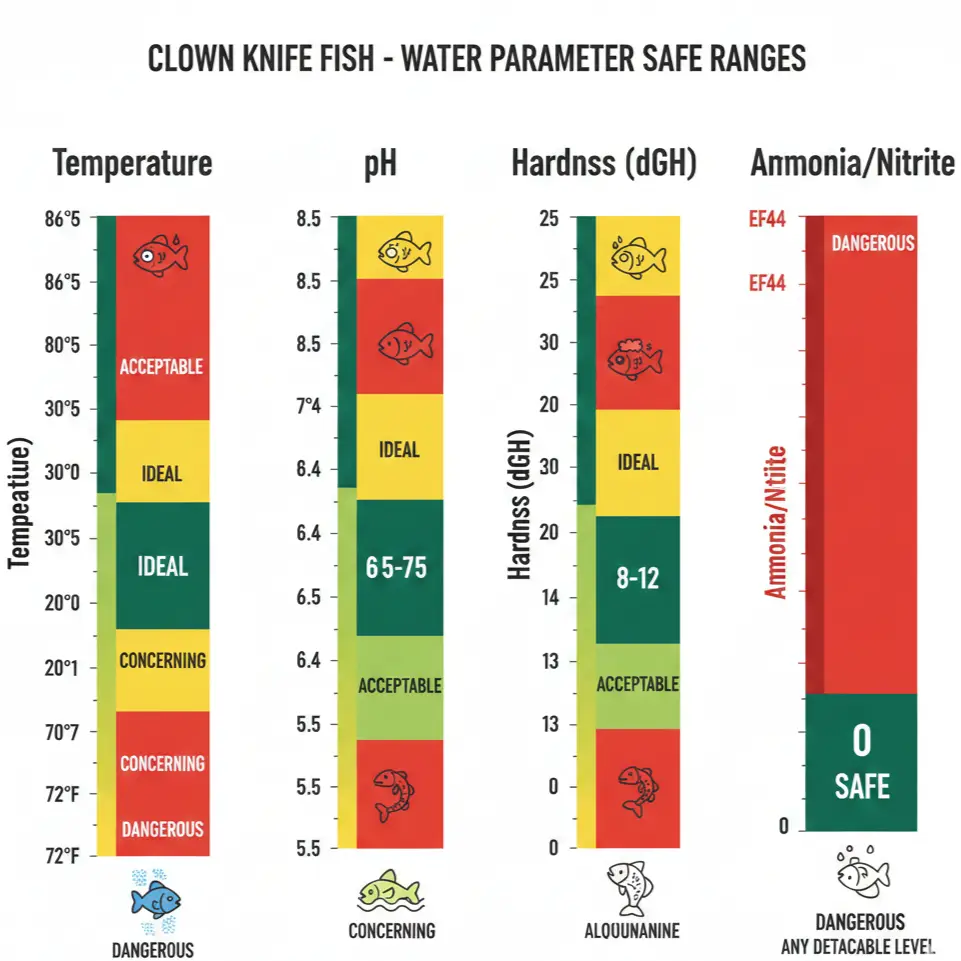
Water Parameters: What Actually Matters vs. What’s Overcomplicating Things
SPECIFICATIONS: Chitala ornata Water Requirements
SCIENTIFIC: Chitala ornata (Gray, 1831)
COMMON NAMES: Clown Knife Fish, Clown Featherback, Spotted Knife Fish
PARAMETERS:
Temperature: 75-82°F (24-28°C) ± 2° tolerance
pH: 6.0-7.5 (optimal: 6.5-7.0)
Hardness: 5-15 dGH / 89-267 ppm
Ammonia/Nitrite: 0 ppm (non-negotiable)
Nitrate: <20 ppm (optimal), <40 ppm (acceptable)
“I’ve kept clown knives at pH 7.4 (my tap water) without issues for
years. They’re more adaptable than most guides suggest, STABLE parameters
matter more than hitting exact numbers.”
CARE REALITY CHECK:
Difficulty: Advanced
Beginner-Suitable: No, size, feeding needs, and aggression escalation
Common Failure: Ammonia spikes from overfeeding + inadequate filtration
Temperature stability matters more than hitting an exact number. I’ve seen keepers obsess over maintaining 78.0°F while their tank swings 4 degrees every day from a poorly sized heater. That daily fluctuation causes more stress than keeping the tank consistently at 76°F or 80°F.
Your heater sizing becomes critical with tanks this large, I run dual heaters on opposite ends of my 300-gallon to prevent cold spots and provide redundancy if one fails.
The pH Myth
MYTH: “Clown knife fish require soft, acidic water (pH 6.0-6.5)”
REALITY: Captive-bred clown knives adapt to pH 6.0-7.8 with no measurable health impacts when parameters remain stable. Wild-caught specimens may need gradual acclimation.
Wild habitat data (soft, acidic rivers) gets applied directly to captive
care without accounting for multi-generational tank breeding. Most clown
knives in the hobby are 5-10+ generations removed from wild collection.
Test your tap water. If it’s between 6.0-7.8, use it. Don’t chase
“perfect” parameters, maintain consistency. Only adjust if you’re
experiencing unexplained health issues after ruling out other causes.
Understanding the relationship between GH and KH helps you evaluate whether your water source works for clown knives without modification.
Feeding Clown Knife Fish: Transitioning from Live to Prepared Foods
This is where most keepers struggle. Badly.
Clown knife fish are obligate carnivores with strong feeding responses to movement. Juveniles sold in stores have typically been raised on live feeder fish, ghost shrimp, and live worms, making the transition to prepared foods a genuine challenge that requires patience.
Clown knife fish should be weaned from live foods to frozen/prepared foods as juveniles. Adults eat 2-3 times weekly. Target foods: frozen silversides, frozen shrimp, quality carnivore pellets (Hikari Massivore, Northfin Carnivore), and earthworms. Avoid feeder fish due to disease transmission and nutritional deficiency. Feeding occurs primarily at night.
My Weaning Process
When I got my second clown knife in June 2020, it refused everything except live food for the first 6 weeks. Here’s what finally worked:
Week 1-2: Fed live ghost shrimp exclusively to build trust and establish feeding response location (front left corner of tank, always same spot).
Week 3-4: Introduced frozen silversides by dropping them into the feeding zone immediately after live shrimp consumption. Fish ignored them initially, then started striking at them reactively.
Week 5-6: Reduced live food to every other feeding, alternating with frozen. Hunger drove acceptance.
Week 7-8: Transitioned to frozen-only, introduced frozen bloodworm cubes and cut pieces of market shrimp.
Week 10+: Began pellet training using Hikari Massivore. Soaked pellets in tank water for 60 seconds before dropping, this helped them sink at the right speed and softened texture. Success rate: approximately 70% of pellets consumed.
The fish never achieved 100% pellet acceptance. That’s fine. I budget for frozen food purchases, roughly $25-30 monthly for a single adult.
Why Feeder Fish Are a Bad Idea
I fed feeder goldfish to my first clown knife for about 4 months in 2018. Seemed convenient. Then I got hit with an ich outbreak that originated from a contaminated feeder batch, followed by internal parasites that required two rounds of medication.
Never again.
Feeder fish, especially goldfish and rosy reds from chain pet stores, carry disease loads that would shock most hobbyists if they actually tested them. The nutritional profile is also poor: fatty, low in essential nutrients, and potentially thiaminase-positive (which destroys vitamin B1 and causes long-term neurological damage).
Earthworms from your yard work better. Night crawlers from bait shops work. Frozen silversides work. Ghost shrimp from a quarantine tank you maintain yourself work. Random feeder fish from a tank of 200 stressed, diseased animals do not.
Tank Mates for Clown Knife Fish: Compatibility Reality Check
I’m going to be blunt: clown knife fish eat their tank mates.
Not always immediately. Not even always intentionally. But anything that fits in that mouth, which opens wider than you’d expect, eventually becomes food. I’ve lost corydoras, medium-sized plecos, and a 6-inch silver dollar to clown knives that “had been peaceful for months.”
MYTH: “Clown knife fish are peaceful community fish suitable for large tanks with medium-sized tank mates.”
REALITY: Clown knives are ambush predators that become increasingly aggressive and predatory with age. “Compatibility” is temporary, fish tolerated at 8 inches often become prey when the clown knife reaches 18+ inches.
Juvenile clown knives ARE relatively peaceful. They’re nervous, hide constantly, and pose minimal threat to similar-sized fish. This behavior changes dramatically around 14-18 inches when territorial instincts and predatory confidence emerge.
Only keep clown knives with fish too large to eat AND able to defend themselves: adult oscars (10″+), large plecos (12″+), adult silver arowanas, large catfish (Pseudoplatystoma, large Synodontis). Even then, monitor regularly. Species-only tanks eliminate guesswork.
What Has Actually Worked For Me
My current 300-gallon houses one 31-inch clown knife with:
- One 14-inch common pleco (too large, too armored to bother)
- One 16-inch sailfin pleco (same logic)
That’s it. I tried adding a school of silver dollars in 2022, lost three within 5 weeks despite them being “too fast” and “too large” according to compatibility charts. The clown knife hunts at night when other fish are sluggish. Speed during daylight hours doesn’t help.
If you’re interested in predator setups with more visual variety, understanding freshwater angelfish behavior helps, though angels themselves become clown knife food above the 12-inch knife size threshold.
Setting Up the Tank: Equipment and Aquascaping
Large predator tanks require different thinking than planted community setups. You’re not building an underwater garden, you’re building a functional habitat for a powerful, messy fish that will rearrange anything not secured.
Filtration Requirements
Rate your filtration for 2-3× your tank volume turnover per hour. On my 300-gallon, I run a Fluval FX6 (rated 563 GPH) plus a large sump with 800 GPH return pump, giving me approximately 4.5× turnover. Overkill? Maybe. But clown knives produce serious bioload, especially after feeding, and I’d rather over-filter than deal with ammonia spikes.
The filter media selection matters significantly with predator tanks, prioritize biological media volume over mechanical filtration since the waste produced is largely organic.
Substrate Choices
Sand works best. Pool filter sand specifically, it’s cheap, inert, and easy to clean.
I learned this the hard way. My original 125-gallon had gravel substrate. Uneaten food particles, fish waste, and debris accumulated between gravel pieces, creating ammonia pockets that leached into the water column unpredictably. After switching to pool filter sand, maintenance became straightforward: waste sits on top, gets stirred by the fish’s movement, and gets picked up by filtration or siphoned during water changes.
Bare-bottom tanks work too. Less aesthetically pleasing, but zero maintenance concerns. Many predator keepers prefer this approach.
Hardscape: Less Is More
Clown knives need hiding spots, but they’ll destroy elaborate aquascaping. My approach:
One or two large pieces of Malaysian driftwood secured to the tank base. The fish will wedge itself behind or under these during daylight hours.
Avoid: Stacked rock formations (they’ll knock them over), delicate branching wood (they’ll break it), anything with sharp edges (potential injury during nighttime activity bursts).
PVC pipe works functionally if aesthetics don’t concern you. A 12-inch diameter pipe provides perfect cover for adult clown knives and is indestructible.
Common Health Issues and Troubleshooting
Clown knife fish are hardy once established, but “once established” is doing a lot of work in that sentence.
The First 30 Days Are Critical
New clown knives die from three main causes:
- Ammonia poisoning in uncycled or undersized tanks
- Stress-related illness from shipping and acclimation
- Starvation from feeding refusal
Your tank must be fully cycled before adding a clown knife. Period. These fish don’t tolerate ammonia, even at 0.25 ppm, you’ll see stress behaviors within 48 hours.
Ich Susceptibility
Clown knives seem particularly vulnerable to ich (white spot disease) during temperature fluctuations or after transport stress. I’ve treated two of my four fish for ich within the first month of ownership.
Treatment protocol that worked for me: Raised temperature to 86°F gradually (2 degrees per day), added aquarium salt at 1 tablespoon per 5 gallons, maintained for 14 days. Heat alone wasn’t sufficient, the salt seemed critical for resolution.
Spinal Deformities
This is the slow killer nobody warns you about.
Clown knives kept in too-small tanks develop spinal curvature over 12-24 months. It’s subtle at first, a slight bend near the tail, a swimming pattern that pulls left or right. By the time it’s obvious, the damage is irreversible.
My first clown knife developed this. I moved it to a larger tank at 20 months, but the curve had already progressed too far. The fish lived another 3 years but with reduced mobility and eventual feeding difficulty.
If you notice any spinal irregularity, upgrade tank length immediately. You might stop progression even if you can’t reverse existing damage.
Growth Rate Expectations and Lifespan
Clown knife fish grow approximately 1-1.5 inches per month during their first year with adequate feeding and tank size. Growth slows to 0.5-0.75 inches monthly during year two, then tapers to 0.25 inches or less monthly after reaching 24+ inches. Maximum captive size ranges from 24-36 inches depending on genetics and husbandry. Lifespan is 10-15 years with proper care.
My Recorded Growth Data
| Fish | Starting Size | 6 Months | 12 Months | 18 Months | 24 Months |
| #1 | 4″ | 9″ | 15″ | 18″ | 19″ (growth stall) |
| #2 | 5″ | 11″ | 16″ | 20″ | 21″ |
| #3 | 4″ | 10″ | 17″ | 22″ | 26″ |
| #4 | 6″ | 13″ | 19″ | 24″ | 28″ |
Fish #1’s growth stall directly correlates with the tank size limitation I described earlier. Fish #3 and #4, both in the 300-gallon with 96″ length from the start, showed no plateau during the observation period.
The 15-Year Commitment
Before buying a clown knife, ask yourself: Where will you be in 15 years?
These fish outlive many pets. They outlive dorm rooms, apartments, relationships, and career changes. I’ve seen multiple clown knives end up in rescue situations because keepers couldn’t maintain the long-term commitment, a 28-inch predator fish isn’t easy to rehome.
If you’re not prepared for a decade-plus commitment to a 300+ gallon tank, consider alternatives. German blue rams offer stunning color in a 30-gallon package. Apistogramma species provide interesting behavior without the space demands.
Cost Reality: What Clown Knife Fish Actually Cost to Keep
Nobody talks about this enough.
FIRST YEAR STARTUP:
Fish: $15-40 (juvenile)
Tank (200+ gallon used): $400-800
Tank (300 gallon new): $1,500-3,000+
Filtration (canister + backup): $300-600
Heaters (2× for redundancy): $80-150
Substrate (sand): $40-80
Driftwood/Decor: $50-200
Testing supplies: $40-60
TOTAL FIRST YEAR: $925-4,890
MONTHLY ONGOING:
Food (frozen + pellets): $25-40
Electricity (large tank): $30-60
Water changes (increased water bill): $10-25
Filter maintenance: $5-15
TOTAL MONTHLY: $70-140
ANNUAL ONGOING: $840-1,680
I’ve spent approximately $2,200 on my current clown knife setup over 3 years, not counting the fish itself or the electricity costs I can’t easily separate from household usage. That’s manageable for me, but it’s not cheap, and costs increase with tank size.
Final Recommendations: Should You Get a Clown Knife Fish?
Here’s my honest assessment after 7 years with this species.
Get a clown knife fish if:
- You have space for a 200+ gallon tank NOW (not “eventually”)
- You’re willing to upgrade to 300+ gallons within 18-24 months
- You find predator fish feeding behavior genuinely fascinating
- You’re committed to a 10-15 year project
- You have budget for ongoing large-tank maintenance
- You’re okay with a mostly nocturnal pet you’ll rarely see during daytime
Don’t get a clown knife fish if:
- Your current tank is your “forever” setup
- You want a diverse community tank
- You expect the fish to stay under 18 inches
- Feeding live/frozen foods regularly seems inconvenient
- You’re not established in your living situation
I don’t regret keeping clown knives, they’re genuinely fascinating predators with more personality than most fish I’ve owned. But I also understand why so many fail within two years. The commitment is real.
If you’re still interested after reading all of this, you’re probably the right kind of keeper. Start planning your tank before you buy the fish. Budget your startup costs realistically. And be patient, rushing this species never ends well.