I bought my first ghost shrimp in February 2022. Twelve of them. They cost $0.39 each from a feeder tank at a big-box pet store.
Nine were dead within 11 days.
Ghost shrimp (Palaemonetes paludosus) need stable temperatures between 65-80°F, pH 7.0-8.0, zero ammonia, and, critically, they need to not come from stressed feeder stock. The species itself is genuinely hardy. The problem is that pet stores sell multiple species under one name, keep them in conditions that compromise their immune systems, and hobbyists inherit pre-damaged shrimp that were never going to survive.
I spent the next 18 months figuring out what actually determines ghost shrimp survival. I tracked four batches from different sources, monitored parameters obsessively with my API Master Test Kit, and documented everything. What I found challenged basically every piece of “common knowledge” I’d read online.
The survival gap between batches was massive, and it had almost nothing to do with my care.
What Exactly IS a Ghost Shrimp? (The Species Problem Nobody Mentions)
“Ghost shrimp” is a common name applied to at least 3-4 different freshwater shrimp species in North American pet stores. The most common is Palaemonetes paludosus (Gibbes, 1850), but stores also sell Palaemonetes kadiakensis, Macrobrachium lanchesteri (whisker shrimp), and occasionally juvenile Macrobrachium species, all labeled identically.
This is where most ghost shrimp care guides fail you.
They give you parameters for Palaemonetes paludosus, the “true” ghost shrimp, but you might actually be keeping Macrobrachium lanchesteri, which has longer claws, predatory tendencies, and completely different behavioral patterns. Or you could have a mix. I’ve bought bags labeled “ghost shrimp” that contained what I’m 90% sure were three separate species.
The taxonomy gets messy fast. Palaemonetes is a genus containing around 40 species distributed across North and Central America. Pet stores don’t distinguish between them because, honestly, even biologists need microscopic examination of rostrum teeth to tell some species apart. FishBase lists P. paludosus as the primary aquarium species, but their distribution maps show significant overlap with P. kadiakensis in the wild catch areas suppliers use.
Why this matters for your tank:
| Species | Claw Length | Behavior | Max Size | Breeding in Freshwater |
| P. paludosus (true ghost) | Short, subtle | Peaceful scavenger | 1.5-2″ | Yes, successful |
| P. kadiakensis | Short | Peaceful | 1.5″ | Yes |
| Macrobrachium lanchesteri (whisker shrimp) | Long, prominent | Semi-aggressive, may attack fish/shrimp | 2-3″ | Difficult |
| Macrobrachium spp. (misc.) | Very long | Predatory | 3-6″ | Often requires brackish |
So when someone says “my ghost shrimp killed my betta,” they probably had whisker shrimp. When someone else says “ghost shrimp are completely peaceful,” they probably had true Palaemonetes. Both are correct. Neither knows it.
How to tell them apart (imperfectly):
Look at the claws. True ghost shrimp have small, almost invisible pincers. Whisker shrimp have claws you can actually see from across the room, they look like they’re ready to box. If your “ghost shrimp” has prominent orange or red bands on its claws, that’s almost certainly Macrobrachium.
I learned this the hard way in August 2023 when one of my “ghost shrimp” grabbed an ember tetra by the tail. That shrimp had claws I should have noticed.
Ghost Shrimp Care Requirements: Parameters That Actually Matter
SPECIFICATIONS: Ghost Shrimp (Palaemonetes paludosus)
SCIENTIFIC: Palaemonetes paludosus (Gibbes, 1850)
COMMON NAMES: Ghost shrimp, Glass shrimp, Grass shrimp, Eastern grass shrimp
PARAMETERS (Research-Based):
- Temperature: 65-80°F (18-27°C) , optimal 72-76°F
- pH: 7.0-8.0 (optimal: 7.2-7.6)
- GH: 3-15 dGH (6-10 optimal)
- KH: 3-12 dKH
- Ammonia/Nitrite: 0 ppm (non-negotiable)
- Nitrate: <20 ppm optimal, <40 ppm acceptable
“I’ve kept ghost shrimp successfully at pH 7.8 and GH 14, harder water than most guides recommend. What killed batches wasn’t parameters. It was source quality and acclimation speed.”
REQUIREMENTS:
- Minimum Tank: 5 gallons (19 liters)
- Recommended: 10+ gallons for stable parameters and breeding
- Stocking: 3-4 shrimp per gallon maximum
CARE REALITY CHECK:
- Difficulty: Easy if healthy stock obtained
- Beginner-Suitable: Yes, with caveats about source
- Common Failure: DOA or death within 2 weeks from feeder stock stress
COSTS:
- Initial: $0.30-0.50 (feeder) / $2-4 (pet quality)
- Monthly: ~$3 (food, minimal)
- Setup: $50-150 (basic suitable setup)
Here’s what I’ve found actually kills ghost shrimp, ranked by how often I’ve seen it happen:
1. Pre-existing stress from feeder conditions
This is the big one. Feeder shrimp are kept in massively overcrowded tanks, often with poor water quality that spikes ammonia. They’re not fed well. They’re shipped roughly. By the time they reach your tank, their immune systems are already compromised.
I ran a direct comparison in spring 2023. Same 10-gallon tank, split with a divider. Same parameters, same food, same everything. One side got 10 shrimp from a feeder tank ($3 total). Other side got 10 from a specialty invertebrate seller ($25 total).
Results after 60 days:
- Feeder batch: 3 survivors (70% mortality)
- Pet-quality batch: 9 survivors (10% mortality)
That $22 difference bought me 6 additional living shrimp. The “cheap” option wasn’t cheap.
2. Ammonia and nitrite spikes
Ghost shrimp are more sensitive to nitrogen compounds than most fish. Not as sensitive as Caridina species like Crystal Red Shrimp, but sensitive enough that a spike during cycling will kill them.
Never add ghost shrimp to an uncycled tank. Just don’t.
3. Rapid parameter changes
Temperature swings, pH crashes, sudden GH shifts, these stress shrimp more than stable “imperfect” parameters. I’ve seen ghost shrimp thrive at pH 8.2 (higher than recommended) because the tank was stable at 8.2. Consistency beats perfection.
4. Copper exposure
Most fish medications contain copper. Copper kills invertebrates. If you’ve treated a tank with ich medication, copper residue may persist in the substrate for months. I lost a batch this way in my quarantine tank, forgot I’d used copper-based treatment six weeks earlier.
Tank Setup: Size, Substrate, and the Hiding Spot Mistake
When I set up my first dedicated ghost shrimp tank, I made what I thought was a smart decision: minimal decorations for maximum viewing. They’re transparent! I wanted to watch them!
Terrible idea.
Ghost shrimp are prey animals. In the wild, they’re eaten by basically everything, fish, birds, larger crustaceans, turtles. Their response to feeling exposed is stress. Chronic stress leads to weakened immune systems, failed molts, and death. Even if nothing in your tank can actually harm them, they don’t know that.
SETUP:
- Tank: 20-gallon long, divided into 3 zones
- Duration: 12 weeks (March-May 2023)
- Method: Different hiding spot densities per zone
- Parameters: Identical across zones
RESULTS:
- Zone A (bare): 40% mortality, constant hiding, no breeding
- Zone B (moderate, some plants, one driftwood): 15% mortality, normal activity, one berried female
- Zone C (dense, heavy plants, multiple caves): 5% mortality, confident behavior, three berried females
The shrimp in the densest zone were actually more visible because they felt safe enough to forage openly.
More hiding spots = more visible shrimp. Counterintuitive but consistent.
Single tank, may have had subtle parameter differences between zones despite identical filtration.
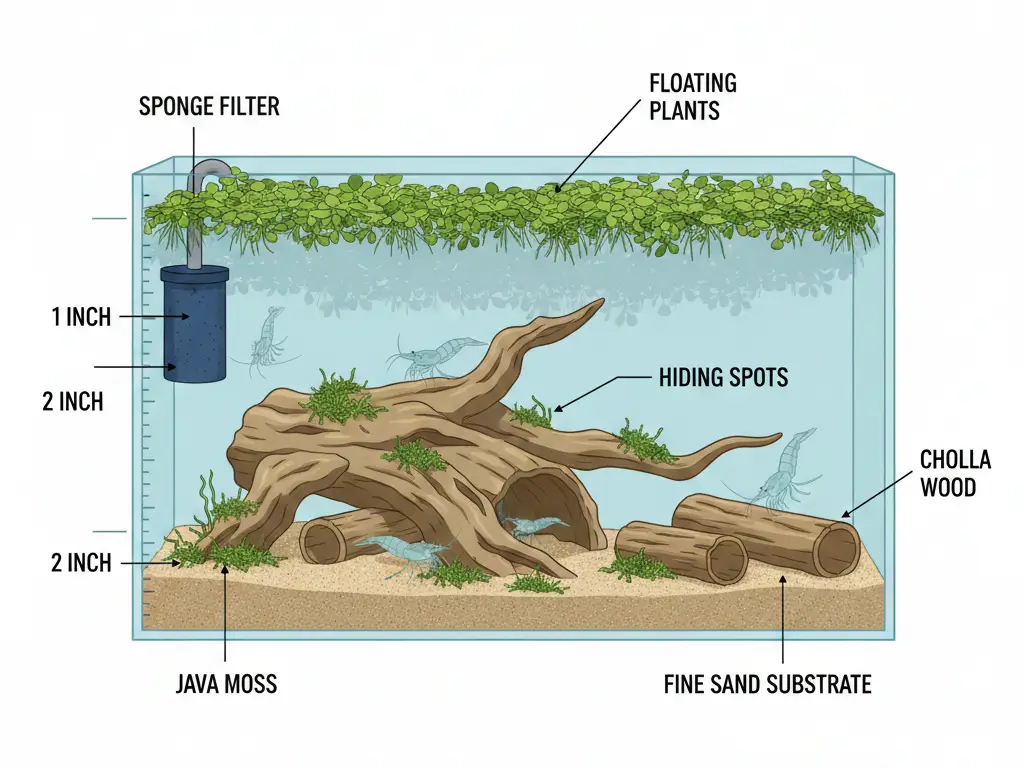
What actually works for a ghost shrimp setup:
- Tank size: 10 gallons minimum for a colony. You can keep a few in 5 gallons, but parameter stability becomes harder.
- Substrate: Fine gravel or sand. Ghost shrimp sift through substrate for food particles, sharp-edged gravel can damage their delicate legs. I use pool filter sand in my shrimp tanks.
- Plants: Java moss is perfect. It provides hiding spots, grows biofilm that shrimp graze on, and protects shrimplets. Floating plants like Amazon frogbit diffuse light and make shrimp feel less exposed.
- Filtration: Sponge filters are ideal, no shrimplet gets sucked in, and the sponge surface grows biofilm. If you’re using a hang-on-back or canister, cover the intake with a sponge pre-filter.
- Hardscape: Driftwood and rocks with crevices. Cholla wood is particularly good because the tube structure creates natural shrimp caves.
For a complete beginner setup approach that works well for invertebrates, the planted tank fundamentals guide covers filtration sizing and cycling steps I won’t repeat here.
Feeding Ghost Shrimp: Less Is More (With One Exception)
Ghost shrimp are opportunistic omnivores that primarily eat algae, biofilm, detritus, and decaying plant matter. In established tanks with fish, they often need zero supplemental feeding, they survive entirely on leftover fish food and natural tank growth.
I used to feed my ghost shrimp every day. Algae wafers, blanched vegetables, shrimp pellets. I thought I was being a good shrimp parent.
What I was actually doing was crashing my water quality.
Shrimp have tiny bioloads. A group of 10 ghost shrimp produces less waste than a single adult guppy. But uneaten food? That decomposes fast, spikes ammonia, and kills shrimp. I learned this in April 2022 when I lost 5 shrimp after dropping in a full algae wafer “for them to share.”
Current feeding approach:
- Shrimp-only tank: Feed 2-3 times per week, tiny portions (what they consume in 2 hours)
- Community tank: Often nothing extra, they scavenge fish food
- Breeding tank: 3-4 times weekly for higher protein to support egg development
The exception: Newly arrived shrimp.
Fresh shrimp from pet stores are often starving. Feeder conditions don’t include regular feeding. For the first 1-2 weeks, I feed new arrivals lightly every day to help them recover condition. After they’re settled and active, I scale back.
Best foods:
| Food Type | Pros | Cons | My Rating |
| Blanched zucchini | Cheap, they love it, sinks | Rots quickly if uneaten | 8/10 |
| Algae wafers | Convenient, balanced | Easy to overfeed | 7/10 |
| Shrimp-specific pellets | Formulated nutrition | More expensive | 8/10 |
| Biofilm (grown in tank) | Natural, always available | Can’t control amount | 9/10 |
| Blanched spinach | High calcium for molts | Messy, decomposes | 7/10 |
| Fish food leftovers | Free | Unpredictable nutrition | 6/10 |
The calcium thing matters. Ghost shrimp molt every 3-4 weeks, and failed molts are a common cause of death. Calcium in the diet and adequate GH in the water support successful molting. I add a small piece of cuttlebone to my shrimp tanks, it dissolves slowly and supplements calcium.
Tank Mates: What Actually Works (And the Fish That Will Eat Them Overnight)
MYTH: “Ghost shrimp can go with any peaceful community fish.”
REALITY: Any fish that can fit a ghost shrimp in its mouth will eat ghost shrimp. This includes many “peaceful” species once they reach adult size. Even fish that can’t swallow adults will often kill and consume juvenile shrimp.
Ghost shrimp survive short-term with many fish because fish often ignore new tank mates initially. Give it 2-3 weeks. The shrimp start disappearing one by one, usually overnight when you can’t witness it.
Choose tank mates under 1.5 inches that lack the mouth size or predatory instinct to hunt shrimp.
I’ve lost ghost shrimp to fish I never expected.
The angelfish made sense, they’re ambush predators with big mouths. But a platy? I watched a full-grown female platy chase down and consume a half-inch shrimplet in about three seconds. Didn’t think she had it in her.
Actually safe tank mates (tested personally):
- Otocinclus , too small, completely disinterested in shrimp (full oto care here)
- Small rasboras , chili rasboras, celestial pearl danios (mouths too small)
- Pygmy corydoras , bottom feeders, ignore shrimp (dwarf cory guide)
- Snails , mystery snails, nerites, ramshorns (different food sources)
- Other small shrimp , cherry shrimp coexist peacefully
Risky tank mates (often work, sometimes don’t):
- Bettas , Individual personality varies wildly. Some bettas ignore shrimp completely. Others hunt them for sport. I’ve had both. You won’t know which you have until shrimp start disappearing. (Betta care reference)
- Guppies/endlers , Adults usually fine with adult shrimp. Shrimplets are at risk.
Avoid entirely:
- Any cichlid (including German blue rams, too predatory)
- Goldfish (eat everything)
- Most gouramis
- Large tetras (Buenos Aires tetras will absolutely hunt shrimp)
Breeding Ghost Shrimp: Why “Easy” Isn’t the Same as “Successful”
Ghost shrimp breed readily in captivity. Females become “berried” (carrying eggs under their tail) within weeks of good conditions. The eggs are visible as a greenish-gray mass. Females fan them constantly for oxygenation.
About 2-3 weeks later, the larvae hatch.
And here’s where “easy breeding” meets reality: ghost shrimp larvae are planktonic. Unlike Neocaridina (cherry shrimp) that hatch as miniature adults, ghost shrimp larvae are tiny, free-floating, and incredibly delicate. In a community tank, or even a shrimp-only tank with a filter, they get eaten or sucked up within hours.
SETUP:
- Tank: 10-gallon, heavily planted, sponge filter
- Duration: 8 months (June 2023 – January 2024)
- Starting population: 15 shrimp (mix of male/female)
- Method: No special intervention, just observation
RESULTS:
- Berried females observed: 12+ instances
- Larvae spotted: Countless
- Juveniles surviving to 0.5″ size: 4 total
- Adults surviving to 1 year: 8 of original 15
Despite constant breeding activity, population barely sustained itself. Virtually all larvae were consumed before developing.
Ghost shrimp breed prolifically but have extremely low juvenile survival in typical aquarium conditions.
I didn’t attempt a dedicated breeding setup with brackish conditions, which may improve larval survival for some populations.
If you actually want to raise ghost shrimp:
Dedicated breeding approach:
- Move berried female to a separate, heavily planted container 2-3 days before expected hatch
- Use air-powered sponge filter only (no powerheads, no HOB)
- Add java moss absolutely everywhere
- Feed larvae with infusoria or liquid fry food
- Accept that survival rates will still be low
Some hobbyists successfully raise larvae by adding light salt (1 tablespoon per 5 gallons) to the rearing container. This works for some ghost shrimp populations but not others, likely because they’re dealing with different species that have different salinity tolerances. I haven’t verified this personally, so I can’t recommend it confidently.
For reliable breeding with high survival rates, cherry shrimp are simply better for most hobbyists. Their offspring hatch as miniature adults and need no special care.
Why Your Ghost Shrimp Keep Dying (The Real Causes)
Timeline Matters:
| When They Die | Most Likely Cause | What To Check |
| Within 48 hours | Acclimation failure OR pre-existing damage | Drip acclimate minimum 1 hour next time; source from better supplier |
| Days 3-14 | Delayed stress response from capture/shipping | Often unavoidable with feeder quality stock |
| Weeks 2-8 | Water quality issue | Test ammonia, nitrite, nitrate, check for bacterial bloom |
| During/after molting | Calcium deficiency OR parameter instability | Check GH, add calcium source, maintain stability |
| Random over months | Predation, old age, or disease | Observe tank mates; lifespan is only 12-18 months |
The “White Ring of Death”
If you see a white band around your ghost shrimp’s body, right behind the carapace where the tail connects, they’re stuck mid-molt. This is almost always fatal. The exoskeleton is splitting but they can’t fully escape.
Causes:
- Low GH (below 4 dGH)
- Low calcium in diet
- Sudden pH or temperature swings during vulnerable molt period
Prevention: Maintain stable GH between 6-10 dGH, provide calcium-rich foods or cuttlebone, avoid parameter swings.
Ammonia poisoning
Even 0.25 ppm ammonia causes shrimp stress. Above 0.5 ppm, expect deaths. If you’re still cycling your tank, don’t add shrimp until you’ve had consistent 0/0/under-20 readings (ammonia/nitrite/nitrate) for at least a week.
I test new shrimp tanks twice weekly for the first month. Old tanks, weekly during regular water changes.
Copper contamination
Already mentioned this, but it’s common enough to repeat: check any medications, fertilizers, or tap water conditioners for copper content. Seachem Prime and similar dechlorinators are shrimp-safe. Many ich treatments are not.
If you’ve previously treated a tank with copper-based medication, either re-home shrimp or run activated carbon in your filter for several weeks before introducing invertebrates.
Ghost Shrimp vs. Cherry Shrimp: The Honest Comparison
I get asked this constantly: should beginners start with ghost shrimp or cherry shrimp?
The standard answer is ghost shrimp because they’re cheaper.
I disagree.
| Factor | Ghost Shrimp | Cherry Shrimp | My Finding |
| Cost per shrimp | $0.30-0.50 (feeder) | $2-5 | Cherry actually cheaper long-term |
| Survival rate (feeder) | 30-50% typical | N/A (not sold as feeders) | Ghost die more |
| Survival rate (pet quality) | 80-90% | 90-95% | Similar when sourced well |
| Breeding success | Low (larvae vulnerable) | High (direct development) | Cherry populate tanks easily |
| Visibility | Clear/transparent | Bright red/orange | Cherry more visible |
| Lifespan | 12-18 months | 18-24 months | Cherry live longer |
| Sensitivity | Moderate | Moderate | Similar |
“I spent about $40 on ghost shrimp over 18 months (replacing deaths). I spent $25 on cherry shrimp once, and they’ve been self-sustaining for over two years. My cherry shrimp have been cheaper.”
RECOMMENDATION:
- Choose ghost shrimp if: You want them as feeders, you can source pet-quality stock, or you specifically like their transparent appearance
- Choose cherry shrimp if: You want a sustainable colony, you’re a beginner, or you want maximum color
- Avoid both if: Your tank has predatory fish, isn’t cycled, or has copper contamination
Making Ghost Shrimp Work Long-Term
After everything I’ve tested, here’s my honest assessment:
Ghost shrimp are genuinely hardy animals. The species Palaemonetes paludosus tolerates a wide parameter range, adapts to most community setups, and lives 12-18 months under good care. They’re interesting to watch, useful as cleaners, and, when healthy, remarkably low-maintenance.
The challenge isn’t keeping them. It’s obtaining them in a condition where they can be kept.
What I’d do differently starting over:
- Never buy from feeder tanks. Ever. The $3 savings isn’t worth the 70% mortality rate.
- Source from local hobbyists or specialty invertebrate sellers. Facebook aquarium groups, r/aquaswap, local aquarium club auctions. Shrimp that have been in someone’s tank for months are already proven survivors.
- Start with 6-10 minimum. Ghost shrimp are social and breed more readily in groups. Below 5-6, they often become reclusive.
- Plant heavily. Java moss, Christmas moss, anubias, anything that provides surface area for biofilm and hiding spots for molting.
- Accept that breeding isn’t free shrimp. Unless you set up dedicated larvae rearing, ghost shrimp won’t sustain their population through reproduction alone. Budget for occasional replacements.
Ghost shrimp taught me more about shrimp keeping than any other species. Mostly by dying until I figured out what actually mattered.
The ones I keep now? Going on 14 months, still sifting through sand, still molting successfully every few weeks, still transparent and weird and doing their ghost shrimp thing.
They’re not as flashy as cherry shrimp. They’re not as expensive as Caridina. But when you get the source right and the conditions stable, they’re genuinely good aquarium inhabitants.
Just make sure you know which species you actually bought.