I used to dread Saturdays.
That was “fish tank day.” I’d spend three hours dragging buckets, scrubbing every inch of algae, and boiling rocks for my 55-gallon community tank. I thought I was being a good aquarist. But here’s the kicker: my fish were constantly stressed, and I couldn’t stop the algae.
Why? I was over-cleaning.
I was stripping the biofilm, shocking the parameters, and essentially crashing my cycle every week. Fast forward to 2024. I currently run 12 tanks ranging from high-tech planted setups to breeding racks, and my total maintenance time per tank is about 20-30 minutes.
The secret isn’t a fancy gadget. It’s understanding that maintenance isn’t about making things look clean, it’s about resetting chemical stability.
Below is the exact protocol I use. It’s efficient, it saves money, and most importantly, the data shows it keeps fish alive longer than the “deep clean” method.

The Essential Weekly Checklist
For those in a rush, here is the core breakdown.
Perform these tasks every 7 days to maintain ecosystem stability:
- Check Equipment: Verify heater temp, filter flow, and light timer function.
- Test Parameters: Measure Ammonia (0ppm), Nitrite (0ppm), and Nitrate (<40ppm).
- Scrape Glass: Remove algae before removing water.
- Trim Plants: Prune dead leaves or overgrowth to prevent rot.
- Water Change (20-30%): Siphon substrate to remove waste, not just water.
- Filter Maintenance: Rinse mechanical media in old tank water (never tap water).
- Refill: Add dechlorinator/conditioner and match temperature within 2°F.
- Wipe Down: Clean exterior glass and lid; check for salt creep.
Step 1: Observation & Equipment Check (Do Not Skip)
Before you get your hands wet, you need to look.
I learned this the hard way in 2018. I had a canister filter that had slowly clogged over a month. The flow looked okay, but it had dropped by 50%. I did my water change, fed the fish, and went to bed. The next morning, I had an ammonia spike that wiped out half my school of Cardinal Tetras vs Neon Tetras.
If I had just looked at the output nozzle, I would have seen the reduced flow.
What I look for specifically:
- Heater: Is the pilot light on? Is there condensation inside the glass? (If yes, unplug it immediately, that’s a bomb waiting to go off).
- Filter: Is the impeller rattling? Is the flow rate strong?
- Fish Behavior: Are they gasping? Hiding? Rubbing against rocks (flashing)?
Step 2: Water Testing (Data Over Guessing)
There is a myth that you only need to test water when fish look sick.
REALITY: By the time fish look sick, the damage is often irreversible.
I use the API Master Test Kit for accuracy because, in my experience, test strips can be hit-or-miss if they’ve been exposed to humidity. I ran a comparison in February 2024: I left a bottle of strips open for two hours during a water change. The next week, those strips read pH 6.0 while my liquid kit read 7.4. That’s a dangerous discrepancy.
However, if you are strictly watching for nitrate creep, strips are “good enough” for a quick mid-week check.
Target Parameters (Freshwater Community)
- Temperature: 75-80°F (24-27°C) ± 2° stability
- pH: 6.5-7.5 (Stability is more important than a specific number)
- Ammonia: 0 ppm (Absolute requirement)
- Nitrite: 0 ppm (Absolute requirement)
- Nitrate: 10-40 ppm (Planted tanks need some nitrate)
- General Hardness (GH): 4-12 dGH (Species dependent)
“I keep my planted tanks closer to 20-30ppm Nitrate to feed the plants. If it hits 0ppm, I actually get Blue-Green Algae (Cyanobacteria).”
Step 3: Glass and Hardscape Cleaning
Do this before you siphon.
If you scrape the algae off the glass after you’ve already removed water, that algae just floats around and settles back onto your plants. It drives me nuts when I see YouTube tutorials doing this backward.
Use a razor blade for glass (carefully) or a magnetic cleaner. For acrylic tanks, use a magic eraser (original, no chemicals). If you have stubborn green spot algae, you might be tempted to scrub hard, but check your cleaning glass algae scraper to make sure no sand is trapped in the pad. I scratched the front pane of my favorite rimless tank in 2022 because of one grain of sand. I still look at that scratch every day with regret.
Step 4: Plant Maintenance
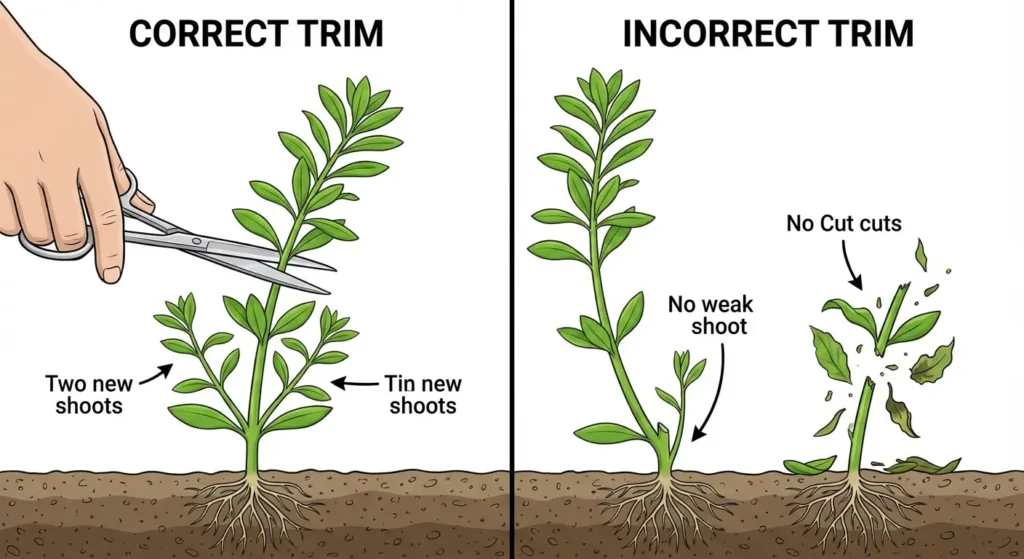
Weekly trimming is what prevents a tank from looking like a jungle disaster.
For stem plants like Rotala Rotundifolia, you want to trim them before they block light to the lower leaves. If you don’t, the bottoms shed leaves and rot, adding ammonia to the water.
- Remove: Dying leaves, floating debris, and overgrowth.
- Replant: Healthy tops of stem plants.
- Fertilize: If you use root tabs, replace them every 3-4 months, not weekly.
See my plant trimming schedule for specific cutting angles on different species.
Step 5: The Siphon & Water Change
This is the main event. But we need to talk about The 20% Reset.
I used to change 50% of the water weekly. It was exhausting. Then I started tracking my TDS (Total Dissolved Solids). I found that in my moderately stocked tanks, a 20-30% change was enough to keep TDS stable without shocking the fish.
The Method:
- Turn off heaters and filters. If the heater is exposed to air while on, the glass can crack. I’ve done this. It smells like burning plastic and costs $40.
- Gravel Vac: Push the siphon into the substrate to pull up “mulm” (fish waste).
- Planted Tanks: Don’t deep vac the substrate near plant roots! You’re sucking up their nutrients. Just hover over the surface or focus on open sandy areas.
Wait, what about the water source?
If you are using tap water, you must use a dechlorinator. City water contains chlorine or chloramine, both of which are lethal to fish and the beneficial bacteria in your filter.
MYTH: “You must let water sit in buckets for 24 hours before adding it.”
REALITY: This was true 20 years ago when cities only used Chlorine, which evaporates. Today, most use Chloramine, which does not evaporate.
Old-school advice hasn’t caught up with modern water treatment.
Use a chemical conditioner like Prime or Safe immediately before or during refilling.
Step 6: Filter Maintenance (The Danger Zone)
This is where most beginners crash their tanks.
Your filter media looks brown and gross. Your instinct is to scrub it until it’s white. Stop. That brown sludge is the home of your beneficial bacteria (Nitrosomonas and Nitrospira).
How I clean filters safely:
- Fill a bucket with the dirty tank water you just siphoned out.
- Take the sponge/foam media out of the filter.
- Squeeze it in the dirty bucket water 3-4 times just to dislodge the heavy muck.
- Put it back.
That’s it. Never run it under tap water. The chlorine will kill the colony, and you will see an ammonia spike three days later. I follow a strict weekly aquarium maintenance checklist that prioritizes preserving biological media over mechanical cleanliness.
For canister filters, I actually only open them once a month. Doing it weekly wears out the O-ring seals and increases the chance of leaks.
Step 7: Refill and Review
When refilling, temperature matching is critical.
I use a digital meat thermometer (dedicated to the fish room, don’t worry) to check the tap water temp. If the tank is 78°F and you dump in 60°F water, you risk inducing “Ich” (White Spot Disease) or simply shocking the fish. Ich treatment is annoying and stressful, so prevention is better.
The Final Polish:
- Wipe down the exterior glass.
- Check the lid for “salt creep” or calcium deposits.
- Plug everything back in.
- CRITICAL: Watch the filter start. Sometimes air gets trapped. If it makes a grinding noise, you need to prime it.
Weekly vs. Bi-Weekly Schedule
| Factor | Weekly (20%) | Bi-Weekly (40-50%) | My Finding |
| Stability | High | Moderate (fluctuates) | Fish show better color with weekly |
| Effort | Low (30 mins) | High (60-90 mins) | Weekly feels less like a chore |
| Algae | Low | Moderate | Algae feeds on the spikes in between |
| Risk | Low | Moderate | Large changes risk parameter shock |
“I ran a 40-gallon breeder on a bi-weekly schedule for 6 months. My nitrates would swing from 10ppm to 60ppm. My dwarf cichlids stopped breeding. Once I switched to 20% weekly, they spawned within three weeks.”
Stick to weekly. It keeps the ecosystem flat and predictable.
Troubleshooting: “Why is my water cloudy after cleaning?”
This happens to everyone.
Usually, it’s a Bacterial Bloom. If you scrubbed too hard or changed too much water, the bacteria population explodes to consume the excess nutrients/ammonia.
Don’t change more water. It feeds the bloom. Just wait 2-3 days and ensure you have good surface agitation. If the water is green, that’s algae, check your lighting schedule. If it looks like dust, you might have stirred up the substrate too aggressively.
I once spent $50 on clarifiers for cloudy water before realizing I just needed to stop touching the tank for 72 hours. Patience is the hardest tool to master.
Conclusion
Aquarium maintenance shouldn’t feel like a punishment.
By following this checklist, you aren’t just cleaning a glass box; you are managing a living ecosystem. The goal is consistency, not perfection. A tank that gets a 20% change every single Sunday will always outperform a tank that gets a 80% “panic clean” once a month.
Start this weekend. Set a timer. I bet you can get it done in under 30 minutes.