I remember staring at my first 55-gallon tank in 2011, dropping fish food into an empty glass box and wondering if I was losing my mind. The guides said “wait 4 weeks.” They didn’t mention that my cold basement apartment (68°F) would turn that 4 weeks into 8, or that my soft water would cause a pH crash that killed the very bacteria I was trying to grow.
Fishless cycling typically takes 4 to 6 weeks to complete. However, this timeline is highly dependent on temperature, pH stability, and initial bacterial seeding. By dosing pure ammonia to 2-4 ppm and maintaining water temperatures between 80-82°F, the process can often be reduced to 14-21 days. The goal is to cultivate Nitrosomonas and Nitrospira bacteria capable of processing 2 ppm of ammonia into nitrate within 24 hours.
But numbers on a screen are easy. Actually staring at a test tube that refuses to turn yellow is frustrating. After tracking data logs across 8 different startups, from high-tech planted setups to bare-bottom breeding tanks, I’ve realized that “patience” isn’t the only ingredient. You need chemistry.
What is the Nitrogen Cycle?
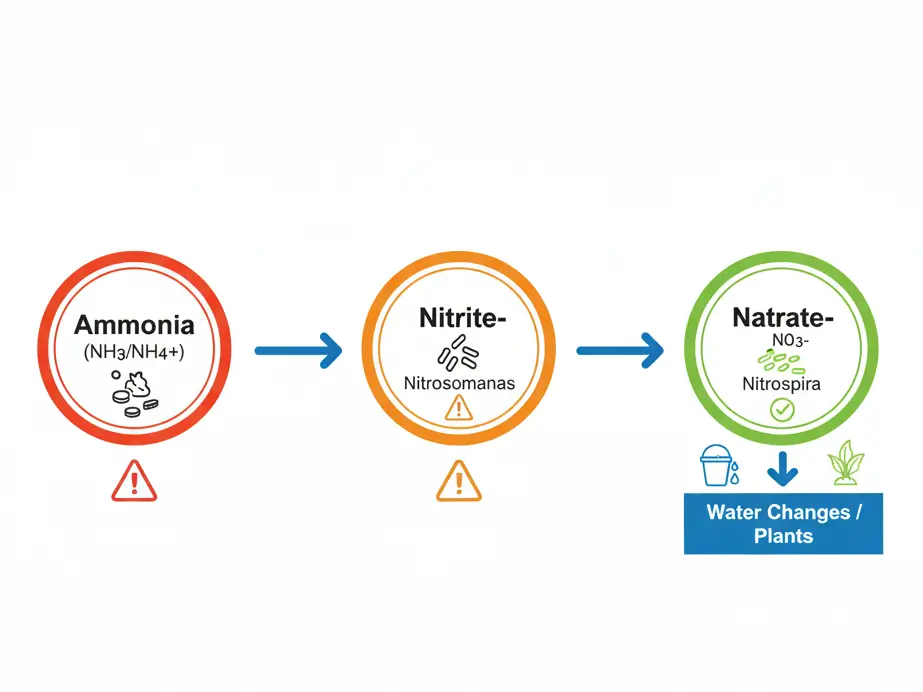
We tend to overcomplicate this. At its core, you are building a microscopic waste processing plant.
Fish expel ammonia (toxic). Nitrosomonas bacteria eat ammonia and poop out nitrite (super toxic). Nitrospira bacteria then eat the nitrite and poop out nitrate (manageable). You aren’t keeping fish yet; you are keeping bacteria. Until this invisible colony is large enough to handle the waste load of your future fish, your tank is a death trap.
I used to think biological filtration was just “having a filter.” Wrong. It’s surface area. The bacteria live on surfaces, not in the water column. This is why ceramic filter media is crucial, it provides the housing for your invisible pets.
The Setup: What You Actually Need
Don’t buy the “all-in-one” kits without checking the contents. I wasted $40 on a “starter kit” once that contained nothing but dechlorinator.
The Mandatory List:
- Liquid Ammonia: Pure ammonium chloride. No surfactants, no scents. Shake the bottle, if it foams like soap, don’t put it in your tank.
- Test Kit: Strips are useless here. You need the API Master Test Kit because you need to distinguish between 0.25ppm and 0ppm ammonia.
- Heater: Even if you plan on cold-water fish. (More on this “heater hack” later).
- Dechlorinator: Chlorine kills bacteria. Period.
Step-by-Step Ammonia Dosing Method
This is the exact protocol I use. It’s aggressive, but it works.
Phase 1: The Spike (Days 1-7)
Fill the tank. Turn on the filter. Crank the aquarium heater to 82°F (28°C). Bacteria reproduce significantly faster in warmer water (Hovanec et al.).
- Action: Dose ammonia to 2-4 ppm.
- Test: Check ammonia daily. It should stay high.
- Reality Check: Nothing will happen for days. It’s boring. I usually obsess over hardscape placement during this week.
Phase 2: The Drop (Days 7-21)
You’ll eventually see ammonia drop. Simultaneously, nitrite will skyrocket off the charts (purple on the API kit).
- Action: Keep ammonia at 2 ppm. If it drops to 0, dose it back up.
- Crucial Warning: Do not let ammonia exceed 5 ppm. High concentrations can actually stall the cycle by inhibiting Nitrospira growth. I stalled a 20-gallon long for three weeks because I thought “more food = more bacteria.” It doesn’t.
Phase 3: The Conversion (Days 21-45)
Nitrites will hang high forever. It feels like forever. Then, literally overnight, they will vanish.
- The Victory Test: Dose ammonia to 2 ppm. Wait 24 hours.
- Pass: Ammonia = 0, Nitrite = 0, Nitrate = High.
- Fail: Any ammonia or nitrite readable.
Temperature Impact
SETUP: Two 10-gallon tanks, identical sponge filters, same ammonia source.
VARIABLE: Tank A at 70°F vs. Tank B at 82°F.
RESULTS:
- Tank A (70°F): Cycle complete in 38 days.
- Tank B (82°F): Cycle complete in 19 days.
The warmer tank developed a bacterial bloom (cloudy water) on day 4, which cleared by day 6. The cold tank remained clear but chemically inactive for nearly two weeks.
Heat is an accelerator. Just remember to turn it down before adding cool-water species!
Why Your Cycle Stalled (The pH Factor)
This is the part nobody talks about. Bacteria consume carbonates as they process ammonia. This means your cycling process actively eats away at your water’s buffering capacity (kH).
If your pH drops below 6.0, nitrification stops dead. The bacteria go dormant.
I had a high-tech planted tank with Amazonia Aquasoil (which lowers pH) where the cycle “stalled” for six weeks. I was furious. I kept adding ammonia, and it just sat there. The pH had crashed to 5.5. A simple water change to restore carbonates fixed it in 48 hours.
Fishless vs. Fish-In: The Ethical Debate
I used to be “old school.” My grandfather taught me to throw a couple of “hardy” feeder goldfish in to start a tank.
MYTH: “Use hardy fish like Danios to cycle the tank; they are tough enough to handle it.”
REALITY: “Hardy” just means they take longer to die from gill burns. Ammonia burns gills and permanently damages the fish’s immune system.
- Ammonia levels as low as 0.05 mg/L cause histological damage to fish gills (EPA Aquatic Life Criteria).
- I did a fish-in cycle with Zebra Danios in 2008. They survived, but they never grew to full size and were plagued by disease for their short lives.
- Modern ethical standards universally recommend fishless cycling.
Use pure ammonia. It’s precise, humane, and doesn’t leave you with fish you don’t want.
If you absolutely must add livestock instantly, use a massive amount of plant mass, I’m talking heavy loads of fast-growing stem plants and floaters like Amazon Frogbit. Plants consume ammonia directly. But for a true bacterial cycle? Use the bottle.
Bottled Bacteria: Snake Oil or Science?
“Instant Cycle in a Bottle.” We’ve all seen the labels. Do they work?
I’ve tested five major brands. Three were basically expensive water. Two actually worked. The problem is that many products contain terrestrial nitrifying bacteria that drown in aquatic environments, or Nitrobacter, which isn’t the primary oxidizer in freshwater (it’s Nitrospira, identified by Dr. Timothy Hovanec in 1998).
- Tetra SafeStart / Dr. Tim’s One & Only: Successfully sped up my cycles by about 50%.
- Generic “Cycle Boosters”: Zero measurable impact in my logs.
Even with the good stuff, “Instant” is marketing fluff. It turns a 4-week cycle into a 2-week cycle. It is not immediate.
Common Pitfalls I Learned the Hard Way
- The “Phantom” Ammonia: Tap water sometimes contains chloramines (chlorine + ammonia). If you test your tap water and see 0.50ppm ammonia, don’t panic. Your dechlorinator will handle the toxicity, but the biological filter still needs to process the ammonia.
- Cleaning Too Soon: I once scrubbed all the “brown gunk” (diatoms) off my glass and vacuumed the gravel deeply during week 3. I crashed my cycle. That “gunk” helps house biofilm. Leave the tank dirty until the cycle is done.
- The Plant Paradox: If you are setting up a low-tech planted tank, the plants will compete with bacteria for ammonia. This is actually good for safety, but it makes testing confusing because you won’t see the massive nitrate spikes typical of bare tanks.
Specifications: Ammonia Dosing Reference
TARGET LEVEL: 2.0 – 4.0 ppm
CALCULATION: ~4 drops per gallon (varies by concentration)
PARAMETERS (Ideal for Cycling):
- Temperature: 80-84°F (26-29°C)
- pH: 7.4 – 8.0 (Oxidation is more efficient at higher pH)
- kH: > 4 dGH (Prevents pH crash)
- Oxygen: High (Run airstones or lower water level for splash)
“I use a medical syringe for dosing. Dropping ‘capsful’ is how you overdose and stall the cycle. 1ml of 10% ammonia raises 10 gallons by roughly 2-3ppm.”
SOURCE: Hovanec, T. A., et al. (1998). Nitrospira-like bacteria as nitrite-oxidizers… Applied and Environmental Microbiology.
The Patience Factor
If you see cloudy water, celebrate. That’s a heterotrophic bacterial bloom. It means life is taking hold.
At Aquatic Pools & Spa, we often tell beginners that the empty tank phase is the most important part of the hobby. It’s where you learn that you cannot force nature; you can only optimize the conditions for it.
Once your tank can process 2ppm of ammonia to 0 ammonia and 0 nitrite in 24 hours, do a massive water change (50-80%) to remove the accumulated nitrates. Turn the heater down to the correct temperature for your fish. Then, and only then, are you ready for life.