Here’s a number that still irritates me: $1,247. That’s what my first “budget” 20-gallon aquarium actually cost after six months, once I added up every receipt, every replacement part, every emergency purchase at 9 PM on a Tuesday because something failed. The internet told me I could start for $200.
A basic freshwater aquarium costs between $200 and $800 to set up properly, depending on tank size (10–55 gallons), equipment quality, and whether you’re going planted or fish-only. A 20-gallon starter setup with reliable equipment runs $275–$400. A planted tank of the same size hits $450–$700 with decent lighting and substrate.
But those ranges mean nothing without context. I’ve built 12 tanks over six years across three distinct budget levels, tracking costs in a spreadsheet my wife thinks is absurd. What I found changed how I recommend setups to beginners entirely.
Total Aquarium Startup Costs by Tank Size
A 10-gallon freshwater aquarium costs $150–$300 to set up with quality equipment. A 20-gallon runs $275–$500. A 55-gallon hits $500–$1,200. These ranges assume new equipment, basic freshwater species, and a properly cycled tank, not the bare-minimum numbers you find on forums that conveniently omit half the essentials.
| Tank Size | Budget Build | Mid-Range Build | Planted / Premium | Monthly Running Cost |
| 10 gal | $150–$200 | $250–$350 | $400–$550 | $10–$20 |
| 20 gal | $250–$350 | $400–$550 | $550–$800 | $15–$30 |
| 40 gal | $350–$500 | $550–$800 | $800–$1,200 | $20–$40 |
| 55 gal | $500–$700 | $750–$1,000 | $1,000–$1,800 | $25–$50 |
Your local prices might vary 10–15%, and sales like Petco’s dollar-per-gallon events shave 40–60% off tank costs alone. What isn’t included: livestock, ongoing food, or the inevitable “I need one more thing” trips. Those add $50–$200 depending on your self-control. Mine is terrible.
The Starter Kit Trap I Fell Into
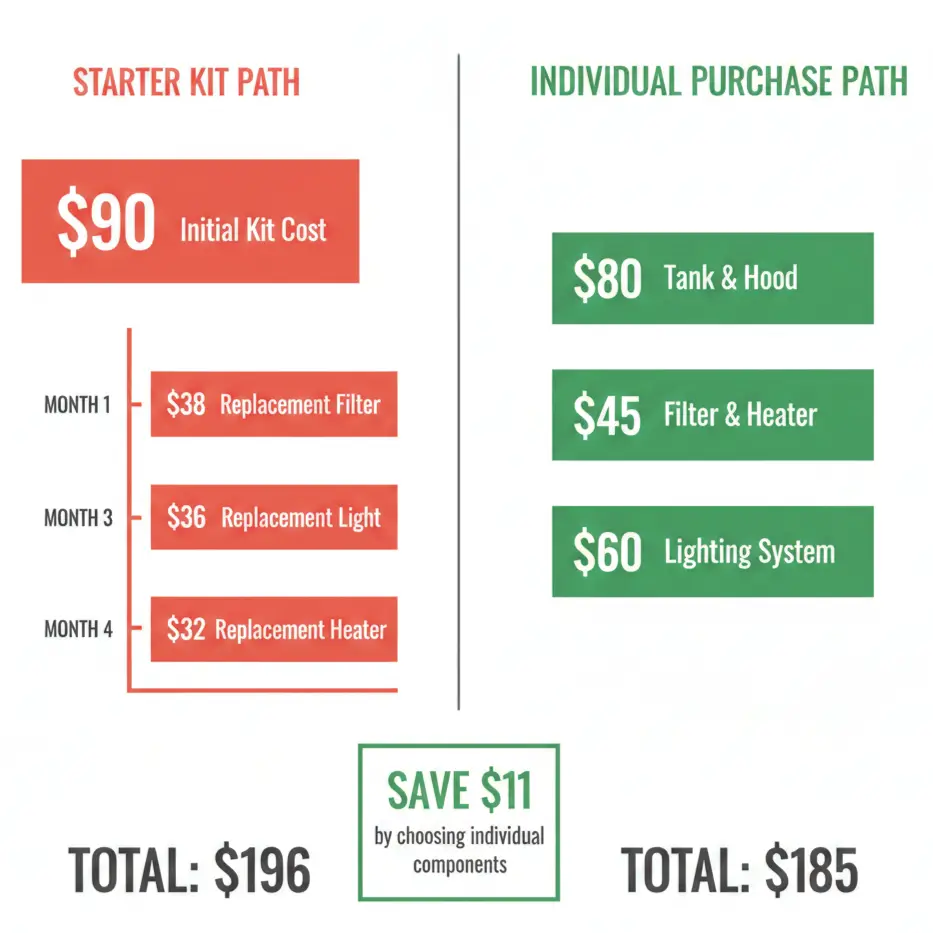
In March 2019, I bought a Top Fin 20-gallon starter kit from PetSmart for $89.99. Came with a tank, hood with built-in LED, filter, heater, and a net. I thought I was being smart.
Within four months I’d replaced the filter (inadequate flow, swapped to an AquaClear 50, $38), the light (couldn’t grow anything beyond java fern, upgraded to a Nicrew ClassicLED Plus, $36), and the heater (fluctuated ±4°F daily, replaced with an Eheim Jäger 100W, $32). The net I still use, so there’s that.
Total kit plus replacements: $196. An individually purchased mid-range setup would’ve run $180–$210 from the start. I wouldn’t have dealt with three months of frustration, two algae outbreaks from that garbage lighting, and stressed fish from temperature swings.
The kit “saved” me $90 upfront and cost an extra $106 and significantly more headaches.
One exception I’ll give credit to: Aqueon’s 10-gallon LED kit ($60–$75) is genuinely decent for a betta or shrimp setup. The filter handles that bioload, the light supports low-light plants, and the heater… actually you still need to replace the heater. But it’s closer to a real value.
Equipment-by-Equipment: Where Your Money Actually Goes
Here’s the breakdown ranked by what percentage of your budget each component eats. I’m using a 20-gallon freshwater setup as baseline, it’s the most common beginner size for good reason.
Tank: $25–$200 (10–25% of budget)
Standard glass 20-gallon: $25–$40 at sale prices. Rimless low-iron glass: $120–$200. The price gap is enormous. Standard glass is completely fine for a first tank. I didn’t switch to rimless until my fourth build, and the difference is purely aesthetic.
Filtration: $20–$150 (15–20% of budget)
Hang-on-back (HOB): $25–$50. Canister filter: $80–$200. Sponge filter: $8–$15 (with air pump, $20–$30 total).
Spend more here than you think you should. But here’s what surprised me, a sponge filter with a decent air pump is genuinely excellent for tanks under 20 gallons. I ran one on my cherry shrimp breeding tank for two years. Zero issues. Twenty-two bucks total.
Lighting: $25–$300 (10–20% of budget)
Kit LED hood: included (but usually inadequate). Mid-range planted LED: $30–$80. High-performance planted LED: $100–$300. If you’re growing live plants, and you should, skip kit lights entirely.
Substrate: $10–$80 (5–15% of budget)
Gravel: $10–$20. Pool filter sand: $8–$12 for 50 lbs (enough for multiple tanks). Aquasoil: $25–$45 per bag, need two bags for a 20-gallon.
Pool filter sand is one of the best budget hacks in this hobby. I use it in four of my current tanks with root tabs, and plant growth is comparable to tanks running $80 worth of aquasoil.
Heater: $15–$45 (5–10% of budget)
Don’t cheap out. A failed heater kills fish. I’ve had two budget heaters malfunction, one stuck on (cooked my tank to 92°F, lost four corydoras in October 2022) and one stuck off during a cold snap. Understanding proper heater sizing for your tank volume and room temperature is worth the five-minute read before you buy.
Water Testing: $25–$35 (essential, non-negotiable)
The API Master Test Kit runs $25–$35 and lasts roughly 800 tests. Test strips cost the same over time and give vague, unreliable results. This isn’t where you cut corners.
Dechlorinator + Cycling Supplies: $15–$30
Seachem Prime (500 mL): $12–$15. Bacterial starter (Fritz Turbo Start or Dr. Tim’s): $12–$18. Fishless cycling requires ammonia dosing and patience, understanding the nitrogen cycle before adding fish saves lives and money.
Hidden Costs Nobody Mentions Upfront
MYTH: “A 10-gallon is the cheapest way to start”
REALITY: A 20-gallon costs $10–$15 more for the tank itself, but equipment costs (filter, heater, light) are nearly identical for both sizes. The 20-gallon is dramatically easier to maintain and more chemically stable. When I compared total spend, the difference was $30–$50, but the 20-gallon had half the maintenance problems.
The University of Florida’s IFAS Extension aquarium guidelines specifically recommend 20+ gallons for beginners because smaller volumes amplify parameter swings. I measured this in December 2023 when my home heating was inconsistent: my 10-gallon swung 3.5°F overnight while my 29-gallon in the same room moved 1.2°F.
Pet stores push 10-gallon kits as “beginner” setups because the sticker price is lower. The total cost of ownership tells a different story.
Costs that hit your wallet within 90 days:
- Water conditioner refills: $12–$15 every 4–6 months
- Quality fish food (not just flakes): $8–$15, replace every 6 months
- Replacement filter media: $10–$20 every 2–3 months for mechanical media (biological media lasts years)
- Medications (when, not if): $10–$30 for ich treatment alone
- Algae scraper, gravel vacuum, buckets: $20–$35 total
- Electricity: $3–$12/month depending on tank size and equipment
That electricity number surprises people. A 55-gallon with heater, canister filter, light on 8 hours, and air pump draws roughly 200–350 watts. At the US average of $0.16/kWh (EIA, 2024), that’s $8–$13/month. Rates vary wildly by state, Hawaii averages $0.43/kWh while Louisiana sits around $0.10/kWh, so your actual number depends on where you live.
Three Real Builds at Three Price Points
These are actual setups I’ve built. Not theoretical. Receipts exist.
Budget Build: 20-Gallon Community Tank , $283 (July 2023)
| Item | Product | Cost |
| Tank | Aqueon 20-gal long (dollar/gal sale) | $20 |
| Filter | AquaClear 30 | $32 |
| Heater | Eheim Jäger 75W | $30 |
| Light | Nicrew ClassicLED Plus 24″ | $36 |
| Substrate | Pool filter sand + root tabs | $18 |
| Hardscape | Collected rocks + cholla wood | $8 |
| Plants | Java fern, anubias, vallisneria (online) | $35 |
| Livestock | 8 ember tetras, 6 pygmy corydoras, 3 nerites | $48 |
| Supplies | Test kit, Prime, thermometer, net, bucket | $46 |
| Cycling | Fritz Turbo Start + ammonia | $10 |
| Total | $283 |
Still running. One of my favorites. Nothing fancy, but the fish are healthy, the plants grow, and the whole thing cost less than a decent pair of running shoes.
Mid-Range Build: 40-Gallon Breeder Planted , $687 (February 2024)
The jump from budget to mid-range is mostly lighting and filtration. A Fluval Plant 3.0 ($140) costs more than my entire budget lighting setup but grows carpeting plants the Nicrew never could. A Fluval 207 canister ($130) handles the biological load with room to spare. I also switched to UNS Controsoil ($72 for three bags) and spent $55 on spiderwood and dragon stone.
Worth the step up if you want a planted tank that actually looks like the photos online.
Premium Build: 60-Gallon Rimless Planted , $1,890 (September 2024)
The big-ticket items: UNS 60U rimless tank ($280), Oase BioMaster 350 ($190), Twinstar 600S ($230), and a pressurized CO2 system ($250 for regulator, cylinder, diffuser, drop checker). CO2 alone represents the single biggest cost difference between mid-range and premium builds.
Was it worth $1,890? It’s the most beautiful tank I’ve ever built. But my $283 budget tank brings me just as much daily enjoyment. That’s the truth nobody selling equipment wants you to hear.
Monthly Costs: The Number That Actually Matters
Most cost guides treat monthly expenses as an afterthought. That’s backwards. Setup is a one-time hit. Monthly costs compound forever.
10–20 gallon: $10–$20/month
Electricity ($3–$5), food ($3–$5), water conditioner ($2–$3), miscellaneous supplies ($2–$5).
40–55 gallon: $20–$45/month
Electricity ($5–$12), food ($5–$10), fertilizers if planted ($5–$8), CO2 refills if pressurized ($5–$8 amortized), conditioner and supplies ($5–$10).
What frustrates me about other cost guides: they ignore time. A proper weekly maintenance routine takes 30–60 minutes per tank. I spend roughly two hours per week across my current tanks on water changes, glass cleaning, trimming, and testing. That’s real time.
The American Pet Products Association’s 2023–2024 National Pet Owners Survey reported freshwater fish owners spend $55–$85 per year on routine expenses, but that average includes people doing the bare minimum. Maintaining proper water quality with regular testing runs $150–$350/year for a single 20-gallon.
How I’d Spend $300 Starting Over Today
No hesitation, no research paralysis.
A standard 20-gallon long during a dollar-per-gallon sale ($20). AquaClear 50, sized up intentionally for extra biological capacity ($38). Eheim Jäger 100W because I trust it after running five without a single failure ($30). Nicrew ClassicLED Plus ($36), not the best planted light, but it grows low-to-medium light plants and I’ve had two running for over three years.
Pool filter sand with Osmocote Plus root tab caps for substrate ($18). Some manzanita or spiderwood from an online retailer ($25) and a few pieces of stone ($15), because good hardscape transforms a tank more than expensive equipment ever will.
Plants ordered online, java fern, anubias nana petite, a couple stem species, and dwarf sagittaria for ground cover. All low-tech, all nearly impossible to kill. About $35–$40.
That leaves $80–$100 for livestock, the API test kit, Prime, food, and a bucket. I’d cycle fishless for 3–4 weeks, then stock slowly over 2–3 more.
Total: roughly $280–$300, and you’d have a tank that looks great, runs stable, and doesn’t need upgrading for years. The resource library at Aquatics Pool & Spa covers a lot of the species-specific and equipment decisions that come up once you’ve got the basics sorted.
Final Thoughts
The biggest mistake I see beginners make isn’t buying the wrong equipment or picking incompatible fish. It’s underbudgeting by 40–60% because they trusted a “starter cost” number that excluded half the essentials.
Budget $250–$400 for a solid 20-gallon freshwater setup with everything you actually need. Set aside $15–$25/month for ongoing costs. Resist the urge to upgrade everything in the first six months.
Start simple. Track what you spend. And when someone online says their stunning planted tank “only cost $200”, ask if they’re including the CO2 system, the premium substrate, the three lights they tried before finding the right one, and the fish they lost while learning.
The real number is always higher. Knowing that upfront is the most valuable thing I can give you.
Prices verified against major US retailers. Your local costs may vary.