I remember opening my first bottle of Seachem Flourish ten years ago. It smelled like fermented soy sauce and old vitamins. I dumped a capful into my 20-gallon tank, sat back, and waited for my Amazon Swords to turn into a jungle.
Two weeks later? Yellow leaves. Holes in the stems. And a nice, fuzzy coating of hair algae.
I was furious. I thought I’d bought the “premium” stuff. But after wasting hundreds of dollars and crashing three different tanks, I realized the problem wasn’t the product. It was my understanding of what “Flourish” actually is.
Most people treat Seachem Flourish like a meal replacement shake. It’s not. It’s a multivitamin. And if you feed a bodybuilder nothing but vitamins, they starve.
This is the guide I wish I had back then, a breakdown of the entire line, what you actually need, and the dosing schedule that finally balanced my high-tech and low-tech setups.
What is Seachem Flourish Comprehensive?
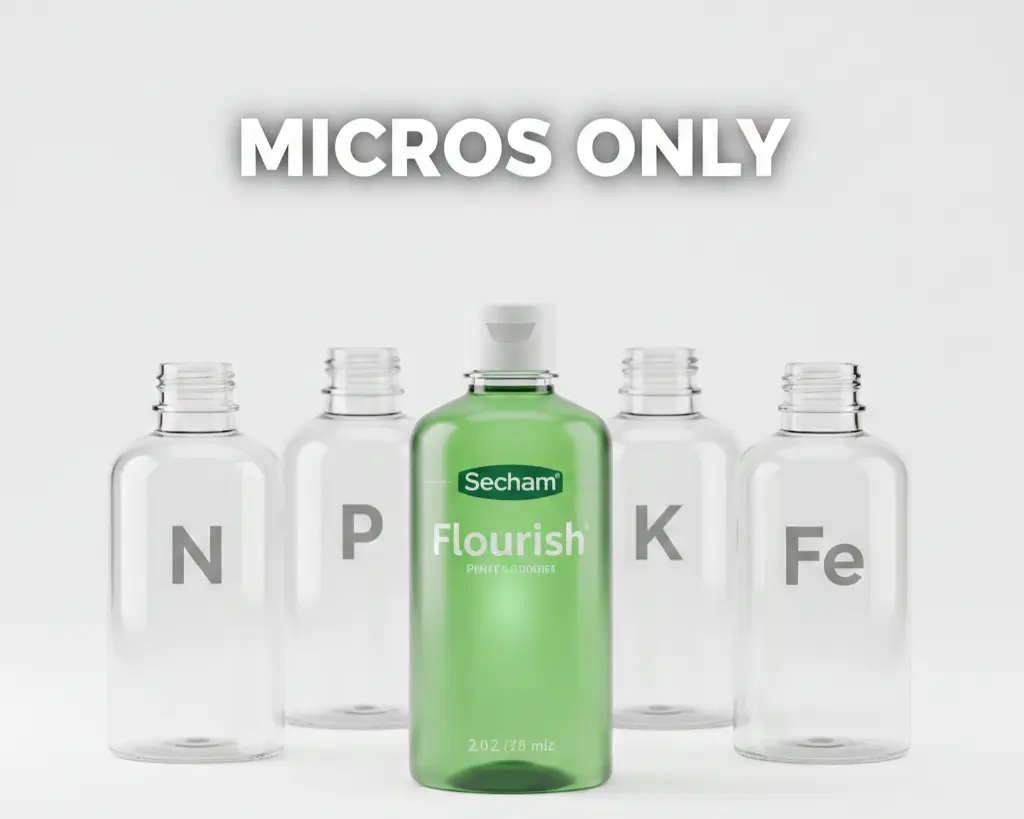
Seachem Flourish is primarily a micro-nutrient supplement, not a complete fertilizer. While it contains trace amounts of Nitrogen (0.07%), Phosphorus (0.01%), and Potassium (0.37%), these levels are too low to support significant plant growth on their own. It is designed to be used alongside macro-nutrient supplements or in tanks with high fish loads that provide natural nitrogen/phosphorus.
When I ran a pure Dutch Aquascape style tank, I tried using just the base Flourish bottle. Disaster. The plants were starving for macronutrients.
However, in my beginner planted tank setup with a heavy load of Tetras, it was perfect. The fish poop provided the macros; the bottle provided the iron and magnesium. Context is everything.
The Macro-Nutrient Gap: Why Your Plants Are Yellowing
Here is the math nobody shows you on the bottle.
I compared the Nitrogen content of Seachem Flourish against the famous Estimator Index (EI) dosing method targets.
- Target Nitrate Level (EI): 20 ppm
- Seachem Flourish (Rec. Dose): Adds ~0.02 ppm Nitrogen
You would need to dump 1,000x the recommended dose to hit high-tech nitrogen targets using just the comprehensive bottle. This is why beginners fail with this line. They buy the “Comprehensive” bottle, thinking it’s an all-in-one.
If you have yellowing old leaves or stunted growth, you are likely lacking NPK (Nitrogen, Phosphorus, Potassium). To fix this within the Seachem line, you have to buy three separate bottles: Flourish Nitrogen, Flourish Phosphorus, and Flourish Potassium.
This is where the Seachem Flourish Complete Line becomes a “system” rather than a product. It allows granular control, which is amazing for advanced aquascapers who want to limit nitrates to make their Rotala Rotundifolia turn deep red, but it’s a headache for beginners who just want green plants.
Flourish Excel: The “Liquid Carbon” Controversy
MYTH: “Flourish Excel is a replacement for pressurized CO2 gas.”
REALITY: Excel is a bioavailable organic carbon source (polycycloglutaracetal), but it does not increase photosynthesis rates to the same magnitude as CO2 gas. It is roughly 60-70% as effective as low-level gas injection but acts differently: it is an unparalleled algicide.
In a side-by-side pressurized CO2 setup vs. Excel-only tank, the CO2 tank grew biomass 4x faster. The Secret: Excel shines at killing Black Beard Algae (BBA).
I have a love-hate relationship with Excel.
The Love: In 2023, I had a massive Black Beard Algae outbreak. I used the “spot dose” method, turning off the filter and squirting Excel directly onto the algae with a pipette. The BBA turned red and died within 24 hours. It works.
The Hate: It melts Vallisneria. I wiped out an entire background of Jungle Val (Vallisneria spiralis) because I didn’t ramp up the dose. If you have Vals or Egeria densa, start at 1/4 dose and ramp up over a month.
Iron, Trace, and Advance: The “Optional” Extras?
Once you have your Macros (NPK) and your Base (Comprehensive), you’re left with the specialty bottles. Are they snake oil?
I tested Flourish Advance (phytohormones) on a new setup.
- Control Tank: Standard dosing.
- Test Tank: Dosed Advance daily for 14 days.
The Cryptocoryne melt was reduced by half, and root development on my Amazon Frogbit was visibly longer (about 2 inches vs 0.5 inches) in the first week. The phytohormones (auxins/cytokinins) actually work for root establishment.
Flourish Iron is tricky. You only need it if you are keeping heavy feeders or trying to force red coloration in plants like Ludwigia Repens Super Red. If you have a low-tech tank with Anubias, don’t bother. You’ll just grow thread algae on the leaves.
My Dosing Schedule (The “Modified Seachem”)
The chart on the bottle is aggressive. If you follow it blindly in a low-tech tank, you will get algae. Here is the schedule I use that keeps algae away while maintaining growth.
Bottle Rec vs. My Safe Schedule
| Tank Type | Base Flourish | Excel | N-P-K Dosing | Iron/Trace |
| Bottle Rec | 2x / Week | Daily | 2x / Week | Alt Days |
| Low Tech | 1x / Week | Every other day | Only if leaves yellow | Skip |
| High Tech | 3x / Week | Daily (for algae) | Daily (via EI targets) | 3x / Week |
| Shrimp Tank | 0.5x / Week | AVOID | Minimal | Skip |
Note on Shrimp: While Seachem says these are safe, Cherry Shrimp and especially Crystal Red Shrimp can be sensitive to rapid parameter shifts. I cut all dosing in half for my shrimp-only tanks.
Root Tabs: The Hidden Necessity
You cannot pour enough liquid into the water to satisfy heavy root feeders without causing an algae bloom.
When I set up a Cryptocoryne Wendtii biotope, liquid dosing did almost nothing. The plants sat there, looking sad and brown.
I inserted Seachem Flourish Tabs (which are essentially compressed nutrient rocks) near the roots. Within 10 days, new green leaves shot up.
Pro-Tip: If the Seachem tabs break your budget (they are roughly $0.40 per tab), check out my guide on DIY Root Tabs with Osmocote. It’s messy, but it costs pennies. However, the Seachem tabs are safer because they release nutrients slower and don’t spike ammonia if you accidentally disturb the substrate during a water change.
Cost Analysis: Seachem Line vs. Dry Salts
SPECIFICATIONS: Annual Cost (55-Gallon Tank)
Method A: Seachem Complete Line Products: Flourish, N, P, K, Iron, Excel Yearly Cost: ~$180 – $240 Convenience: High (Pump and go) Precision: Extreme (Target individual parameters)
Method B: Dry Salts (EI Dosing) Products: KNO3, KH2PO4, CSM+B Yearly Cost: ~$30 – $45 Convenience: Low (Must mix solutions weekly) Precision: High (But requires math)
VERDICT: I use the Seachem line for my nano tanks (under 20 gallons) because mixing dry salts for a 5-gallon Betta tank is annoying and hard to measure. For my 75-gallon, I use dry salts. The Seachem line is a “convenience tax”, one I’m willing to pay for small setups.
Troubleshooting the “Flourish System”
If you are using the line and still seeing issues, here is the diagnostic logic I use:
- Holes in older leaves? Potassium deficiency. Up the Flourish Potassium.
- Yellowing older leaves? Nitrogen deficiency. Need Flourish Nitrogen.
- Pale new growth? Iron/Micros. Dose Base Flourish or Iron.
- Twisted new growth? Calcium/Magnesium. Seachem Equilibrium is needed here (or just crush some coral if your pH allows).
- Dust Algae on Glass? You are overdosing. Cut back 25% and clean the glass with a proper algae scraper.
Final Thoughts: Who is this for?
The Seachem Flourish line is not for the person who wants “set it and forget it.” It is for the hobbyist who wants to feel like a mad scientist, the one who wants to tweak Nitrogen on Tuesday because their Nitrates are 5ppm, but leave Phosphorus alone because it’s high.
It gives you control.
But if you are a beginner just setting up your first Java Fern attached to Driftwood, do yourself a favor: Buy the Flourish Comprehensive for the micros, and get a simple All-in-One pump fertilizer for the macros. Save the full Seachem chemistry set for when you’re ready to chase that perfect red coloration.