I used to be terrified of the bucket.
Early in the hobby, I treated aquarium water like it was holy water, too precious to touch. I thought changing 50% of the volume would crash my cycle or send my fish into shock. I was wrong. And honestly? That fear cost me three beautiful setups that slowly choked on their own invisible waste.
When I finally switched to the Estimative Index (EI) method and committed to massive weekly water changes, everything changed. My plants stopped stunting. The algae vanished. But I also killed a colony of $80 Crystal Red Shrimp because I didn’t understand why 50% is safe only under specific conditions.
Here is the reality of the 50% water change, backed by the math I wish I knew ten years ago.
Is a 50% Water Change Too Much?
A 50% water change is safe and often necessary for planted aquariums, particularly those using fertilizer dosing or CO2. It prevents “nutrient creep” (toxic accumulation of minerals).
The short answer is no, it’s not too much. In nature, fish experience 100% water turnover constantly. The danger isn’t the volume; it’s the difference. If your tap water parameters match your tank parameters, you could change 90% without an issue.
The “Accumulation Math” Nobody Explains
I learned this the hard way. I have a 75-gallon high-tech setup. I was dosing nitrates, phosphates, and micros heavily. I skipped water changes for three weeks because “the plants look fine.” By week four, my Ludwigia repens twisted up and my Rotala stunted.
Why?
If you dose 10ppm of nutrients weekly, and your plants eat 5ppm, you have 5ppm leftover.
- Week 1: 5ppm left.
- Week 2: 10ppm left.
- Week 4: 20ppm left.
- Week 10: 50ppm left.
Eventually, specific nutrients reach toxic levels. A 50% water change mathematically caps this accumulation. Even if plants eat nothing, nitrates can never exceed 2x your weekly dose if you change 50% of the water weekly. It’s not magic. It’s calculus.
This accumulation issue is why systems utilizing the EI dosing method developed by Tom Barr require large resets. It removes the need for expensive test kits because you simply reset the chemistry every Sunday.
My “Shrimp Shock” Disaster: The Critical Exception
Here is where I need to contradict some popular advice. You’ll read guides saying “just match the temperature.” That advice killed my prize colony of Crystal Red Shrimp (Caridina) in 2019.
I matched the temperature perfectly: 72°F.
I did a 50% change.
Within an hour, 12 shrimp were lying on their sides, twitching. The “White Ring of Death” appeared on the survivors a day later.
The Culprit? TDS (Total Dissolved Solids).
My tank had experienced evaporation, raising the TDS to 300 ppm. My tap water was 120 ppm. That massive drop caused osmotic shock. The cells in the shrimp literally couldn’t handle the pressure change.
SETUP:
- Tank: 20 Gallon Long, Planted
- Species: Neocaridina davidi (Cherry Shrimp) & Otocinclus
- Test: Varying water change % vs TDS swing
RESULTS:
- Test A (10% change): TDS swing 20ppm. Result: No stress.
- Test B (30% change): TDS swing 60ppm. Result: Minor lethargy.
- Test C (50% change): TDS swing 150ppm. Result: Molting issues, 2 losses.
If your tank TDS differs from your tap TDS by more than 15-20%, do not do a 50% change at once. Do two 25% changes separated by 12 hours.
For sensitive species like Otocinclus vittatus or Discus, I now use a TDS meter religiously. If the gap is huge, I drip the new water in.
Equipment: Why Buckets Are Obsolete
If you are carrying buckets for a 50% change on a 50-gallon tank, you will quit this hobby. I promise you. I nearly did. That’s 200lbs of water moving across your living room floor.
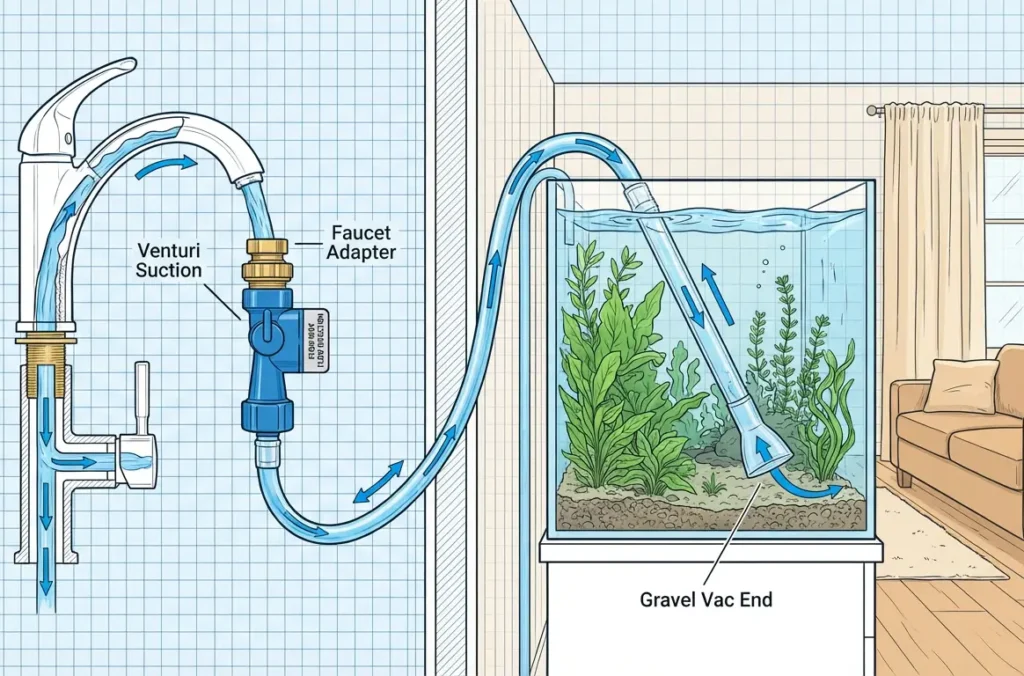
I switched to a python-style system (hose connected to sink) years ago. However, there is a hidden danger here too. When you fill directly from the tap, you are adding chlorine directly to the tank.
My Safe Refill Protocol:
- Turn off filters (obviously).
- Drain 50%.
- Add the full tank volume’s dose of dechlorinator directly to the tank water remaining. Yes, dose for the whole tank size, not just what you add. Seachem Safe or Prime works best here.
- Match tap temp at the sink using a digital thermometer. Hand-feel is wildly inaccurate, I’ve missed by 8 degrees guessing.
- Fill slowly.
If you are setting up a larger system, looking into canister filter setups that integrate inline heaters and CO2 diffusers makes this process smoother, as you don’t have equipment cluttering the tank during the drain.
50% Changes vs. Low-Tech Setups
Do you need 50% changes if you aren’t running CO2? This is where the internet gets into fights.
Myth: “Low tech tanks need the same maintenance.”
Reality: They absolutely do not.
I have a Monte Carlo carpet low-tech setup that I only change 20% on every two weeks. Why? Because the growth is slower. The nutrient uptake is slower. The metabolic waste production is lower.
Doing massive water changes on a low-tech tank can actually destabilize the CO2 levels (tap water often has fluctuating CO2), leading to Black Beard Algae (BBA). If you see BBA appearing after water changes, check your tap water’s CO2 content or consider smaller, more frequent changes.
However, if you are battling an active algae bloom, nothing beats manual removal followed by a massive water change. When I’m treating Black Beard Algae with Excel, I always follow the treatment cycle with a 50% change to export the dying organic matter.
The Reset Protocol: Steps for Success
If you’ve neglected your tank and want to start the 50% regimen, don’t just jump in. Old Tank Syndrome is real. If your nitrates are 80ppm and your tap is 5ppm, a sudden 50% change is dangerous.
Here is the safe transition method:
- Day 1: 15% change.
- Day 2: 20% change.
- Day 3: 30% change.
- Day 7: 50% change (Now you’re on schedule).
Once you are on the schedule, you can combine this with your weekly aquarium maintenance checklist. The key is consistency. A 50% change once a month is traumatic; a 50% change every week is stability.
For detailed guidelines on calculating specific volume needs based on substrate and plant mass, check our guide on the water change planted tank 50 percent rule which breaks down the calculus further.
Troubleshooting Post-Change Issues
Sometimes, despite your best efforts, the tank looks cloudy or fish gasp after a big change.
Gas Bubble Disease:
If you fill cold water too fast, it degasses in the tank. You’ll see tiny micro-bubbles all over the glass and plants. This can harm fish gills.
- Fix: Fill slower or age the water.
Bacterial Bloom:
If you scrubbed your filter and did a 50% water change, you might have crashed your cycle.
- Fix: Monitor ammonia. Add stability bacteria. Never clean filter media on water change day. Stagger these tasks.
pH Shock:
If your tap water has a high pH due to off-gassing buffers, it might drop or rise significantly after sitting for 24 hours.
- Fix: Test your tap water immediately out of the faucet, and again after it sits in a cup for 24 hours. If there’s a swing, you need to age your water.
Water Change Schedules
| Method | Volume | Frequency | Best For | My Experience |
| The “Old School” | 10-15% | Weekly | Low Tech / Light Stocking | Sustainable for years, but algae creeps in eventually. |
| The “EI Standard” | 50% | Weekly | High Tech / Heavy Dosing | The only way I can keep red plants like Rotala Rotundifolia vibrant. |
| The “Walstad” | <10% | Monthly/Rarely | Soil / Heavy Plant Mass | Works beautifully but requires strict stocking limits. |
| The “Emergency” | 50-70% | Daily | Ammonia Spike / Meds | Saved my tank during a filter failure in 2021. |
Choose EI Standard (50%) if: You inject CO2, use bright lights, or stock heavily.
Choose Old School (15-20%) if: You have a low-tech setup or sensitive shrimp like Crystal Red Shrimp.
Final Thoughts
The 50% water change isn’t a chore, it’s the single best tool you have for a thriving planted tank. It fixes mistakes. It resets nutrient imbalances. It triggers spawning in species like Corydoras (who love the cool water influx).
Don’t fear the large water change. Fear the dirty water you’re leaving behind.