I still remember the first time I dumped a tablespoon of dry nitrate into my pristine 40-gallon breeder. It felt wrong. Every guide I’d read since 2015 told me that nitrates were the enemy, the silent killer of fish and the primary fuel for algae.
I was terrifyingly wrong.
Within three weeks, the Green Spot Algae on my Anubias vanished. The Rotala I’d been struggling to keep red suddenly turned a deep, vibrant crimson. This wasn’t magic; it was the Estimative Index (EI) method developed by Tom Barr.
If you are tired of measuring specific drops per gallon or dealing with mysterious plant deficiencies, you are in the right place. EI Dosing isn’t about precision chemistry, it’s about providing an all-you-can-eat buffet for your plants so they never stop growing.
What is EI Dosing?
The Estimative Index (EI) is a fertilizer dosing method pioneered by Tom Barr that floods the water column with slightly more nutrients (NPK + Micros) than plants can consume. This prevents any nutrient deficiency from becoming a limiting factor for growth.
- The Key: A large (50%) weekly water change resets the system, preventing toxic accumulation.
- The Goal: Maximizing plant mass to outcompete algae.
- Best For: High-light, CO2-injected tanks with heavy planting.
The “Algae Fear” Myth vs. Reality
Let’s address the elephant in the room immediately. Most hobbyists believe that excess nutrients = algae blooms.
I believed this for years. In 2021, I ran a “lean dosing” schedule on a high-tech setup, keeping Nitrates at strictly 5ppm and Phosphates near 0. The result? A filamentous algae farm. My plants stalled, leaked sugars from their decaying leaves, and the algae feasted on that organic waste.
MYTH: “High phosphates and nitrates cause algae outbreaks.”
REALITY: Algae is triggered by fluctuating CO2 and organic waste (ammonia spikes), not inorganic fertilizer salts. Healthy, fast-growing plants produce natural algaecides and outcompete algae for resources.
- Tom Barr’s controlled tests (The Barr Report) demonstrated algae-free tanks with Phosphate levels exceeding 5ppm, 10x the “recommended” limit.
- June 2023. I purposely dosed PO4 to 4ppm in a mature tank. Result: Zero algae bloom, but Green Spot Algae on glass disappeared within 10 days.
Poorly maintained tanks often have high nitrates and high organic waste (dirty filters/substrate). The waste causes the algae; the nitrates are just innocent bystanders.
The Philosophy: Liebig’s Law of the Minimum
To understand EI, you have to understand a concept from agricultural science called Liebig’s Law of the Minimum.
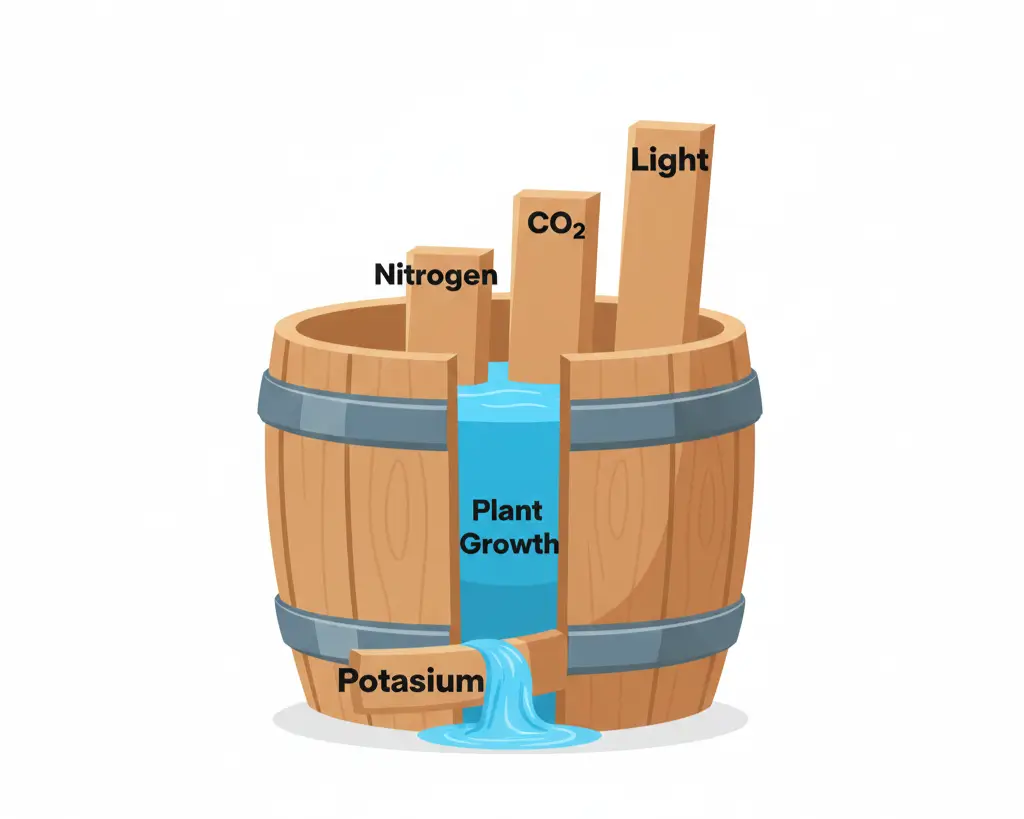
Imagine a wooden barrel with staves of different lengths. The capacity of that barrel is determined not by the longest stave, but by the shortest one.
In your aquarium:
- Light is a stave.
- CO2 is a stave.
- Nitrogen, Potassium, Iron are staves.
If you have high light and high CO2 (long staves) but run out of Potassium (short stave), plant growth stops completely. When plants stop growing, algae, which is far more adaptable, takes over.
The EI method ensures that nutrients are never the shortest stave. We provide excess nutrients so that Light or CO2 becomes the only limiting factor, factors we can easily control.
My 8-Week EI Experiment: The Data
I didn’t just read the forum posts; I tracked this on my own 29-gallon Dutch-style aquascape.
Setup:
- Tank: 29 Gallon Standard
- Light: High Output LED (80 PAR at substrate)
- CO2: Pressurized, 30ppm drop checker (Lime Green)
- Plants: Heavy load (Rotala, Ludwigia, Monte Carlo carpet)
Lean vs. EI Dosing
PHASE 1: LEAN DOSING (Weeks 1-4)
- Dosing: Maintained NO3 < 10ppm, PO4 < 0.5ppm.
- Observation: Monte Carlo yellowing. Ludwigia dropped lower leaves.
- Algae: Staghorn algae appeared on wood. Green dust on glass daily.
PHASE 2: EI DOSING (Weeks 5-8)
- Dosing: NO3 target 20ppm, PO4 target 3ppm.
- Observation: Monte Carlo thickened noticeably by Week 6.
- Algae: Staghorn stopped spreading (spot treated to kill). Glass cleaning reduced to once weekly.
- Surprise: My Rotala Rotundifolia Red Coloration actually improved. I thought low nitrates caused redness, but the plant was just healthier.
LESSON: Healthy plants are the best filter. Starving them to fight algae is like starving yourself to fight a fever.
The Critical Component: The 50% Reset
Here is the catch.
If you dump fertilizers in endlessly without removing them, your Total Dissolved Solids (TDS) will skyrocket to toxic levels (also known as “Old Tank Syndrome”).
The EI method works on a strict 7-day cycle. By doing a 50% Water Change in your Planted Tank at the end of the week, you mathematically guarantee that nutrients can never exceed 2x the weekly dose.
It resets the game board.
If you cannot commit to the bucket brigade (or setting up a python hose) every single week, do not do EI dosing. You will crash your tank. I learned this the hard way in 2022 when I skipped two weeks due to a vacation; I came back to a twisted, stunted mess because my parameters drifted too high.
The Dry Salts vs. Liquid Cost Breakdown
Why do EI users love dry salts? Because I’m cheap.
Buying pre-mixed liquid fertilizers is essentially buying expensive water. When I switched to dry salts (KNO3, KH2PO4, CSM+B), the price difference was laughable.
LIQUID vs DRY SALTS
| Factor | Premium Liquid Brand | Dry Salts (EI) | My Insight |
| Cost (50 gal) | ~$280 / year | ~$35 / year | You pay 800% markup for water. |
| Customization | Low (Fixed Ratios) | High | Can tweak Nitrates without raising Iron. |
| Convenience | High (Pump & Go) | Med (Mix monthly) | Mixing takes me 10 mins/month. |
| Shelf Life | 1-2 Years | Indefinite | Dry powders don’t degrade. |
“I spent $35 on a starter pack of dry fertilizers in early 2023. It is now late 2024, and I still have half the bag of Potassium Nitrate left. The ROI is unbeatable.”
The Step-by-Step EI Schedule
This is the standard high-light schedule. If you have a low-tech tank (no CO2), divide these doses by 3 or 4 and dose only once a week.
Note: We separate Macro nutrients (NPK) from Micro nutrients (Iron/Trace) because Phosphate can react with Iron to create a cloudy precipitate if mixed directly in the bottle. Dose them on alternate days.
Standard EI Schedule (Per 20 Gallons)
THE MIX (Make your own solutions):
- Macros: Mix KNO3 (Nitrate) and KH2PO4 (Phosphate) in 500ml water.
- Micros: Mix CSM+B (Trace) or comprehensive trace mix in 500ml water.
THE ROUTINE:
- Monday: Macro Dose (target 10ppm NO3, 1-2ppm PO4)
- Tuesday: Micro Dose (Trace elements, Iron)
- Wednesday: Macro Dose
- Thursday: Micro Dose
- Friday: Macro Dose
- Saturday: REST DAY (Enjoy the tank!)
- Sunday: 50% Water Change + Micro Dose (to recharge tap water)
TARGET WATER COLUMN LEVELS:
- Nitrate (NO3): 10-30 ppm
- Phosphate (PO4): 1-3 ppm
- Potassium (K): 10-30 ppm
- Iron (Fe): 0.2-0.5 ppm
Troubleshooting Common Issues
Even with EI, things go wrong. Here is what I’ve encountered as a Systems-Thinking Troubleshooter:
1. The “Green Water” Bloom
If your water turns into pea soup, it’s not the nitrate, it’s usually an ammonia spike coupled with high light.
- Fix: Check your filter. Did you clean it too aggressively? Reduce light intensity by 40% until it clears. A UV sterilizer is the cheat code here.
2. Melting Crypts
When I switched a low-tech tank to EI suddenly, my Cryptocoryne Wendtii Bronze melted to the ground.
- The Cause: rapid change in osmotic pressure.
- The Fix: Ramp up dosing over 4 weeks. Don’t go from 0 to 100 overnight.
3. Shrimp Sensitivity
Are high nitrates safe for shrimp?
- Reality: Neocaridina (Cherry Shrimp) are generally fine with nitrates up to 40ppm in my experience. However, Crystal Red Shrimp (Caridina) are more sensitive. For my Crystal Red Shrimp tanks, I use a modified “Lean EI” where I target half the standard levels.
The Equipment You Actually Need
You don’t need a lab coat. Here is my “Cost-Conscious” setup:
- Dry Fertilizers: NPK pack + CSM+B (Plantex).
- Digital Scale: A cheap $10 gram scale (essential for mixing accurately).
- Dosing Bottles: Reuse old soap pump bottles or buy specific 500ml squeeze bottles.
- TDS Meter: Helps track accumulation. See my guide on the TDS Meter for why this number matters more than pH in EI.
- Drop Checker: To verify your CO2. EI drives growth fast, meaning plants consume carbon rapidly. If CO2 drops, algae attacks.
The Ecosystem Approach
Ultimately, EI is just a tool. It works best when viewed as part of a holistic system.
I used to obsess over individual nutrient numbers, was my magnesium 3ppm or 4ppm? It didn’t matter. What mattered was the balance between light, CO2, and flow. The NPK Ratio provides the foundation, but your maintenance builds the house.
If you are looking for a reliable source for aquatic advice and high-quality setup guides, Aquatics Pool Spa has become my go-to for cross-referencing my own testing data against broader hobbyist experiences. It’s crucial to have a resource that looks at the whole ecosystem, not just the chemistry set.
Conclusion: Embrace the Abundance
Switching to the EI dosing method was the single biggest level-up moment in my planted tank journey. It freed me from the anxiety of test kits. I no longer panic if Nitrates hit 20ppm. I panic if they hit 0ppm.
It requires discipline, that weekly water change is non-negotiable, but the reward is a tank that looks like the jungle photos you see on Instagram.
Stop starving your plants. Feed them, reset the water, and watch nature take its course.