I used to treat my high-tech planted tank like a chemistry lab. I had milligram scales, pipettes, and a spreadsheet that looked like tax software. And you know what? My plants were stunted, and I had hair algae.
It wasn’t until I stopped trying to hit “perfect” numbers and started flooding the tank with nutrients that things actually took off.
This is the core philosophy of the NPK Ratio EI Dosing Method (Estimative Index). Developed by Tom Barr, it fundamentally changed the hobby by proving that algae isn’t caused by excess nutrients, it’s caused by imbalance (usually carbon/light) and ammonia spikes. After running this method on high-tech setups for the last five years, I’ve learned that the secret isn’t precision. It’s abundance, followed by a hard reset.
Here is how to stop starving your plants and start mastering the macros.
What is the NPK Ratio EI Dosing Method?
The Estimative Index (EI) is a fertilization method for planted aquariums that relies on providing nutrients in slight excess to prevent deficiencies.
Instead of measuring uptake rates, you dose enough Nitrogen (N), Phosphorus (P), and Potassium (K) to ensure plants have unlimited access to food throughout the week. To prevent toxic buildup, you perform a mandatory 50% water change at the end of every week to “reset” the nutrient levels. It eliminates the need for expensive test kits.
The “Golden” NPK Ratios: Data vs. Reality
If you look at the research, aquatic plants generally consume nutrients in a specific ratio. This is often compared to the Redfield Ratio (106:16:1 C:N:P), though that applies more to marine phytoplankton. In freshwater, we aim for targets that keep us safe.
Here is the baseline I used when I first started, and what I actually dose now in 2024.
SPECIFICATIONS: EI Target Ranges (Weekly Accumulation)
| Nutrient | Chemical Source | Standard Target | My “Lean” Target |
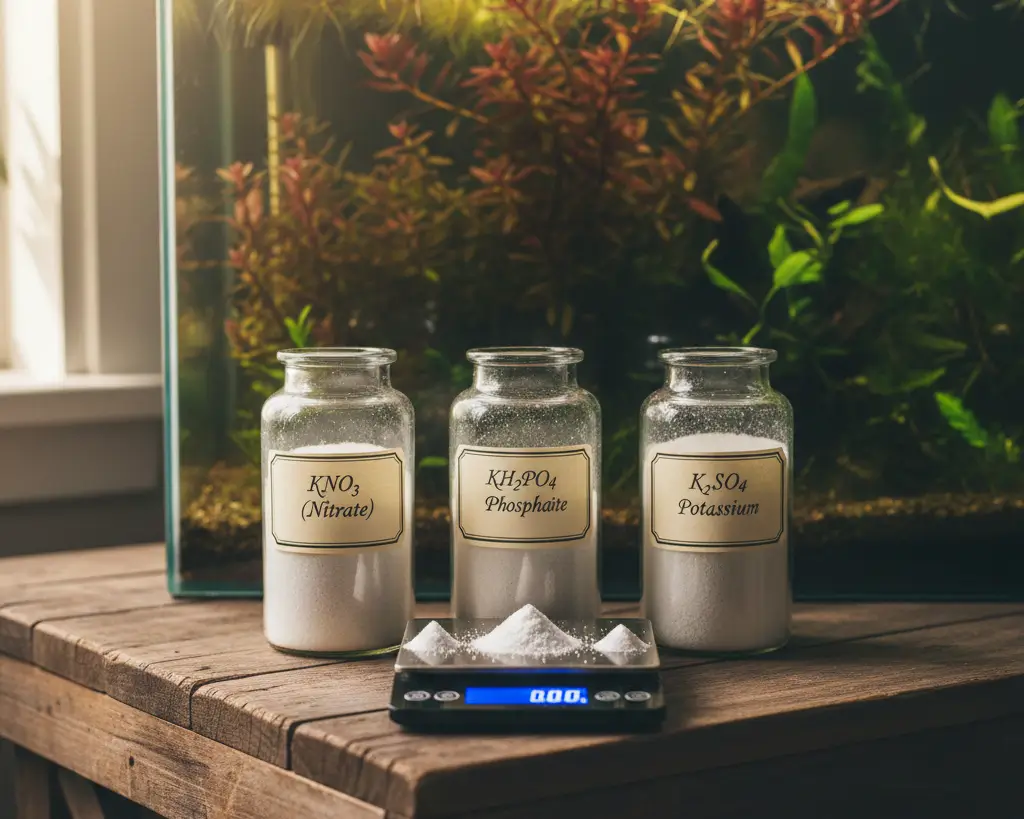
| Nitrate (NO3) | KNO3 (Potassium Nitrate) | 20-30 ppm | 10-15 ppm |
| Phosphate (PO4) | KH2PO4 (Monopotassium Phosphate) | 2-3 ppm | 1-2 ppm |
| Potassium (K) | K2SO4 (Potassium Sulfate) | 20-30 ppm | 15-20 ppm |
| Micros (Trace) | CSM+B or Flourish | 0.5 ppm Fe | 0.2 ppm Fe |
In 2019, I stuck religiously to the “Standard Target.” It worked great for fast growers like Rotala rotundifolia, but I noticed my red plants were turning green. Why? High nitrates inhibit anthocyanin production (red colors). By dropping to my “Lean Target” (10-15 ppm NO3), the reds popped back out within 14 days.
Warning: Don’t drop phosphates. If PO4 bottoms out, you will get Green Spot Algae on your glass and slow-growing Anubias Nana Petite.
Macros vs. Micros: The Confusion
The biggest mistake I see beginners make is buying a bottle labeled “Plant Food” and assuming it has everything. It usually doesn’t.
Macros (The NPK):
These are the meat and potatoes. Plants consume these in large quantities.
- Nitrogen (N): Growth engine. Deficiency = yellowing old leaves.
- Phosphorus (P): Energy transfer/rooting. Deficiency = dark leaves, GSA.
- Potassium (K): Enzyme activation. Deficiency = pinholes in leaves.
Micros (The Trace Elements):
This is the multivitamin. Iron (Fe), Magnesium (Mg), Manganese (Mn), etc. You need very little, but without them, new growth twists and pales.
Contradiction Alert:
I used to think I could mix Macros and Micros in the same bottle to save time. Do not do this. The Phosphate in your macros will react with the Iron in your micros, creating a cloudy precipitate (iron phosphate) that falls out of solution. Your plants can’t use it. Dose them on alternate days.
My 2018 Algae Farm: A Case Study in Failure
I have to be honest, my first attempt at EI dosing was a disaster.
The Setup: 40-gallon breeder, high light, CO2 injection.
The Method: Dosed full EI levels starting Day 1.
The Result: By Week 3, I had a Black Beard Algae outbreak so thick it looked like a shag carpet.
What Went Wrong?
I blamed the fertilizer. “I’m putting too much in!” I screamed at my tank.
I was wrong.
The problem wasn’t the nutrients; it was the plant mass. I had started the tank with just a few tissue culture cups of Monte Carlo and some stem clippings. There weren’t enough plants to consume the massive amount of food I was dumping in. The excess didn’t cause the algae directly, but the lack of plant competition combined with a cycling filter gave algae the upper hand.
The Lesson:
If you are starting a new tank, do a “Dark Start” or dose 1/4 strength EI until your tank is 50% covered in plant mass.
The “Dry Start” of Savings (Liquid vs. Dry Salts)
Let’s talk money. This is the main reason I switched to dry salts.
COST ANALYSIS: 1 Year Supply (75 Gallon Tank)
| Method | Product | Estimated Cost |
| Brand Name Liquid | Seachem Line/Tropica | ~$450 – $600 |
| DIY Dry Salts | KNO3, KH2PO4, CSM+B | ~$35 – $50 |
You are paying for water and a nice plastic bottle. Mixing your own isn’t just cheaper; it gives you control.
How to Mix Your Own (The Simple Way):
You don’t even need to make liquid stock solutions if you’re lazy like me.
- Buy a set of “dash/pinch/smidgen” measuring spoons.
- Use a calculator like Rotala Butterfly.
- Dump the dry powder directly into the high-flow area of your sump or canister output.
Does it dissolve? Yes, instantly. I’ve done this for years with delicate species like Crystal Red Shrimp and never had an issue, provided the flow is good.
The 50% Reset: Why It’s Non-Negotiable
This is the part of EI dosing that makes people quit. “Do I really have to change 50% of the water every week?”
Yes.
Here is the math. If you dose 20ppm of Nitrate every week, and your plants only eat 15ppm, you have 5ppm left over.
- Week 1 end: 5ppm
- Week 2 end: 10ppm
- Week 3 end: 15ppm
Over time, this “creep” leads to parameters that can stun fish or cause algae triggers. The 50% water change resets the clock. It prevents nutrient toxicity and removes dissolved organics that filters miss.
If you absolutely cannot do 50% water changes, EI is not for you. You should look into PPS-Pro or a lean dosing method. But if you have a python hose and 30 minutes, the growth rates from EI are untouchable.
Troubleshooting Common Deficiencies
Even with EI, things go wrong. Here is how I diagnose my tanks based on visual cues.
Visual Diagnostic Guide:
- Yellowing Old Leaves: Nitrogen deficiency. Increase KNO3.
- Check: Are you stocked heavily? Sometimes fish waste provides enough N, but usually not in high-tech tanks.
- Green Spot Algae on Rocks/Glass: Phosphate deficiency. Increase KH2PO4.
- Reality: I often double my PO4 dose if I’m running high light.
- Twisted New Growth: Micro deficiency (Calcium/Magnesium or Boron).
- Fix: Check your GH. If you are using RO water, are you remineralizing correctly? See my guide on RO water remineralization.
- Pinholes in Leaves: Potassium deficiency.
- Target: This is common in Java Fern. They are potassium hogs.
Myth vs. Reality: “Excess Nutrients Cause Algae”
This is the zombie myth of the aquarium world. It refuses to die.
MYTH: “High Nitrates/Phosphates directly trigger algae blooms.”
REALITY: Algae is triggered by Ammonia spikes (often undetectable by hobby kits) and light/CO2 imbalance.
- Dr. Tom Barr’s experiments maintained phosphate levels at 5-10ppm (massive excess) without inducing algae, provided CO2 was stable.
- In 2021, I accidentally overdosed my auto-doser, pushing Nitrates to 80ppm for two weeks. Result? No algae. My Ludwigia Repens Super Red actually grew faster. The fish were the only concern, so I did a reset.
When people neglect tanks, nitrates rise AND organics accumulate. The organics/ammonia cause the algae, but the test kit only shows high nitrates. Correlation is not causation.
Advanced Optimization: CO2 is the Key
You can dose EI perfectly, but if your CO2 is fluctuating, you will fail.
I spent months tweaking my NPK ratios trying to fix BBA on my driftwood, only to realize my drop checker was yellow at noon but blue at 8 AM.
The Rule of Limiters:
In a high-tech tank, light is the accelerator. Nutrients are the fuel. CO2 is the steering wheel. If you hit the gas (High Light + EI Dosing) but let go of the steering wheel (Unstable CO2), you crash.
Ensure your pressurized CO2 setup is dialed in to turn on 1-2 hours before the lights. This saturation ensures that when photosynthesis starts, the carbon is already there to help process the heavy EI nutrient load.
Final Thoughts: The “Feel” Over The “Formula”
After five years of scooping dry salts into my tanks, I rarely measure anymore. I know that a “heaping teaspoon” of KNO3 works for my 75-gallon. I know that if the Monte Carlo looks pale, I add a pinch more micros.
The Estimative Index frees you from the tyranny of test kits. It accepts that we can’t measure everything perfectly, so we provide everything abundantly and clean up the excess.
If you are ready to dive deeper into the hobby, visit Aquatics Pool Spa for more guides on transitioning from low-tech to high-tech systems. Trust the process, do your water changes, and watch the jungle grow.