I spent the first two years of my shrimp keeping hobby fighting my tap water. It was a losing battle. One week the city would flush the pipes with extra chlorine, the next week the hardness would swing wildly after a heavy rain. After losing a prized colony of Crystal Reds to a random parameter spike, I finally caved and bought an RO (Reverse Osmosis) unit.
But that created a new problem: Empty water.
Pure H2O is aggressive. It strips minerals from the shrimp’s exoskeleton if you don’t put them back in. I tried liquid remineralizers, DIY Epsom salt mixes, and random powders. It wasn’t until I standardized on the Salty Shrimp line (specifically the GlasGarten products) that my survival rates for shrimplets went from 40% to near 95%.
But here is the thing nobody tells you on the forum: The instructions on the jar are… optimistic.
At Aquatic’s Pool & Spa, we often talk about stability over perfection, but with RO water, you actually need a bit of perfection to start. I’ve logged the mixing ratios for hundreds of buckets. Here is how to remineralize your water without causing the “White Ring of Death” (molting failure).
How Much Salty Shrimp Per Gallon? (The Short Answer)
For standard Reverse Osmosis (RO) water (0 TDS):
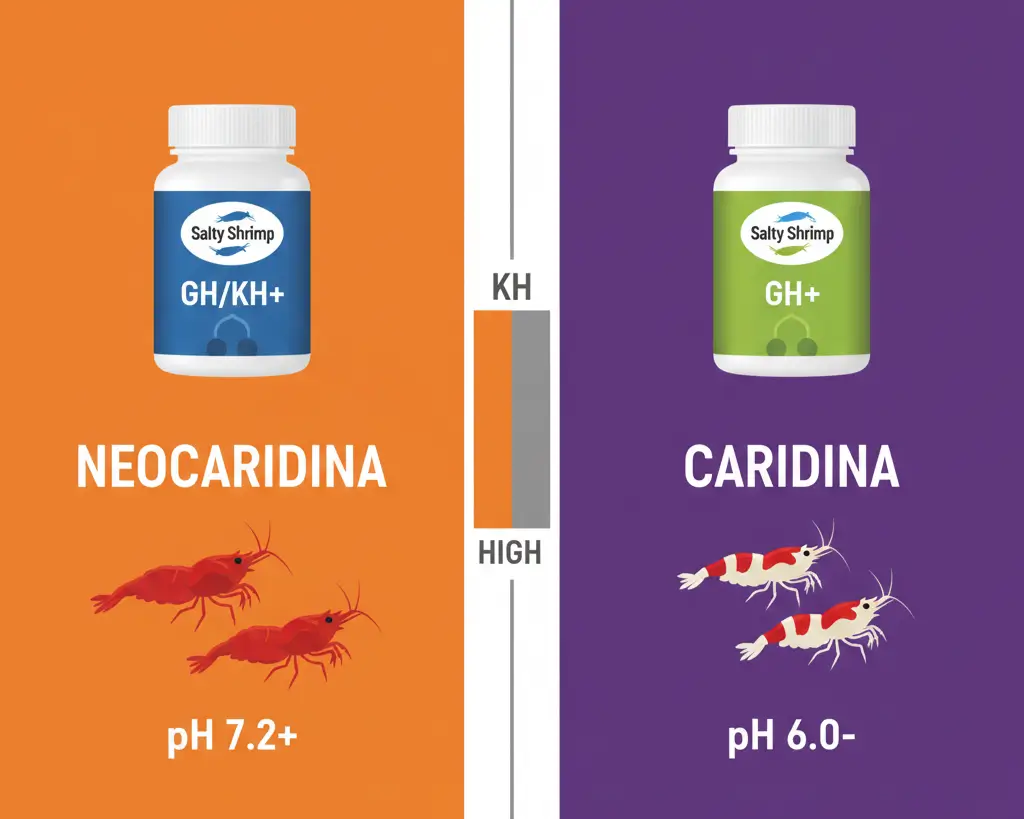
- Neocaridina (Cherry Shrimp): Use Salty Shrimp Shrimp Mineral GH/KH+ (Orange Label). Add ~2.5 grams (1 level scoop) per 10 liters (2.6 gallons) of water. Target TDS: 300 +/- 50 ppm.
- Caridina (Crystal/Bee Shrimp): Use Salty Shrimp Bee Shrimp Mineral GH+ (Purple Label). Add ~1.5 grams (0.6 scoops) per 10 liters (2.6 gallons) of water. Target TDS: 130 +/- 30 ppm.
The “Two Powders” Problem: Orange vs. Purple
This is where I messed up initially. I bought the “Bee Shrimp” mineral for my Cherry Shrimp because I thought, “Well, bees are sensitive, so this must be better quality, right?”
Wrong. Dead wrong.
The chemistry requirements are fundamentally different. I learned this after three weeks of watching my Cherry Shrimp struggle to molt.
Salty Shrimp Shrimp Mineral GH/KH+ (Orange Label)
This is for Neocaridina species (like Cherry Shrimp) and most community fish.
- What it does: Raises both General Hardness (GH) and Carbonate Hardness (KH).
- Why you need it: Neocaridina need KH to buffer the pH above 7.0. If you use the other salt, your pH will crash, and your bacteria cycle might stall.
- My Ratio: Raises Total Hardness approx. 2.0 dGH and Carbonate Hardness approx. 1.0 dKH per dose.
Salty Shrimp Bee Shrimp Mineral GH+ (Purple Label)
This is for Caridina species (like Crystal Red Shrimp) that require acidic water.
- What it does: Raises only GH. Minimal to zero KH impact.
- Why you need it: You are likely using an active buffering substrate (like ADA Aquasoil) which fights to lower pH. If you add KH (Orange label) to a tank with buffering soil, the soil fights the KH, depleting the soil life rapidly and causing parameter swings.
My “TDS Trap” Story: Why Your Meter is Lying
I used to worship my TDS meter. If it read 200 ppm, I assumed the water was perfect.
Here’s the reality check that cost me a lot of money: TDS (Total Dissolved Solids) measures conductivity, not calcium.
In 2022, I ran a test on a 10-gallon tank. I remineralized my RO water until the TDS read exactly 200 ppm. But I had been lazy and left the salt container open; moisture had clumped the powder. What I didn’t realize is that the minerals settle unevenly.
I was dissolving mostly salts that conducted electricity but didn’t contain enough Calcium and Magnesium. The result? My TDS was perfect (200), but my GH (General Hardness) was only 3 degrees.
The shrimp tried to molt. They couldn’t break their shells. They died.
A TDS meter is a quick-check tool, NOT a diagnostic tool. You must verify your TDS reading against a liquid GH/KH test kit occasionally to ensure your ratio hasn’t drifted.
TDS vs. GH CORRELATION
SETUP:
- Water: 0 TDS RO Water
- Product: Bee Shrimp Mineral GH+
- Measurement: Calibrated TDS Pen vs. API Liquid GH Test
RESULTS:
- 100 TDS ≈ 3-4 dGH
- 130 TDS ≈ 5-6 dGH (Sweet Spot for Bees)
- 160 TDS ≈ 7-8 dGH
- 200 TDS ≈ 9+ dGH (Too hard for Crystals)
The relationship isn’t linear at higher concentrations. At high temps (>80°F), conductivity readings shifted by nearly 15%.
Always calibrate your pen at the temperature of your water change water.
The Mixing Protocol That Actually Works
I’ve mixed this stuff in cups, buckets, and trash cans. I’ve tried using warm water, cold water, and air stones. Here is the protocol that leaves zero residue and ensures safety.
Step 1: The “Solvent” Bucket
Don’t dump the powder into your main 5-gallon jug. It never mixes right.
Take a large cup or pitcher of RO water. Add the Salty Shrimp powder to that.
Step 2: The CO2 Trick
This is something the “experts” rarely mention. Remineralizers dissolve via reaction with CO2 in the water. Fresh RO water can be low on dissolved gas.
- My Trick: If the powder sits at the bottom like white sand for more than 10 minutes, I take a straw and blow bubbles into the mix for 30 seconds. Sounds stupid? Absolutely. Does it work? The carbonic acid created helps dissolve the calcium carbonate components faster than stirring for an hour.
Step 3: The Match
Once dissolved, pour the concentrate into your main water bucket.
Crucial Step: Match the temperature to your tank. Dumping 68°F water into a 76°F tank is a guaranteed way to induce “shock molting”, where shrimp panic-molt before their new shell is ready.
Myth vs. Reality: “Just Shake The Bottle”
There is a lot of bad advice on forums. Let’s clear up the biggest one regarding liquid vs. powder remineralizers.
MYTH: “Liquid remineralizers are safer because they are already dissolved.”
REALITY: Liquid remineralizers are mostly water that you pay shipping for. Powdered Salty Shrimp is far more cost-effective and stable long-term.
- One 230g jar of Salty Shrimp ($25) treats approx. 1300 gallons. A standard 500ml liquid bottle ($18) treats maybe 200 gallons.
- I switched from Seachem Equilibrium (which left a gritty mess in my tank) to Salty Shrimp and the clarity difference was instant.
- Serious breeders almost exclusively use powder salts (Salty Shrimp or SL-Aqua) for precision.
Beginners fear “undissolved powder” burning shrimp. This is valid if you dump powder into the tank. If you mix externally, powder is superior.
Troubleshooting: Why is my water cloudy?
So you mixed your RO water, added the Salty Shrimp, and now your bucket looks like milk.
This frustrated me for months. I thought I got a bad batch.
The culprit is usually Precipitation.
If you add the mineral powder to water that has a high pH or is too warm, the calcium and carbonates can react and “precipitate” out of the solution, turning into solid chalk dust rather than dissolving ions.
The Fix:
- Use room temperature water (68-72°F).
- Add the powder slowly while stirring.
- If it clouds, let it sit with an airstone/powerhead for 2 hours. It should clear. If it settles as white dust on the bottom, don’t pour that sludge into the tank.
Specific Product Pairings
You can’t talk about remineralization without talking about the substrate. They work as a system.
For Caridina (Crystal Reds/Blacks)
You need Bee Shrimp Mineral GH+.
You MUST pair this with an active soil.
- Best Pairings: ADA Aquasoil or similar buffering soils.
- Target Parameters: pH 5.5-6.5, KH 0-1, GH 4-6.
For Neocaridina (Cherries/Painted Fire Reds)
You need Shrimp Mineral GH/KH+.
You should use inert substrate.
- Best Pairings: Pool Filter Sand or inert gravel.
- Target Parameters: pH 7.0-7.8, KH 3-8, GH 6-10.
- Note: I have kept Neos on Aquasoil, but the acid buffer fights the KH in the salt, depleting the expensive soil in 6 months rather than 2 years. It’s a waste of money.
Understanding the “Creep”
One phenomenon I’ve documented in my tanks is “TDS Creep.”
When you top off evaporation, you must use pure RO water only. Do not add salt to top-off water. Water evaporates; minerals do not.
I once hired a pet sitter and told them to “use the water in the bucket” to top off the tanks. The bucket was remineralized salt water. When I came back two weeks later, the TDS in my Blue Bolt tank was 450 ppm.
The shrimp were lethargic and hiding. I had to do small 10% water changes with pure RO over a week to bring it down slowly. Rapid drops in TDS are just as dangerous as rapid spikes. The osmotic pressure changes can cause cells to rupture.
Is Salty Shrimp Worth the Price?
Look, $25 for a jar of salt feels steep when Epsom salt is $4 at the pharmacy.
But here is the GH/KH difference. Epsom salt is just Magnesium Sulfate. It raises GH, but lacks the specific Calcium ratios and trace minerals (potassium, micronutrients) that shrimp need for color and shell density.
I wasted about $150 on “cheaper” alternatives and lost maybe $300 worth of livestock learning this. One jar of Salty Shrimp lasts me (with 6 nano tanks) nearly two years. The cost per gallon is pennies.
Summary Checklist for Success
- Know your species: Orange label for Neos, Purple label for Bees.
- Calibrate your meter: Check your TDS pen monthly.
- Mix externally: Never dose the tank directly.
- Check GH occasionally: Don’t rely 100% on TDS.
- Top off with pure RO: Only remineralize water change water.
Getting your water chemistry right is 90% of the battle in shrimp keeping. Once I switched to this system, my only problem became figuring out what to do with all the excess baby shrimp.