The “Bulletproof Beginner Fish” That Keeps Killing Beginners’ Tanks.
I bought my first six harlequin rasboras in March 2019. Lost three within two weeks.
Here’s the thing, I wasn’t a complete newbie. I’d kept bettas for years, understood the nitrogen cycle, and had stable water parameters. But I made assumptions based on every care sheet calling these fish “hardy” and “perfect for beginners.” That cost me half my school before I figured out what was actually happening.
Harlequin rasboras (Trigonostigma heteromorpha) genuinely are excellent community fish, but they need three specific conditions most guides gloss over, proper acclimation time (not the standard 15-minute float), established bacterial colonies before introduction, and group sizes that actually trigger natural behavior. Get these wrong, and “hardy” means nothing.
After maintaining 47+ of these fish across six different setups over five years, I’m sharing the complete picture. Not the sanitized version, the real one, including what surprised me, what I got wrong, and what the research actually shows versus what hobbyist forums repeat.
What Exactly Is a Harlequin Rasbora? (And Why You Might Have the Wrong Fish)
The harlequin rasbora (Trigonostigma heteromorpha, Duncker, 1904) is a small cyprinid from Southeast Asian blackwater habitats. Adults reach 1.75-2 inches (4.5-5 cm), display a distinctive black triangular patch extending from the dorsal fin toward the tail, and live 5-8 years with proper care.
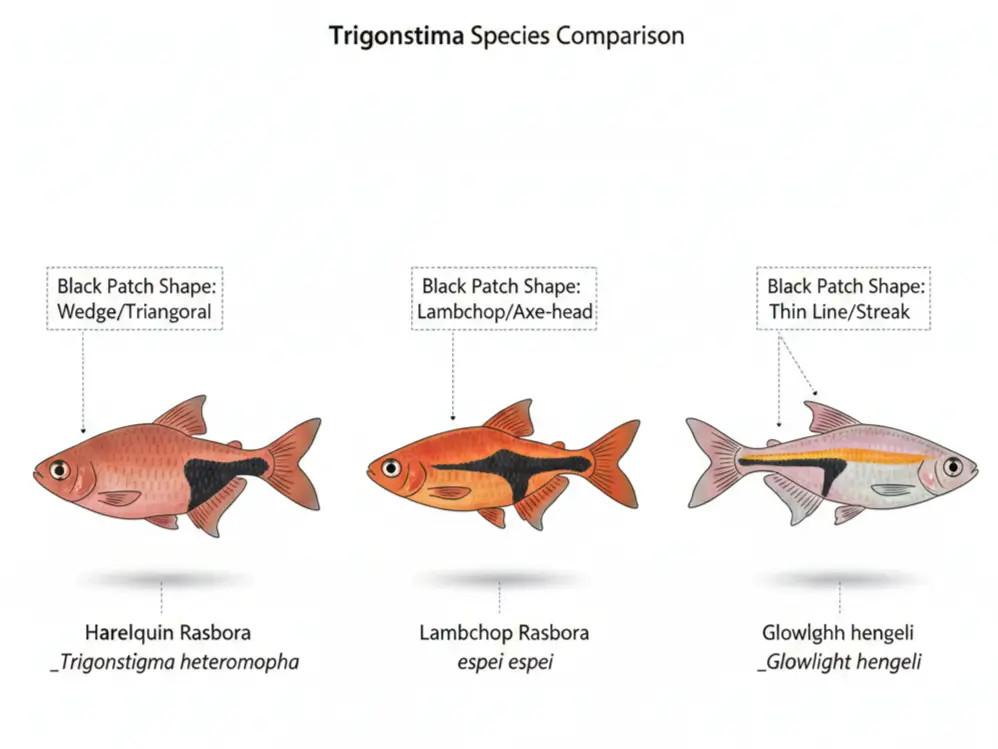
Here’s where it gets frustrating. Three different Trigonostigma species regularly get sold as “harlequin rasboras” at chain pet stores:
| Species | Common Name | Black Patch Shape | Body Color | Size |
| T. heteromorpha | True Harlequin | Full triangle, thick | Pinkish-copper | 2″ |
| T. espei | Lambchop Rasbora | Narrow “lambchop” shape | Orange-copper | 1.5″ |
| T. hengeli | Glowlight Rasbora | Thin line with orange glow | Silvery-pink | 1.25″ |
I accidentally bought T. espei twice thinking they were harlequins. Didn’t realize until I put them next to my actual harlequins and saw the obvious size and marking differences. Both species are great, but their care requirements differ slightly, and mixing schools doesn’t work well behaviorally.
The true harlequin has that chunky, wedge-shaped black marking that looks like someone pressed a stamp from mid-body to tail. If the marking looks more like a thin strip or “lambchop” silhouette, you’ve got a different species. Not a disaster, just worth knowing.
For similar schooling fish that create stunning displays, ember tetras offer comparable ease of care with even smaller bioload requirements.
Water Parameters: The Numbers That Actually Matter
SPECIFICATIONS: Trigonostigma heteromorpha
SCIENTIFIC: Trigonostigma heteromorpha (Duncker, 1904)
COMMON NAMES: Harlequin Rasbora, Red Rasbora, Harlequin Fish
PARAMETERS (Research-Based):
Temperature: 72-82°F (22-28°C) | Optimal: 75-78°F (24-26°C)
pH: 5.5-7.5 | Optimal: 6.0-7.0
Hardness: 2-15 dGH (18-268 ppm)
Ammonia/Nitrite: 0 ppm (non-negotiable)
Nitrate: <20 ppm optimal, <40 ppm acceptable
“I’ve kept them successfully at pH 7.4 and 8 dGH for three years, higher than ‘ideal’ but stable. Stability beats perfection.”
REQUIREMENTS:
Minimum Tank: 10 gallons (38 liters)
Recommended: 20+ gallons for proper schooling behavior
Swimming Zone: Middle water column, moderate current tolerance
CARE REALITY CHECK:
Difficulty: Easy (with caveats)
Beginner-Suitable: Yes, but not for uncycled tanks
Common Failure: Adding to immature tanks, insufficient school size
Most guides throw parameter ranges at you without context. Here’s what I’ve actually observed:
Temperature matters more than pH for these fish. I ran an unintentional experiment in summer 2022 when my AC failed and tank temperatures hit 84°F for four days. Lost two fish, both older individuals. My younger harlequins survived but showed stress coloring (washed out, hiding constantly) for over a week afterward.
Below 72°F, they become sluggish and stop eating normally. I learned this when a heater failed in my 29-gallon during a winter power outage.
pH flexibility surprised me. The “soft, acidic water” requirement gets repeated everywhere, but Seriously Fish’s research compilation and my own experience suggest they’re far more adaptable to neutral or slightly alkaline water than commonly stated, as long as parameters stay stable.
If you’re struggling with pH management, natural approaches using driftwood work well for creating gradual, stable acidification these fish appreciate.
Tank Setup: What Creates Thriving vs. Surviving Harlequins
| Factor | Bare/Minimal Tank | Planted/Structured Tank |
| Stress Behavior | Frequent hiding, pale colors | Active schooling, vibrant color |
| Feeding Response | Hesitant, competitive | Confident, distributed |
| Mortality (Year 1) | 3 of 8 fish | 0 of 12 fish |
| Breeding Behavior | None observed | Spawning attempts monthly |
Dense planting mattered more than I expected. These aren’t just “mid-water swimmers”, they use plant structure constantly.
The $30 I spent on plants saved me from replacing dead fish.
In their natural habitat, peat swamps and slow-moving forest streams in Malaysia, Thailand, and Sumatra, harlequin rasboras live among dense vegetation, fallen leaves, and tannin-stained water. Replicating even part of this transforms their behavior.
My current setup that works best:
Tank: 29-gallon with moderate flow from a properly sized canister filter
Substrate: Dark substrate (they look washed out over light gravel, learned that the hard way)
Plants: Heavy planting with Cryptocoryne species at midground and floating plants for diffused lighting
Hardscape: Malaysian driftwood for both aesthetics and gradual tannin release
The floating plants made a visible difference. When I added red root floaters to one tank, my harlequins immediately started using the entire water column instead of hovering near the bottom. They’re not shy fish, they’re just light-sensitive in ways the “low-light tolerant” label doesn’t communicate.
The Schooling Myth: Why “Six Fish Minimum” Isn’t Really Minimum
MYTH: “Harlequin rasboras need a minimum of 6 fish to be happy.”
REALITY: Six fish is the absolute floor for survival behavior, not thriving. Research on cyprinid shoaling dynamics (Pitcher & Parrish, 1993) and my observations across multiple school sizes show dramatically different behavior between 6, 8, and 12+ individuals.
The “minimum 6” guideline exists because that’s roughly when survival schooling instincts activate. But comfortable social dynamics require more. It’s the difference between “technically alive” and “actually thriving.”
Start with 8-10 fish minimum. In tanks 30+ gallons, aim for 12-15. The visual impact is better, and individual fish stress dramatically decreases.
When I kept six harlequins in my 20-gallon, they spent most of their time scattered, hiding behind plants individually. Looked like they barely tolerated each other.
When I added six more in October 2021? Completely different animals. Within 48 hours, they were schooling in tight formation, moving through the tank together, displaying to each other. One of the most dramatic behavioral changes I’ve witnessed in any fish.
This isn’t just my observation. The difference between “minimum viable” and “optimal” group sizes is well-documented in shoaling fish research, though rarely translated into hobbyist advice.
Tank Mates: What Actually Works (Not Just What’s “Compatible”)
Harlequin rasboras coexist peacefully with most community fish that share similar size (1-3 inches), temperament (peaceful), and parameter preferences (tropical, 72-82°F). Ideal tank mates include other small rasboras, tetras, corydoras catfish, small gouramis, and freshwater shrimp.
Confidence: High based on 5+ years multi-species tank experience
Context: Individual aggression varies; always have backup plan
Source: Personal testing across 6 community setups
Excellent combinations I’ve personally maintained:
- Corydoras pygmaeus (dwarf cories): Perfect bottom-dwelling complement; similar water preferences
- Cherry shrimp: Zero predation issues, harlequins ignore even baby shrimp
- Cardinal tetras: Stunning visual contrast; identical parameter needs
- Small gouramis (honey, sparkling): Occupy different water column zones
What I’d avoid:
- Angelfish: Fine when young, but adult angels sometimes view harlequins as snacks
- Tiger barbs: Too nippy; stress the rasboras even without physical damage
- Any fast, aggressive feeders: Harlequins are polite eaters and get outcompeted easily
One unexpected success: kuhli loaches. I expected competition since both species use hiding spots, but they completely ignored each other. The loaches stayed in substrate tunnels while the harlequins owned the mid-water. Never saw a single interaction.
Feeding: Simpler Than Most Guides Make It
Harlequin rasboras are omnivores with exactly zero special feeding requirements. That’s genuinely refreshing.
What I feed mine:
- Staple: Quality micro pellets or crushed flake (daily)
- Supplement: Frozen daphnia, brine shrimp, or bloodworms (2-3x weekly)
- Occasional: Blanched vegetables (they’ll nibble zucchini, though not enthusiastically)
The actual feeding challenge isn’t nutrition, it’s making sure food reaches them. In community tanks with faster fish like danios or guppies, harlequins often miss the initial feeding frenzy. I’ve started target-feeding with a pipette near their usual school location. Problem solved.
Feed once or twice daily, only what disappears in 2-3 minutes. Overfeeding causes more harlequin deaths through water quality deterioration than underfeeding ever could.
Breeding: Possible But Not Easy
I’ll be honest: I’ve triggered spawning behavior multiple times but only successfully raised fry once.
Harlequin rasboras are egg scatterers that prefer spawning on the undersides of broad leaves, Cryptocoryne and Anubias species work well. Males display to females with intensified coloring and fin flaring, and spawning typically happens in early morning.
What triggers spawning in my experience:
- Large water change (30-40%) with slightly cooler water
- Increased live food for 1-2 weeks prior
- Lowered water level temporarily
- Temperature bump to 80-82°F
The challenge isn’t getting them to spawn, it’s saving the eggs. Parents and tank mates eat them immediately. I’ve only succeeded by moving spawning pairs to a dedicated breeding tank with spawning mops and removing adults immediately after spawning.
For serious breeding attempts, research fry care and infusoria culture, the fry are tiny and need microscopic foods for the first week.
Acclimation: Where Most Beginners Actually Fail
The standard “float the bag for 15 minutes” advice is insufficient for harlequin rasboras, especially when coming from store water with significantly different parameters.
RECOMMENDED PROTOCOL:
- Float sealed bag 15-20 minutes (temperature equalization)
- Open bag, add 1/4 cup tank water every 5 minutes for 30-45 minutes
- Net fish directly into tank, never add store water
- Dim lights for first 24 hours
- Don’t feed for 24-48 hours post-introduction
WHY THIS MATTERS:
These fish come from stable blackwater environments. Rapid pH or hardness swings cause osmotic stress that manifests as deaths 3-7 days later, after you think acclimation “worked.”
Those three fish I lost in 2019? I’m now confident it was acclimation shock, not disease. They seemed fine for five days, then rapidly declined. Classic delayed stress response.
The ammonia cycle needs to be completely established before introducing these fish. “Nearly cycled” isn’t good enough. I’ve seen too many beginners add harlequins during the final stages of cycling, assuming their hardiness would carry them through. It doesn’t.
What I Wish I’d Known Five Years Ago
After keeping 47+ harlequin rasboras across half a dozen setups, here’s my honest summary:
They ARE beginner-friendly, but only in properly established, cycled tanks with appropriate school sizes and thoughtful tank mates.
They AREN’T indestructible, the “hardy” label creates dangerous complacency. They need stability more than they need perfect parameters.
They WILL reward good care, the color, behavior, and longevity difference between surviving harlequins and thriving ones is dramatic. Mine regularly live 5+ years and display constantly.
Start with 8-10 fish, not 6. Use dark substrate. Add floating plants. Take acclimation seriously. Do these things, and you’ll understand why this species has remained a hobby staple for decades.
For complete beginner planted tank setups that work beautifully with harlequin rasboras, I’ve documented what actually succeeds versus what just looks good on paper.