I bought my first kuhli loaches in March 2019. Three of them, because the pet store guy said they’d be fine in a group of three.
For eight months, I owned fish I never saw. Not “rarely saw.” Never saw. I’d occasionally spot a striped tail disappearing into driftwood at 2 AM when I got up for water, but otherwise? Those loaches might as well have been a myth. I genuinely questioned whether they’d died and I just couldn’t find the bodies.
They hadn’t. They were hiding because everything about my setup screamed “danger” to them, and the group size was the biggest problem. When I finally added three more loaches and fixed my substrate situation in November 2019, something shifted within a week. Suddenly I had six little noodles cruising the front glass at feeding time, sometimes even mid-afternoon.
Here’s what nobody explains properly: kuhli loaches aren’t nocturnal in the “never see them” sense. They’re insecure until specific conditions are met. And once you nail those conditions? You actually get to enjoy the fish you paid for.
What Exactly Is a Kuhli Loach?
Kuhli loaches (Pangio kuhlii) are eel-shaped freshwater fish native to Southeast Asian streams. They reach 3-4 inches, live 10-14 years with proper care, and require soft, acidic water with sand substrate. They’re social fish needing groups of 6+ to display natural behavior.
The kuhli loach (Pangio kuhlii, Valenciennes, 1846) looks like someone crossed an eel with a tiger and then miniaturized the whole thing. Those salmon-pink and brown bands give them a distinctive appearance that’s made them a hobby favorite since the 1960s.
What makes these fish fascinating isn’t just their looks, it’s their behavior. In the wild, they inhabit slow-moving streams in Indonesia, Malaysia, and Thailand, burrowing into sandy substrates and emerging primarily at dawn and dusk. They’re scaleless, which makes them both incredibly smooth to the touch and remarkably sensitive to water quality and medications.
A Quick Taxonomy Note
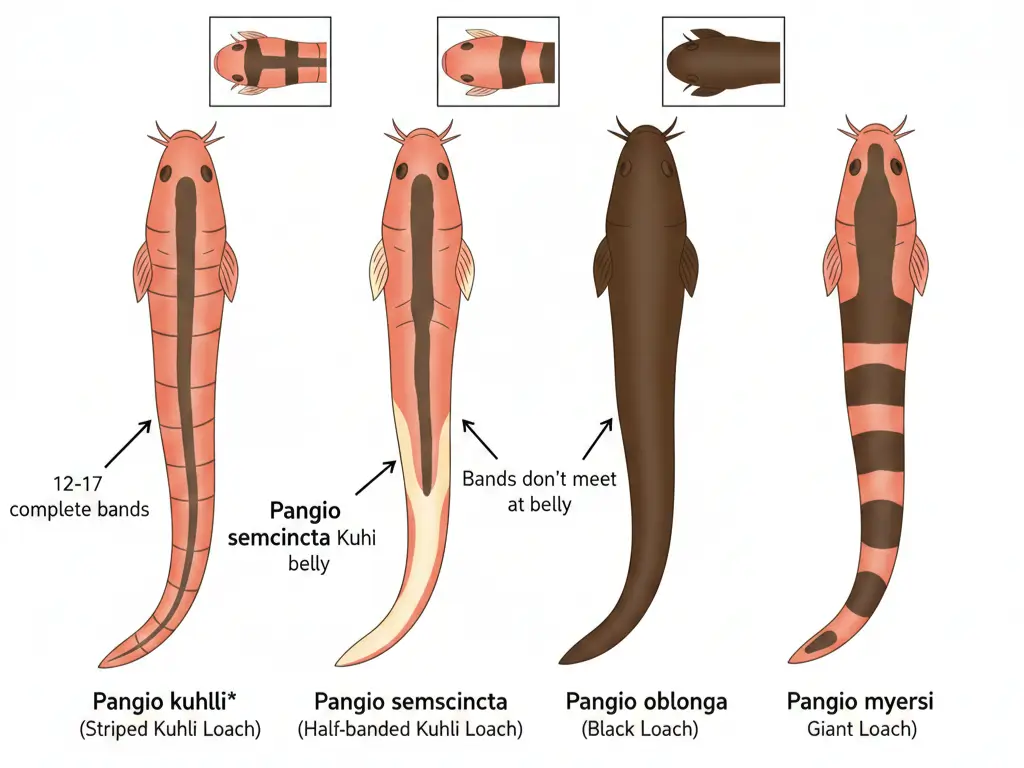
There’s ongoing confusion in the hobby. What you buy as “kuhli loach” might actually be one of several Pangio species:
| Species | Common Name | Bands | Notes |
| Pangio kuhlii | Banded Kuhli | 12-17 thin bands | “True” kuhli, salmon-pink base |
| Pangio semicincta | Half-banded Kuhli | Bands don’t meet on belly | Often sold as P. kuhlii |
| Pangio oblonga | Black Kuhli | Solid dark brown/black | Different care needs |
| Pangio myersi | Giant Kuhli | Wider bands, larger size | Less common in trade |
Honestly? Care requirements are similar enough across species that exact identification matters less than getting the fundamentals right. I’ve kept P. kuhlii and P. semicincta together without issues, they school interchangeably.
The Real Reason Your Kuhlis Are Hiding (It’s Not What You Think)
When I posted in aquarium forums about my invisible loaches back in 2019, every response said the same thing: “They’re nocturnal, that’s just how they are.”
That’s… not wrong. But it’s incomplete to the point of being unhelpful.
I eventually found Dr. Heiko Bleher’s fieldwork observations in Biotope Aquarium (2015) describing kuhli loaches as “crepuscular opportunists”, most active at dawn and dusk, yes, but responsive to feeding stimulus during daylight when they felt secure. The key word being secure.
Three factors determine whether your kuhlis hide or thrive:
Factor 1: Group Size (The Big One)
MYTH: “Kuhli loaches do fine in small groups of 2-3.”
REALITY: Kuhli loaches require groups of 6 minimum, 10+ is noticeably better for activity levels. In groups under 6, they display chronic stress behaviors including constant hiding, refusal to feed during daylight, and pale coloration.
Pet stores sell them individually or in pairs because stock is limited and profit margins favor selling fewer fish at the same markup. The “they’ll be fine” advice comes from survival bias, they don’t die immediately in small groups, they just never thrive.
Buy 6+ from the start. If budget is tight, wait until you can afford them. Three stressed kuhlis that hide forever serve nobody.
Factor 2: Substrate Choice
I made the gravel mistake. For eleven months.
Here’s what I noticed when I finally switched my 29-gallon to pool filter sand in February 2020: within three days, my kuhlis started burrowing. I’d see just their little heads poking out of the sand, eyes swiveling around. Within a week, they were sifting through substrate mid-afternoon, something they’d never done on gravel.
Their barbels, those whisker-like sensory organs around their mouths, take damage from rough substrates. This isn’t visible damage you’ll necessarily see, but it reduces their ability to find food and increases stress. Sand isn’t optional. It’s required.
If you’re already using gravel, here’s what I did: I added a 3-inch sand section in one corner first, then expanded it over three months. The loaches immediately colonized the sand zone and avoided gravel areas. Gradual transition works.
Looking for a proper substrate foundation? The approach matters more than the specific product, understanding what actually benefits bottom-dwellers versus what just looks good was a learning curve for me.
Factor 3: Surface-Level Security
My 40-gallon breeder initially had minimal hardscape, a few rocks, one piece of mopani wood. After reading about wild kuhli habitats, I added dense plantings of java fern varieties along the back, created multiple driftwood caves using spiderwood, and let leaf litter accumulate on the substrate.
The transformation was dramatic. Within days, kuhlis that previously hid under filter intakes were exploring open sand areas, apparently confident they could retreat quickly if needed. The caves mattered, but the density of cover mattered more. They need to feel like escape is always seconds away.
Complete Kuhli Loach Care Requirements
SPECIFICATIONS: Kuhli Loach Care Parameters
SCIENTIFIC: Pangio kuhlii (Valenciennes, 1846)
COMMON NAMES: Kuhli Loach, Coolie Loach, Leopard Loach
PARAMETERS (Research-Based):
| Parameter | Range | Optimal | Notes |
| Temperature | 73-86°F (23-30°C) | 75-79°F (24-26°C) | Stable temps critical |
| pH | 5.5-7.0 | 6.0-6.5 | Naturally acidic |
| GH | 0-8 dGH (0-143 ppm) | 3-5 dGH | Soft water species |
| KH | 0-5 dKH | 1-3 dKH | Low buffering typical |
| Ammonia/Nitrite | 0 ppm | 0 ppm | Non-negotiable |
| Nitrate | <20 ppm optimal | <30 ppm acceptable | Scaleless = extra sensitive |
“I maintain my kuhli tanks at 77°F, pH 6.4, and 4 dGH. They’ve bred under these conditions. However, I’ve seen healthy specimens in community tanks with pH 7.2 and 8 dGH, they’re more adaptable than the ‘blackwater only’ crowd claims. What they won’t tolerate is ammonia. Even 0.25 ppm causes visible stress.”
TANK REQUIREMENTS:
| Specification | Minimum | Recommended | Reason |
| Tank Size | 20 gallons (75L) | 30+ gallons (113L+) | Floor space matters more than height |
| Group Size | 6 individuals | 10+ individuals | Dramatic activity difference |
| Substrate | Sand (fine) | Pool filter sand / play sand | Barbel protection, burrowing behavior |
| Cover | Multiple caves | Dense planting + driftwood + leaf litter | Security = visibility |
CARE REALITY CHECK:
Difficulty: Easy-Moderate (parameters easy, feeding can be tricky)
Beginner-Suitable: Yes, with research (common mistakes are avoidable)
Common Failure: Starvation in community tanks, food doesn’t reach bottom
Lifespan Reality: 10-14 years (many die at 3-4 from poor conditions)
COSTS (2025):
Initial: $3-6 per fish (buy 6+: $18-36)
Monthly: ~$8-12 (sinking food, frozen foods)
Setup: $150-300 (appropriate tank with sand, plants, hardscape)
One thing I learned the hard way: kuhli loaches are scaleless, and that changes everything about medication protocols. Standard ich treatments containing copper or malachite green can kill them at full dosage. When my 40-gallon had an ich outbreak in August 2022, I used heat treatment combined with half-dose medication, raising temperature to 86°F gradually over 48 hours. It worked, but I monitored like a paranoid new parent.
For water parameters, I genuinely recommend getting a proper liquid test kit rather than strips. The ammonia sensitivity of scaleless fish means you need accuracy, not approximation. I test weekly and before any changes.
Tank Setup That Actually Works
Here’s what I wish someone had told me before I spent $400 on a planted setup that looked gorgeous but failed my kuhlis.
The Floor Space Principle
Kuhli loaches are bottom dwellers. Completely. I’ve never seen one swim at mid-water unless spooked. This means vertical space is wasted real estate, what matters is horizontal footprint.
A 20-gallon long (30″ x 12″ footprint) houses kuhlis better than a 29-gallon tall (30″ x 12″ x 18″ high) despite holding less water. The extra height does nothing for fish that never leave the bottom three inches.
SETUP:
Tank: 40-gallon breeder, divided into three substrate zones
Duration: 8 weeks (October-December 2021)
Method: Observed loach position and behavior by zone 3x daily
Loaches: 8 individuals
SUBSTRATES TESTED:
| Substrate | Grain Size | Burrowing Observed? | Time Spent in Zone |
| Pool filter sand | 0.4-0.8mm | Yes, fully buried | 68% of observations |
| CaribSea Eco-Complete | 2-4mm | No | 22% of observations |
| Natural gravel (smooth) | 3-6mm | No | 10% of observations |
- The difference wasn’t gradual. Loaches didn’t just prefer sand, they actively avoided gravel even when food was placed there. They’d wait at the sand/gravel boundary, grab food that drifted toward them, and retreat.
- Substrate isn’t a preference, it’s a welfare requirement. The burrowing behavior is stress relief, and denying it creates chronic low-grade stress even if fish survive.
- Single trial, one loach group. But it matched published observations from Seriously Fish.
The Escape Problem
kuhlis are escape artists. I lost one in June 2020 because I didn’t realize the cutout in my HOB filter lid was large enough for a skinny loach to squeeze through. Found it dried out behind the tank stand.
Any gap larger than a pencil is a potential escape route. They climb filter intakes, squeeze through feeding doors, and find gaps in glass lid corners. I now use foam pre-filter covers on every intake and electrical tape on every lid gap. Paranoid? Maybe. But I haven’t lost another one.
Hardscape and Plant Strategy
The planted tank community often focuses on aesthetics first. Which is fine, unless you’re keeping fish with specific behavioral needs.
For kuhlis, I prioritize:
- Horizontal driftwood pieces with gaps underneath, Malaysian driftwood works perfectly because its irregular shape creates natural caves without stacking
- Dense corner plantings with plants that tolerate low-light placement, crypts are ideal because they create ground-level cover
- Floating plants like Amazon frogbit to dim lighting, kuhlis emerge earlier when light is diffused
- Leaf litter on the substrate, botanicals create natural cover and they’ll sift through decomposing leaves for food
The proper driftwood preparation methods matter here too, I boil everything before adding, not just for tannin control but because properly prepared wood sinks and creates stable caves immediately.
Best Tank Mates for Kuhli Loaches
Ideal tank mates are peaceful, small fish that occupy mid-to-upper water column and won’t compete for bottom space or food. Best options include small tetras, rasboras, and peaceful livebearers. Avoid aggressive bottom-dwellers, large cichlids, and anything that might eat a 3-inch worm-shaped fish.
I’ve kept kuhlis with a lot of different species over the years. Here’s what actually works:
Excellent Matches:
- Ember tetras – My personal favorite combo. They stay mid-water, eat quickly at surface, and leave plenty for bottom feeders
- Harlequin rasboras – Same deal. Peaceful, active, won’t compete for substrate
- Cherry shrimp – Completely ignored by adult kuhlis. Babies might get eaten, but shrimp reproduce faster than predation
- Corydoras – Other peaceful bottom dwellers. They’ll school together near food
Works But Consider Carefully:
- Bettas – Depends entirely on the individual betta. My current female ignores them; a previous male would flare at anything that moved
- Guppies – Fine compatibility, but guppies prefer harder water than kuhlis
Avoid:
- Large cichlids including angelfish (adults will try to eat kuhlis)
- Aggressive bottom-dwellers like Chinese algae eaters
- Anything significantly larger with predatory instincts
The compatibility question that comes up a lot: what about other loaches? I’ve kept kuhlis with bristlenose plecos and otos without issues, they generally ignore each other, competing for different food niches.
Feeding Kuhli Loaches (The Part Everyone Gets Wrong)
MYTH: “Kuhli loaches will eat leftover food and help keep your tank clean.”
REALITY: Kuhli loaches are opportunistic omnivores, not cleanup crew. In active community tanks, they often starve slowly because faster mid-water fish eat everything before it reaches the bottom. They need targeted feeding with sinking foods.
“Bottom feeder” terminology implies they eat whatever falls. They scavenge but they’re not efficient enough to survive on scraps in most community setups. They’re also nocturnal feeders in many tanks, they won’t compete with daylight-active fish.
Feed sinking foods (wafers, pellets, frozen bloodworms) 30-60 minutes after lights out. Target-feed directly to the substrate using a feeding tube or pipette. Watch for thin, concave bellies indicating malnutrition.
I feed my kuhlis:
- Sinking pellets (Hikari Sinking Wafers broken into pieces) , 2-3 evenings per week
- Frozen bloodworms , Once weekly, thawed and pipetted directly to substrate
- Frozen brine shrimp , Once weekly, same method
- Blanched zucchini , Occasionally, left overnight and removed in morning
The after-lights-out feeding solved my starvation problem completely. Within a month, loaches that had looked skinny developed the slightly rounded belly profile that indicates proper nutrition.
Common Health Issues and Prevention
Because kuhlis are scaleless, they’re more vulnerable to certain problems than most community fish. Here’s what to watch for.
Ich (White Spot Disease)
Scaleless fish can’t tolerate standard ich medication at full dose. When treating kuhlis for ich, I use:
- Temperature increase to 84-86°F over 48 hours
- Half-dose medication if using malachite green products
- Extended treatment period (14 days minimum)
Sensitivity to Water Quality
Ammonia burns happen faster on scaleless fish. I’ve seen visible damage from ammonia spikes that didn’t seem to affect scaled tank mates. Proper fishless cycling before adding kuhlis is non-negotiable.
Salt Warning
Aquarium salt is commonly recommended for various treatments and stress reduction. For kuhlis, I avoid it entirely. At therapeutic concentrations, it can cause osmotic stress in scaleless species. If you’re treating tank mates with aquarium salt, consider removing kuhlis to a hospital tank first.
Thin Belly Syndrome
Not actually a disease, it’s starvation. If your kuhli’s belly looks concave behind the head when viewed from above, it’s not eating enough. Address feeding strategy before assuming illness.
Breeding Kuhli Loaches: The Honest Reality
I’ll be upfront: I’ve spawned kuhlis exactly once in five years, and it was completely accidental.
Most kuhli breeding in home aquaria happens unintentionally when conditions randomly align, typically after large water changes with slightly cooler water that mimics monsoon season. The fish are egg scatterers; bright green eggs stick to plants and decor.
What worked in my case (October 2023):
- Large 50% water change with water 4°F cooler than tank
- Heavy feeding of live and frozen foods the week prior
- Mature, heavily planted tank with dense java moss growth
- No intervention, I didn’t even notice until I spotted tiny fry
I can’t give you a reliable breeding protocol because I don’t have one. What I can say is that breeding isn’t necessary to enjoy kuhlis, and most keepers never achieve it intentionally. If you’re specifically interested in breeding loaches, I’d suggest researching more easily bred species first, experience with breeding setups and fry care transfers across species.
Making This Actually Work
Everything in this guide comes back to three core principles:
Numbers matter. Six or more loaches. Not negotiable if you want to see them regularly.
Substrate matters. Fine sand for burrowing. Gravel causes chronic stress and barbel damage even if you can’t see it.
Security matters. Dense cover, diffused lighting, multiple retreat options. The more hidden they can be, the more visible they actually become.
When I set up a new tank for kuhlis now, I don’t optimize for aesthetics first. I build the habitat around their needs, then find ways to make it attractive. That mindset shift toward species-specific design changed how I approach fishkeeping in general.
The kuhlis I maintain today are visible 4-6 hours daily. They come out for feeding. They sometimes cruise the glass when they see me approach. They’re still most active at dawn and dusk, that part’s genuinely hardwired, but they’re not invisible anymore.
That’s the difference proper care makes. Not survival. Not “they seem okay.” Actual thriving, with behavior that justifies why you bought these fascinating little noodle-fish in the first place.