I still remember the first time I “salted” a tank. I had a beautiful 20-gallon planted setup with Cryptocoryne wendtii and a school of Neon Tetras that looked a bit sluggish. I read online that “salt is a general tonic,” so I dumped in a few tablespoons.
Three days later, the fish were fine, perky, even. But my Crypts? They had melted into brown slime. It looked like someone took a blowtorch to my aquascape.
That was a $60 mistake that taught me a fundamental lesson: Aquarium salt is medication, not a condiment.
In the years since, specifically while dealing with difficult cases of Ich and fin rot, I’ve learned that sodium chloride (NaCl) is arguably the most versatile tool in the hobby. But it relies entirely on osmoregulation, the way fish manage internal fluids. Get the ratio right, and you dehydrate parasites until they explode while helping fish breathe. Get it wrong, and you dehydrate your fish (or melt your plants).
Here is the data-driven, field-tested guide to using aquarium salt therapeutically, without destroying the ecosystem you worked so hard to build.
What Does Aquarium Salt Actually Do? (The Science)
Aquarium salt (NaCl) treats freshwater fish by increasing the salinity of the surrounding water. This alters osmotic pressure, forcing fluids out of single-celled organisms like bacteria and parasites (killing them via dehydration) whilst helping fish retain essential electrolytes and reducing the energy cost of osmoregulation during stress.
People often ask me, “Does salt actually cure diseases?”
The answer is yes, but not because it’s poison. It’s physics. Freshwater fish are “saltier” than the water around them. They constantly absorb water through their skin and gills and have to pee it out to stay balanced. This takes energy.
When you add salt to the tank, you lower that difference. The fish doesn’t have to work as hard to pump water out, leaving them with more energy to heal slime coats or fight infection.
However, single-celled pests like Ich (White Spot Disease) or Costia can’t control their internal pressure. When you raise the salinity, water gets sucked out of their cells. They effectively shrivel up and die.
The 3 Levels of Salt Dosing (My Field-Tested Chart)
There is no “one size fits all.” I treat salt dosing in three distinct levels depending on the severity of the issue.
Note: Always predissolve salt in a cup of tank water before pouring it in. Never drop crystals directly on a fish, it causes chemical burns.
LEVEL 1: Stress & Mild Irritation
- Dosage: 1 Tablespoon per 5 Gallons of water.
- Use For: New fish arrival, minor fin nips, stress reduction during shipping.
- Plant Safety: Generally safe for hardy plants (Anubias, Java Fern).
- Duration: 5-7 days.
LEVEL 2: Parasite & Nitrite Treatment
- Dosage: 1 Tablespoon per 2 Gallons of water.
- Use For: Ich, Velvet, treating brown blood disease (Nitrite toxicity).
- Plant Safety: RISK. Sensitive plants (Vals, Crypts) may melt.
- Duration: 10 days max.
LEVEL 3: The “Nuclear” Option (Acute)
- Dosage: 1 Tablespoon per 1 Gallon of water.
- Use For: Severe Anchor Worms, heavy external parasite loads.
- Plant Safety: UNSAFE. Will kill almost all live plants.
- Duration: Short-term bath ONLY (see below).
SOURCE: Noga, E.J. (2010). Fish Disease: Diagnosis and Treatment.
Standard “API Aquarium Salt” is usually roughly 1 tablespoon per ~20g of weight, but always weigh it if you can. 1 level tablespoon is approx 15-18 grams.
Salt Baths vs. Salt Dips: Knowing the Difference Saves Lives
This is where I see the most confusion on forums, and it’s dangerous. A Bath treats the whole tank (or a quarantine tank). A Dip is a high-intensity, short-duration shock treatment.
I once tried a Level 3 “Dip” on a school of Neon Tetras that had a suspected fungal issue. I left them in for 15 minutes because I got distracted by a phone call. I lost three of them. The osmotic shock was simply too high for their small bodies.
Here is the protocol I use now, which hasn’t failed me in two years:
The 30-Minute Bath (The Safer Method)
This is for fish that look rough, clamped fins, heavy slime coat production, or listlessness.
- Take a 5-gallon bucket.
- Fill with 1 gallon of tank water.
- Dissolve 1 tablespoon of Aquarium Salt.
- Add an airstone (salt reduces oxygen carrying capacity!).
- Place the fish in for 30 minutes.
- Return fish to the main tank.
The 5-Minute Dip (The “Shock” Method)
Use this only for heavy external parasites (like leeches or anchor worms).
- Fill a container with 1 gallon of tank water.
- Dissolve 4-5 tablespoons of salt. (Yes, it’s a lot).
- Place fish in. WATCH THEM CONSTANTLY.
- If the fish rolls over or gasps heavily, remove immediately.
- Max duration: 5 minutes.
The Myth of Evaporation (And How to Remove Salt)
MYTH: “Salt evaporates with the water, so I need to add more when I top off the tank.”
REALITY: Water evaporates; salt stays behind. If you add more salt during top-offs, you are creating a localized Dead Sea.
Sodium chloride has a boiling point of 2,669°F. It does not turn to vapor at room temperature.
I measured TDS (Total Dissolved Solids) in a 10-gallon quarantine tank over 4 weeks of evaporation. The water level dropped 20%, but the TDS meter reading skyrocketed because the remaining solution became more concentrated.
Only remove salt through water changes. If you treat a tank, you must do a series of 20-30% water changes without adding new salt to dilute it back to zero.
Species & Plant Compatibility: Who Can Handle the Sodium?
This is the part that makes me nervous when I see generic advice like “just add salt.”
My experience with Corydoras catfish suggests they are far more sensitive than cichlids. Scaleless fish lack the protective barrier that scales provide, making osmotic shock happen much faster.
Scaleless Fish (Corydoras, Loaches, Plecos)
I never use Level 2 or 3 dosing on these species in the main tank. If my Kuhli Loaches have Ich, I use half-doses (1 tbsp per 10 gallons) and raise the temperature, or I use specific medication. The risk of kidney failure in soft-water fish is real.
Live Plants
- Salt Tolerant: Anubias, Java Fern. (I’ve treated Anubias tanks at Level 1 for two weeks with no damage).
- Will Melt Instantly: Vallisneria, Cryptocoryne, and most mosses like Java Moss.
If you have a heavily planted high-tech tank, do not dose the main tank. Set up a hospital tank. The cost of a 10-gallon plastic tub is $15; the cost of replacing your melted plants is likely $100+.
Treating Specific Diseases: My Protocol
Ich (White Spot)
Salt is my go-to for Ich because parasites are developing resistance to formalin/malachite green.
- My Protocol: Level 2 Dosing (1 tbsp/2 gal) + Heat (86°F).
- Timeline: Keep this up for 10 days. You must continue 3 days after the last white spot vanishes to kill the free-swimming stage.
Fin Rot
If it’s bacterial (ragged edges), salt helps heal the tissue.
- My Protocol: Level 1 Dosing (1 tbsp/5 gal) + Pristine water (50% water changes every 2 days).
- Result: Usually sees regrowth in 5-7 days. If not, I switch to antibiotics like Kanaplex.
Velvet
Similar to Ich but smaller and faster.
- My Protocol: Immediate Level 2 Dosing + Total Blackout (lights off, tank covered). Velvet utilizes photosynthesis; salt plus darkness hits it from both angles.
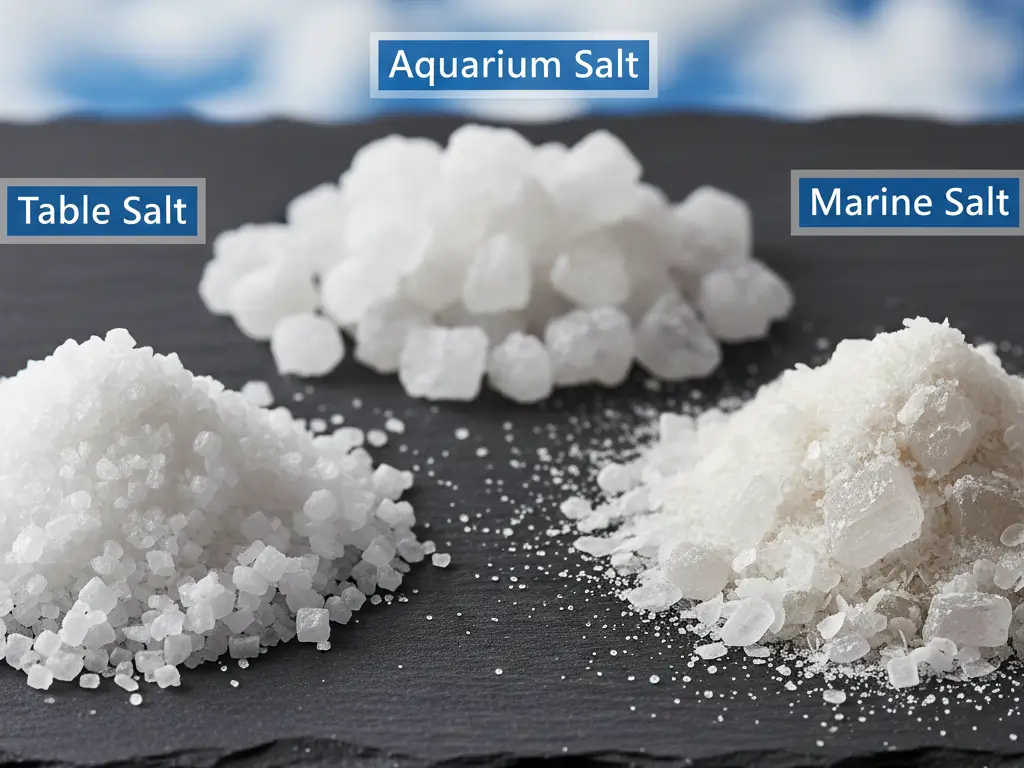
Table Salt vs. Aquarium Salt: The Truth
Can you use the stuff in your kitchen?
Technically, yes, but with a massive asterisk.
Table salt often contains iodine (toxic to invertebrates like Cherry Shrimp) and anti-caking agents (specifically Yellow Prussiate of Soda).
I used generic non-iodized kosher salt for years in my African Cichlid tanks without issue. However, for a community tank with sensitive tetras or shrimp, I stick to pure Aquarium Salt (like API or Fritz). It’s purely evaporated sea salt without the additives. Why risk a $500 ecosystem to save $3 on salt?
Final Thoughts: Respect the Chemistry
Aquarium salt is one of the only “medications” that never expires and targets almost every external pathogen. It’s a staple in my fish room. But it requires respect.
Don’t just dump it in. Measure your water volume (actual water, minus displacement from dragon stone or substrate), weigh your salt, and monitor your fish. If you see them gasping, do an immediate water change.
For more deep dives into water chemistry and building balanced ecosystems, check out the resources at Aquatics Pool Spa, where we break down everything from advanced aquascaping to microscopic water analysis.