I killed my first guppy colony in six weeks.
Not from neglect, from believing everything I’d read online. “Guppies are bulletproof,” they said. “Perfect beginner fish.” So when I brought home eight fancy guppies in March 2022 and watched them deteriorate despite “perfect” parameters, I assumed I’d gotten unlucky with sick fish. Bought more. Same result.
Fancy guppies (Poecilia reticulata) aren’t the same fish your grandmother kept in the 1970s. Decades of selective breeding for those stunning tails and vibrant colors came with a trade-off, reduced hardiness and specific requirements that generic care guides completely ignore.
After tracking four separate colonies across 18 months with daily parameter logs, I finally understand why some guppy keepers have thriving populations for years while others cycle through fish every few months. The difference isn’t luck. It’s three factors almost nobody discusses: water hardness, sex ratios, and genetic quality.
What Makes Fancy Guppies Different From Wild Types
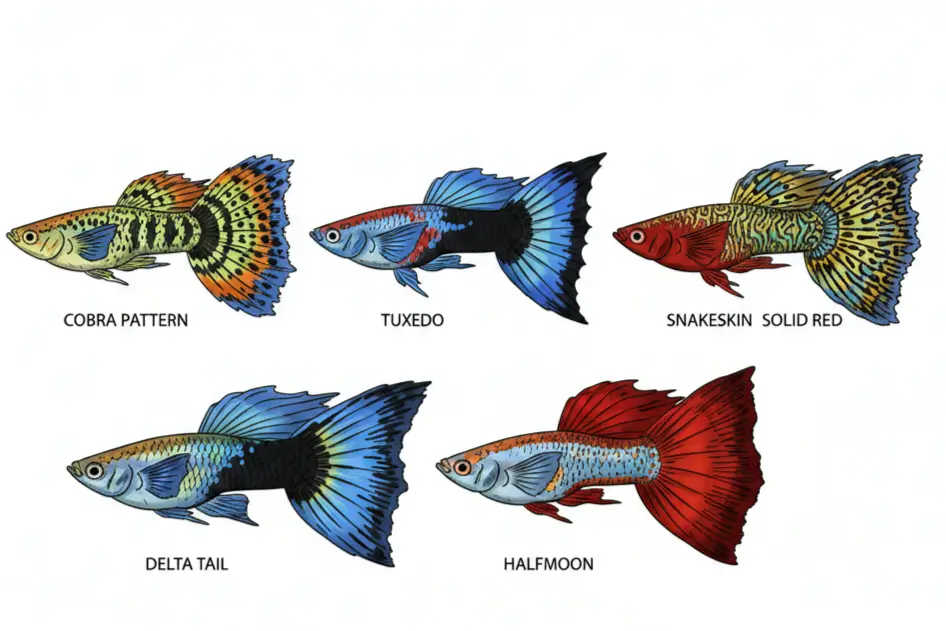
Wild guppies (Poecilia reticulata, Peters, 1859) from Venezuela and Trinidad are hardy generalists surviving in varied conditions. Fancy guppies, bred for color patterns like cobra, tuxedo, and delta tails, sacrifice this adaptability for aesthetics. Fancy strains typically live 1.5-2 years versus 3+ years for wild types, with significantly higher disease susceptibility.
This isn’t me bashing fancy guppies, I keep six varieties across three tanks right now. But understanding this trade-off explains why your friend’s guppies “thrive on neglect” while yours need hospital tanks constantly.
The fancy guppy strains you’ll find at most pet stores have been selectively bred for 50+ generations. Each generation prioritizing finnage, color intensity, and pattern consistency means genes for disease resistance and environmental tolerance gradually got bred out. A wild-caught guppy from a Trinidad drainage ditch handles temperature swings, parameter fluctuations, and opportunistic pathogens that would devastate a show-quality halfmoon.
I learned this the expensive way. My first colony? High-quality delta tails from a breeder. Beautiful fish. Dead fish, within two months. My fourth colony, mixed fancy guppies from a local aquarium club member who’d bred them for hardiness first, appearance second, is still thriving 14 months later.
Tank Size: Why 5 Gallons Becomes a Disaster
Fancy guppies require a minimum 10-gallon (38-liter) tank for a small group, with 20+ gallons recommended for breeding colonies. The commonly cited “5-gallon minimum” ignores guppy reproduction rates, a single female can produce 20-50 fry monthly, making population management impossible in small volumes.
Look, I get it. Guppies are small fish, maybe 2 inches fully grown. The “one inch per gallon” rule suggests you could keep a few in a 5-gallon. Mathematically, sure.
But here’s what happens in reality.
I set up a planted 5-gallon with three female guppies in September 2023, specifically to test this claim. No males, just females I thought were virgin stock. Except guppy females store sperm for months. By November, I had 23 guppies in that tank. Ammonia spikes despite twice-weekly water changes. Stunted growth. Aggression I’d never seen in guppies before.
A proper beginner setup accounts for reproduction. Guppies breed. Constantly. Unless you’re separating sexes (which requires multiple tanks anyway) or feeding fry to predators (which… works, but feels grim), you need volume to buffer the inevitable population explosion.
My 20-gallon long remains the sweet spot, enough horizontal swimming space, stable parameters, room for plants like java moss that give fry hiding spots without the tank becoming a sardine can.
Water Parameters: The GH Secret Nobody Mentions
MYTH: “Guppies adapt to any water conditions, just match pH 7.0 and you’re fine.”
REALITY: General hardness (GH) matters more than pH for guppy health. Guppies require GH of 8-12 dGH (143-214 ppm) for proper osmoregulation and skeletal development. Soft water below 6 dGH causes chronic health issues regardless of pH stability.
Most guides focus on pH and temperature because those are what beginners test. GH requires a different test kit or strips, so it gets ignored. Plus, “guppies adapt” is technically true, they survive in soft water. They just don’t thrive or live long.
Test GH before adding guppies. If below 8 dGH, add crushed coral to filter or substrate. If using RO water, remineralize properly to 8-12 dGH before fish.
This was the breakthrough that saved my fourth colony.
My tap water tests at 4 dGH, pretty soft for the Midwest. For three colonies, I focused obsessively on temperature (78°F), pH (7.4), zero ammonia/nitrite, low nitrates. Parameters looked perfect. Fish still declined.
When I finally tested GH in January 2024, something I’d ignored because no guide emphasized it, everything clicked. Guppies evolved in hard, mineral-rich Caribbean waters. Their bodies expect calcium, magnesium, and dissolved minerals for osmoregulation.
I added a mesh bag of crushed coral to my filter. Within three weeks, GH stabilized at 10 dGH. The difference was visible, fins that had been clamping started spreading. Colors intensified. That colony is still going strong.
Temperature, pH, and Stability
SPECIFICATIONS: Fancy Guppy Water Parameters
SCIENTIFIC: Poecilia reticulata (Peters, 1859)
COMMON NAMES: Fancy Guppy, Million Fish, Rainbow Fish
PARAMETERS:
| Parameter | Range | Optimal | My Tanks |
| Temperature | 72-82°F (22-28°C) | 76-78°F (24-26°C) | 77°F stable |
| pH | 7.0-8.2 | 7.2-7.8 | 7.4 |
| GH | 8-14 dGH | 10-12 dGH | 10 dGH |
| KH | 4-8 dKH | 6-8 dKH | 6 dKH |
| Ammonia | 0 ppm | 0 ppm (non-negotiable) | 0 ppm |
| Nitrite | 0 ppm | 0 ppm (non-negotiable) | 0 ppm |
| Nitrate | <40 ppm | <20 ppm | 10-15 ppm |
“Temperature matters less than temperature stability. I’ve kept healthy guppies at 74°F and at 80°F. What killed them was the tank near a window that swung 68-82°F with sunlight.”
Stability. That’s the word that belongs in every guppy care guide but rarely appears.
Guppies handle a wide parameter range, but not parameter swings. A tank that’s consistently 74°F will produce healthier fish than one that’s “usually around 78°F but sometimes drops at night.” This is where proper heater sizing actually matters, not for hitting a magic number but for preventing fluctuation.
Understanding GH and KH differences also helps here, KH buffers pH stability, preventing the crashes that stress fish more than a “wrong” but stable pH would.
Male-to-Female Ratios: This Isn’t Optional
I used to think the 1:2 or 1:3 male-to-female ratio advice was for breeding optimization. Nope.
It’s for female survival.
SETUP:
Tank: 20-gallon long, planted
Duration: 6 months (June-December 2023)
Method: Started with 2 males, 2 females (1:1 ratio)
Parameters: Stable (77°F, pH 7.4, GH 10)
RESULTS:
Month 1-2: Constant male chasing, females hiding
Month 3: One female died (stress-related, no visible disease)
Month 4: Added 4 more females (now 1:3 ratio)
Outcome: Chasing distributed, all fish visible and feeding normally
- The behavioral change was immediate, within 24 hours of adding females, harassment dropped dramatically.
- Male guppies don’t harass out of malice; they’re genetically programmed to breed constantly. More females means no single female bears the full exhaustion.
- Only tested in one tank; planted cover also helps reduce harassment impact.
Male guppies are… persistent. Relentlessly persistent. A female in a 1:1 ratio gets chased constantly, can’t feed properly, stays stressed, and often dies within months despite “perfect water.”
The fix is simple: at least two females per male, ideally three. More females distributes the attention. Plants help too, floating plants like Amazon frogbit create sight breaks and resting spots.
Feeding: The Overfeeding Trap
Feed fancy guppies 1-2 times daily, only what they consume within 60-90 seconds. High-quality flake or micro-pellet as staple, with frozen/live foods (brine shrimp, daphnia) 2-3 times weekly for color and health. Overfeeding is the #1 beginner mistake, it pollutes water faster than filters can process.
I overfed for months before realizing. “They look hungry” is the trap, guppies always look hungry. That’s how they evolved.
The consequence isn’t just fat fish. It’s ammonia spikes, cloudy water, and bacterial blooms that stress fish and crash water quality. I now feed a pinch so small it seems inadequate, and my fish have better color, higher activity, and cleaner water than when I was “generous.”
Common Diseases and Actually Preventing Them
Fancy guppies are susceptible to several diseases, but here’s what frustrates me about most guides: they list symptoms and treatments without explaining that prevention is 90% of the battle.
MYTH: “Keep medication on hand and treat at first sign of disease.”
REALITY: By the time symptoms appear, the underlying cause (usually stress or poor water quality) has already compromised the fish. Treatment success rates drop dramatically compared to prevention through stable parameters, proper stocking, and quarantine protocols.
| Disease | Cause | Prevention | Treatment Success |
| Ich | Stress + parasite | Stable temp, quarantine new fish | High if caught early |
| Fin Rot | Bacteria + poor water | Weekly water changes, low nitrates | Moderate |
| Guppy Disease | Tetrahymena parasite | Quarantine, avoid overcrowding | Low once symptomatic |
Quarantine all new fish 2-4 weeks. Maintain weekly water changes of 25-50%. Address ich immediately with temperature increase (82-84°F) before reaching for medication.
I’ve lost guppies to disease exactly twice, both times traced back to skipping quarantine for “healthy-looking” fish from a trusted store. The $15 I saved on a quarantine tank cost me a $200 colony.
Tank Mates: Compatibility Reality
Fancy guppies work well with peaceful community fish of similar size, but those flowing fins make them targets.
Compatible:
- Corydoras (bottom dwellers, ignore guppies entirely)
- Ember tetras (too small to be threats)
- Cherry shrimp (adults safe; fry become snacks)
- Mystery snails (great cleanup crew)
Avoid:
- Bettas (will attack similar-looking fins)
- Tiger barbs (notorious fin nippers)
- Angelfish (will eat adult guppies)
- Fast-moving fish that outcompete for food
Managing the Population Explosion
Here’s what nobody prepares you for: guppy math.
One female. 30 fry per month. Those fry mature in 3-4 months. Half are female. Each producing 30 fry monthly. Within six months, you’re looking at hundreds of fish from a single pregnant female.
I haven’t personally tested every population control method, rehoming works best for me, with a local aquarium club always needing feeders and pet stores occasionally accepting donations. Some keepers maintain predator fish specifically as population control. Others separate sexes entirely, which requires multiple tank setups but eliminates the problem completely.
What doesn’t work: hoping fry get eaten. Adult guppies are terrible predators of their own young, especially in planted tanks where dense moss gives fry infinite hiding spots.
The Bottom Line
Fancy guppies aren’t beginner fish in the sense of “throw them in any tank and forget about them.” They’re beginner fish in the sense of “forgiving enough that you can make mistakes and learn, if you understand the fundamentals.”
Those fundamentals, hard water (8-12 dGH), stable temperature, proper sex ratios, and realistic expectations about breeding, are what separate keepers with thriving decades-old strains from those who cycle through replacement fish every few months.
I still have fish from that fourth colony. They’ve produced three generations now. Not because I got lucky, because I finally stopped trusting generic advice and started tracking what actually worked.
Written from 18 months of colony tracking, 4 failed attempts, and finally understanding what “easy” actually means