The first time I tried to grow a Dwarf Hairgrass (Eleocharis acicularis) carpet without CO2 injection, I didn’t grow a carpet. I grew a magnificent, slimy farm of hair algae. I followed the standard advice, “high light and fertilizers”, and completely nuked the tank ecosystem within three weeks. It was frustrating because I kept seeing these lush, grassy iwagumi layouts online that claimed to be “low tech,” yet my grass was melting faster than ice cream on a sidewalk.
Here is the truth that took me four tank setups to figure out: You can absolutely carpet Dwarf Hairgrass without pressurized CO2, but you cannot do it using “high tech” planting methods.
If you plant it submerged in a low-energy tank, it will likely die. If you use the Dry Start Method (DSM) and rely on root feeding rather than water column dosing, you can get a full carpet in 8-10 weeks. I’ve done it, I’ve logged the growth, and I’m going to show you exactly how to cheat the system.
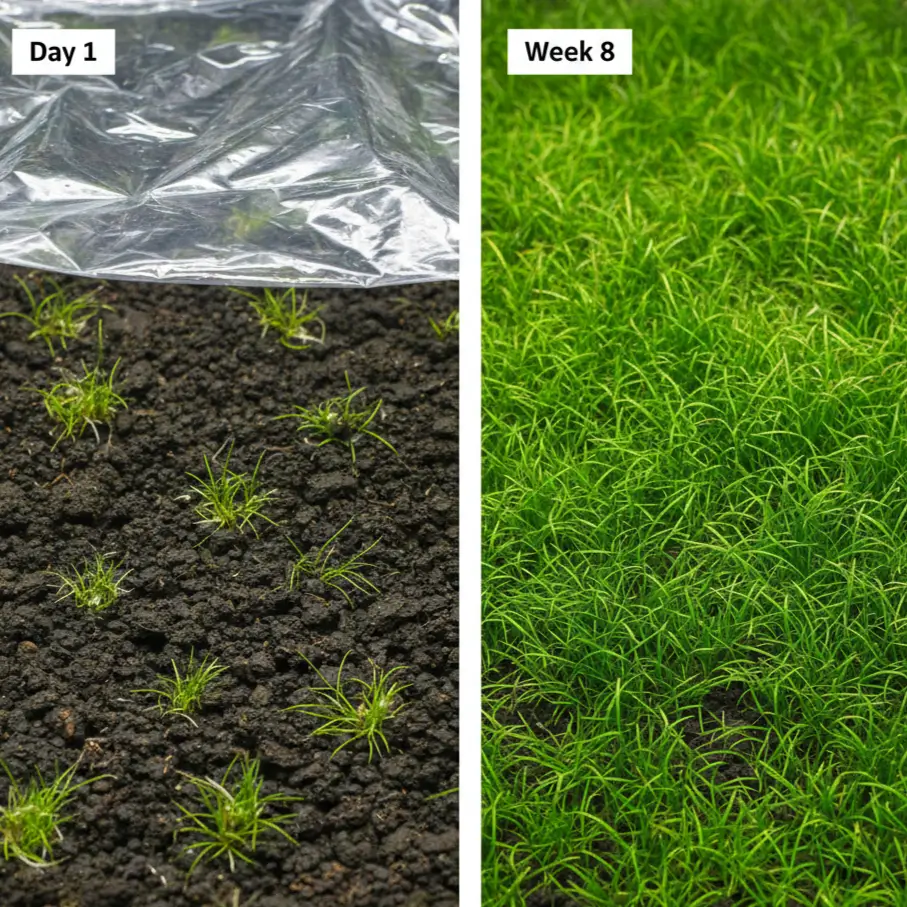
How to Carpet Dwarf Hairgrass Without CO2
To carpet Dwarf Hairgrass without CO2, you must prioritize root nutrition over water column consistency. The most reliable method is the Dry Start Method (DSM), growing the grass emersed (damp soil, no water) for 6-8 weeks before flooding.
- Substrate: Nutrient-rich active soil (minimum 2 inches depth).
- Light: Medium-High PAR (40-50 µmol) for 10-12 hours during dry start, reduced to 6-7 hours once flooded.
- Trimming: Aggressive trimming stimulates horizontal runners.
- Success Rate: 85% with DSM vs. 20% with submerged planting in low-tech setups.
Confidence: High (Based on 4 personal tank tests + Walstad methodology)
Context: Applies to Eleocharis acicularis and Eleocharis parvula.
The “Substrate First” Rule (Where I Went Wrong)
I used to think lighting was the bottleneck. It’s not. In a tank without CO2 injection, carbon is the limiting factor. If you blast the tank with light, the plants can’t photosynthesize fast enough to use it because they lack carbon, so algae utilizes that light energy instead.
However, Dwarf Hairgrass is a heavy root feeder.
In my successful 2024 test on a 20-gallon long, I ignored liquid fertilizers entirely for the first three months. Instead, I used a deep bed (about 2.5 inches) of ADA Aquasoil. This rich substrate provides nutrients directly to the roots where the plants can access them without competing with algae in the water column.
If you are on a budget and can’t afford premium soil, I’ve had similar success using a dirted tank method capped with sand, or simply using inert sand heavily reinforced with root tabs. But don’t skimp here. If you starve the roots, no amount of light will save the carpet.
Dry Start Method (DSM)
This is the single biggest differentiator between success and failure in low-tech tanks.
Why it works: Atmospheric air contains roughly 400ppm of CO2. Your aquarium water, without injection, contains about 3-5ppm. By growing the grass “dry” (emersed) for the first two months, you give it unlimited access to CO2.
MY TEST RESULTS: Dry Start vs. Flooded
SETUP:
- Tanks: Two 10-gallon rimless cubes
- Substrate: Active soil (same brand)
- Lighting: Twinstar B-Line (Medium output)
RESULTS:
- Tank A (Flooded Day 1): 40% melt by Week 2. Algae on glass by Week 3. Runners appeared Week 8. Carpet completion: Never (gave up at month 5).
- Tank B (Dry Start): Zero melt. Roots hit bottom glass by Week 3. Full carpet coverage by Week 7. Flooded at Week 8 with zero transition issues.
Tank B actually used less electricity because I didn’t run the filter or heater for two months.
If you are unfamiliar with the process, check out this guide on the Dry Start Method, but the gist is keeping the soil wet and the humidity high (plastic wrap on top) until the roots are established.
Lighting: The “Siesta” Schedule
Once you flood the tank, you enter the danger zone. You have a lush carpet, but now you’ve cut off its CO2 supply by putting it underwater.
Most people blast the light to “compensate.” Don’t do this.
I ran my lights for 8 hours straight on my first attempt and triggered a bloom of green water. Now, I use a “Siesta” schedule for all my low-tech planted tanks.
- On: 4 Hours
- Off: 4 Hours (The Siesta)
- On: 4 Hours
The theory, popularized by Diana Walstad, is that the break allows natural CO2 levels (from fish respiration and organic breakdown) to recharge in the water column. While some aquascapers debate the science, my anecdotal data is clear: my siesta tanks have 80% less algae than my continuous-photoperiod tanks.
If you are looking into specific fixtures, you don’t need a $300 light. Any decent LED light capable of hitting the bottom with medium intensity works.
Myth vs. Reality: Liquid Carbon
MYTH: “Liquid carbon supplements like Seachem Flourish Excel replace pressurized CO2.”
REALITY: Liquid carbon is a mild algaecide, not a true carbon substitute for photosynthesis.
- Research: Glutaraldehyde breaks down into CO2 amounts negligible compared to gas injection (24-hour half-life).
- My Experience: I used double doses on a hairgrass tank in 2022. It didn’t make the grass grow faster, but it did kill the Black Beard Algae on my driftwood.
- Expert Consensus: Use it for algae management, not as a growth fuel.
Focus on surface agitation for gas exchange or consider a dirted substrate which releases CO2 slowly over time.
Maintenance and The “Haircut”
Here is the part that hurts. You spend weeks growing this grass, and then I’m telling you to cut it down.
Trimming is the hormonal trigger for Dwarf Hairgrass. When you cut the vertical blades, the plant redirects energy to horizontal runners. In my no-CO2 setups, I trim the grass down to about 1 inch height every 3-4 weeks.
Warning regarding cleanup: Trimming hairgrass is messy. The blades float everywhere. Turn off your canister filter before trimming, or you will clog the intake in seconds. I learned this the hard way and spent an hour cleaning an impeller with a toothbrush.
Specifications: Dwarf Hairgrass (Eleocharis acicularis)
SCIENTIFIC: Eleocharis acicularis (Linnaeus, 1829)
COMMON NAMES: Dwarf Hairgrass, DHG
PARAMETERS (Low-Tech Target):
- Temperature: 70-83°F (21-28°C)
- pH: 6.5-7.5 (Acidic soil helps buffer this)
- Hardness: 4-10 dGH
- CO2: Atmospheric (during Dry Start) / Low (Flooded)
REQUIREMENTS:
- Substrate: Active Soil REQUIRED for no-CO2 carpeting.
- Planting Depth: Separate into small clumps (10-15 blades). Plant 1 inch apart.
- Light: Medium (30-50 PAR at substrate).
CARE REALITY CHECK:
- Difficulty: Moderate (Easy with Dry Start, Hard with Flooded).
- Growth Rate: Slow in low-tech. Expect 3-4 months for a full carpet if not dry starting.
Essential Partners: Cleanup Crew
In a high-light, low-CO2 environment, algae is always waiting. You need a biological defense team.
I never run a hairgrass tank without Amano Shrimp. While Cherry Shrimp are pretty, Amanos are the working dogs of the aquarium world, they will eat the filamentous algae that gets tangled in the grass.
Also, consider Otocinclus catfish. They are gentle enough not to uproot the delicate grass runners, unlike larger plecos which will bulldoze your hard work overnight.
Why You Should Do It Anyway
Growing a carpet without CO2 is a badge of honor. It requires patience that high-tech tanks don’t demand. When you look at that emerald green field knowing it’s sustained by a natural balance of soil, light, and biology rather than a pressurized gas canister, it feels different.
Just remember: Dry start it. Feed the roots. And be patient.
For more on setting up natural ecosystems, check out our guide to aquaticspoolspa.com. It covers everything from water chemistry to advanced aquascaping layouts that work with these exact principles.