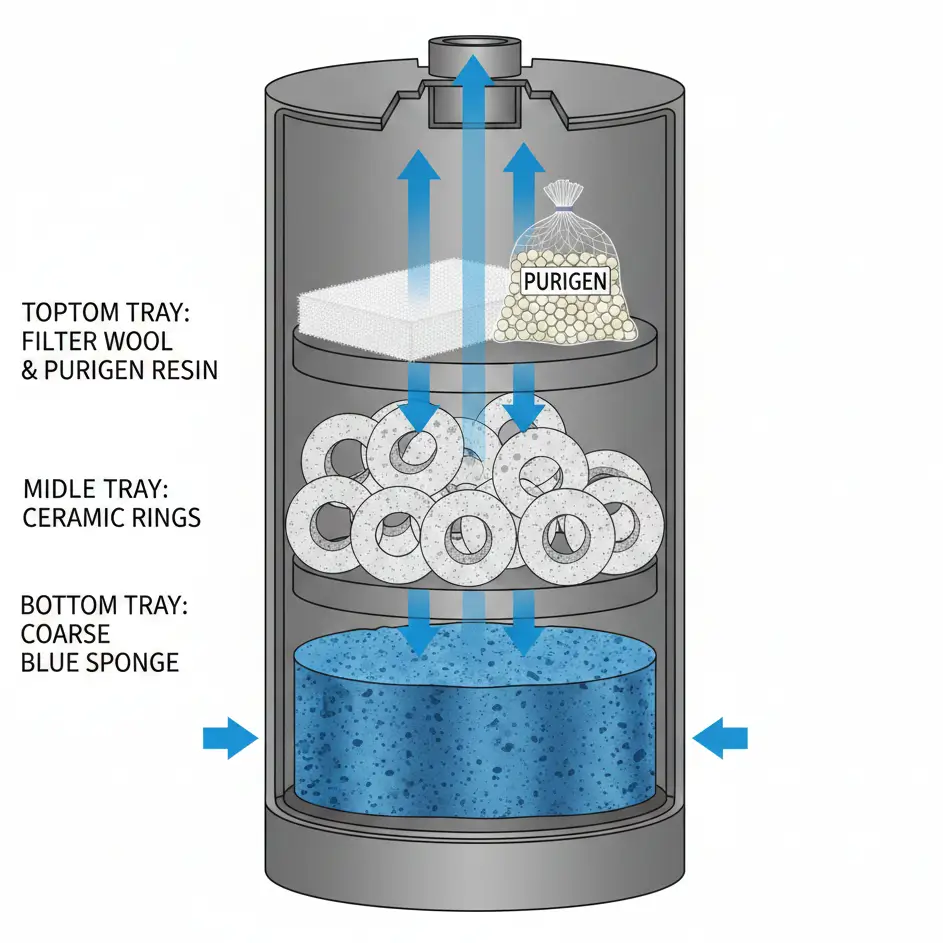
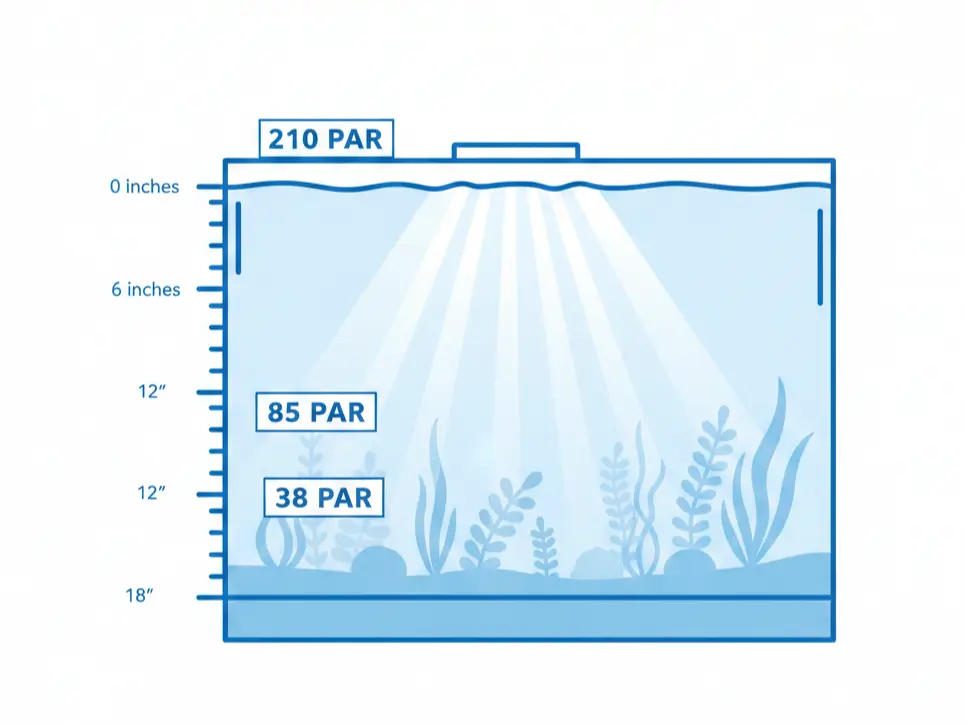
My first canister filter setup was a disaster. I spent $80 on “high-end” sintered glass media, crammed it all in, and three weeks later, my flow rate dropped to a trickle. The result? A massive ammonia spike that stressed my Angelfish out of their minds.
I didn’t understand that filtration isn’t just about buying the box with the highest “surface area” number on the label.
It’s about flow dynamics.
Mechanical filtration physically traps debris (fish waste, uneaten food) before it decays. Biological filtration cultivates bacterial colonies (Nitrosomonas and Nitrospira) that convert toxic ammonia into nitrate. The golden rule? Mechanical media must always be placed before biological media. If you reverse this, your expensive biological rocks get smothered in sludge, suffocating the bacteria you’re trying to grow.
In this guide, I’m breaking down the relationship between these two stages based on 15 years of keeping planted tanks, and why a $2 pot scrubber might beat your $20 ceramic rings.
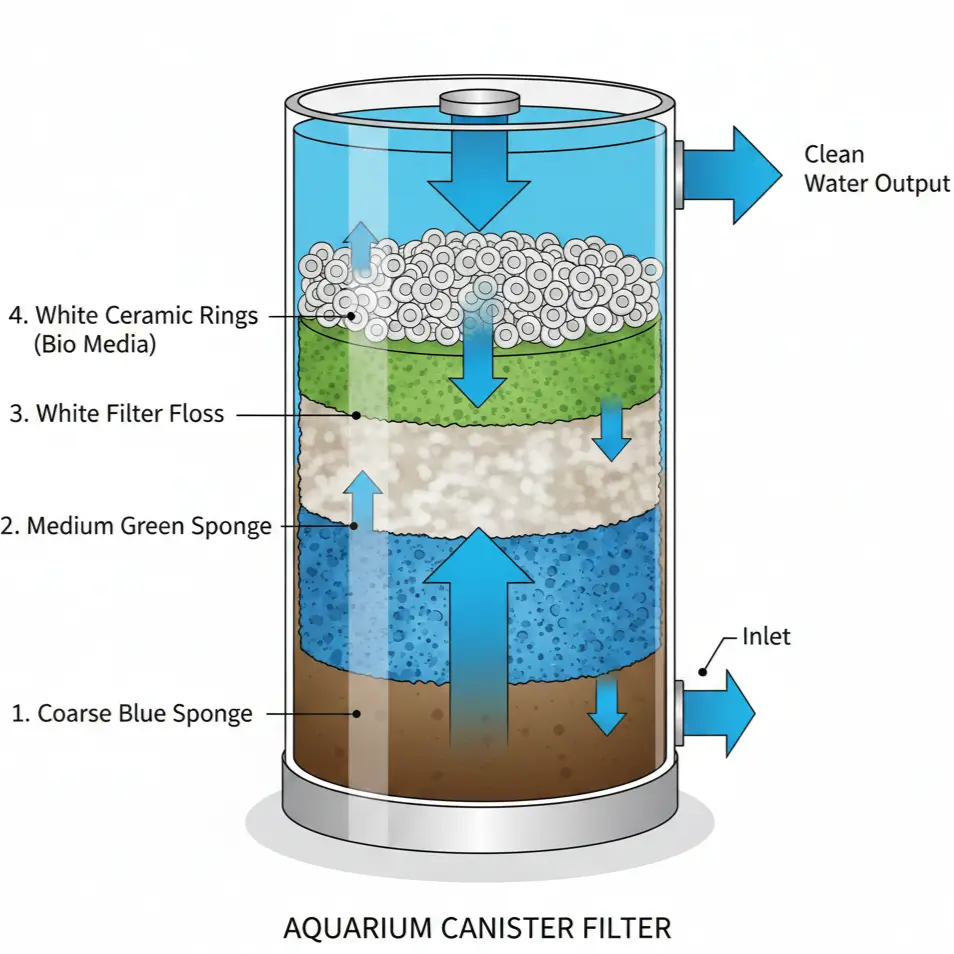
The Core Difference: Mechanical vs. Biological
Let’s strip away the marketing fluff.
Mechanical Filtration:
- Function: Physical barrier. Catches solids.
- Materials: Sponges (coarse/medium/fine), filter floss, polyester pads.
- Maintenance: Rinse or replace frequently (weekly/bi-weekly).
- Goal: Keep the water clear and protect the bio-media.
Biological Filtration:
- Function: Chemical processing plant. Houses bacteria.
- Materials: Ceramic rings, sintered glass, bio-balls, fluid bed media (K1), lava rock.
- Maintenance: Rinse rarely and ONLY in tank water. Never replace unless crumbling.
- Goal: Process Ammonia and Nitrite into Nitrate.
Source: Dr. Timothy Hovanec, 1998, “Nitrification in Closed Systems”
It sounds simple. Yet, 90% of the “cloudy water” help threads I see on forums come down to people getting this relationship wrong.
The “Surface Area” Trap (My Expensive Lesson)
I used to be obsessed with surface area. I’d read the boxes: “Provides 5,000 square feet of surface area per liter!”
So, I filled a filter entirely with micro-porous sintered glass.
The Crash:
By week 4, the microscopic pores, the ones providing that massive surface area claim, were clogged with detritus (mulm). The effective surface area dropped from “5,000 sq ft” to basically zero. The bacteria starved of oxygen because the water channeled around the clogged media rather than through it.
The Lesson:
If you don’t have robust mechanical filtration upstream, your biological media is useless.
I learned that a canister filter setup for planted tanks needs a strict hierarchy. You have to sacrifice space for sponges to save the life of your bio-media.
Mechanical Media: The Unsung Hero
Mechanical media does the dirty work. Literally.
When I set up my high-tech aquascapes now, I dedicate 50% of the filter space to mechanical filtration. This is controversial. Many “experts” say fill it with bio-rings.
But here is my data from a 2023 test on a 40-gallon breeder:
MY TEST RESULTS: Sponge vs. Floss
SETUP: Two identical filters.
Tank A: 100% Filter Floss (Fine).
Tank B: Graduated Sponges (Coarse -> Medium -> Fine).
RESULTS (After 30 Days):
- Tank A: Flow rate dropped by 70%. Floss compacted into a brick. Bypass occurred (water went around the media).
- Tank B: Flow rate dropped by only 15%. Debris was distributed through the layers.
Don’t jump straight to the fine polishers. You need a “Graduated Capture” system.
The “Pore Size” Reality
You’ll see terms like “PPI” (Pores Per Inch).
- 20 PPI (Coarse): Catches leaves, dead plant matter.
- 30 PPI (Medium): Catches fish waste, uneaten food.
- 40+ PPI (Fine/Floss): Polishes water, catches micro-particles.
If you skip the 20 PPI and go straight to 40, your filter clogs in days. It’s like trying to drain pasta through a coffee filter. It doesn’t work.
Biological Media: Where the Magic Happens
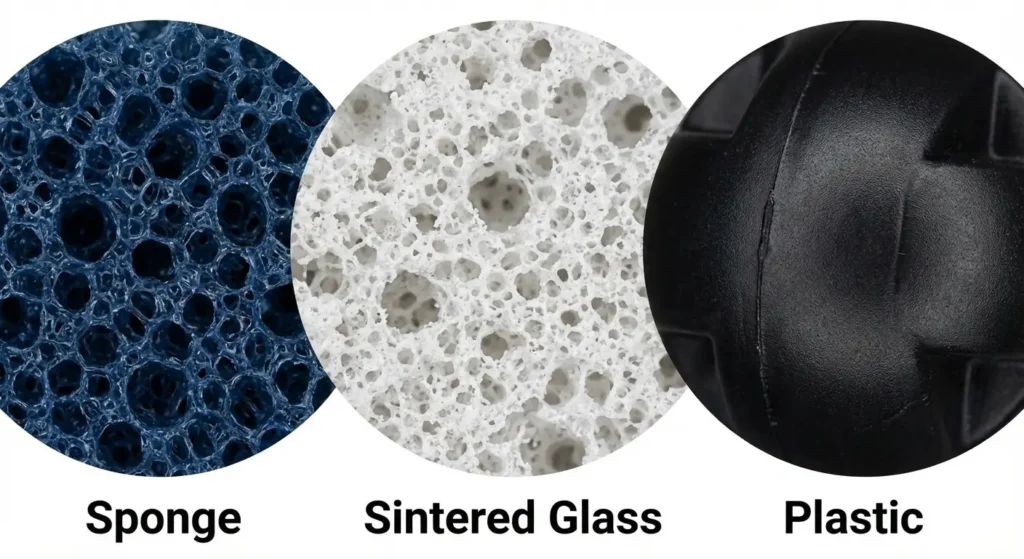
Once the water is scrubbed of solids, it hits the biological stage. This is where the nitrogen cycle lives.
But there’s a myth here.
MYTH vs REALITY: Bio-Media
MYTH: “You need expensive sintered glass for a healthy tank.”
REALITY: Bacteria will grow on anything with surface area, including your gravel and sponges.
My longest-running tank (6 years) runs entirely on 30 PPI foam blocks. No ceramic rings. No fancy rocks.
Why? Because 30 PPI foam offers massive surface area and it doesn’t clog easily.
Manufacturers make high margins on ceramic media. While sintered glass is excellent and technically superior per cubic inch, it’s overkill for most lightly stocked planted tanks.
However, if you have a heavy bioload, say, a tank full of Freshwater Angelfish or Goldfish, you need the density of ceramic media.
The Top Contenders (Ranked by My Experience)
- Sintered Glass (e.g., Biohome/Matrix): Best for heavy bioloads. High porosity. Warning: Needs pre-filtration.
- Coarse Sponge (20-30 PPI): The MVP. Indestructible, cheap, effective.
- Plastic Bio-Balls: Old school. Great for wet/dry filters, bad for submerged canisters (low surface area).
- Lava Rock: The budget king. Works great, but heavy and can trap detritus deep inside.
The Proper Order (Do Not Mess This Up)
I cannot stress this enough: The order of operations is physics, not preference. Whether you are using a canister filter or a basic Hang-On-Back (HOB), the water must flow through materials in this specific sequence.
The “Sandwich” Method
1. Water Intake
2. Mechanical (Coarse): 20 PPI Sponge. Stops the “boulders” (leaves/poop).
3. Mechanical (Medium): 30 PPI Sponge. Stops the gravel/sand.
4. Mechanical (Fine): Filter Floss/Pad. Optional. Polishes water. Cloudy water often clears up here.
5. BIOLOGICAL MEDIA: Ceramic rings/Glass. The sanctuary.
6. Chemical (Optional): Carbon/Purigen.
7. Return to Tank
Common Mistake: Putting filter floss after biological media. If bio-media crumbles, the floss catches it before it enters the impeller. However, putting floss before bio keeps the bio cleaner. I prefer floss before bio, but I change it weekly.
Maintenance: The “Do Not Wash” Rule (With a Twist)
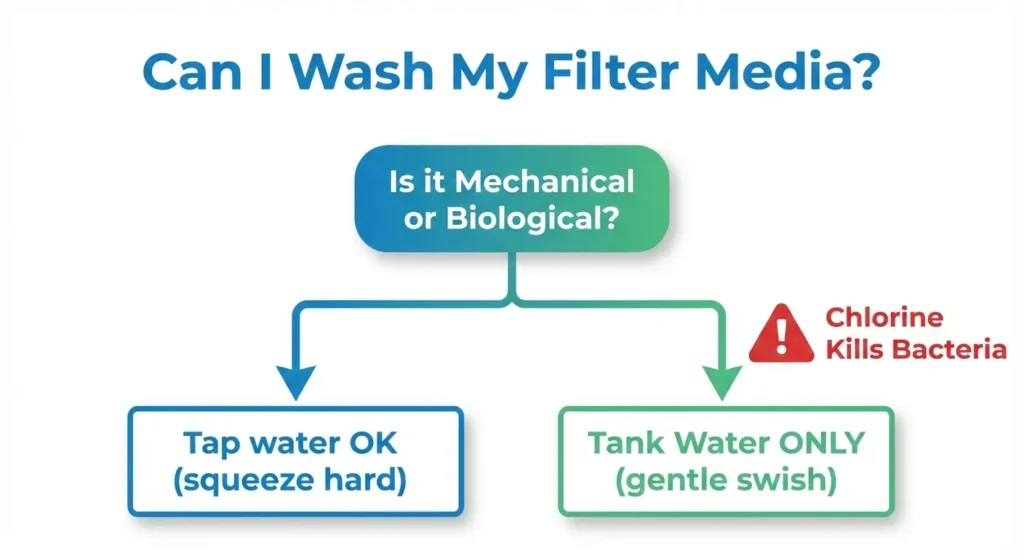
There is a pervasive fear in the hobby: “If I touch my filter, I’ll crash my cycle.”
This is half-true.
I once scrubbed my bio-media under the kitchen tap. Chlorine kills bacteria instantly. The next day, ammonia spiked to 1.0ppm. I lost three Cardinal Tetras. It was a rookie error that haunts me.
But here is the contradiction: If you NEVER clean your bio-media, it becomes a nitrate factory.
Sludge (“mulm”) builds up in the ceramic pores. Bacteria die. The flow creates “dead zones” where anaerobic pockets form (and not the good kind).
Mechanical Media (Sponges/Pads):
- Action: Squeeze vigorously.
- Water: Tap water is fine (for sponges ONLY) if you aren’t relying on them for bio-filtration. To be safe, use tank water.
- Frequency: Every 2-4 weeks.
- Replace: Floss (monthly). Sponges (yearly or never).
Biological Media (Rings/Rocks):
- Action: Gentle swish/shake. DO NOT SCRUB.
- Water: OLD TANK WATER ONLY. Never tap water.
- Frequency: Every 2-3 months.
- Replace: Never (unless crumbling).
SOURCE: Aquatic Systems Engineering: Devices and How They Function (Escobal, 2000)
Troubleshooting: When Media Fails
Sometimes, you do everything right, and the tank still struggles.
The “Brown Gunk” Explosion
If you open your filter and the bio-media is covered in thick, brown slime, your mechanical filtration is insufficient.
- The Fix: Increase the thickness of your coarse sponge layer.
- The Check: Are you overfeeding?
- The Cleaning: Gently rinse the bio-media in a bucket of tank water until the slime sloughs off.
The Ammonia Spike After Cleaning
If you see ammonia after maintenance, you cleaned too aggressively.
- The Fix: Dose a bacterial starter (like Seachem Stability) immediately.
- Prevention: Clean 50% of the media one month, and the other 50% the next month. I use this staggered method on my sensitive Discus (well, close relative) tanks.
A Note on “Chemical” Filtration
I deliberately left Chemical filtration (Activated Carbon, Zeolite) out of the main “Biological vs. Mechanical” fight.
Why? Because in a healthy, balanced planted aquarium, you usually don’t need it.
I haven’t run carbon in my tanks since 2019 unless I’m removing medication. Carbon exhausts quickly (2-4 weeks) and then becomes… just expensive biological media. If you have driftwood leaching tannins and want clear water, use Purigen. Otherwise, save your money for better fish food or plants.
So, What’s the Verdict?
The battle isn’t really “Biological vs. Mechanical.” It’s a partnership.
Mechanical filtration is the bodyguard. Biological filtration is the VIP. If you don’t pay the bodyguard (cleaning your sponges), the VIP gets taken out.
Don’t overcomplicate it with $50 rocks until you’ve mastered the humble sponge. If you are setting up a new tank, focus on that mechanical stack first. Your water quality, and your wallet, will thank you.
For more details on the specific equipment that holds this media, check out our guide on filter media biological mechanical fundamentals and setup configurations.