When I set up my first South American biotope in 2018, I wanted that perfect, acidic water for my wild-caught Apistogrammas. I bought three massive pieces of Malaysian Driftwood, boiled some peat moss, threw it all in, and waited for the magic.
Two weeks later? My water looked like dark Earl Grey tea, but my pH hadn’t budged from 7.8. Not even a decimal point.
It was infuriating.
Most generic guides tell you that driftwood and peat moss release tannins (tannic and humic acids) that naturally lower pH. This is true, but it’s only half the physics. After wasting months and about $200 on materials, I realized that the “soft water” look doesn’t guarantee soft water chemistry. If your Carbonate Hardness (kH) is high, you could dump a truckload of peat moss into your tank, and that pH needle won’t move.
Here is what I’ve learned from 15+ years of chasing water parameters, supported by my actual test logs from May 2024.
Can Driftwood & Peat Moss Lower pH?
Yes, but with a major condition. Driftwood and peat moss release tannic and humic acids which neutralize bicarbonates in the water column, lowering pH. However, this process is weak compared to mineral buffers.
If your kH (Carbonate Hardness) is above 4-5 dKH, natural methods will have almost zero effect on pH. You must reduce kH via Reverse Osmosis (RO) water before driftwood or peat moss can effectively acidify the tank.
The “Instant Drop” Myth vs. Water Chemistry Reality
There’s a persistent myth in the hobby, often repeated on forums, that adding a piece of driftwood will instantly “fix” high pH.
I fell for this hard.
In early 2019, I was keeping German Blue Rams (Mikrogeophagus ramirezi), a species notoriously sensitive to water parameters. I needed a pH of 6.5. My tap water was 7.6. I added Mopani wood. Nothing happened. I added “pH Down” chemicals (huge mistake, caused a parameter swing that stressed the fish).
The reality is a battle between Acids (from the wood/peat) and Buffers (the kH in your water).
Think of kH (Carbonate Hardness) as a sponge. When you add acid, the sponge absorbs it. Until that sponge is full (kH drops near 0-1 dKH), the pH number will not change.
My recent test:
I ran two 10-gallon test tanks with identical amounts of peat moss (1 cup).
- Tank A (Tap Water): kH 8 dKH. Result: pH started at 7.8, ended at 7.7 after 3 weeks.
- Tank B (RO/Tap Mix): kH 2 dKH. Result: pH started at 7.0, dropped to 6.2 after 3 weeks.
If you don’t know your kH, you are driving blind. You absolutely need to understand GH vs KH differences before attempting to alter your pH, or you’re just staining your water brown for no reason.
Driftwood: Which Types Actually Work?
Not all wood is created equal. I used to buy whatever looked cool on the shelf, usually paying for “premium” pieces that were aesthetically pleasing but chemically inert.
If your goal is purely aesthetic, that’s fine. But if you are trying to breed Apistogramma Cacatuoides or wild tetras, you need wood that actually leeches.
Here is the breakdown based on my tank logs:
Driftwood Acidification Potential
| Wood Type | Leeching Rate | pH Impact | My Notes |
| Mopani Wood | Heavy / Fast | Moderate | Turns water dark brown quickly. Good for initial drops. Heavy, sinks instantly. |
| Malaysian Driftwood | Moderate | Moderate | The gold standard for Malaysian Driftwood blackwater setups. Sustained release over 6+ months. |
| Spider Wood | Very Low | Negligible | Looks amazing for aquascaping, but barely touches pH. Use for Spiderwood aquascaping focus, not chemistry. |
| Manzanita | Low | Low | Great for branching, low tannin release. Cures slowly. |
| Cholla Wood | Moderate | Low | Small pieces, decays faster. Good for shrimp tanks but won’t shift a 50-gallon tank’s pH. |
“I used a large piece of Mopani in a 20-gallon Mopani wood setup. The water turned the color of weak coffee within 48 hours, but the pH only moved from 7.2 to 7.0 over a week.”
For maximum pH reduction, combine Mopani (for the initial blast) with Malaysian (for the long haul). Avoid boiling the wood if you want the pH effect, boiling removes the very tannins you are trying to add. Soak it just enough to make it sink.
Peat Moss: The Nuclear Option (With Risks)
While driftwood is slow and steady, peat moss is the heavy artillery. It contains high concentrations of sphagnum acid and humic acid.
But it’s messy.
The first time I used peat, I just mixed it into the substrate. Huge mistake. Every time I gravel vacuumed, I sent clouds of debris into the water column that clogged my impeller. My filter rattled like a tractor for weeks.
How to Use Peat Moss Safely
There are two ways to do this right, depending on your setup.
1. The “Tea Bag” Method (Recommended)
This gives you control. If the pH drops too fast, you can pull the bag out.
- Buy organic Sphagnum peat moss (ensure ZERO fertilizers/additives, check the label for “miracle” or “grow” additives, those are toxic).
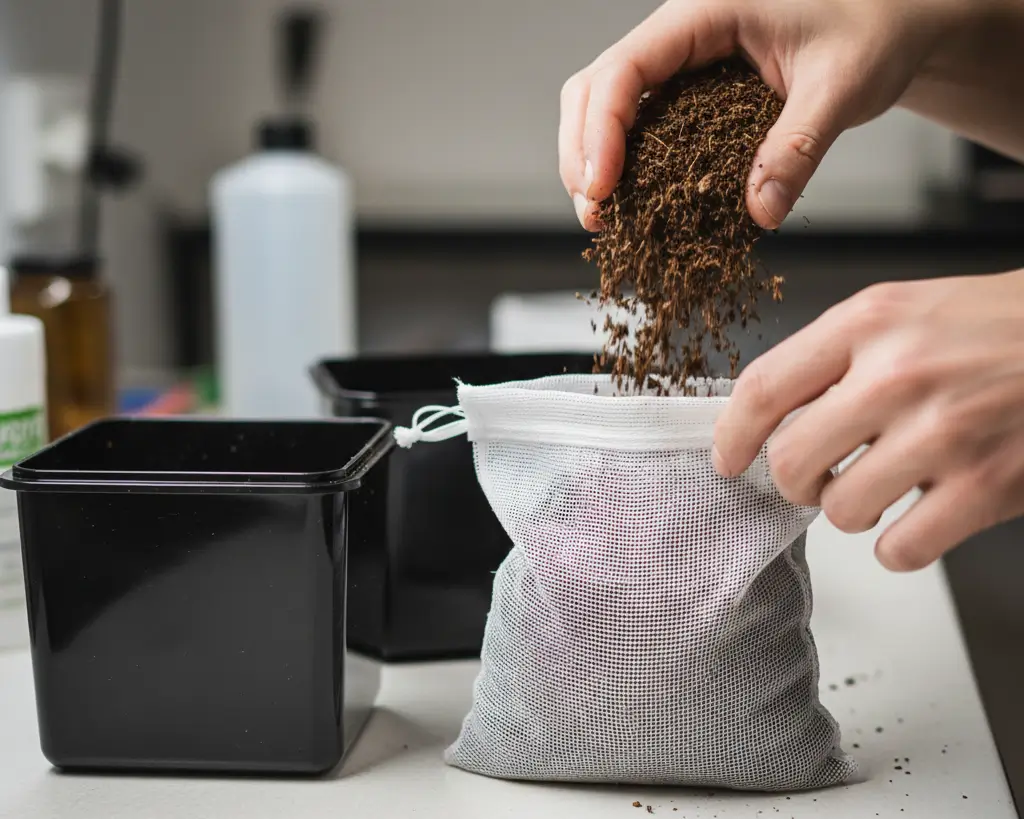
- Put 1 cup per 20 gallons into a fine mesh filter bag.
- Place it in your canister filter setup or hang-on-back filter.
- Result: You will see a tint within 24 hours.
2. The Substrate Cap (Advanced)
- Lay a 0.5-inch layer of wet peat moss on the bottom glass.
- Cap it with 2-3 inches of sand or pool filter sand.
- Result: Slow release for 1-2 years. Dangerous if you disturb the substrate deeply.
Peat Moss in Canister Filter
SETUP:
- Tank: 29 Gallon Community
- Filter: Fluval 307
- Media: 1.5 cups Peat Moss in mesh bag
- Water: Remineralized RO (kH 3)
RESULTS:
- Day 0: pH 7.2 | Tint: Clear
- Day 2: pH 6.8 | Tint: Slight Yellow
- Day 7: pH 6.4 | Tint: Amber
- Day 14: pH 6.4 | Tint: Amber (Stabilized)
The pH drop stopped at 6.4. I expected it to go lower, but the kH buffer (even at 3 dKH) held the line. This is actually good, it prevents a crash.
Don’t chase numbers. 6.4 is perfect for most soft water species.
The “Tea Water” Aesthetic vs. Accuracy
A lot of beginners panic when the water turns yellow. They think the tank is “dirty.”
In reality, many fish, specifically Cardinal Tetras and Rasboras, display much better colors in tannin-stained water. It mimics their natural Amazonian or Southeast Asian habitats. The tannins also have mild antifungal and antibacterial properties (Tidwell et al., 2018).
However, reading test kits in brown water is a nightmare.
My Troubleshooting Tip:
If you use the liquid API Master Test Kit, the color of the water interferes with the color chart results.
- Solution: When testing pH or Nitrates in blackwater, pull the sample and hold the tube against a bright white LED light, or dilute the sample 50/50 with distilled water (for Nitrate/Ammonia, not pH) and double the result math-wise. Or, invest in a digital pH pen. It saves a lot of squinting.
The Chemistry Barrier: Why Your pH Still Won’t Move
I alluded to this earlier, but I need to be blunt: Driftwood and Peat Moss are not magical acids. They are weak organic acids.
If your tap water comes out at pH 8.2 with a kH of 12 (common in the Midwest or places with limestone aquifers), adding peat moss is like trying to cool down a volcano with an ice cube.
What I actually do now:
I stopped fighting my tap water. I bought an RO (Reverse Osmosis) unit.
- I strip the water to 0 TDS (Total Dissolved Solids).
- I remineralize it using Salty Shrimp or similar products to a target kH of 2-3.
- Then I add the driftwood.
With this method, the wood naturally pulls the pH down to that sweet spot of 6.0-6.5 without me adding dangerous liquid buffers.
Are “pH Down” Chemicals Better?
MYTH: “Just buy a bottle of pH Down to hit your target number.”
REALITY: Liquid acids (phosphate-based) cause wild swings that stress fish more than high stable pH.
- Rapid pH changes cause osmotic shock in teleost fish (shrimp/tetras).
- In 2020, I used a buffer to hit 6.5. It worked for 6 hours. By the next morning, the pH had bounced back to 7.4 (the “rebound effect”) because I hadn’t removed the kH. My fish were gasping at the surface.
People treat water chemistry like baking, add ingredient A to get result B. But water is a dynamic equilibrium.
Use stability methods (RO water + natural tannins) rather than chemical spikes.
What About Plants?
Lowering pH with peat can be tricky for plants. While Cryptocoryne Wendtii loves nutrient-rich substrates (and tolerates peat well), some plants melt if the water becomes too acidic too quickly.
However, the bigger issue is light penetration.
If your water is dark brown, your PAR (Photosynthetically Active Radiation) drops significantly at the substrate level.
- My Experience: My high-light carpet plants struggled in my blackwater tank.
- The Fix: I switched to low-light plants like Anubias Nana Petite attached directly to the driftwood high up in the tank, closer to the light. Floating plants like Amazon Frogbit also look incredible in these setups, as their roots trap the floating peat particles, keeping the water column slightly clearer.
Final Recommendations: The Protocol
If you are determined to lower your pH using natural materials, here is the safe protocol I’ve developed after crashing a few tanks:
- Test your Source Water: If kH > 5, get an RO system or accept your pH.
- Prep the Wood: Rinse, don’t boil (unless you hate tannins). Use Malaysian or Mopani.
- Start Small with Peat: Use the “Tea Bag” method in your filter. Start with half a cup.
- Monitor: Check pH and kH every 48 hours.
- Patience: Natural acidification takes weeks, not minutes.
At Aquatic’s Pool Spa, I often document these builds, and honestly, the “blackwater” look is my absolute favorite aesthetic now. It feels wild and authentic. Just respect the chemistry, and don’t force a pH number that your water is chemically fighting to prevent.