I killed my first colony of Crystal Red Shrimp in 2014. It was heartbreaking. I had the temperature perfect (72°F). I had the pH dialed in at 6.4. But I didn’t understand that while my pH was correct, my GH (General Hardness) was effectively zero. My shrimp weren’t dying from stress; they were dying because they physically couldn’t build new shells during molting.
They would turn opaque, struggle for hours, and perish. It was a hard lesson that cost me about $150 and a lot of guilt.
In the aquarium hobby, we obsess over pH. It’s the celebrity parameter. But GH and KH are the stage crew running the show. If they fail, the whole production crashes.
This isn’t a high school chemistry lecture. This is a breakdown of what these acronyms actually do to your fish, based on years of keeping everything from African Cichlids (liquid rock water) to wild Betta complexes (essentially rainwater).
Here is exactly how GH and KH differ, why they matter, and how to manage them without needing a degree in chemistry.
What is the Difference Between GH and KH?
GH (General Hardness) measures the concentration of divalent metal ions, primarily Calcium (Ca²⁺) and Magnesium (Mg²⁺). It determines “hard” or “soft” water and is essential for bone development in fish and shell growth in invertebrates.
KH (Carbonate Hardness), or alkalinity, measures the concentration of Carbonates (CO₃²⁻) and Bicarbonates (HCO₃⁻). It acts as a “buffer” or shield for your pH, preventing rapid acid crashes.
Think of GH as the “minerals” in the water for health, and KH as the “insulation” protecting your pH stability. They often exist together in tap water, but can be adjusted independently.
The “Sponge” Analogy
When I explain this to new hobbyists at local meets, I use the sponge analogy.
Imagine your pH is a glass vase. It’s fragile.
KH is the sponge wrapping that vase. If you hit the vase (add acids like fish waste or CO2), the sponge absorbs the impact. If you have a thick sponge (High KH), the vase is safe. If you have a thin sponge or no sponge (Low KH), even a small tap can shatter the vase (pH crash).
GH is irrelevant to the vase’s safety. GH is the water inside the vase that the fish actually drink and absorb.
GH (General Hardness): The Builder
I used to ignore GH entirely. Big mistake. General Hardness is the biological building block.
When we talk about “hard water” causing limescale on your showerhead, we are talking about GH. In the aquarium, Calcium and Magnesium are crucial for physiological processes.
Why GH Matters
- Osmoregulation: Fish constantly balance internal fluids with external water. Improper GH forces their kidneys to work overtime, leading to “osmotic shock.”
- Molting: Shrimp and snails require Calcium from the water column to harden their exoskeletons.
- Plant Health: Calcium and Magnesium are secondary macro-nutrients. Without them, new leaves curl and wither.
SPECIFICATIONS: Ideal GH Ranges
Soft Water Species: 3-6 dGH (50-100 ppm)
Examples: Tetras, Discus, Rasboras
Hard Water Species: 12-20 dGH (200-350 ppm)
Examples: African Cichlids, Livebearers (Guppies/Mollies)
Invertebrates: 6-10 dGH (100-180 ppm)
Examples: Cherry Shrimp, Mystery Snails
I’ve kept Neocaridina shrimp in 4 dGH water. Result: 30% mortality rate during molting.
I raised that same tank to 8 dGH using a mineralizer. Result: Mortality dropped to near 0%.
KH (Carbonate Hardness): The Shield
Here is where it gets tricky. KH is your safety net.
In 2018, I had a heavily stocked 40-gallon breeder tank. I did water changes religiously, but I never checked KH. Over six months, the natural biological process (nitrification) slowly consumed the carbonates in the water.
One morning, I woke up to a tank of gasping fish. My pH, which had been a steady 7.0 for years, had plummeted to 4.5 overnight. This is called “Old Tank Syndrome.” The bacteria had eaten all the KH buffer, and the acidity from the nitrates crashed the system.
The pH-KH Relationship
- High KH = High, stable pH (Hard to lower).
- Low KH = pH is flexible but unstable (Easy to crash).
- Zero KH = pH swings wildly.
You cannot easily have a low pH (6.0) with a high KH (10 dGH). The carbonates will naturally force the pH up towards 8.0-8.4. This is why fighting your water chemistry is usually a losing battle.
Comparison Matrix: GH vs KH
| Feature | GH (General Hardness) | KH (Carbonate Hardness) |
| Main Elements | Calcium, Magnesium | Carbonate, Bicarbonate |
| Primary Function | Biological health (bones/shells) | Chemical stability (pH buffer) |
| Effect on pH | None directly | Direct link (Higher KH = Higher pH) |
| Depletion | Slow (plant uptake) | Fast (consumed by acids/bacteria) |
| Removal | Reverse Osmosis (RO) | Reverse Osmosis or Acid buffers |
| Addition | Seachem Equilibrium / Salty Shrimp | Baking Soda / Crushed Coral |
“I run a high-tech planted tank where I inject CO2. CO2 creates carbonic acid, which lowers pH. If my KH is too low (<3 dGH), the CO2 drops the pH too far, stressing the fish. If my KH is too high (>10 dGH), I can’t get the pH low enough for the plants to easily absorb nutrients. I aim for exactly 4-5 dGH KH.”
Sources: Diana Walstad, Ecology of the Planted Aquarium (1999) + Personal Logs 2020-2024.
How to Test GH and KH (Accurately)
I have a love-hate relationship with test strips. They are convenient, sure. But “pinkish-red” isn’t a measurement; it’s a guess.
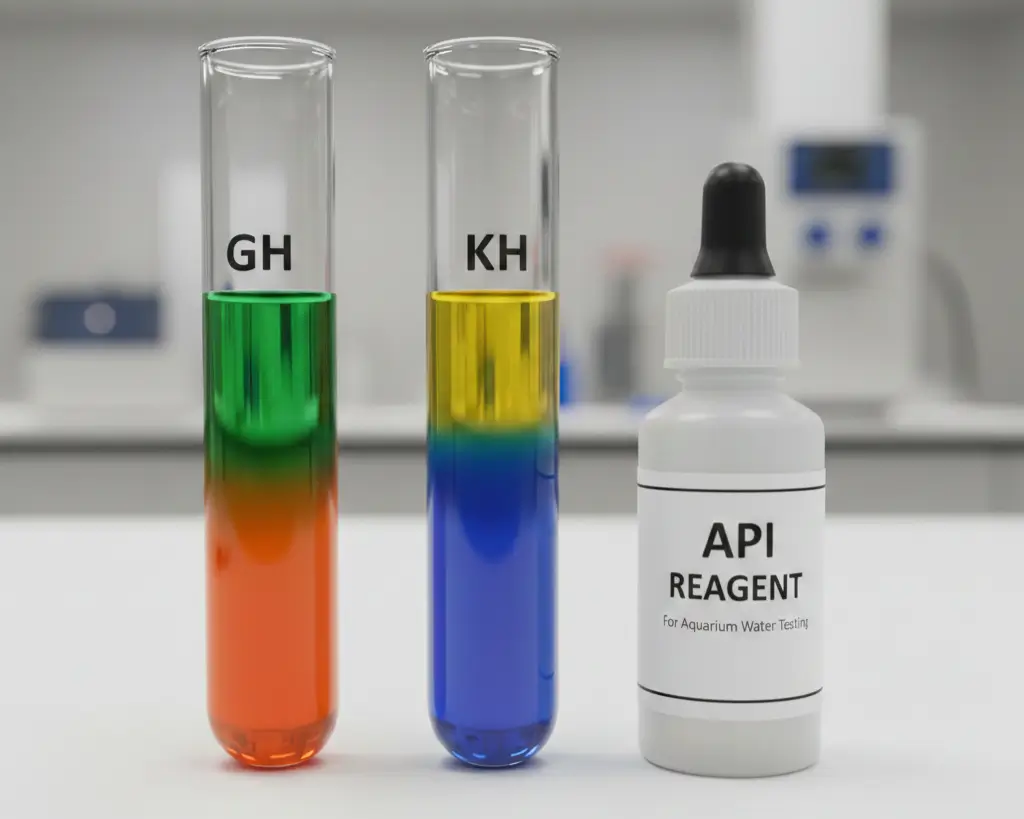
For GH and KH, I exclusively use liquid titration kits, like the API GH & KH Test Kit. You count the drops until the color changes.
- GH Test: Orange → Green
- KH Test: Blue → Yellow
The “Precision” Trap:
You don’t need to hit exactly 7.5 dGH. If your tap water is 9 dGH and your fish prefer 8 dGH, do not chase the number. Stability is better than precision. However, if your tap water is 20 dGH and you want to keep sensitive Crystal Red Shrimp, you have a problem.
Reliability is key. I’ve found that the API Master Test Kit is generally accurate enough for the hobby, but liquid reagents do expire. Check the dates.
Adjusting Parameters: The “Safe” Way
If you determine you absolutely must change your water chemistry, and please, only do this if you have a specific reason, here is how I do it without shocking the livestock.
Raising GH and KH
This is common for people with “soft” tap water or those using RO water.
- Crushed Coral: The natural method. Put a mesh bag of crushed coral in your filter. It slowly releases calcium carbonate, raising both GH and KH.
- Remineralizers: Products like Salty Shrimp are the gold standard for shrimp keepers. They are specifically formulated to hit exact ratios (e.g., GH+ for Caridina, GH/KH+ for Neocaridina).
- Limestone/Seiryu Stone: Using these rocks in your hardscape will leech minerals over time.
Lowering GH and KH
This is harder. You cannot just “add chemicals” to remove minerals safely.
- Reverse Osmosis (RO) Water: This is the only consistent way. You strip the water of everything (0 GH, 0 KH) and then mix it with your tap water to dilute the hardness.
- My Method: For my German Blue Ram breeding tank, I use 75% RO water and 25% tap water. This cuts my rock-hard city water down to a manageable softness.
- Peat Moss / Indian Almond Leaves: These release tannins and organic acids that can soften water slightly over time, but they won’t turn liquid rock into Amazon river water overnight.
- Active Substrates: Soils like ADA Amazonia will absorb KH to lower pH. This works well for planted tanks but the soil eventually “exhausts” its buffering capacity after 12-18 months.
Softening Water
MYTH: “Boiling water removes hardness.”
REALITY: Boiling only removes temporary hardness (bicarbonates/KH) by precipitating it out, but it does virtually nothing for permanent hardness (sulfates/chlorides) and concentrates the remaining minerals as water evaporates.
My Test: Boiled 1 gallon of 12 dGH tap water for 20 mins.
Result: 13 dGH (concentration effect) and KH dropped from 8 to 5.
Recommendation: Don’t boil water to soften it. Use an RO unit.
Troubleshooting Common Scenarios
Scenario 1: High pH, High GH/KH
Diagnosis: Liquid Rock.
Best Fish: African Cichlids, Livebearers, Rainbowfish.
The Fix: Don’t fix it. Keep fish that love it. If you force soft water fish into this, they will suffer kidney failure over time.
Scenario 2: Low pH, Low GH/KH
Diagnosis: Soft / Acidic.
Best Fish: Tetras, Rasboras, South American Cichlids.
The Danger: pH Crash. With Low KH, you must keep up with water changes to prevent acids from building up.
Scenario 3: High pH, Low GH
Diagnosis: The “Sodium” Trap.
This happens when people use domestic water softeners. These systems swap Calcium ions for Sodium ions.
Result: The water tests “soft” (Low GH) but acts “basic” (High pH/Alkalinity).
Verdict: This is terrible for planted tanks (sodium blocks nutrient uptake) and bad for fish. Use the bypass valve on your house softener for aquarium water.
Conclusion
Understanding GH vs KH isn’t about memorizing the periodic table. It’s about understanding the environment you are creating.
If you take one thing away from this, let it be this: KH protects the water quality, GH protects the animal’s biology.
I spent years chasing numbers, buying “pH Down” chemicals (which are usually just phosphate buffers that cause algae blooms), and stressing my fish. Once I switched to a holistic approach, measuring my source water, choosing livestock that matched it, or using RO water remineralization for delicate species, the “mysterious deaths” stopped.
If you are looking for a holistic approach to water keeping, Aquatics Pool Spa has been my go-to resource for understanding how these parameters integrate with filtration, lighting, and substrate choices to create a balanced ecosystem.
Test your source water today. Not just pH. Check the GH and KH. The results might explain problems you’ve been battling for months.