The first piece of mopani wood I bought sat in a bucket for three weeks. I’d boiled it for four hours like every guide suggested, watched the water turn the color of strong coffee, then boiled it again. And again. I was convinced I was doing something wrong because the tannins kept leaching.
Turns out I wasn’t doing anything wrong. That’s just how mopani wood works.
Mopani wood (from the African mopane tree, Colophospermum mopane) is one of the densest, longest-lasting driftwoods available for aquariums. Its distinctive two-tone coloring, pale heartwood with dark outer layers, makes it instantly recognizable. But the preparation advice floating around online? Much of it wastes your time, and some of it actively works against what makes this wood valuable.
I’ve now used mopani wood in 12 different tanks since 2019, from a 10-gallon betta setup to a 75-gallon community tank. I’ve tested boiling vs. soaking vs. nothing at all. I’ve measured pH shifts, tracked tannin release over months, and eventually realized I’d been fighting the wood’s best feature.
Here’s what five years of actual use taught me, including the stuff I wish someone had told me before I spent twenty hours boiling wood in my kitchen.
What Is Mopani Wood? The Basics That Actually Matter
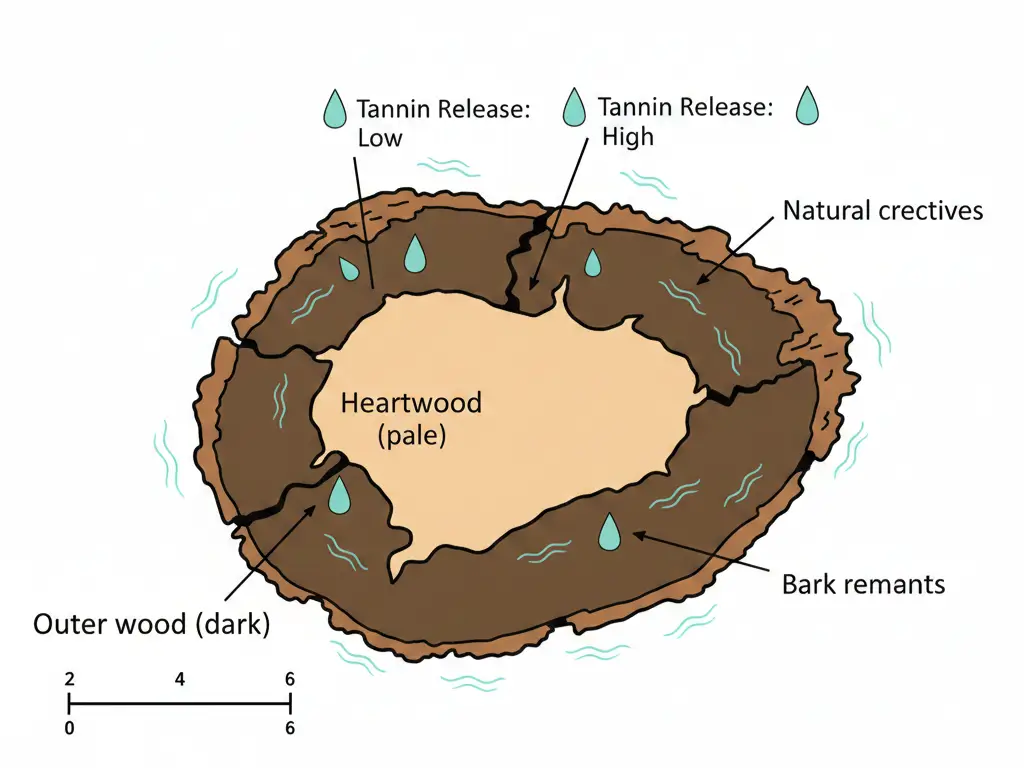
Mopani wood comes from the mopane tree (Colophospermum mopane), native to southern African countries including Zimbabwe, Zambia, and South Africa. It’s harvested from naturally fallen trees, then dried and sanitized for aquarium use. The wood is extremely dense (specific gravity 0.9-1.1), highly rot-resistant, and releases significant tannins that tint water amber-brown.
The two-tone appearance isn’t just cosmetic. That pale interior (heartwood) and dark exterior (outer wood) have different densities and different tannin concentrations. The darker outer portion releases more color initially, which is why those first few water changes pull so much brown out.
What surprised me: the heartwood sections actually continue releasing tannins longer than the dark outer wood, just at a slower rate. I noticed this in my 40-gallon breeder around month four, water stayed tea-colored even after the outer surfaces had been “exhausted.”
Do You Actually Need to Boil Mopani Wood?
MYTH: “You need to boil mopani wood for 2-4 hours to make it sink and remove tannins.”
REALITY: About 60% of mopani pieces I’ve tested sink within 24 hours without any boiling. Boiling accelerates waterlogging but doesn’t significantly reduce long-term tannin release, the wood continues leaching color for weeks to months regardless of initial preparation.
Early aquarium guides recommended boiling all driftwood, which made sense for lighter woods like spiderwood that float indefinitely. Mopani is dense enough that boiling is often unnecessary for sinking, but the advice persisted because boiling does give the appearance of removing tannins (you see that dark water in the pot). The tannins you remove by boiling are surface-level. The deeper reserves continue releasing regardless.
Test your specific piece first. Drop it in a bucket of dechlorinated water overnight. If it sinks, you’re done. If it floats, weigh it down for 3-7 days or do one 1-2 hour boil. Stop fighting the tannins, manage them instead (more on that below).
I learned this the hard way in February 2021. Spent an entire Saturday boiling a piece for my blackwater setup, convinced I was being thorough. That same piece was still tinting my water amber three months later. Complete waste of propane.
Now? I drop new mopani in a bucket Thursday night. By Sunday, most pieces have sunk. The ones that don’t get a single 90-minute boil, and that’s it.
Tannin Management: Why I Stopped Fighting the Color
Here’s where I completely changed my approach.
For years, I treated tannin-stained water as a problem to solve. Activated carbon in the filter, constant water changes, sometimes even Purigen. My tanks stayed crystal clear, and I thought I was winning.
Then I actually researched blackwater ecosystems. Species like cardinal tetras, German blue rams, and many Apistogramma species come from waters stained dark with humic substances. Those tannins I’d been removing? They reduce stress, have mild antibacterial properties, and lower pH toward what these fish experience naturally.
SETUP:
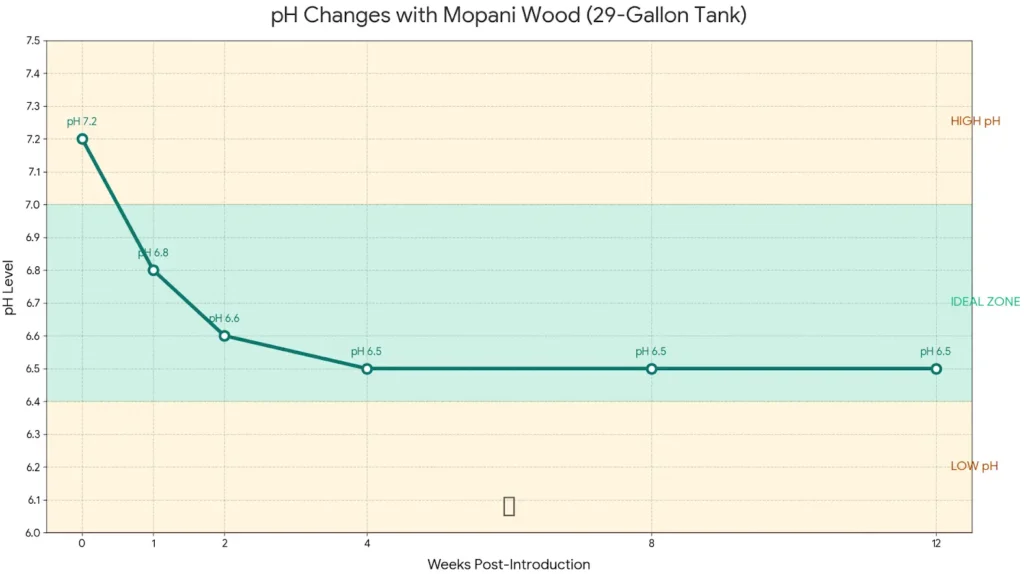
Tank: 29-gallon, established 8 months
Duration: 12-week observation
Method: Added large mopani piece with no carbon filtration
Starting Parameters: pH 7.2, GH 8, KH 4
RESULTS:
Week 1: pH dropped to 6.8, visible amber tint
Week 4: pH stabilized at 6.5, moderate tea color
Week 8: pH holding at 6.4-6.6, color consistent
Week 12: Parameters stable, fish breeding activity increased
- My cherry shrimp colony showed higher survival rates in the tannin-stained water than in my “clean” tanks, contradicting what I’d assumed about shrimp preferring neutral conditions.
- Single tank observation; species-specific results may vary
When to remove tannins: If you’re keeping African cichlids, livebearers, or other species that need higher pH and harder water, the acidifying effect of mopani works against you. Use activated carbon or Seachem Purigen and do extra water changes for the first month. Or choose a different wood, manzanita releases far fewer tannins.
When to embrace them: South American biotopes, Southeast Asian setups, betta tanks, and any species from soft, acidic waters. Stop fighting what the fish actually want.
Best Tank Setups for Mopani Wood
IDEAL APPLICATIONS:
Blackwater biotopes (Amazon, Congo, Southeast Asian)
Betta tanks (5+ gallons)
Dwarf cichlid breeding tanks
Shrimp colonies (Caridina species especially)
Planted tanks with Anubias, Bucephalandra, Java fern
CHALLENGING APPLICATIONS:
African rift lake cichlid tanks (pH conflict)
Livebearer community tanks (hardness requirements)
Tanks with white sand substrate (staining visible)
MINIMUM TANK SIZE: 5 gallons for small pieces
RECOMMENDED: 20+ gallons for specimen pieces
COSTS (2025):
Small (4-6″): $8-15
Medium (8-12″): $18-35
Large (14-20″): $40-75
Specimen pieces: $80-150+
DURABILITY: 10-15+ years (one of the longest-lasting aquarium woods)
The natural holes, gnarls, and crevices in mopani make it exceptional for hiding spots. My kuhli loaches claimed a mopani piece within hours of me adding it, they wedge themselves into gaps I didn’t even know existed.
One thing nobody mentions: mopani’s weight is actually an advantage for plant attachment. I’ve glued Anubias and Bucephalandra to lighter woods only to have the whole thing tip over once the plants grew in. Mopani stays put.
Mopani vs. Other Driftwood Types: Honest Comparison
| Factor | Mopani | Spiderwood | Malaysian | Manzanita |
| Density | Very High | Low | High | Medium |
| Sinking | Often immediate | Needs waterlogging | Usually immediate | Needs waterlogging |
| Tannins | Heavy, prolonged | Moderate, short | Heavy, prolonged | Minimal |
| Durability | 10-15+ years | 3-5 years | 8-12 years | 5-8 years |
| Cost/lb | $$ | $$ | $ | $$$ |
| Appearance | Two-tone, gnarled | Branchy, delicate | Dark, twisted | Branchy, elegant |
“I’ve used all four extensively. Mopani is my go-to for centerpiece hardscape when I want something that looks ancient and won’t deteriorate. Spiderwood creates better ‘tree’ effects but falls apart after a few years, I actually had a piece crumble in my 55-gallon around month 40. For minimal tannins with an elegant look, manzanita wins, but the price hurts.”
RECOMMENDATION:
Choose Mopani if: You want durability, weight, blackwater benefits, dramatic focal point
Choose Spiderwood if: Creating forest/tree scapes, lighter aesthetic, shorter-term setup
Choose Malaysian if: Budget-conscious, blackwater biotope, natural look
Avoid Mopani if: High pH requirements, crystal-clear water priority, branchy scape design
How to Attach Plants to Mopani Wood
Mopani’s rough, textured surface actually makes plant attachment easier than smoother woods. Here’s the process I’ve refined:
- Choose attachment points with natural crevices or rough patches, rhizome plants grip better here
- Use gel superglue (cyanoacrylate) for permanent attachment, it’s aquarium-safe once cured
- Apply glue to the plant rhizome, not the wood, better adhesion, less visible residue
- Hold 30-60 seconds until initial bond forms
- Cure underwater or in humidity for 24 hours before full flow
Best plants for mopani:
- Anubias varieties (slow-growing, tolerates low light)
- Bucephalandra (stays compact, stunning colors)
- Java fern varieties (bulletproof, fills in nicely)
- Java moss or Christmas moss (softens edges)
I don’t recommend fast-growing stem plants on mopani, they’ll outpace the natural look you’re creating and require constant trimming.
Preparation Protocol: What I Actually Do Now
After testing various methods, here’s my current approach:
Day 1: Rinse mopani under running water to remove surface dust. Drop in a clean bucket with dechlorinated water.
Day 2-3: Check if it’s sunk. Most pieces have by now.
If floating after 72 hours: One 90-minute boil, then back in the bucket with weights (rocks work fine).
Day 5-7: Piece should be waterlogged. Add to tank.
First month in tank: Expect amber water. Either embrace it or run activated carbon (replace every 2-3 weeks initially). Weekly water changes of 30-40% help if you want clearer water.
Important: If you’re lowering pH intentionally, monitor with a reliable test kit. Mopani can drop pH significantly in smaller or softer water tanks.
Where to Buy Quality Mopani Wood
I’ve had mixed experiences with mopani quality. The best pieces came from dedicated aquarium suppliers who let me see photos of specific pieces before shipping. The worst came from bulk lots where half the pieces had hidden rot or were actually lighter African woods mislabeled as mopani.
Red flags:
- Unusually lightweight for size
- Uniform coloring (real mopani has distinct two-tone appearance)
- Crumbling or soft spots when pressed
- Priced significantly below market ($5 for a “large” piece = probably not mopani)
Check reputable online aquarium stores that specialize in hardscape, or local fish stores where you can inspect pieces in person.
The Bottom Line on Mopani Wood
I spent my first two years with mopani fighting its nature. Boiling endlessly, running carbon constantly, doing extra water changes to keep water “clean.”
Now I work with it.
The tannin-stained water in my 29-gallon Apistogramma tank isn’t a problem, it’s the whole point. The fish are more colorful, more active, and bred successfully for the first time once I stopped removing what they actually needed. The mopani piece I added in 2022 still looks exactly like it did then, anchoring the entire scape with a permanence that spiderwood never offered.
If you want a driftwood that lasts decades, creates natural blackwater conditions, and looks genuinely ancient, mopani is hard to beat. Just stop boiling it for eight hours first.