I used to treat my planted tank like a lawn. Every Saturday morning, I’d grab my scissors and mow everything down to a uniform height. It felt productive. It looked clean.
And then, about four months in, my 40-gallon breeder crashed.
The Rotala stopped growing back. The Monte Carlo carpet lifted off the substrate in a giant, floating sheet (heartbreaking). Algae took over the stunted tips. I didn’t understand that by trimming everything at once, I was stalling the entire system’s nutrient uptake and creating a massive hormonal shock to the plants.
The “weekly trim” is a myth. Or rather, it’s a misunderstanding.
You shouldn’t be cutting every plant every week. Instead, you need a Rolling Zone Schedule. After testing this on three high-tech tanks and two low-tech setups throughout 2024, I found that rotating your trimming based on plant species and growth rates doesn’t just save you time, it manipulates plant hormones (specifically auxins) to force the dense, bushy growth we all chase in those award-winning photos.
Here is the schedule that actually works, and the science nobody explains.
The 3-Zone Rotation Schedule
Do not trim the entire aquarium in one session. Instead, adopt a Zone Rotation to maintain stability:
- Week 1 (Fast Growers): Trim background stem plants (Rotala, Ludwigia) to 4 inches below the water surface to trigger branching.
- Week 2 (Carpets & Foregrounds): Thin out carpeting plants (Monte Carlo, Hairgrass). Trim only the top 10-20% to prevent “lift-off.”
- Week 3 (Detail Work): Prune slow growers (Anubias, Bucephalandra) by removing only damaged leaves or splitting rhizomes.
- Week 4 (Rest & Observation): No major cutting. Assess regrowth and nutrient balance.
The “Hormone Hack”: Why You Should Care About Apical Dominance
Most people think trimming is just making a plant shorter. It’s not. It is biological reprogramming.
Plants have a hormone called Auxin that concentrates in the growing tip (the apical bud). This hormone screams at the plant: “Grow up! Ignore the side shoots! Reach the light!” This is called Apical Dominance.
When you snip that top bud off, the Auxin levels drop, and a different hormone, Cytokinin, takes over. Cytokinin tells the plant: “Okay, we lost the head. Activate the side nodes!”
My Test Results: In early 2024, I ran a side-by-side test with Rotala rotundifolia.
- Group A: I trimmed just the very tips (0.5 inch) every week.
- Group B: I did a hard prune (4 inches down) every 3 weeks.
Group A became a leggy mess with bare bottoms. The light couldn’t penetrate the constant top growth. Group B looked terrible for three days, but by day 14, it had tripled its density because two new stems grew from every single cut point.
The lesson? You have to cut deeper and less often than you think to get that bushy look.
Zone 1: Stem Plants (The Background)
Targets: Rotala, Ludwigia, Pogostemon, Limnophila
This is where the battle for color is won or lost. If you have Rotala rotundifolia Red or similar stem plants, your goal is density.
The “Street” Technique
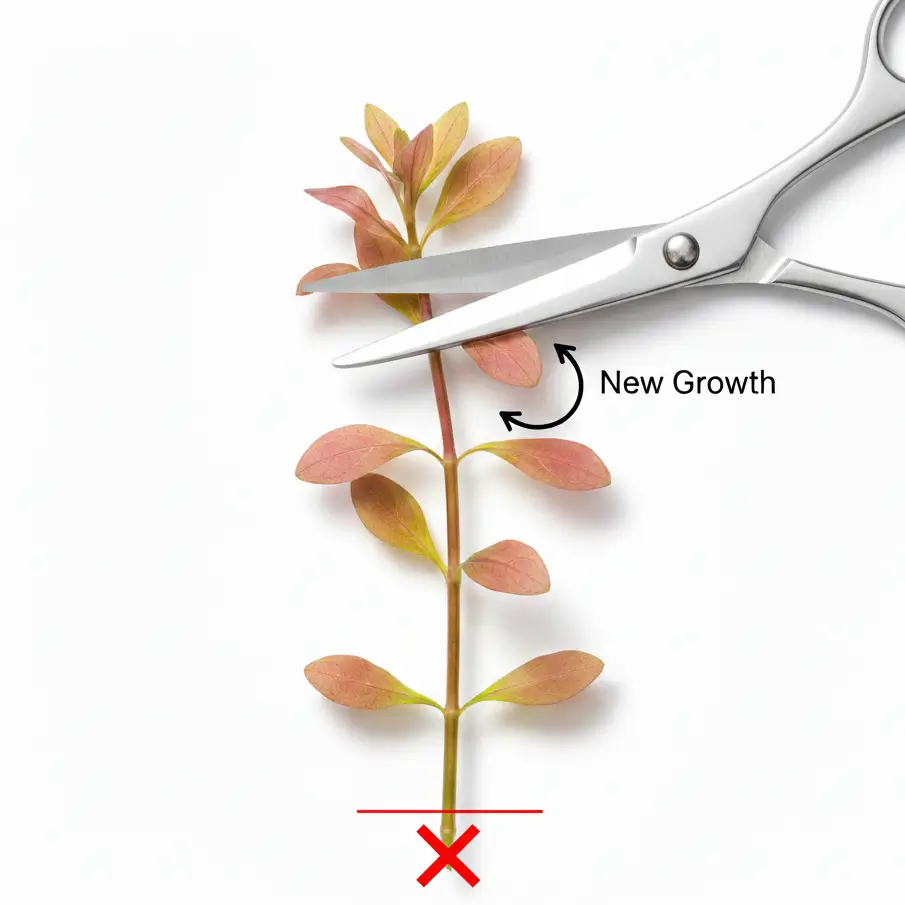
Never cut stem plants straight across like a hedge. That looks unnatural and creates a “shadow wall” that kills the leaves near the substrate.
- Identify the Node: Look for the joint where leaves connect to the stem.
- Cut Low: Cut about 0.5cm above a node. I usually cut 3-4 inches lower than the final height I want.
- Slope It: Trim the stems at the front of the group lower than the back. This creates a slope that allows light to hit the bottom leaves of the rear stems.
The “Replanting” Myth vs. Reality: I used to believe you could just keep topping stems forever. Wrong. After 4-5 trims, the bottom of the stem gets old, woody, and ugly.
- Reality: Every 3-4 months, you need to pull the whole group up, cut off the healthy tops (the top 4 inches), and replant those, throwing away the old bottoms. It’s messy, but it’s the only way to keep vibrant color.
Zone 2: Carpeting Plants (The Foreground)
Targets: Monte Carlo, Dwarf Baby Tears, Hairgrass
This is where I had my biggest disaster. I let my Monte Carlo carpet grow about 2 inches thick because it looked lush. One morning, I woke up and the entire carpet, the whole 2-foot section, was floating at the top of the tank.
Because the bottom layer had died from lack of light, it detached from the substrate. The buoyancy of the healthy top growth ripped it out.
Carpeting Plant Trim Heights
| Plant Species | Trim Trigger (Height) | Target Cut Height | Frequency |
| Dwarf Hairgrass | > 2 inches | 0.5 – 1 inch | Every 3-4 weeks |
| Monte Carlo | > 1 inch thick | 0.5 inch | Every 2-3 weeks |
| Glossostigma | Overlapping layers | Single layer | Every 2 weeks |
| Dwarf Sagittaria | > 3 inches | Do not cut tips* | Pull runners |
*Note: Do not cut Dwarf Sagittaria leaves horizontally; they will rot. Pull entire plants to thin density.
How to Trim Without Making a Mess
Trimming Dwarf Hairgrass is a nightmare for cleanup. The tiny blades stick to everything.
- My Trick: I turn off the filter before I cut. I trim a small patch, then immediately use a syphon hose hover-vacuuming right over the scissors as I snip. It catches 90% of the clippings before they float away. If you wait until the end to net them out, you’ll be finding grass blades in your filter intake for six months.
Zone 3: Rhizomes and Slow Growers
Targets: Anubias, Bucephalandra, Java Fern
Slow growers play by different rules. If you trim an Anubias like a stem plant, you just hurt it.
For species like Anubias Nana Petite, I operate on a “leaf deletion” policy. I don’t follow a schedule here; I follow the plant’s condition.
- The Algae Magnet: Older leaves on slow growers are prime real estate for Green Spot Algae and BBA. Once a leaf is 50% covered in algae, I cut it off at the very base of the rhizome. The plant stops wasting energy trying to repair that leaf and pushes a new, clean one.
- Rhizome Division: If the rhizome gets longer than 3-4 inches, I snip it in half (leaving at least 3 leaves on each section). This usually triggers a growth spurt in both sections.
Contradiction: Some guides say “never cut Java Fern leaves.” I disagree. If you have Java Fern Windelov that is turning black or producing too many plantlets on the leaf tips, cut that leaf off. It’s ugly and draining the plant.
The Tool Kit: Stop Using Kitchen Scissors
I managed my first tank with kitchen shears. It was clumsy, and I crushed more stems than I cut. When you crush a stem, you damage the vascular tissue (xylem/phloem), leading to rot rather than healing.
| Factor | Kitchen Scissors | Aquatic Wave Scissors | My Finding |
| Precision | Low | High | Wave shape allows flat cuts on substrate. |
| Damage | Crushes stem | Slices stem | Clean cuts heal in 24hrs vs 3 days. |
| Ergonomics | Poor (wet hands) | Good | Long handle keeps hands dry-ish. |
| Rust | High | Low (Stainless) | Worth the $15 investment. |
You don’t need the $80 ADA scissors. A $15 pair of generic “S-Curve” or “Wave” aquatic scissors from Amazon works perfectly fine. The curve is essential for trimming carpets without contorting your wrist.
Handling the “Post-Trim” Spike
Here is the part nobody talks about. When you trim a heavily planted tank, two things happen:
- Organic Dump: The cut plants release sap and proteins into the water.
- Uptake Stall: The plants stop eating nitrates for 24-48 hours while they seal their wounds.
If you continue your high-intensity lighting and heavy EI dosing method immediately after a heavy trim, you are inviting algae. The plants are in “shock mode,” but the algae is ready to feast.
After a Zone 1 (Stem) or Zone 2 (Carpet) trim, I immediately do a 50% water change. This removes the sap and organic waste. For the next 2 days, I reduce my liquid fertilizer dosing by 50%. This “lean period” prevents an algae bloom while the plants recover.
Troubleshooting: What Your Plants Are Telling You
- New growth is white/twisted: You might be trimming too aggressively, or you have a micronutrient deficiency.
- Lower leaves falling off: You aren’t trimming enough. The top canopy is blocking light. Slope your stems more.
- Algae on cut tips: Your scissors aren’t sharp enough (crushing stems), or you aren’t doing the water change after trimming.
Final Thoughts
I spent years trying to maintain a “perfect” tank every single week. It was exhausting, and the plants actually resented it. By switching to a Zone Rotation schedule, I spend less time with wet hands and my tank looks more natural.
Remember, at Aquatics Pool Spa, we believe the goal isn’t to control nature perfectly, but to guide it. Put the scissors down this Saturday. Look at your growth rates. Maybe it’s a “Zone 3” week.