I still remember the smell. It was sweet, pungent, and chemically sharp, and it was coming from a bottle that promised to replace my expensive pressurized gas system.
Spoiler alert: It didn’t.
But what happened next was even more interesting. While my plants didn’t explode with growth like they do with injected gas, the stubborn Black Beard Algae (BBA) that had plagued my 20-gallon for six months turned red and died within a week.
Does liquid carbon work?
Yes, but not how you think. Liquid carbon products (based on Glutaraldehyde isomers) act primarily as a mild algaecide that reduces competition for nutrients, allowing plants to thrive. While they do provide a carbon intermediate that plants can metabolize, it provides roughly 10-15% of the growth benefit compared to pressurized CO2 gas.
If you are looking to treat algae or support a low-tech tank, it’s liquid gold. If you think it’s a 1:1 replacement for gas injection? You’re going to be disappointed.
Here is the data from my testing, the safety warnings nobody puts on the label, and why your Vallisneria might hate you for using it.
What is Glutaraldehyde?
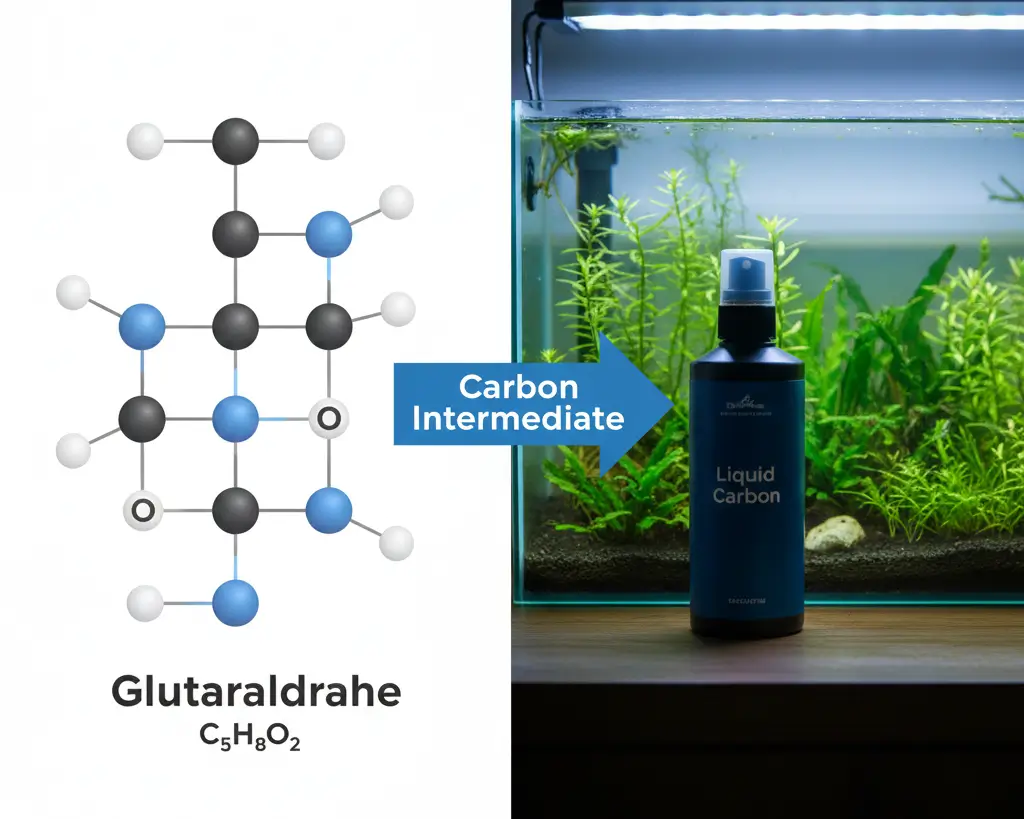
“Liquid Carbon” in the aquarium hobby is almost exclusively a dilute solution (1.5% – 4.0%) of Glutaraldehyde or a structural isomer like polycycloglutaracetal. It is a biocide commonly used to sterilize medical equipment. In low doses within an aquarium, it functions as a carbon source by breaking down into intermediates that enter the plant’s metabolic cycle (Krebs cycle), though its primary visible benefit often comes from inhibiting algae spores.
Let’s be real for a second. Marketing teams have done a brilliant job rebranding a hospital disinfectant as “Liquid CO2.”
There is no such thing as liquid carbon dioxide at room temperature and pressure (unless you have a heavily pressurized canister, in which case, it’s a liquid gas). What we are pouring into our tanks is an organic compound: C5H8O2.
When I first started diving into the research on liquid carbon glutaraldehyde excel, I found that it degrades within about 10-12 hours in the aquarium. This short half-life is exactly why daily dosing is required. You can’t just dump a week’s worth in on Monday and hope for the best.
Well, you can, but you’ll probably kill your fish. More on that later.
Liquid Carbon vs. Pressurized CO2: My Test Results
I ran a comparison in early 2024. I set up two identical 10-gallon tanks with the same substrate, light (medium PAR), and plant mass.
- Tank A: Pressurized CO2 (30ppm drop checker green).
- Tank B: Daily dosing of Glutaraldehyde (standard dose).
- Tank C: Control (No added carbon).
The Results (After 6 Weeks):
- Tank A (Gas): Plants grew 300% faster. I was trimming the Rotala Rotundifolia weekly. Red coloration was intense.
- Tank B (Liquid): Plants grew about 30-40% faster than the control. However, the glass was spotless. Zero algae. The plants looked cleaner and healthier than the Control, even if they weren’t growing at warp speed.
- Tank C (Control): Slow growth, minor diatom algae, healthy but lackluster.
Liquid carbon isn’t a replacement for a high-tech pressurized CO2 setup. It’s a different tool entirely. It bridges the gap for low-tech setups where you want to suppress algae and give plants a slight edge.
The “Val Melt” Disaster (My Cautionary Tale)
I used to think “safe for plants” meant all plants.
In 2018, I had a beautiful, flowing background of Vallisneria Spiralis (Jungle Val). I decided to double-dose liquid carbon to fight off some staghorn algae.
Three days later, my tank looked like someone had put the plants in a blender.
The Vals didn’t just die; they turned transparent and disintegrated into goo. It clogged my filter intake and caused an ammonia spike.
Glutaraldehyde Risk
| Plant Species | Tolerance | My Experience |
| Anubias / Ferns | High | Loves it. Keeps leaves algae-free. |
| Stem Plants | Moderate | Good growth, rare issues. |
| Vallisneria | VERY LOW | Melts at standard dose. Acclimate slowly. |
| Elodea / Egeria | Low | Structural damage to cell walls. |
| Mosses | Low/Mod | Java Moss can brown out if overdosed. |
| Cryptocoryne | Moderate | Rare melt, usually safe. |
“If you have Vals or Egeria, start at 1/4 dose. Seriously. Ramp up over 4 weeks. I learned this the expensive way.”
If you are keeping rare Bucephalandra varieties, liquid carbon is actually fantastic because these slow growers are algae magnets. The glutaraldehyde keeps the leaves clean, allowing the plant to photosynthesize efficiently.
How to Use It for Algae Control (The “Spot Treat” Method)
This is where liquid carbon shines. It is arguably the best weapon against Black Beard Algae (BBA).
BBA is red algae that is notoriously tough. Herbivores usually won’t touch it. But Glutaraldehyde disrupts its cellular structure.
My Spot Treatment Protocol:
- Turn off filters: You want the water to be still.
- Draw the dose: Use your daily allowance in a syringe or pipette.
- Target: Spray the liquid directly onto the algae tufts underwater.
- Wait: Let it sit for 10-15 minutes.
- Restart: Turn the filters back on.
Within 24 hours, the black/grey tufts usually turn a bright angry red or white. That means they are dead. Once dead, shrimp and snails (like the Mystery Snail) will often eat them.
Do not exceed the recommended daily volume for the whole tank just because you have a lot of algae. If you have 50 gallons of water, only use the dose for 50 gallons, even if you only treat one rock. Overdosing strips oxygen from the water column.
MYTH vs REALITY: The “Liquid CO2” Debate
MYTH: “Liquid carbon is just as good as gas injection.”
REALITY: Not even close. Gas injection provides unlimited carbon availability (30ppm). Liquid carbon provides trace amounts.
- Glutaraldehyde degradation studies show limited CO2 yield.
- 300% growth gap between Tank A (Gas) and Tank B (Liquid).
- It is an algaecide that aids nutrient uptake, not a primary carbon fertilizer.
Because plants do grow better with it. But they grow better largely because the glutaraldehyde kills the biofilm and algae on their leaves, removing the competition for light and nutrients.
Safety and Toxicity: Read This Part
I cannot stress this enough: Glutaraldehyde is a potent chemical.
I once spilled a small amount on my hand and didn’t wash it off immediately. Ten minutes later, my skin was irritated, and the fumes gave me a headache that lasted all afternoon. This is a fixative used in labs to preserve tissue samples. Treat it with respect.
For Your Fauna:
- Shrimp: Cherry Shrimp and definitely sensitive types like Crystal Red Shrimp can be sensitive to overdosing. Stick to standard dosing or slightly less.
- Fish: Generally safe at recommended doses. However, Glutaraldehyde reduces dissolved oxygen. If you dose it at night (when plants aren’t producing oxygen), you risk suffocating your fish. Always dose when the lights come on.
When Should You Use Liquid Carbon?
I don’t use it in every tank anymore. I’ve become selective.
Use it if:
- You have a Low-Tech planted tank and want to boost growth slightly without buying a regulator.
- You are fighting BBA or Staghorn algae.
- You have slow-growing plants like Anubias Nana Petite that are prone to algae on older leaves.
Skip it if:
- You have a jungle of sensitive Vallisneria or expensive mosses (unless you are very careful).
- You are already running a tuned pressurized CO2 system (unless using it specifically for spot-treating algae).
- You think it will fix an imbalance caused by poor lighting or lack of Seachem Flourish fertilizers. It won’t.
Final Thoughts
Is Liquid Carbon a scam? No. Is the marketing misleading? Absolutely.
It is a tool. In the hands of a beginner who dumps it in hoping for a lush Dutch Aquascape overnight, it’s a recipe for melted Vals and gasping fish. But for the aquarist who understands it as a targeted algaecide and mild growth booster, it’s essential.
I keep a bottle under my cabinet. It’s not hooked up to a dosing pump, but when I see that first tuft of black fuzz on my driftwood, I know exactly what to do.