I stared at my first 20-gallon high-tech tank for three months, trying to figure out why it looked like a chaotic salad bar instead of the nature aquarium I’d pictured. I had the expensive ADA Aquasoil, I had the CO2, and I had premium stones. But the tank felt… flat. Boring.
It wasn’t a gear problem. It was a math problem.
I was centering everything. The big “hero” stone? Dead center. The red plants? Center. I was fighting thousands of years of artistic theory and human psychology.
The Rule of Thirds is the single most effective “cheat code” for aquascaping, but here is the part most tutorials skip: it’s not just about where you put the rock. It’s about how that placement dictates water flow, light direction, and swimming space. After re-scaping that 20-gallon using a strict 3×3 grid system in early 2023, the difference wasn’t just visual, my flow dead spots vanished, and my algae issues cleared up.
Here is how to stop guessing and start engineering your layout.
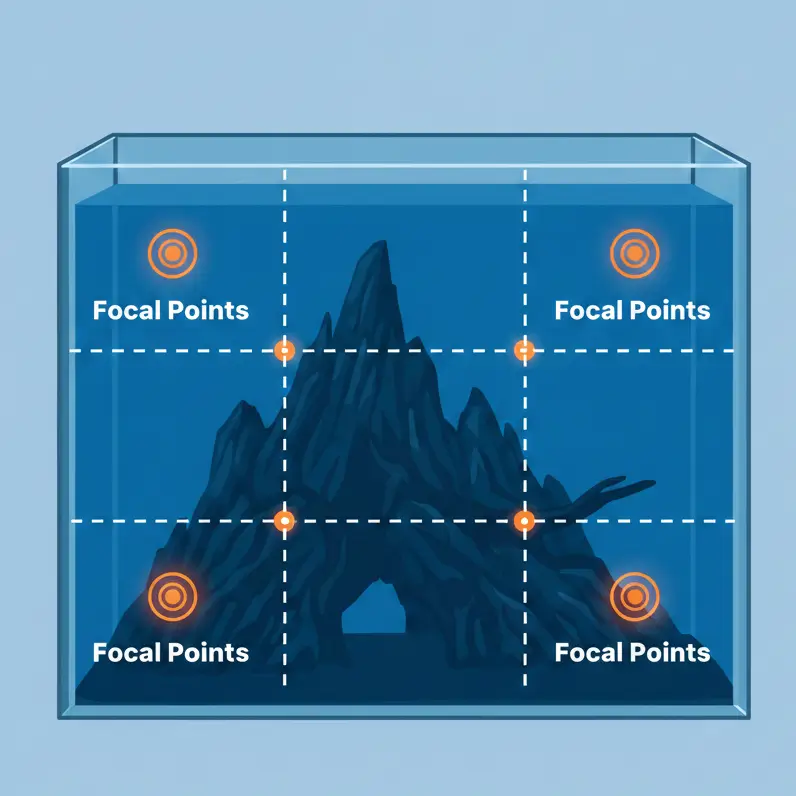
What is the Rule of Thirds in Aquascaping?
The Aquascaping Grid
The Rule of Thirds is a composition guideline that divides your aquarium into nine equal parts using two equally spaced horizontal lines and two equally spaced vertical lines. The most visually engaging aquascapes place the focal point (main hardscape or standout plant) at the intersections of these lines, rather than in the center.
When you place a massive piece of Dragon Stone dead center, the viewer’s eye hits the object and stops. It gets stuck. When you move that stone to the left or right “third” line, the eye travels across the negative space to find it. That travel creates the illusion of depth.
The “Center Island” Trap: A Personal Failure
My first attempt at an Iwagumi stone layout was a disaster. I bought a gorgeous 12-pound Seiryu stone (cost me about $60, ouch) and plopped it right in the middle of a 10-gallon tank.
I thought it looked majestic.
Three weeks later, I realized two things:
- The tank looked tiny.
- Debris was collecting in the corners because the flow hit the center rock and dispersed weakly.
When you center the mass, you create symmetry. Symmetry is static. Nature is rarely symmetrical. By moving the primary stone 4 inches to the left (hitting the left vertical third line), I opened up a “plain” on the right side. Suddenly, my Cardinal Tetras had a swimming lane. They started schooling tighter because they had a designated open space.
The layout looked bigger, but functionally, the flow from my lily pipe could now circulate the entire perimeter without hitting a stone wall immediately.
Step-by-Step: Mapping Your Tank
Don’t eyeball this. I used to eyeball it, and I was always off by inches. Get a dry-erase marker.
SPECIFICATIONS: The 3×3 Grid Method
1. MEASURE THE LENGTH
Measure your tank glass from edge to edge.
- 20 Gallon Long (30 inches): Draw vertical marks at 10″ and 20″.
- 10 Gallon (20 inches): Draw vertical marks at 6.6″ and 13.3″.
2. MEASURE THE HEIGHT
Measure from the substrate line (not the bottom glass) to the water surface.
- Standard Height (12 inches): Draw horizontal marks at 4″ and 8″.
3. LOCATE THE “POWER POINTS”
You now have 4 intersections where lines cross.
- Top Left / Top Right: Ideal for tall driftwood branches or stem plant peaks.
- Bottom Left / Bottom Right: Ideal for main stone placement or cavern entrances.
“I keep these lines on the glass for the first 4 weeks of planting. It helps me visualize where my Rotala Rotundifolia needs to be trimmed to maintain the focal point.”
Myth vs. Reality: The “Golden Ratio” Confusion
You will hear people use “Rule of Thirds” and “Golden Ratio” interchangeably. This frustrates me because they are mathematically different, even if they aim for the same vibe.
MYTH: “The Rule of Thirds and the Golden Ratio are the same thing.”
REALITY: The Rule of Thirds is a simplified version (1:1:1). The Golden Ratio is a spiral based on 1:1.618.
- Research: The Golden Ratio (Phi) appears in nature (nautilus shells, phyllotaxis in plants).
- My Testing: In a 4-foot tank, the Golden Ratio focal point is slightly more central than the Rule of Thirds.
Because 1.618 is hard to calculate on the fly. Dividing a tank by three is easy.
Unless you are entering the IAPLC contest, stick to the Rule of Thirds. It is easier to maintain. Plants grow; they don’t respect decimal points.
Hardscape Selection: Buying for the Grid
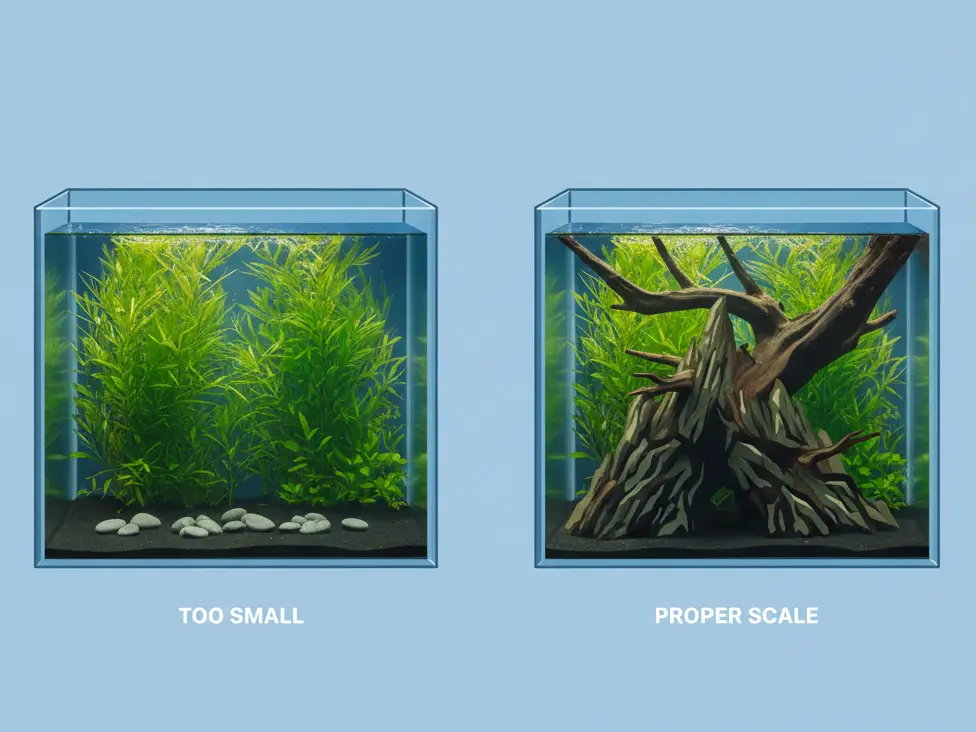
Here is a financial tip I learned the hard way: Don’t buy hardscape that is too small.
If your tank is 12 inches tall, and your bottom-right intersection point is 4 inches off the substrate, a 3-inch rock will disappear once you add a carpet of Monte Carlo.
My Rule of Thumb: Your main focal piece needs to reach the Top Horizontal Line.
- In a standard 20-gallon, your main driftwood or stone needs to be at least 8-9 inches tall.
- If it doesn’t cross that top line, the layout feels heavy on the bottom and empty on top.
I recently set up a 40-gallon breeder using Manzanita Driftwood. I spent $45 on smaller pieces, thinking I could stack them. Bad idea. They looked like a pile of sticks. I had to scrap them and buy one large $80 stump that actually hit that upper-left intersection. It hurt the wallet initially, but the visual impact was instant.
The “Flow-Dynamic” of the Thirds
This is the part nobody talks about. The Rule of Thirds isn’t just about pretty pictures; it helps you manage your filtration.
If you are using a canister filter or HOB (Hang on Back), you generally have an intake and an output.
- Scenario A (Bad): You place a giant rock in the center. The output hits the rock, creates turbulence, and stops. The corners get zero flow.
- Scenario B (Thirds): You place the high hardscape on the left third. You place your filter output on the left, blowing over the hardscape toward the open right two-thirds.
I tested this with dye in a 60cm tank. When I aligned the hardscape to the Rule of Thirds (high on left, low on right), the water completed a full circular loop (gyre) much faster. This meant CO2 was getting to my Dwarf Baby Tears in the farthest corner.
The aesthetic layout is the mechanical layout. They function together.
Plants as Focal Points: The “Red Spot”
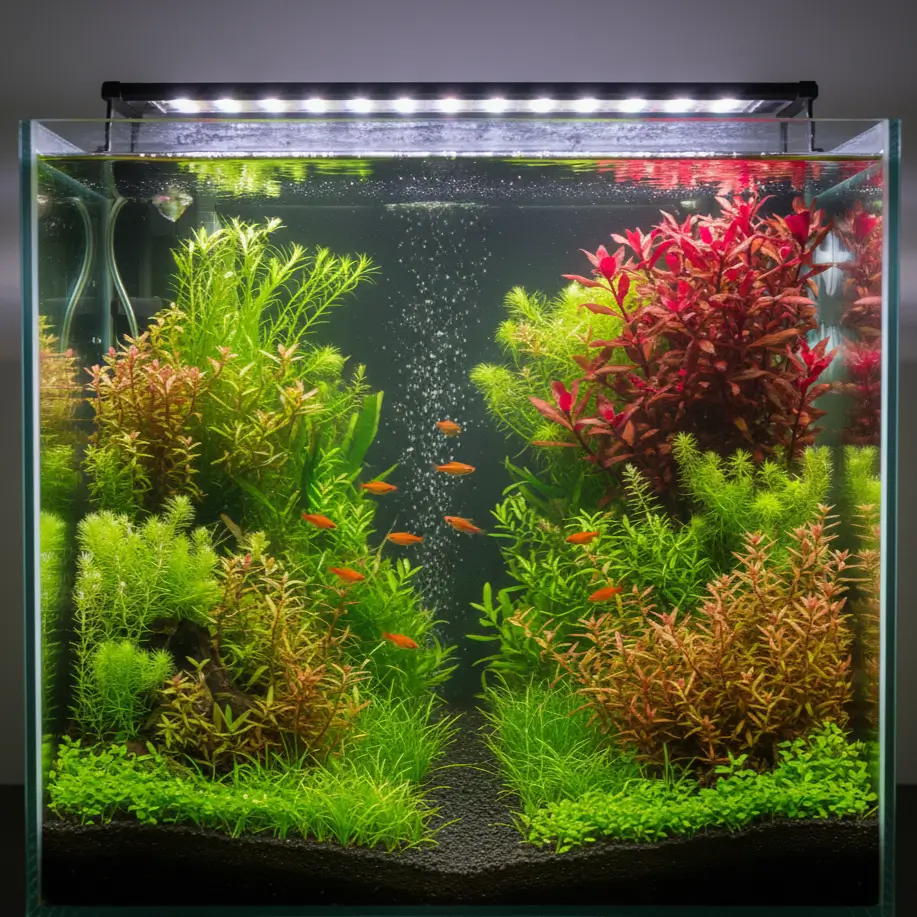
You don’t always need rocks or wood to define the third. In Dutch-style aquascaping, we use color.
I ran an experiment in a Dutch-style setup where I used only green plants. It looked healthy, but messy. There was no place for the eye to rest.
I replaced a bush of green Rotala with Ludwigia Repens ‘Super Red’ exactly at the Top Right intersection.
The result? The tank looked organized. The red spot acted like a gravitational pull for the eye.
Hardscape vs. Plant Focal Points
| Factor | Hardscape Focal Point | Plant Focal Point | My Finding |
| Stability | Permanent | Changes weekly | Hardscape is easier for beginners. |
| Cost | High initial ($50+) | Low initial ($10) | Plants are cheaper but high labor. |
| Algae Risk | High (surfaces) | Low (absorbs nutrients) | Hardscape needs more scrubbing. |
| Impact | Structural | Color/Texture | Combine both for best results. |
- Beginner: Use Dragon Stone or Wood at the intersection. It doesn’t die.
- Advanced: Use a specific stand of high-contrast plants.
Breaking the Rule: When to Center
Is the Rule of Thirds a law? No. It’s a guideline.
I have seen incredible “Island Style” layouts where the hardscape is dead center. But there is a catch: Negative Space.
If you center your hardscape, you need massive amounts of negative space (empty water or low carpet) on both sides to make it work. It creates a “pedestal” effect.
I tried this with a Bucephalandra covered lava rock island. It worked because I kept the surrounding 6 inches of substrate completely bare, just sand. If I had planted tall stems on the sides, the “Island” effect would have collapsed into a “Wall” effect.
The Evolution of Design
Aquascaping is a journey of refinement. You start with a grid, you struggle with growth, and eventually, you develop an intuition for balance.
This connects deeply to the philosophy at Aquatics Pool Spa, where we believe that understanding the fundamental rules of aquatic environments, whether it’s a 10-gallon planted tank or a 10,000-gallon pool, is the prerequisite to breaking them creatively.
I used to obsess over the millimeter-perfect placement of my stones. Now? I place them on the Thirds for flow and structure, but I let the plants soften the lines. The Rule of Thirds gets you 90% of the way there; nature does the last 10%.
Common Mistakes (I’ve Made All of Them)
- The “Soldier Row”: Placing three rocks equally spaced on the three lines. It looks like a cemetery. Vary the size. One main stone (Parent), one secondary (Supporting), one accent (Sacrificial).
- The “Flat Horizon”: Placing the substrate perfectly flat. Slope it! I bank my substrate 3 inches higher in the back. This pushes the rear “Third” up, making it visible.
- Ignoring the Surface: Don’t forget floating plants. I use Red Root Floaters to frame the top third of the tank, creating a shadow box effect that highlights the illuminated focal point below.
Final Thoughts: Draw the Lines
If your tank looks boring, don’t buy more fish. Don’t upgrade your light.
Grab a dry-erase marker. Draw a tic-tac-toe board on your front glass. Move your biggest rock to an intersection.
I guarantee the tank will look twice as deep and your flow will improve. It feels artificial at first, like painting by numbers, but it builds the structure that allows your chaotic, beautiful nature aquarium to thrive.