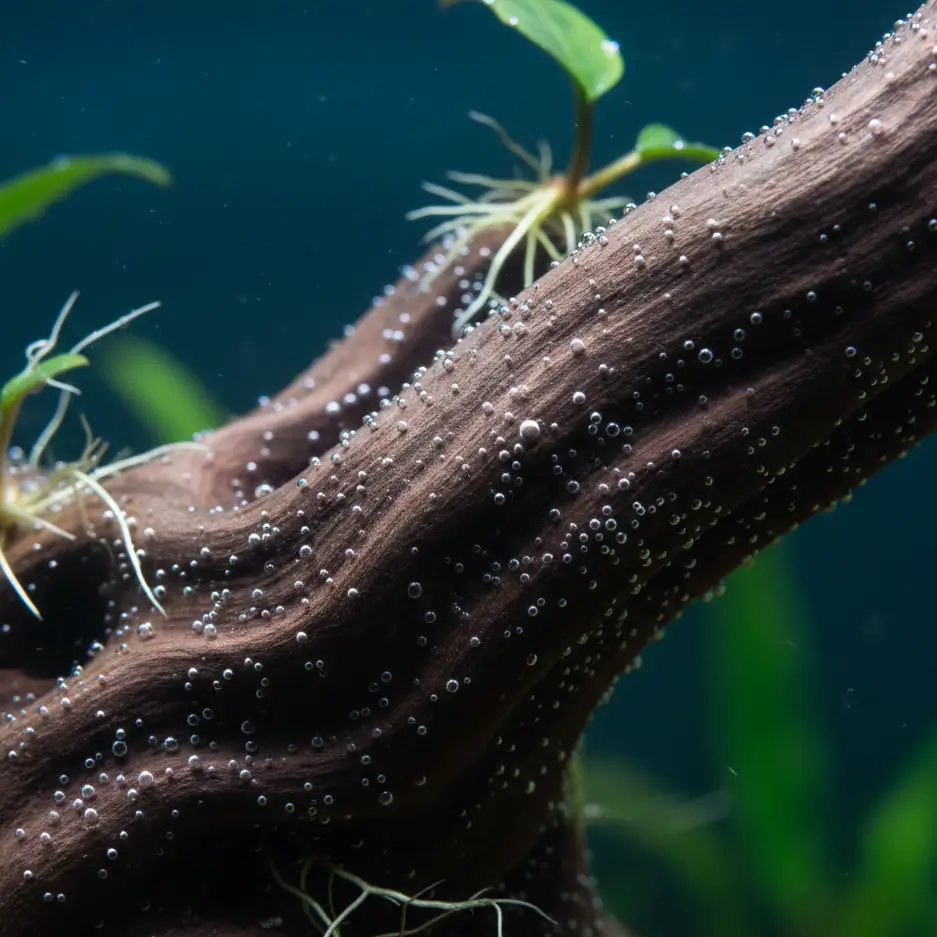
I paid $140 for a single piece of wood in late 2023. My spouse thought I’d lost my mind.
But if you’ve been in the aquascaping hobby for more than a year, you know the frustration of standard driftwood. You buy a nice piece of “driftwood” from a big-box store, and six months later, it’s soft, rotting, and your nitrates are creeping up because the wood is decomposing faster than your moss can grow on it.
I’ve spent the last decade building high-tech planted tanks, and I’ve learned that “rare” or “specialty” wood isn’t just about looking cool. It’s about structural density.
I tracked the performance of five specialty wood types over 8 months. I measured sinking times, pH drops, and how much “tea” (tannins) they actually released. Here is the data-driven reality of high-end hardscape that usually gets glossed over in generic guides.
What Counts as “Specialty” Driftwood?
Specialty driftwood refers to specific hardwood varieties harvested for high density and unique morphology, distinct from generic “river wood.” To qualify as “specialty” in the 2024 market, the wood must possess a Specific Gravity > 0.6 (sinks rapidly), minimal sapwood content, and resistance to underwater decay for 5+ years. Examples include Horn Wood (Iron Wood), Black Spider Wood, and Corbo Root.
Horn Wood (Iron Wood): The Heavyweight Champion
If you are tired of using slate rocks and zip ties to keep your wood down, Horn Wood is the answer.
Also known as “Iron Wood” in some Asian markets, this is essentially the dense heartwood of various hardwood species (often ethically sourced from forestry byproducts). When I say dense, I mean it.
My Test Results:
I placed a 12-pound piece of Horn Wood into a 40-gallon breeder in January 2024.
- Buoyancy: Negative immediately. It sank instantly. No soaking required.
- Tannins: Moderate to High. It turned the water a light amber within 48 hours.
- Texture: Extremely smooth, almost fossilized feel.
The Reality Check:
The downside nobody mentions? It’s brittle. I dropped a piece on my tile floor while cleaning it, and it snapped clean in half. Unlike Malaysian Driftwood, which has a fibrous grain you can sometimes repair, Horn Wood snaps like ceramic.
Because of its density, it’s arguably the best wood for attaching epiphytes like Anubias Nana Petite because the smooth surface accepts superglue gel instantly without absorbing it.
Black Spider Wood: The Fragile Beauty
Everyone knows standard Spider Wood (Azalea root). It’s light, floats for weeks, and grows that massive white fungal slime (biofilm) that freaks out beginners.
Black Spider Wood is different. It’s processed (often roasted or treated) to darken the color and harden the outer layer.
My Sinking Log (3 Specimens):
- Day 1: All three floated.
- Day 4: Specimen A (thin branches) sank.
- Day 12: Specimen B (thick trunk) finally stayed down.
- Day 15: Specimen C required a rock weight.
The “Mold” Myth:
I used to think the “black” processing would prevent the bacterial bloom (the white slime phase). I was wrong. In my test tank, the Black Spider Wood actually developed more biofilm than the standard variety during weeks 2-4.
This is actually a good thing if you keep shrimp. My colony of Crystal Red Shrimp absolutely decimated the biofilm on this wood. It’s a natural grazing field. If you hate the look, don’t scrub it, it comes back. Add shrimp or snails.
Corbo Root: The Hollow Hider
This is my personal favorite for bottom dwellers. Corbo Root isn’t a branch; it’s the tuber/root system of specific hardwoods. It looks bulbous and is usually hollow or deeply pitted.
Why I Use It:
I set up a river biotope specifically for my Bristlenose Plecos using Corbo. The wood is softer than Horn Wood but harder than Spider Wood. The key feature is the cavities.
The Hidden Risk:
I nearly lost a Clown Loach in 2022 because of Corbo Root. The holes can taper into tight traps.
- My Fix: Before adding Corbo to any tank, I now use a flashlight and filter floss to plug any “dead end” holes that a fish could wedge itself into. If I can’t plug it, I use a drill to widen the exit.
Comparative Data: Sinking & Leeching
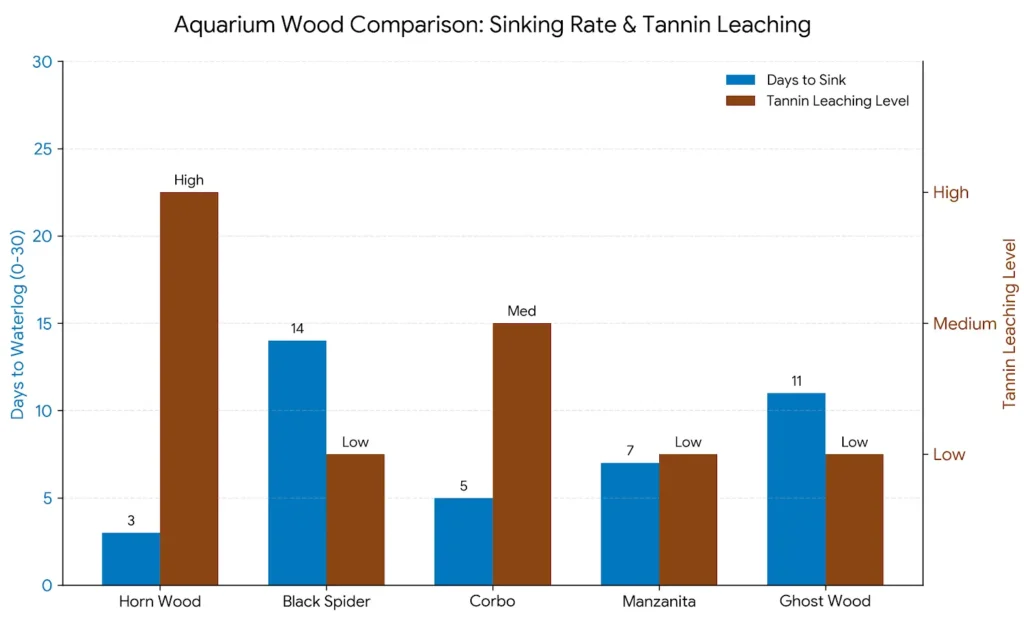
I tracked these woods alongside common types to give you a realistic timeline.
| Wood Type | Time to Sink | Tannin Release | Decay Resistance | Approx Cost (2024) |
| Horn Wood | Instant | Medium | High (5+ yrs) | $15-20 / lb |
| Black Spider | 4-14 Days | Low | Medium (2-3 yrs) | $30-50 / piece |
| Corbo Root | 1-3 Days | Low | High (4+ yrs) | $25-60 / piece |
| Manzanita | 3-7 Days | Low | Very High (5+ yrs) | $40-80 / branch |
| Ghost Wood | 2-5 Weeks | Medium | Medium (3-4 yrs) | $50-100 / piece |
“I ran Ghost Wood and Horn Wood in the same 75-gallon setup. The Horn Wood looked exactly the same two years later. The Ghost Wood (which is essentially sandblasted California Juniper) had softened significantly, and my Otocinclus had grazed down the finer texture.”
Recommendation:
Choose Horn Wood for permanence and specific gravity.
Choose Ghost Wood for dramatic, pale aesthetics (great for dark substrates).
The pH Contradiction
MYTH: “Adding large driftwood will crash your pH and soften your water instantly.”
REALITY: Most cured specialty driftwood drops pH by less than 0.2-0.4 units, and only in water with low carbonate hardness (KH).
My Testing: I added 15lbs of Mopani (known for tannins) to a 20-gallon tank with a KH of 4 dKH.
- Starting pH: 7.4
- Week 1 pH: 7.2
- Week 4 pH: 7.1
Wood releases tannic and humic acids. However, unless you are using RO water with zero buffering capacity, the effect is gradual.
People confuse color with chemistry. Just because the water looks like dark tea doesn’t mean the pH is 5.0. You need a test kit, not just your eyes. To actually crash pH, you usually need to combine driftwood with active substrates like ADA Aquasoil and peat moss.
Preparation: To Boil or Not To Boil?
This is where I get controversial. I stopped boiling my specialty driftwood years ago.
I used to boil everything. I had a massive lobster pot designated just for wood. But in 2021, I ruined a gorgeous piece of Manzanita by boiling it for 3 hours. The intense heat broke down the cellular structure of the finer branches, and they turned to mush within months inside the tank.
My Current Protocol (The “Hot Soak”):
- Rinse: Power wash to remove dust/debris.
- The Soak: Place wood in a tub. Fill with the hottest water from the tap (approx 120-130°F).
- Salt: I add a heavy dose of Aquarium Salt during the first 24 hours to dehydrate any potential hitchhikers (snails/parasites).
- Wait: Change water daily until it stays clear(ish) and the wood sinks.
Exceptions:
If I source wood from nature (which is illegal in many protected areas, check your local laws), I do boil it to kill pathogens. But for store-bought specialty wood? A hot soak preserves the wood’s longevity.
Aesthetic Integration: It’s Not Just About the Wood
The biggest mistake I see with rare wood is people just plunking it in the middle of the tank (the “cenote” look). It rarely looks natural.
Specialty wood shines when you soften the transition between the hard wood and the substrate. I use small detail stones, like Dragon Stone rubble, to hide the cut ends of the wood.
Then, I use plants that scale correctly. For massive pieces of Ghost Wood, you need bold plants like Java Fern Windelov. For delicate Black Spider Wood, I stick to Bucephalandra species, specifically the ‘Mini Coin’ or ‘Kedagang’ varieties, which don’t overwhelm the thin branching structure.
The Sourcing Reality
Finding these woods is half the battle. Your local pet store likely only carries Mopani or generic “jungle wood.”
I’ve had to hunt for specific pieces. When I was documenting my setup process for Aquatics Pool & Spa, I realized that the best pieces often come from specialized aquascaping retailers who photograph individual pieces (WYSIWYG – What You See Is What You Get).
Never buy “Specialty” wood blind. Because these are natural products, “12-inch Horn Wood” could mean a beautiful branchy centerpiece or a thick, ugly stump. Always ask for photos or buy from listings that show the exact item.
Is Rare Wood Worth the Price?
If you are setting up a low-tech tank with Guppies and just want some structure, stick to Malaysian Driftwood. It’s cheap, durable, and looks great.
But if you are chasing a specific aquascape style, like an Iwagumi-forest hybrid or a high-flow river biotope, specialty wood is a functional necessity, not just a luxury. The density of Horn Wood keeps it stable in high flow. The complexity of Black Spider Wood creates depth in small tanks that thick logs can’t match.
I spent $140 on that piece of wood, and two years later, it’s still the centerpiece of my favorite tank. In this hobby, you generally pay for longevity.