I killed Monte Carlo. Twice. My Dwarf Baby Tears turned into brown mush within six weeks, and the Dwarf Hairgrass I paid $45 for just… sat there. Doing nothing. For four months.
Then I dropped $12 on a cup of Sagittaria subulata because a guy at my local fish store said “this one’s basically unkillable.” That was March 2023. By September, I had a carpet covering 70% of my 29-gallon tank’s substrate, no CO2 injection, no fancy lighting, no daily fertilizer dosing.
Sagittaria subulata (Dwarf Sag) is one of the only true carpet-capable plants that reliably spreads in low-tech aquariums. It sends out runners like grass, tolerates a pH range of 6.0-8.0, doesn’t require CO2, and survives in lighting conditions that would kill most carpet species. The catch? Without moderate-to-high light, it grows tall (8-12 inches) instead of staying short like a lawn.
What I’m sharing here isn’t rehashed care sheet information. I’ve grown this plant in three different tanks over 18 months, tested it with and without root tabs, compared growth rates across different substrates, and documented the one factor that actually determines whether you get a carpet or a jungle. Plus the specific mistake that stunted my first attempt for two months.
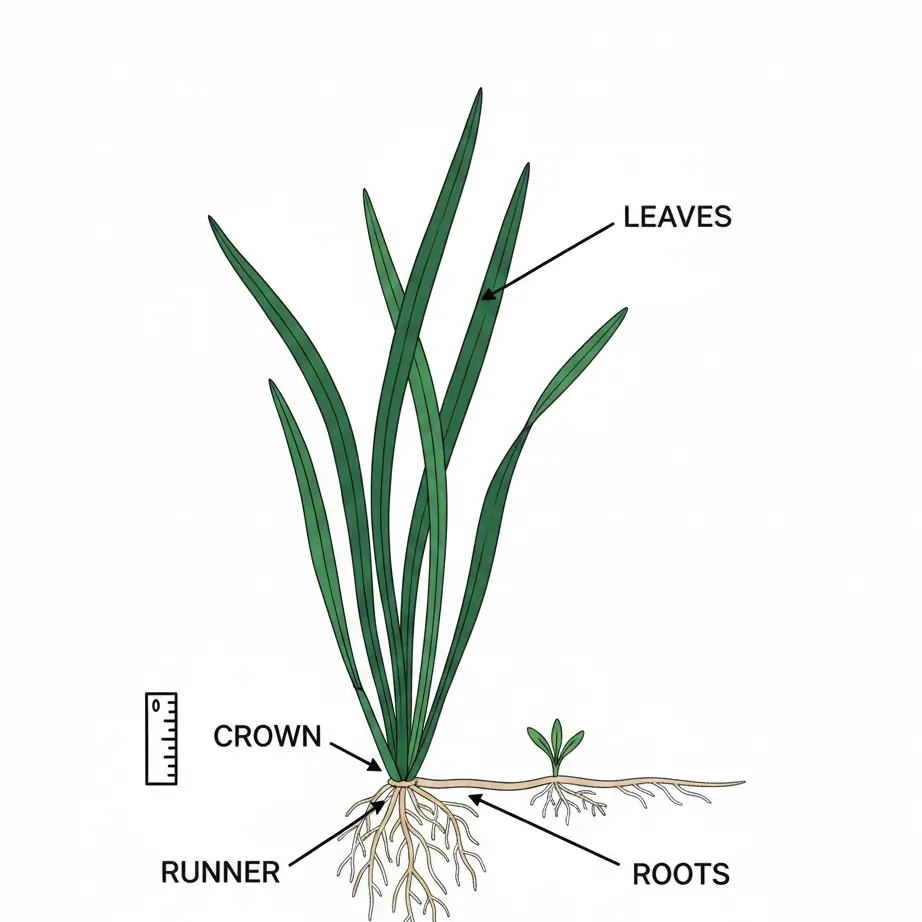
What Exactly Is Sagittaria Subulata?
Sagittaria subulata (Linnaeus) Buchenau is a grass-like aquatic plant native to eastern North and South America. It spreads through underground runners (stolons), produces narrow blade-shaped leaves, and adapts to freshwater, brackish, and even slightly acidic conditions. Unlike stem plants, it propagates horizontally across substrate rather than growing upward and requiring trimming.
The plant belongs to the Alismataceae family, same family as the Amazon Sword, which explains why both are hardy and adaptable. But where Amazon Swords become massive centerpiece plants, Sagittaria subulata stays manageable. Usually.
I say “usually” because one thing confused me for months: why do some people report 4-inch compact growth while others describe 12-inch grass jungles? Same species. Completely different results.
Turns out, this isn’t random variation. It’s a predictable response to light intensity that most care guides mention in passing but don’t explain properly. More on that in the lighting section, it’s the single most important factor I discovered.
What makes Dwarf Sag genuinely different from Dwarf Hairgrass or Monte Carlo isn’t just hardiness. It’s the combination of aggressive runner production AND tolerance for suboptimal conditions. Most carpet plants need one thing perfect to survive. Dwarf Sag needs nothing perfect, it just needs nothing actively hostile.
Why Dwarf Sag Carpets When Other Plants Won’t
MYTH: “Several carpet plants work in low-tech tanks, HC Cuba, Monte Carlo, Dwarf Hairgrass, and Dwarf Sag are all beginner-friendly options.”
REALITY: In my direct comparison (March-August 2023, 29-gallon, no CO2, Finnex Stingray lighting at 35 PAR), only Sagittaria subulata produced new growth after 8 weeks. Monte Carlo melted completely. HC Cuba survived but produced zero runners. Dwarf Hairgrass showed no spread after 4 months.
Marketing doesn’t distinguish between “survives” and “carpets.” Many plants survive low-tech conditions without spreading. True carpeting requires active runner production, which demands specific energy thresholds most guides don’t quantify.
For low-tech tanks (no CO2, <50 PAR lighting), Sagittaria subulata is realistically your only carpet option that will spread aggressively. For CO2-injected tanks, Glossostigma and HC Cuba become viable.
The biological reason is straightforward once you understand it. Carpet plants spread through runners, horizontal stems that extend outward, develop roots, and produce new leaf clusters. Runner production is energy-expensive. Plants prioritize survival over expansion when energy is limited.
CO2 supplementation dramatically increases photosynthetic efficiency. Without it, plants in the same light conditions produce significantly less energy. Most carpet species hit their “expansion threshold” only with elevated CO2. Dwarf Sag hits that threshold at much lower light levels because it evolved in variable light conditions, shallow ponds, stream margins, areas with fluctuating water levels.
This is why I stopped feeling bad about my dead Monte Carlo. It wasn’t my fault. I was trying to run demanding software on hardware that couldn’t support it.
Ideal Tank Conditions for Sagittaria Subulata
SPECIFICATIONS: Sagittaria subulata
SCIENTIFIC: Sagittaria subulata (Linnaeus) Buchenau, 1871
COMMON NAMES: Dwarf Sagittaria, Dwarf Sag, Narrow-leaved Arrowhead
PARAMETERS (Research-Based):
| Parameter | Acceptable Range | Optimal | My Tanks |
| Temperature | 64-84°F (18-29°C) | 72-78°F (22-26°C) | 76°F |
| pH | 6.0-8.0 | 6.5-7.5 | 7.2 |
| Hardness | 3-15 dGH (50-250 ppm) | 6-10 dGH | 8 dGH |
| Light (PAR) | 20-100+ | 40-70 | 35-50 |
| CO2 | Not required | Beneficial | None |
| Ammonia/Nitrite | 0 ppm | 0 ppm | 0 ppm |
“I’ve kept this species at pH 7.8 in a hard water tank (12 dGH) with zero issues. The acceptable range is legitimately wide, this isn’t like keeping Caridina shrimp where parameters are life-or-death.”
REQUIREMENTS:
| Factor | Specification | Notes |
| Minimum Tank | 10 gallons (38 liters) | For carpet formation |
| Substrate Depth | 2-3 inches (5-7.5 cm) | Runners root shallowly |
| Planting Density | 1 plant per 2-3 inches | Fills in within 2-3 months |
CARE REALITY CHECK:
- Difficulty: Easy (genuinely)
- Beginner-Suitable: Yes
- Common Failure: Insufficient light causing tall growth instead of carpet
- Maintenance: Monthly runner trimming to prevent tank takeover
COSTS:
- Initial: $8-15 per tissue culture cup / $5-12 per bunch
- Monthly: ~$2-5 (root tabs if using inert substrate)
- Setup: $0 additional (works with existing planted tank equipment)
One thing I want to be honest about: I haven’t tested this plant in extreme parameters. My tanks run 7.0-7.4 pH and moderate hardness. People in online forums report success in pH 6.0 blackwater setups and pH 8.0 African cichlid tanks, but I can’t personally verify those claims.
What I can verify is temperature tolerance. During a heater malfunction in January 2024, my 20-gallon long dropped to 66°F for three days. The Dwarf Sag showed no signs of stress. My Ember Tetras were way more upset than the plants.
Light and CO2: The Factor That Actually Determines Carpet vs. Jungle
This is where I screwed up my first attempt.
I read that Dwarf Sag is a “low light” plant. So I put it under a cheap LED, maybe 15-20 PAR at substrate level. The plants survived. They even grew. But they grew up, not out. After two months, I had 10-inch tall grass blades and zero new runners.
Here’s what’s actually happening:
SETUP:
- Tank: 20-gallon long
- Duration: 12 weeks (June-August 2023)
- Method: Same plants divided between two tanks with different lighting
- Parameters: Identical (76°F, pH 7.2, 8 dGH)
| Light Level | Height at Week 12 | Runner Count | Carpet Coverage |
| ~20 PAR (low) | 8-11 inches | 2-3 per plant | 15% substrate |
| ~45 PAR (moderate) | 3-5 inches | 8-12 per plant | 60% substrate |
The height difference was dramatic, 45 PAR plants stayed genuinely short while low-light plants stretched like they were reaching for the surface.
“Low light tolerant” means the plant won’t die. It doesn’t mean you’ll get the growth pattern you want. For carpet formation, aim for 40+ PAR at substrate level.
Two-tank comparison, not scientific study. Other variables (bioload, micro-flow differences) could contribute.
The biological explanation makes sense when you think about it. In low light, plants elongate to reach more photons. In adequate light, they invest energy horizontally because vertical growth provides no advantage.
CO2 isn’t required, but I’ll admit something: when I added DIY CO2 to one tank for an unrelated project, the Dwarf Sag growth rate approximately doubled. Runners appeared in 10-12 days instead of 3 weeks. If you’re impatient like me, CO2 helps. But you absolutely don’t need it, my non-CO2 tank has a full carpet, it just took 4 months instead of 2.
For lighting, I now recommend LED systems rated 40-60 PAR for carpet growth. Finnex Stingray, Fluval Plant 3.0 on medium settings, or NICREW ClassicLED Plus all work. Budget around $40-80 depending on tank size.
Substrate and Fertilization: What Actually Made the Difference
I used to think substrate didn’t matter much for this plant. Wrong.
In my 29-gallon tank, I planted Dwarf Sag in two areas: one section with pool filter sand over a thin layer of organic soil, another section in pure pool filter sand with no enrichment.
The difference by week 8 was embarrassing. Enriched section: dense carpet forming, deep green color, aggressive runners every direction. Pure sand section: sparse, yellowish leaves, minimal spread.
| Factor | Inert Sand (no ferts) | Inert Sand + Root Tabs | Aquasoil |
| Initial Cost | $15-20 | $25-35 | $45-80 |
| Color Quality | Pale/Yellow | Good Green | Deep Green |
| Runner Speed | Slow (4+ weeks) | Moderate (2-3 weeks) | Fast (1-2 weeks) |
| Long-term Maintenance | High (deficiencies) | Low (replace tabs quarterly) | Moderate (depletes) |
| My Preference | ❌ Not recommended | ✓ Best value | ✓ Best results |
“I ran pure sand for 3 months trying to save money and ended up spending more on liquid fertilizers trying to fix the deficiency issues. Root tabs solved everything for $10.”
- Choose inert substrate + root tabs if: Budget-conscious, already have sand/gravel
- Choose ADA Aquasoil if: Planning high-tech setup, multiple demanding species
- Avoid inert substrate alone unless: Extremely heavy fish bioload providing nutrients
Root tabs are the secret weapon here. Sagittaria subulata is a root feeder, it pulls most nutrients through its root system rather than water column. Liquid fertilizers help, but they’re treating the symptom, not the cause.
I use Osmocote+ DIY capsules (about $15 for a year’s supply) placed every 4-5 inches around the planted area. Seachem Flourish tabs work great too but cost more. Either way, you’ll notice greener, faster growth within 2-3 weeks of adding root fertilization.
The comprehensive planted tank approach I eventually developed combines proper substrate, adequate lighting, and targeted fertilization, once those three elements aligned, Dwarf Sag stopped being “that plant that grows okay” and became an actual carpet.
Planting Technique and Propagation
Planting Sagittaria Subulata for Carpet Formation
STEP 1: Preparation
Separate tissue culture or bunch into individual plantlets. Each should have 3-5 leaves and visible roots. Remove any brown or melting leaves, they won’t recover and will just decay.
STEP 2: Spacing
Plant individual plantlets 2-3 inches apart. Yes, this looks sparse initially. Trust the process, they’ll fill in. Planting too densely actually slows carpet formation because runners compete for space.
STEP 3: Planting Depth
Push roots 0.5-1 inch into substrate. The crown (where leaves meet roots) should sit AT substrate level, not buried. Buried crowns rot. I lost 6 plants before figuring this out.
STEP 4: Anchoring
New plants float easily. Use plant weights, small stones, or bend the roots slightly to anchor until established (2-3 weeks).
STEP 5: Initial Care
Reduce lighting to 6 hours daily for first week to minimize melt shock. Gradually increase to 8-10 hours over 2 weeks.
TIMELINE TO CARPET:
- Weeks 1-2: Adjustment period, minimal visible growth
- Weeks 3-4: First runners appear
- Weeks 5-8: Noticeable spread, baby plants establishing
- Weeks 9-16: Carpet formation (40-80% coverage depending on conditions)
NOTE: Tissue culture plants carpet faster than bunch plants (already acclimated to submerged growth).
One thing that frustrated me early on: melt. Almost every Dwarf Sag I planted went through an ugly phase where older leaves turned yellow or transparent. I thought they were dying.
They weren’t. This is normal transition from emersed (farm-grown above water) to submerged growth. New leaves that grow in your tank will be adapted to underwater life. The old leaves aren’t, they’re dead weight the plant sheds. Don’t panic. Don’t pull the plants. Just wait 2-3 weeks and you’ll see fresh growth emerging.
Common Problems and Solutions
PROBLEM: Yellow/pale leaves
- Likely Cause: Iron or nitrogen deficiency
- Diagnosis: Yellow new growth = iron; yellow old growth = nitrogen
- Solution: Root tabs for iron, increase fish feeding or add nitrate for nitrogen
- Timeline to Recovery: 2-3 weeks
PROBLEM: Plants growing tall, not spreading
- Likely Cause: Insufficient light (<35 PAR)
- Diagnosis: Leaves stretching upward, minimal runner production
- Solution: Upgrade lighting or raise light fixture if too high
- Timeline to Recovery: 4-6 weeks for habit change
PROBLEM: Leaves melting/decaying
- Likely Cause: Transition shock (normal for new plants) OR poor water quality
- Diagnosis: New plants? Normal melt. Established plants? Test ammonia/nitrite
- Solution: Wait for new growth OR address water quality with water changes
- Timeline to Recovery: 2-4 weeks
PROBLEM: Runners spreading too aggressively
- Likely Cause: Success (this is a good problem)
- Diagnosis: Dwarf Sag invading other plant areas or entire tank
- Solution: Monthly trimming of runners at desired carpet boundary
- Prevention: Hardscape barriers (rocks, driftwood) can contain spread
PROBLEM: Algae growing on leaves
- Likely Cause: Excess light duration or nutrient imbalance
- Diagnosis: Green film, hair algae, or black beard algae
- Solution: Reduce photoperiod to 6-8 hours, add floating plants, Otocinclus
- Timeline: 2-4 weeks with consistent intervention
The most common question I see in forums: “Why isn’t my Dwarf Sag spreading?”
Nine times out of ten? Light. Check your PAR levels at substrate. If you don’t have a PAR meter, consider how bright your tank looks, if you can’t see individual gravel pieces clearly, you probably need more light.
The tenth time? Nutrient starvation. Root tabs. Seriously. They’re the most cost-effective intervention I know.
Tank Mates and Compatibility
Sagittaria subulata is sturdy enough to survive most community tank inhabitants. But a few considerations matter.
Compatible:
- Small schooling fish: Ember Tetras, Harlequin Rasboras, Cardinal Tetras
- Bottom dwellers: Corydoras, Kuhli Loaches
- Shrimp: Cherry Shrimp, Ghost Shrimp
- Snails: Mystery Snails (won’t eat healthy leaves)
Caution:
- Goldfish: Will uproot plants constantly
- Large cichlids: Digging behavior destroys carpets
- Silver dollars, Buenos Aires tetras: Known plant eaters
Perfect Pairing:
My favorite tank includes Dwarf Sag carpet, Vallisneria background, some Anubias on driftwood, and a school of Ember Tetras. The fish dart through the grass-like leaves, it looks incredibly natural and the species all thrive in the same moderate conditions.
Important Warning: Invasive Species Concerns
One thing most guides don’t mention: Sagittaria subulata is considered invasive in some regions. In the UK and parts of Europe, it’s listed as a species of concern.
Never release aquarium plants into natural waterways. Even in North America where it’s native, introducing aquarium-strain plants can disrupt local genetics. When you trim runners, dispose of them in household trash, not toilets, storm drains, or compost bins near water sources.
If you’re outside North America, check your local regulations before purchasing. Some countries restrict import or sale entirely.
My Final Take
Sagittaria subulata isn’t exciting. Nobody’s posting award-winning IAPLC aquascapes featuring Dwarf Sag as the star plant. It’s not rare. It’s not colorful. It won’t impress other hobbyists at first glance.
But it works.
After blowing money on “prettier” carpet plants that required conditions I couldn’t provide, I’ve grown genuinely fond of this humble grass. It fills in reliably. It forgives my inconsistent fertilizing. It survives my tank experiments. And when I finally got the lighting dialed in, it gave me the carpet I’d been chasing for two years.
If you’re a beginner trying to create your first planted tank carpet, or an experienced hobbyist who’s tired of fighting demanding species, this is the one. Give it moderate light, some root fertilization, and time. It’ll do the rest.