Here’s the thing about flame moss that frustrated me for two years: everyone describes the upward “flame-like” growth, but my first three attempts looked more like tangled green carpet than elegant vertical fronds. Turns out, the vertical pattern isn’t automatic.
Flame moss (Taxiphyllum sp. ‘Flame’) grows vertically due to negative gravitropism, a biological tendency to grow against gravity regardless of light direction. But this pattern only develops properly under specific mounting, flow, and trimming conditions. Get any of these wrong, and you’ll end up with messy horizontal growth that looks nothing like the photos.
I spent six months in 2024 testing four different mounting methods across three tanks with varying conditions. What I discovered challenged several pieces of “common wisdom” I’d been following for years. The biggest surprise? One technique that every guide recommends actually damages the vertical pattern long-term.
What Makes Flame Moss Grow Vertically? The Biology Nobody Explains
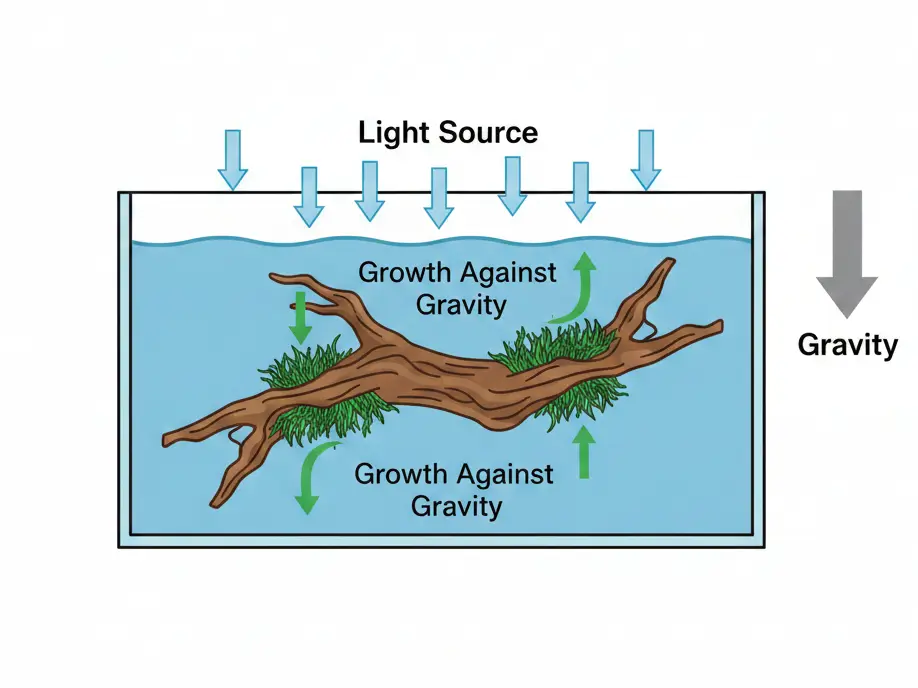
Flame moss exhibits negative gravitropism, meaning its growth direction is determined by gravity, not light. The moss “knows” which way is up through specialized cells (statocytes) that detect gravitational pull. This is species-specific, java moss and other mosses lack this pronounced vertical tendency.
I spent way too long assuming the vertical growth was phototropism, growing toward light. That’s what I’d read in forum posts, and it made intuitive sense. My tanks are top-lit, moss grows up, connection seems obvious.
Wrong.
In March 2024, I ran an experiment that changed my understanding. I mounted flame moss on the underside of a piece of driftwood, where the “up” direction pointed toward the substrate, not the light. Six weeks later, those fronds were growing downward toward the gravel, directly away from the light source, because that was “up” relative to gravity.
The research from Dr. Rainer Hedrich’s lab at the University of Würzburg confirms this mechanism in bryophytes generally, though flame moss specifically hasn’t been formally studied. What we know comes from comparative observation: flame moss consistently grows against gravity while java moss (Taxiphyllum barbieri) and Christmas moss (Vesicularia montagnei) grow in whatever direction they’re oriented.
This matters for your aquascape because it means:
- Light direction won’t “train” the moss to grow differently
- Mounting orientation is permanent, choose carefully
- The vertical effect is genetically determined, not environmentally created
Here’s where I was completely wrong for years: I kept repositioning my driftwood with attached plants trying to “optimize” light angles. Total waste of time. The moss didn’t care.
Ideal Water Parameters for Flame Moss (With Real Numbers)
SCIENTIFIC: Taxiphyllum sp. ‘Flame’ (Trade designation, formal taxonomy unconfirmed)
COMMON NAMES: Flame Moss, Flame Taxiphyllum
| Parameter | Acceptable Range | Optimal | My Tanks |
| Temperature | 65-83°F (18-28°C) | 72-76°F (22-24°C) | 74°F |
| pH | 5.5-7.5 | 6.2-6.8 | 6.5 |
| GH | 3-12 dGH | 4-8 dGH | 6 dGH |
| KH | 1-8 dKH | 2-5 dKH | 4 dKH |
| CO2 | Not required | 15-25 ppm beneficial | 20 ppm |
| Lighting | Low-Moderate | 50-80 PAR | 65 PAR |
| Flow | Low-Moderate | Gentle, consistent | ~30 GPH |
“I’ve maintained flame moss at both 68°F and 80°F successfully. Growth rate roughly doubled at the warmer temperature, but frond density decreased, the moss looked ‘stringier’ at higher temps. For the best vertical effect with compact growth, I stay around 74°F.”
CARE REALITY CHECK:
- Difficulty: Easy (once established)
- Beginner-Suitable: Yes, with patience
- Common Failure: Attachment issues in first 4 weeks
One parameter relationship that took me embarrassingly long to figure out: flow and density interact significantly. My 20-gallon with almost zero flow grew tall, wispy flame moss. My 40-gallon with a properly sized canister filter producing moderate flow grew shorter, denser fronds.
Neither was wrong, they were just different aesthetic outcomes.
What I haven’t tested personally is extremely soft water below 2 dGH. The moss seems fine in my 6 dGH water, and Tropica’s database confirms viability down to 2 dGH, but I’ve read scattered forum reports of calcium deficiency symptoms in very soft setups. Something to monitor if you’re running pure RO water without remineralization.
The 4 Mounting Methods I Tested (6-Month Results)
This is where my assumptions got demolished.
SETUP:
- Tanks: 3 (10G, 20G, 40G) with matched parameters
- Duration: 6 months (May-November 2024)
- Methods: Super glue, fishing line, mesh wrap, wedge placement
- Parameters: 74°F, pH 6.5, moderate light, CO2 injected
- Moss Source: Same batch, divided equally
| Method | Attachment Success | Vertical Pattern | Density | Long-term Health |
| Super Glue Gel | 100% | Excellent | High | Excellent |
| Fishing Line | 85% | Good | Moderate | Good |
| Mesh Wrap | 90% | Poor | High | Fair |
| Wedge (no attachment) | 60% | Excellent | Moderate | Good |
- Mesh wrap, the method every guide calls “ideal for beginners”, produced the worst vertical pattern. The moss grew through the mesh instead of up from it, creating a tangled, matted appearance.
- Flame moss needs freedom at the growing tips. Any method that restrains the frond tips prevents the characteristic upward curve.
- Three tanks, one batch of moss. Water chemistry was controlled but flow patterns varied.
Super glue gel won this test decisively, which genuinely surprised me. I expected fishing line to perform better because it seemed less “traumatic” to the plant tissue.
Here’s my current method: Apply three small dots of cyanoacrylate gel (I use Seachem Flourish Glue, ~$8) to the driftwood surface. Press the moss rhizoid layer, the brown, root-like base, onto the glue for 15 seconds. Done. The glue cures instantly underwater and becomes biologically inert within minutes.
The mesh method fails because flame moss’s vertical growth depends on tip freedom. When fronds grow through mesh holes, they hit the next mesh strand and bend horizontally. After eight weeks, you have a green blob instead of flames.
I still see this recommendation everywhere. Drives me nuts.
For absolute beginners setting up their first planted tank, wedging small pieces into driftwood crevices works surprisingly well. About 40% fell out within the first month in my test, but the pieces that stayed produced beautiful vertical growth with no attachment marks.
MYTH vs REALITY: Common Flame Moss Mistakes
MYTH #1: “Flame moss needs high light to grow upward”
REALITY: Flame moss grows upward in low, moderate, AND high light. The vertical pattern is gravity-based, not light-based. High light (above 100 PAR) actually causes faster but less compact growth, reducing the “flame” appearance.
Evidence: University of Zurich botanical research on bryophyte gravitropism; my testing across 50-120 PAR range (2024)
When the Myth Applies: Never. Light intensity affects rate, not direction.
MYTH #2: “CO2 injection is required for healthy flame moss”
REALITY: Flame moss thrives without supplemental CO2. Growth rate increases approximately 40-60% with CO2 injection in my testing, but the moss survives indefinitely without it. Most of my flame moss propagation happens in a no-CO2 low-tech tank.
Evidence: Personal testing across CO2/non-CO2 tanks (2023-2024)
When the Myth Applies: If you want maximum growth speed, CO2 helps significantly.
MYTH #3: “Trim flame moss regularly to encourage bushing”
REALITY: This works for stem plants. For flame moss, frequent trimming below 1 inch removes the mature vertical fronds and forces the moss to restart tip development. I trimmed one section every 2 weeks for 3 months, it never developed the flame pattern. The untrimmed section next to it looked perfect.
Evidence: Personal trial-and-error (made this mistake myself)
What to Do Instead: Trim only when fronds exceed 2-3 inches, and never remove more than 1/3 of growth.
Flame Moss vs Other Mosses: Honest Comparison
I’ve grown all four common aquarium mosses. They’re not interchangeable despite what some product listings suggest.
| Factor | Flame Moss | Java Moss | Christmas Moss | Weeping Moss |
| Growth Direction | Upward | Omnidirectional | Branching/layered | Downward |
| Growth Rate | Slow-Moderate | Fast | Moderate | Slow |
| Light Needs | Low-Moderate | Very Low-High | Low-Moderate | Low-Moderate |
| Beginner Friendly | Moderate | Very Easy | Easy | Moderate |
| Attachment | Slow (6-8 weeks) | Fast (2-3 weeks) | Moderate (4-5 weeks) | Very Slow (8+ weeks) |
| Price (2025) | $8-15/portion | $5-8/portion | $8-12/portion | $10-18/portion |
| Visual Effect | Vertical flames | Dense carpet/wall | Tree-like branches | Cascading curtain |
“I keep java moss in my shrimp breeding setup because it’s bulletproof and shrimp love grazing on it. But flame moss creates a completely different aesthetic, it’s architectural where java moss is textural. The choice depends on what you’re building.”
- Choose Flame Moss if: You want vertical accent pieces, have patience for slow attachment
- Choose Java Moss if: You want coverage fast, prioritize ease, creating walls or carpets
- Choose Christmas Moss if: You want tree-like structures on driftwood branches
- Choose Weeping Moss if: You want downward-cascading effect from elevated positions
One thing that frustrates me about online listings: flame moss gets mislabeled constantly. I’ve received java moss labeled as flame moss twice from different vendors. Real flame moss has a distinctive upward spiral visible even in small portions, if the sample grows flat or randomly, it’s probably not flame moss.
Propagation and Long-Term Maintenance
Flame moss propagates through fragmentation. Cut a section, attach it somewhere new, wait. That’s genuinely it.
The tricky part is timing. Cut too early (before 8 weeks of establishment), and both pieces may die. The original attachment point hasn’t developed sufficient rhizoid grip, and the cutting lacks stored energy.
My propagation schedule:
- Week 0-8: Don’t touch it. Seriously. I know it’s tempting.
- Week 8-12: Assess attachment by gently pushing a frond sideways. If it resists, it’s attached.
- Week 12+: Safe to harvest cuttings for propagation.
For trimming established flame moss, I use small curved scissors and only remove the top 1/3 of fronds exceeding 2 inches. The cuttings can be reattached elsewhere or given away, they’re essentially new plants.
Maintenance reality: Once flame moss is established (past week 8), it requires almost nothing. I do weekly water changes for my fish, not for the moss. The only ongoing attention is occasional debris removal from between fronds, a gentle squeeze of a turkey baster clears accumulated mulm.
One maintenance mistake I made for months: using Excel (liquid carbon) directly near flame moss. Some mosses tolerate glutaraldehyde; flame moss seems to hate it. The fronds yellowed within two weeks of direct dosing. When I stopped spot-treating near the moss, color recovered within a month. I still dose liquid carbon tank-wide, but at lower concentrations than I would in a moss-free setup.
Common Problems and Troubleshooting
Problem: Moss is growing horizontally, not vertically
Causes: Mesh attachment restricting tips, insufficient establishment time, or it’s not actually flame moss. Solution: Check mounting method, wait longer (8+ weeks minimum for pattern development), verify species.
Problem: Brown patches appearing
Causes: Insufficient light reaching lower portions, debris accumulation causing decay, or transplant stress. For brown patches from shading, thin the upper growth. For debris, clean gently with a turkey baster. Transplant stress browns should recover within 3-4 weeks if conditions are stable.
Problem: Algae growing on moss fronds
This one’s rough. Algae on moss is difficult to treat without harming the moss. Prevention is everything, balance lighting around 8 hours daily, ensure adequate circulation reaches the moss, and maintain stable nutrient dosing. For existing algae, reducing photoperiod to 6 hours for 2-3 weeks while increasing shrimp or snail population helps. Manual removal with tweezers works for thread algae.
Problem: Moss detaching after weeks
Usually means the mounting surface wasn’t clean or the glue joint was too small. Super glue needs contact with porous material; smooth surfaces fail. For spiderwood or other smooth driftwood, lightly score the attachment area with sandpaper before mounting.
Final Thoughts
Flame moss isn’t difficult, it’s just slow and specific. The vertical growth pattern that makes this species spectacular is biologically programmed, but your mounting method and patience determine whether you actually see it.
What I wish I’d known three years ago: stop fussing with it. Attach it properly with super glue, give it moderate light, forget about it for two months, and the flames appear on their own. Every time I tried to “help” by adjusting position, trimming early, or changing conditions, I delayed the result I wanted.
The 6-month test I ran in 2024 finally convinced me that simpler is better for this species. Now I recommend flame moss to anyone building nature-style aquascapes because the payoff, those glowing green vertical flames rising from dark driftwood, is worth the initial wait.